Sidebar 4: More Measurements
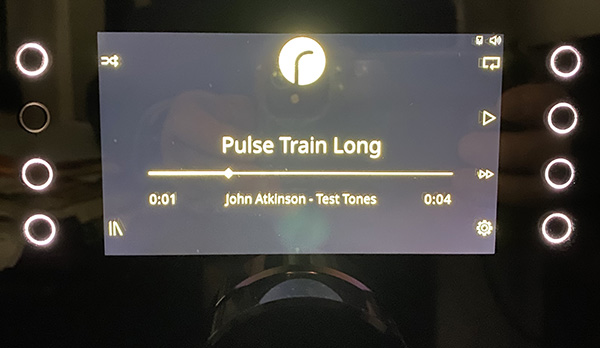 I used optical and coaxial S/PDIF data to test the DAC/streamer module's digital inputs, as well as network data played with Roon and test tone files stored on a USB stick. The Roon app recognized the amplifier as "Burmester 232 Integrated Amplifier." When I connected the amplifier's USB-C port to my 2017 MacBook Pro, Apple's USB Prober app identified the 232 as "Burmester Amplifier" from "Burmester Audiosysteme GmbH" with the serial number "2320164," and indicated that the USB port operated in the optimal isochronous asynchronous mode. However, the AudioMIDI utility revealed that the USB port accepted 32-bit integer data sampled at a single sample rate of 48kHz. As the Burmester has a USB-C port and I was using an adapter cable, it is possible that my laptop's USB-A output was not able to send data with different sample rates without resampling them to 48kHz. However, data sourced with Roon, S/PDIF—optical at rates up to 96kHz, coaxial up to 192kHz—and from the USB stick played at the correct sample rates.
The digital inputs preserved absolute polarity at the speaker and headphone outputs but inverted it at the preamplifier output. With the volume control set to maximum, the output level with a 1kHz tone at –20dBFS from the Preamplifier output was 2.7V into 100k ohms; from the headphone output it was 1.22V into 300 ohms; but from the loudspeaker output it was 25.3V into 8 ohms. This is just 0.75dB below the clipping voltage (27.57V) into that load; except where noted, I examined the digital inputs' behavior at the speaker outputs with the volume control set to –20dB.
I used optical and coaxial S/PDIF data to test the DAC/streamer module's digital inputs, as well as network data played with Roon and test tone files stored on a USB stick. The Roon app recognized the amplifier as "Burmester 232 Integrated Amplifier." When I connected the amplifier's USB-C port to my 2017 MacBook Pro, Apple's USB Prober app identified the 232 as "Burmester Amplifier" from "Burmester Audiosysteme GmbH" with the serial number "2320164," and indicated that the USB port operated in the optimal isochronous asynchronous mode. However, the AudioMIDI utility revealed that the USB port accepted 32-bit integer data sampled at a single sample rate of 48kHz. As the Burmester has a USB-C port and I was using an adapter cable, it is possible that my laptop's USB-A output was not able to send data with different sample rates without resampling them to 48kHz. However, data sourced with Roon, S/PDIF—optical at rates up to 96kHz, coaxial up to 192kHz—and from the USB stick played at the correct sample rates.
The digital inputs preserved absolute polarity at the speaker and headphone outputs but inverted it at the preamplifier output. With the volume control set to maximum, the output level with a 1kHz tone at –20dBFS from the Preamplifier output was 2.7V into 100k ohms; from the headphone output it was 1.22V into 300 ohms; but from the loudspeaker output it was 25.3V into 8 ohms. This is just 0.75dB below the clipping voltage (27.57V) into that load; except where noted, I examined the digital inputs' behavior at the speaker outputs with the volume control set to –20dB.
Footnote 1: This signal consists of data at –1 least significant bit (LSB), digital zero, and +1 LSB. In the twos-complement encoding used by 16-bit digital audio, –1 LSB is represented by 1111 1111 1111 1111, digital zero by 0000 0000 0000 0000, and +1 LSB by 0000 0000 0000 0001. If the undithered waveform is symmetrical, changing all 16 bits in the digital word gives exactly the same change in the analog output level as changing just the LSB.
I used optical and coaxial S/PDIF data to test the DAC/streamer module's digital inputs, as well as network data played with Roon and test tone files stored on a USB stick. The Roon app recognized the amplifier as "Burmester 232 Integrated Amplifier." When I connected the amplifier's USB-C port to my 2017 MacBook Pro, Apple's USB Prober app identified the 232 as "Burmester Amplifier" from "Burmester Audiosysteme GmbH" with the serial number "2320164," and indicated that the USB port operated in the optimal isochronous asynchronous mode. However, the AudioMIDI utility revealed that the USB port accepted 32-bit integer data sampled at a single sample rate of 48kHz. As the Burmester has a USB-C port and I was using an adapter cable, it is possible that my laptop's USB-A output was not able to send data with different sample rates without resampling them to 48kHz. However, data sourced with Roon, S/PDIF—optical at rates up to 96kHz, coaxial up to 192kHz—and from the USB stick played at the correct sample rates.
The digital inputs preserved absolute polarity at the speaker and headphone outputs but inverted it at the preamplifier output. With the volume control set to maximum, the output level with a 1kHz tone at –20dBFS from the Preamplifier output was 2.7V into 100k ohms; from the headphone output it was 1.22V into 300 ohms; but from the loudspeaker output it was 25.3V into 8 ohms. This is just 0.75dB below the clipping voltage (27.57V) into that load; except where noted, I examined the digital inputs' behavior at the speaker outputs with the volume control set to –20dB.
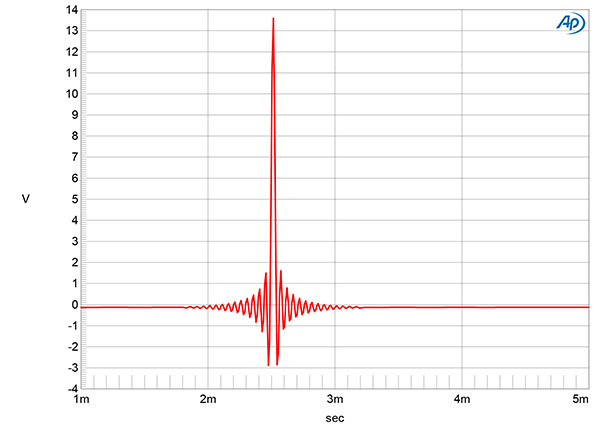
Fig.10 Burmester 232, digital inputs, impulse response (one sample at 0dBFS, 44.1kHz sampling, 4ms time window).
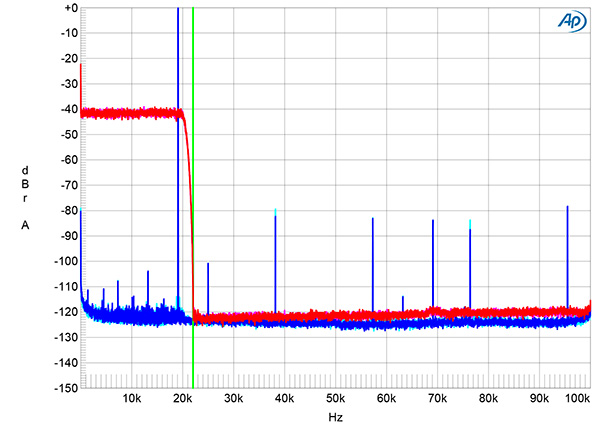
Fig.11 Burmester 232, digital inputs, wideband spectrum of white noise at –4dBFS (left channel red, right magenta) and 19.1kHz tone at 0dBFS (left blue, right cyan) with data sampled at 44.1kHz (20dB/vertical div.).
The Burmester 232's impulse response with PCM data sourced from Roon (fig.10) revealed that the review sample's reconstruction filter is a long linear-phase type, with equal amounts of ringing before and after the single sample at 0dBFS. The magenta and red traces in fig.11 show the ultrasonic rolloff of the Burmester 232's digital inputs with white noise data sampled at 44.1kHz. The traces reach full stop-band attenuation at exactly half the sample rate, indicated by the vertical green line. The filter is therefore an apodizing type. The aliased image at 25kHz of a 19.1kHz tone at 0dBFS (cyan, blue) is suppressed by 100dB, and the harmonics associated with the 19.1kHz tone all lie at or below –80dB (0.01%).
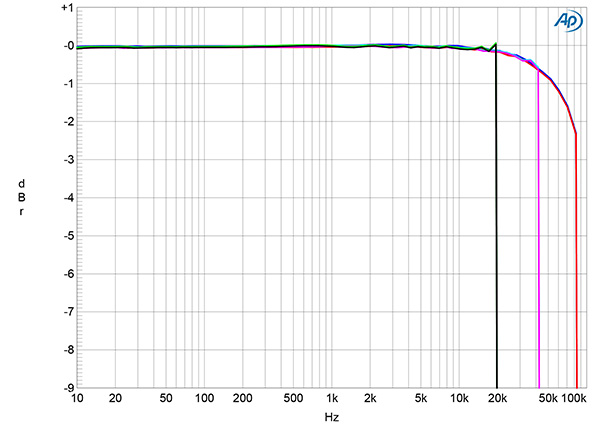
Fig.12 Burmester 232, digital inputs, frequency response at –12dBFS with data sampled at: 44.1kHz (left channel green, right gray), 96kHz (left cyan, right magenta), and 192kHz (left blue, right red) (1dB/vertical div.).
The digital frequency response with data sampled at 44.1kHz, 96kHz, and 192kHz (fig.12) was flat in the audioband with a sharp rolloff just below half of each sample rate. Some passband ripple is evident in the response with 44.1kHz data (green, gray traces).
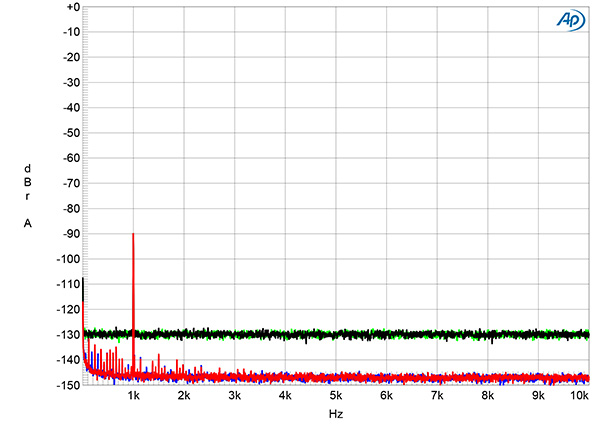
Fig.13 Burmester 232, digital inputs, spectrum with noise and spuriae of dithered 1kHz tone at –90dBFS with: 16-bit data (left channel green, right gray), 24-bit data (left blue, right red) (20dB/vertical div.).
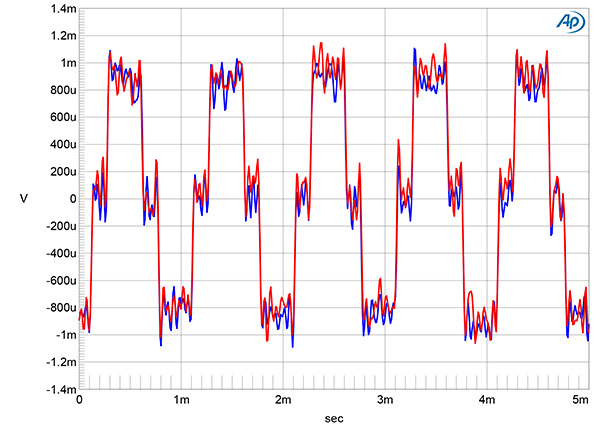
Fig.14 Burmester 232, digital inputs, waveform of undithered 1kHz sinewave at –90.31dBFS, 16-bit data (left channel blue, right red).
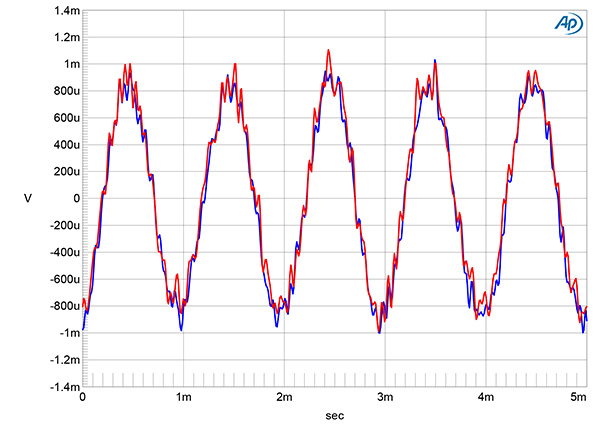
Fig.15 Burmester 232, digital inputs, waveform of undithered 1kHz sinewave at –90.31dBFS, 16-bit data (left channel blue, right red).
An increase in bit depth from 16 to 24, with dithered data representing a 1kHz tone at –90dBFS and the volume control set to the maximum, dropped the Burmester 232's noisefloor by 18dB (fig.13), which implies a measured resolution of 19 bits. With undithered data representing a tone at exactly –90.31dBFS (footnote 1), the waveform was symmetrical, with negligible DC offset, and the three DC voltage levels described by the data were clearly defined (fig.14). With undithered 24-bit data (fig.15), the Burmester 232 output a relatively clean sinewave.
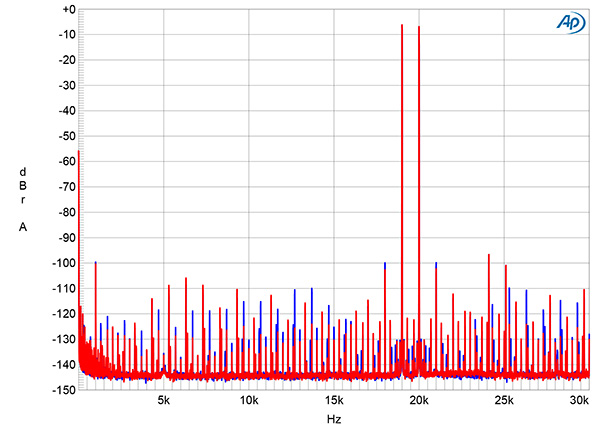
Fig.16 Burmester 232, digital inputs, HF intermodulation spectrum (DC–30kHz), 19+20kHz, 24-bit data, at –6dBFS (left channel blue, right red; linear frequency scale).
Intermodulation distortion with 24-bit data representing an equal mix of 19 and 20kHz tones, each at –12dBFS, was low in level, the difference product at 1kHz lying at –100dB (0.001%, fig.16). However, a large number of low-level spurious tones are present in this graph.
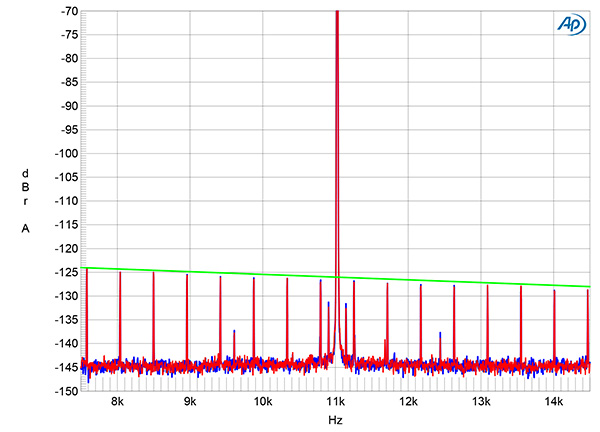
Fig.17 Burmester 232, high-resolution jitter spectrum of analog output signal, 11.025kHz at –6dBFS, sampled at 44.1kHz with LSB toggled at 229Hz: 16-bit TosLink data (left channel blue, right red). Center frequency of trace, 11.025kHz; frequency range, ±3.5kHz.
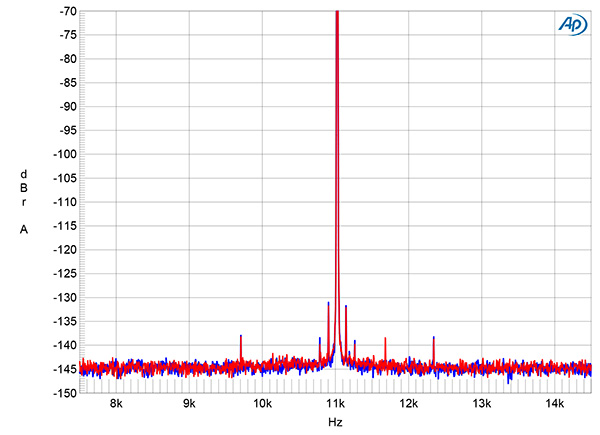
Fig.18 Burmester 232, high-resolution jitter spectrum of analog output signal, 11.025kHz at –6dBFS, sampled at 44.1kHz with LSB toggled at 229Hz: 24-bit TosLink data (left channel blue, right red). Center frequency of trace, 11.025kHz; frequency range, ±3.5kHz.
The Burmester 232's digital inputs offered excellent rejection of data-related jitter. Fig.17 shows the output spectrum when the amplifier was fed 16-bit optical J-Test data. The odd-order harmonics of the undithered low-frequency, LSB-level squarewave all lie at the correct levels, shown by the green line, though the central spike that represents the high-level tone at one-quarter the sample rate (Fs/4) s surrounded by symmetrical low-level sidebands at ±120Hz. These sidebands were also present when I repeated this test with 24-bit J-Test data, but the random noisefloor was very low in level (fig.18).
The Burmester 232's measured performance with the analog inputs is superb, with extremely low distortion and noise. Other than the excessive gain, the DAC/streamer module's measurements are very good.—John Atkinson
Footnote 1: This signal consists of data at –1 least significant bit (LSB), digital zero, and +1 LSB. In the twos-complement encoding used by 16-bit digital audio, –1 LSB is represented by 1111 1111 1111 1111, digital zero by 0000 0000 0000 0000, and +1 LSB by 0000 0000 0000 0001. If the undithered waveform is symmetrical, changing all 16 bits in the digital word gives exactly the same change in the analog output level as changing just the LSB.