

The Spyder's platter is driven by an outboard motor pod containing the Sinus—a new AC synchronous motor, designed and manufactured by Brinkmann, that replaces the Pabst motor used in the La Grange. The Sinus is based on the motor Brinkmann designed and manufactured for the direct-drive Bardo and Oasis. It's a four-phase design (4 × 90°) that produces 16 pulses per revolution, and has a 500gm body of nickel-plated steel that rotates to produce a flywheel effect. The motor drives the platter with an O-ring that rides in grooves machined into the platter's perimeter and the motor's pulley.
Also included are revised solid-state and optional tubed power supplies, optimized for and tuned to the Spyder's 20-lb platter of aluminum-lead-copper alloy, to which is elastomer-bonded a top plate of crystal glass. In addition, Brinkmann has reworked the power supply's shunt-regulation element, contained within the motor housing, that produces ultralow (down to DC) power-line impedance.
The RöNt II—the new version of Brinkmann's tubed power supply—is a single-ended class-A design that uses two high-current, low-resistance P36 pentode tubes and a 5AR4 rectifier tube. Skeptics certain that a tubed power supply can't possibly affect a turntable's sound need only compare the Spyder's performance using both supplies, as I did.
The Spyder, with one arm pod and solid-state power supply, costs $14,000. Additional arm pods are $3000 each; the RöNt II tubed supply adds $4300. For this review, Brinkmann also supplied a 12.1 tonearm ($7500) and a second arm pod for it, bringing the total cost of the review sample to $28,800.
Setup and Use: For the most part, setting up the Brinkmann Spyder was straightforward, especially on a stable, level platform. I use the Harmonic Resolution Systems SXR stand and an oversize HRS M3 1925 base, which has an isolation foot at each corner. Two additional feet can be added, depending on the mass supported.
The Spyder's instructions need expanding and updating; Helmut Brinkmann has promised that this will be done. For instance, the bearing housing comes wrapped in orange "warning" tape. The instructions don't make clear if this tape should be removed before the platter is placed atop the bearing. I did. "No problem," I was told—but I still wasn't sure what's meant by the tape.
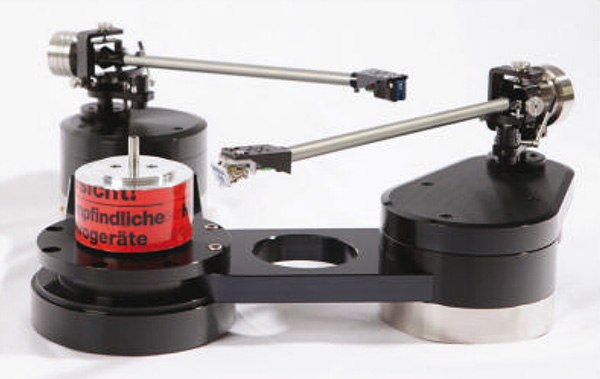
In any case, after the circular bearing platform is put in place, you position the arm pod(s) where you want them, inserting the end of each pod's strut into a slot in the turntable's base and securing it with the two bolts. Each pod is massive, and attractively machined of aluminum. If the arm-mount opening has been eccentrically drilled, loosen the three screws that affix the top plate to allow it to be rotated, then retighten it to fine-tune the distance of the arm pivot to the platter's spindle. An opening at the pod base can be fitted with termination blocks (RCA jacks), or left open to pass hardwired or DIN-to-RCA phono cables. I positioned one arm pod at 2 o'clock, the second one at 10 o'clock, and the motor pod at 7 o'clock.
The movable arm pods are particularly useful for those using a USB microscope to set vertical tracking angle (VTA) and stylus rake angle (SRA) but who can't get behind the equipment rack. That would be me. With the Spyder, you can set SRA with the arm in the usual position, then move it to the rear one. I used both the Brinkmann 12.1 tonearm and, on the second pod, a Kuzma 4Point.
Because the Spyder's solid-state power supply runs the bearing heater as well as the motor, it must be used even if you've ordered the RöNt II tubed supply. Brinkmann supplies a granite platform for the RöNt II, and a generous length of connecting cable to give you wide placement latitude—a small but thoughtful consideration.
Using the Spyder was straightforward: a spindle insert provides the center lift for the screw-on reflex record clamp. Power up the tube supply and choose the speed, 33 1/3 or 45rpm, by pushing one of the two buttons mounted on the top plate of the motor pod. Speed is adjustable via two potentiometers on the same top plate.
I ran into what I think is a small glitch: When I turned on the RöNt II, the platter spun—even when I'd made sure to stop it before powering it down. The 33 1/3 light glowed amber on startup until I cycled it off, at which point it glowed the correct color, green. I'm not sure why that happens, but I don't think it's a major problem.
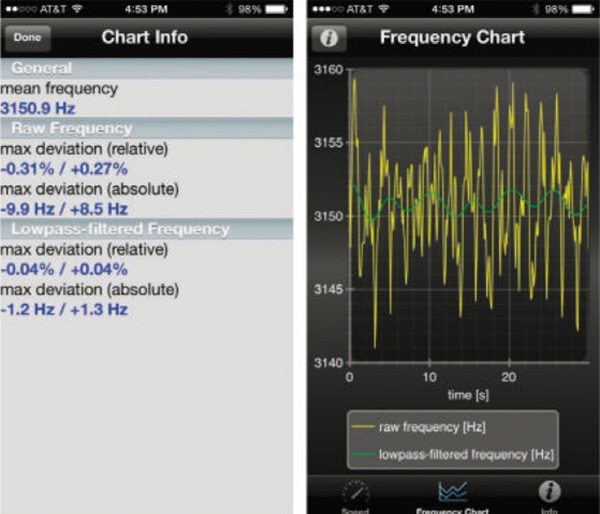
For reference: VPI's Classic Direct Drive with 3D-printed 12" arm costs $30,000. The Spyder with supplied pod and 12.1 arm costs $21,500 (or $25,800 with RöNt II supply), but produced low-pass–filtered numbers about four times worse.
Sound of a Spyder: I took those measurements after two month of listening to the Brinkmanns. While those figures were surprising and somewhat disappointing, the Spyder's sound had been anything but. Subjectively, the Brinkmann's speed stability was outstanding—including with piano recordings with long sustains.
I played a variety of classical LPs, including the superdeluxe ones from the Electric Recording Company mentioned in my review of Bricasti's M28 power amplifier elsewhere in this issue. In addition, I began auditioning Analogue Productions' latest reissues of RCA Living Stereo vinyl, including the Sibelius Violin Concerto with violinist Jascha Heifetz and the Chicago Symphony conducted by Fritz Reiner (LSC-2435), and Charles Munch and the Boston Symphony's recordings of Debussy's La Mer and Ibert's Ports of Call (LSC-2111). I have multiple original pressings of both, but none that sounds as dead quiet, dynamic, and transparent as these.
 I used the Kuzma 4Point and Brinkmann 12.1 arms, and a diverse group of cartridges that included: Lyra's Atlas and Etna; the Triangle Arts Zeus; Ortofon's Anna, MC A90, and MC A95; and Miyajima Lab's Madake. The Spyder allowed each cartridge to speak its own mind, imparting very little of its own character, especially in terms of all-important tonality and rhythmic authority. The Spyder produced authoritative dynamics, an especially strong sense of musical flow, and backgrounds so "black" that I often thought I'd selected the wrong input when, after a stylus had hit the record, I unmuted the preamp. While the Spyder didn't match the VPI Classic Direct's or the Continuum Audio Labs Caliburn's weight and drive, few 'tables in my experience have.
The Spyder's bottom-end weight, control, and rhythmic authority kept me fully engaged, though I wasn't taken by surprise as I'd been, a decade ago, by the Balance's subterranean, "fundamentally correct, deep, tight, articulate, yet delicate bottom-end performance," as I described it in my review. Nor did I expect to be, given the differences in price and platter weight.
The Spyder's overall sound was slightly warm, and it didn't recover from big, low-frequency body slams quite as quickly as did the Balance—which meant that it didn't carve out the big spaces as well as I recall the Balance doing. However, its soundstage width and depth, and its resolution of low-level decay information, put it in the big leagues compared to the more tidy and far less expensive Bardo.
I used the Kuzma 4Point and Brinkmann 12.1 arms, and a diverse group of cartridges that included: Lyra's Atlas and Etna; the Triangle Arts Zeus; Ortofon's Anna, MC A90, and MC A95; and Miyajima Lab's Madake. The Spyder allowed each cartridge to speak its own mind, imparting very little of its own character, especially in terms of all-important tonality and rhythmic authority. The Spyder produced authoritative dynamics, an especially strong sense of musical flow, and backgrounds so "black" that I often thought I'd selected the wrong input when, after a stylus had hit the record, I unmuted the preamp. While the Spyder didn't match the VPI Classic Direct's or the Continuum Audio Labs Caliburn's weight and drive, few 'tables in my experience have.
The Spyder's bottom-end weight, control, and rhythmic authority kept me fully engaged, though I wasn't taken by surprise as I'd been, a decade ago, by the Balance's subterranean, "fundamentally correct, deep, tight, articulate, yet delicate bottom-end performance," as I described it in my review. Nor did I expect to be, given the differences in price and platter weight.
The Spyder's overall sound was slightly warm, and it didn't recover from big, low-frequency body slams quite as quickly as did the Balance—which meant that it didn't carve out the big spaces as well as I recall the Balance doing. However, its soundstage width and depth, and its resolution of low-level decay information, put it in the big leagues compared to the more tidy and far less expensive Bardo.
 An Unexpected Surprise—Brinkmann's 12.1 tonearm: Given the overwhelming superiority of the Kuzma 4Point tonearm ($6675) to the Brinkmann 9.6 ($3990) when I compared them in my review of the Brinkmann Bardo and 9.6 in the May 2011 issue, I expected the same performance differences here—even though the 12.1 ($7500) uses a more sophisticated horizontal bearing. (To keep down costs, the 9.6 has a unipivot-like horizontal bearing.)
While the Kuzma 4Point still maintains an edge in terms of bass weight and authority, the 12.1 had two things going for it that, at least on the Spyder, bettered the 4Point, or at least made for a more attractive sound. One was the 12.1's lusciously velvet midrange. The other was the delicacy and nimbleness of the bass. It didn't have the 4Point's slam or dynamic expression, but with some recordings it made the 4Point sound somewhat lead-footed. If you listen mostly to classical or acoustic jazz and you're willing to give up that last bit of bottom-end slam and push-you-back-in-your-seat weight, I'd go with the 12.1 on the Spyder. You could always get another arm pod for a 4Point, or another arm with fully developed bottom-end slam.
Conclusions: I'm not sure what to make of the Brinkmann Spyder's speed deviations, which I measured but didn't hear. Had I just used a strobe to set the speed, I wouldn't be talking about speed problems at all—they weren't audible as such. Perhaps the Spyder's slight lower-frequency warmth and inability to carve deep trenches between the notes was what I heard and measured. I don't know.
I also know that, when I A/B'd Brinkmann's solid-state and tubed power supplies, I preferred the RöNt II's more nuanced reproduction of transients and deeper soundstages. Were those the results of the even greater measured speed fluctuation? I don't have an answer there either.
What I do know is that the $21,500 combination of Brinkmann Spyder and 12.1 arm with standard power supply will get you a versatile, ingeniously designed turntable built to the highest manufacturing standards, and an equally well-designed and precisely executed tonearm. The combination kept me listening blissfully for two months.
Otherwise, Brinkmann's combination of innovative, flexible, upgradable design, quality manufacturing, careful attention to small but important details—and outstanding sound—make the Brinkmann Spyder with 12.1 tonearm easy to recommend.
An Unexpected Surprise—Brinkmann's 12.1 tonearm: Given the overwhelming superiority of the Kuzma 4Point tonearm ($6675) to the Brinkmann 9.6 ($3990) when I compared them in my review of the Brinkmann Bardo and 9.6 in the May 2011 issue, I expected the same performance differences here—even though the 12.1 ($7500) uses a more sophisticated horizontal bearing. (To keep down costs, the 9.6 has a unipivot-like horizontal bearing.)
While the Kuzma 4Point still maintains an edge in terms of bass weight and authority, the 12.1 had two things going for it that, at least on the Spyder, bettered the 4Point, or at least made for a more attractive sound. One was the 12.1's lusciously velvet midrange. The other was the delicacy and nimbleness of the bass. It didn't have the 4Point's slam or dynamic expression, but with some recordings it made the 4Point sound somewhat lead-footed. If you listen mostly to classical or acoustic jazz and you're willing to give up that last bit of bottom-end slam and push-you-back-in-your-seat weight, I'd go with the 12.1 on the Spyder. You could always get another arm pod for a 4Point, or another arm with fully developed bottom-end slam.
Conclusions: I'm not sure what to make of the Brinkmann Spyder's speed deviations, which I measured but didn't hear. Had I just used a strobe to set the speed, I wouldn't be talking about speed problems at all—they weren't audible as such. Perhaps the Spyder's slight lower-frequency warmth and inability to carve deep trenches between the notes was what I heard and measured. I don't know.
I also know that, when I A/B'd Brinkmann's solid-state and tubed power supplies, I preferred the RöNt II's more nuanced reproduction of transients and deeper soundstages. Were those the results of the even greater measured speed fluctuation? I don't have an answer there either.
What I do know is that the $21,500 combination of Brinkmann Spyder and 12.1 arm with standard power supply will get you a versatile, ingeniously designed turntable built to the highest manufacturing standards, and an equally well-designed and precisely executed tonearm. The combination kept me listening blissfully for two months.
Otherwise, Brinkmann's combination of innovative, flexible, upgradable design, quality manufacturing, careful attention to small but important details—and outstanding sound—make the Brinkmann Spyder with 12.1 tonearm easy to recommend.
Fig.1 speed stability data(left). Fig.2 speed stability (right; raw frequency yellow, low-pass filtered frequency green).
Of greater concern was the platter's speed stability, which I measured using Dr. Feickert Analogue's PlatterSpeed iPhone app and test record. Whatever problems the Feickert setup itself may have, using it to measure every turntable at least provides a level playing field. I carefully positioned the tonearm pod relative to the platter and adjusted the speed—which must be very carefully done, due to the pot's relative coarseness. Although on the Feickert test record's 3150Hz tone the Spyder achieved a mean of 3150.9Hz—pretty accurate—the raw frequency-deviation measurements, relative and absolute were greater than I like to see in so costly a turntable (fig.1). What's more, the low-pass–filtered frequency (fig.2, green line) undulated, deviating from flat more than I'd hope to see for this kind of cash. Repeating the test using Brinkmann's solid-state supply produced better raw frequency results and similar low-pass–filtered ones.
I used the Kuzma 4Point and Brinkmann 12.1 arms, and a diverse group of cartridges that included: Lyra's Atlas and Etna; the Triangle Arts Zeus; Ortofon's Anna, MC A90, and MC A95; and Miyajima Lab's Madake. The Spyder allowed each cartridge to speak its own mind, imparting very little of its own character, especially in terms of all-important tonality and rhythmic authority. The Spyder produced authoritative dynamics, an especially strong sense of musical flow, and backgrounds so "black" that I often thought I'd selected the wrong input when, after a stylus had hit the record, I unmuted the preamp. While the Spyder didn't match the VPI Classic Direct's or the Continuum Audio Labs Caliburn's weight and drive, few 'tables in my experience have.
The Spyder's bottom-end weight, control, and rhythmic authority kept me fully engaged, though I wasn't taken by surprise as I'd been, a decade ago, by the Balance's subterranean, "fundamentally correct, deep, tight, articulate, yet delicate bottom-end performance," as I described it in my review. Nor did I expect to be, given the differences in price and platter weight.
The Spyder's overall sound was slightly warm, and it didn't recover from big, low-frequency body slams quite as quickly as did the Balance—which meant that it didn't carve out the big spaces as well as I recall the Balance doing. However, its soundstage width and depth, and its resolution of low-level decay information, put it in the big leagues compared to the more tidy and far less expensive Bardo.
An Unexpected Surprise—Brinkmann's 12.1 tonearm: Given the overwhelming superiority of the Kuzma 4Point tonearm ($6675) to the Brinkmann 9.6 ($3990) when I compared them in my review of the Brinkmann Bardo and 9.6 in the May 2011 issue, I expected the same performance differences here—even though the 12.1 ($7500) uses a more sophisticated horizontal bearing. (To keep down costs, the 9.6 has a unipivot-like horizontal bearing.)
While the Kuzma 4Point still maintains an edge in terms of bass weight and authority, the 12.1 had two things going for it that, at least on the Spyder, bettered the 4Point, or at least made for a more attractive sound. One was the 12.1's lusciously velvet midrange. The other was the delicacy and nimbleness of the bass. It didn't have the 4Point's slam or dynamic expression, but with some recordings it made the 4Point sound somewhat lead-footed. If you listen mostly to classical or acoustic jazz and you're willing to give up that last bit of bottom-end slam and push-you-back-in-your-seat weight, I'd go with the 12.1 on the Spyder. You could always get another arm pod for a 4Point, or another arm with fully developed bottom-end slam.
Conclusions: I'm not sure what to make of the Brinkmann Spyder's speed deviations, which I measured but didn't hear. Had I just used a strobe to set the speed, I wouldn't be talking about speed problems at all—they weren't audible as such. Perhaps the Spyder's slight lower-frequency warmth and inability to carve deep trenches between the notes was what I heard and measured. I don't know.















