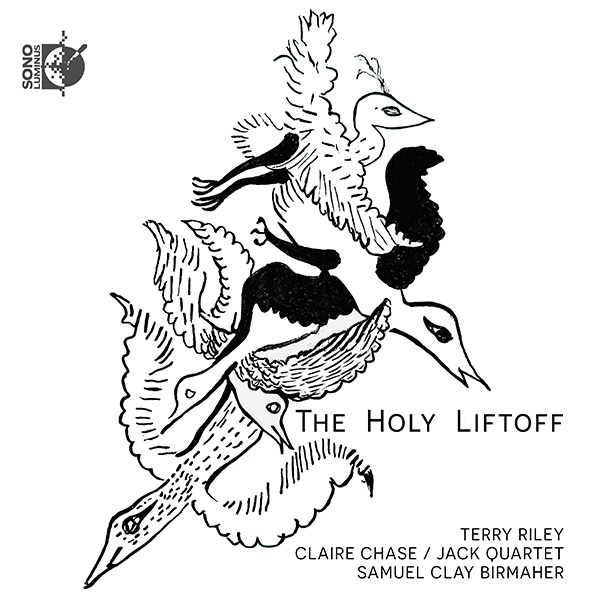
Terry Riley: The Holy Liftoff
Claire Chase, flute; JACK Quartet. Realized by Samuel Clay Birmaher
Sono Luminus DSL-92290 (CD; reviewed as 24/96). 2026. Ryan Streber, producer, editing; Dan Shores engineering, mixing, mastering.
Performance *****
Sonics ****½ More than two years after its Brooklyn premiere, Terry Riley's mesmerizing The Holy Liftoff receives a definitive multitracked recording by its commissioner, flutist Claire Chase, and the ever-adventurous JACK Quartet. The genesis and completion of the work is unusual even by the standards of the 90-year-old father of Minimalism. Riley, you may recall, began composing his seminal In C during a stoned-out bus ride to a regular piano gig in San Francisco's North Beach. A mere 60 years later, the first draft of The Holy Liftoff began with a series of delightful full-color drawings framing a four-part flute chorus that became "The Holy Liftoff Chorale." Another 25-minute through-composed piece formed the foundation of the finale.
An exchange of through-composed material with Chase commenced. Riley engaged Samuel Clay Birmaher to develop additional musically annotated cartoons for eight-part flute chorus and string quartet. As Riley told me by email, "I have a great collaborator in Sam, who really gets my ideas and arranges and orchestrates them to suit Claire's various ensembles. His contributions are major, and he has contributed some brilliant passages. Together with Claire, we have one of the most exciting teams I have worked with."
The early movements of The Holy Liftoff reflect the childlike wonder, metaphysical unity, and ecstatic bliss shared by many of Riley's works, yet halfway through, The Holy Liftoff turns surprisingly dark. The 21 chordal repetitions in "The Tragedy of What We Lost," the longest of the 22 movements, memorializes the 21 victims of the April 2022 school shooting in Uvalde, Texas. To me, the birdsong that follows represents their souls flying free. You may, too, while listening to this marvelous recording.—Jason Victor Serinus
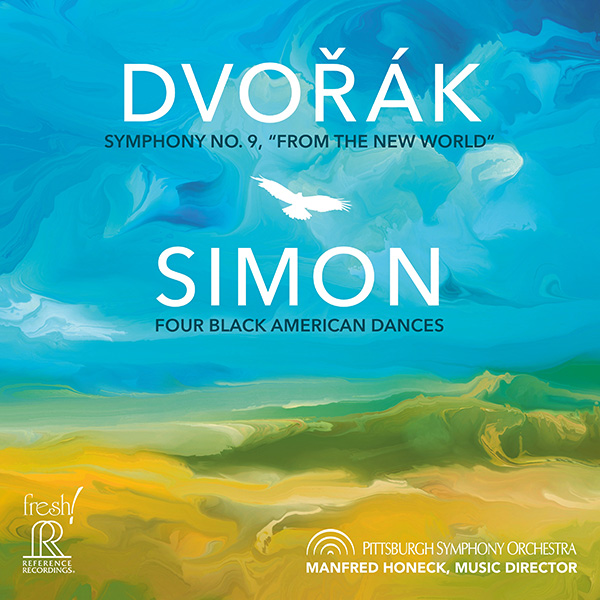 Dvorák: Symphony No.9 ("From the New World")
Simon: Four Black American Dances
Pittsburgh Symphony Orchestra/Manfred Honeck
Reference Recordings FR-769SACD (192/24 WAV download). 2026. Dirk Sobotka, prod.; Mark Donahue, eng.
Performance ***½
Sonics ****½
Reference Recordings, along with the Pittsburghers, offers moments of rare beauty. In the symphony's slow introduction, the woodwind chorale, even as it swells, remains luminous and transparent. The lean, unified brass choir that opens the Largo is focused and deep. Buzzy, incisive string attacks vividly launch the Scherzo. In several places, rapid accompaniments emerge from the busywork without upstaging the principal material. This is all wonderful.
The estimable Honeck, though, seems oddly uncomfortable in the first movement. He pushes each of the main Allegro's first two themes rather hard. After a few phrases, they settle down enough to breathe. Conversely, the third theme is very slow and molded, and the flutist's tone, while round, is diffuse.
The rest is better. I liked the Largo's simply singing English-horn solo, which elides smoothly into the following woodwind chords. The movement concludes with a nice repose. The Scherzo, with whirling violins, is taut and bracing, though the Trio misses hearty buoyancy. The Finale's direct, thrusting start is a call to attention, and it goes well, with a calm, spacious clarinet theme.
Carlos Simon's intent, in his Four Black American Dances, is to celebrate dance as it functions in Black American culture. "Ring Shout" is grand and splashy in color, driven by a hard, pulsing beat, like a jazz-influenced William Grant Still. "Waltz" begins searchingly, feinting at the '50s before turning heartfelt; the brief "Tap!" comes with strongly marked accents. The "Holy Dance," with a strong trombone presence, rounds it all off.
As usual, Reference Recordings offers download options at a variety of bitrates as well as a "hard" hybrid SACD.—Stephen Francis Vasta
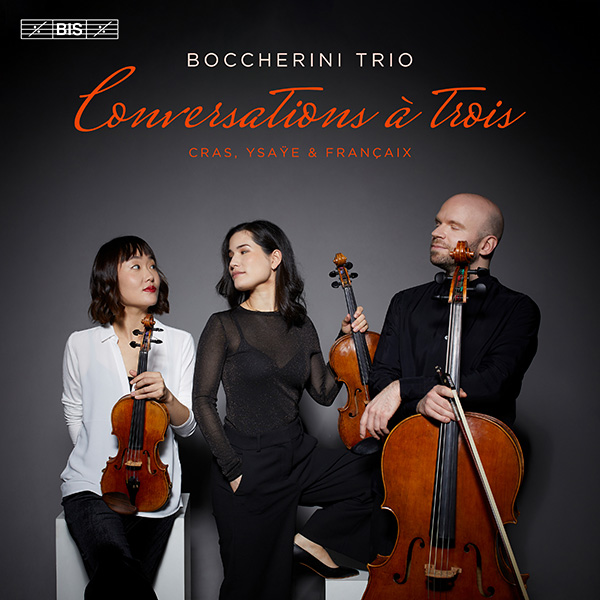 Trio Boccherini: Conversations à Trois: Cras, Ysaÿe & Françaix
BIS-2708 (SACD; reviewed in native 24/96). 2026. Marion Schwebel (Take5), prod., eng.
Performance *****
Sonics ****½
For color, flavor, and beauty, I urge you to explore this wonderful recording of three early–20th century French string trios.
The recording begins the Trio pour violon, alto et violoncelle by a composer whose music you've likely never heard, Jean Cras. Despite the declaration, by no less a refined composer than Henri Duparc, that Cras was his spiritual "son," Cras composed little during his lifelong career in the French navy. Which makes his delightful trio, whose second movement takes us on a journey through some of the exotic Middle Eastern and North African musical modes that Cras encountered during his travels, a rare find. The first movement begins with a genial stroll before growing introverted and tender, while the final movement presents an effusion of glorious melody. String aficionados and world music fans are going to have a ball with this one.
Ysaÿe's Trio à cordes "Le Chimay," Op. posth., composed in 1927, one year after Cras's trio, sounds even more exotic. Opening a portal into a complex web of feelings, its 20-minute first movement is gorgeous, with shimmering colors. By trio's end, my being was drunk with Ysaÿe's distilled longing and passion. As everywhere on the recording, Trio Boccherini's Suyeon Kang (violin), Vicki Powell (viola), and Paolo Bonomini (cello) play impeccably, with perfect balance.
Françaix's instantly lovable Trio à cordes, from 1933, is the lightest, most whimsical work on the program. Its third movement grows surprisingly tender, diminishing to a whisper in its final bars, before its lively final movement trips along gaily and concludes with a wink. Then comes the bonus, a trip back in time to the gorgeous, languid harmonies of Debussy's seminal Clair de lune, masterfully arranged for string trio by Nicholas Shardlow. A perfect summer bouquet.—Jason Victor Serinus
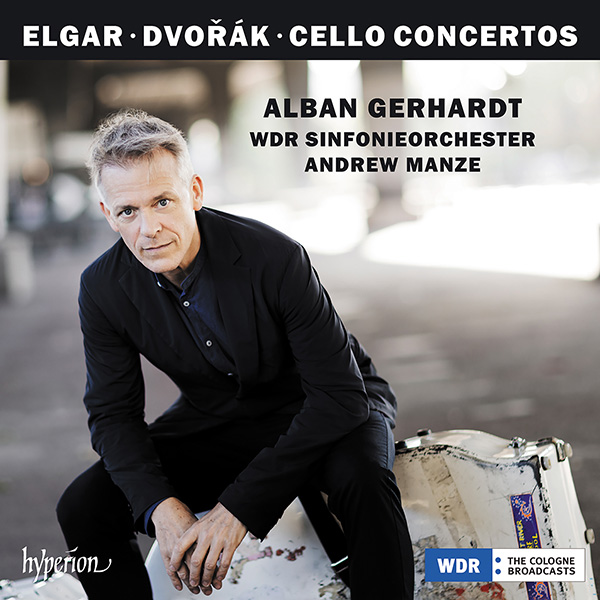 Elgar: Cello Concerto
Dvorák: Cello Concerto
Alban Gerhardt, cello; WDR Symphony Orchestra/Andrew Manze
Hyperion CDA68486 (CD). 2026. Leonard Loock, prod.; David Schwager, eng.
Performance ***½
Sonics **** Alban Gerhardt is a perplexing cellist. His sound ranges from a rich, deep resonance to a lighter but never nasal tone up above. His technique encompasses both these scores' showy flights, particularly the fast runs, with ease, though in vigorous "scrubbing" passages he prizes energy over tuning and tone. He can inflect lyric themes with melting phrasing but favors a flow that doesn't always allow those themes enough breathing room.
Gerhardt's forthright attack on the Elgar is arresting. The quieter second theme has the right lift, and the third is a lovely open affirmation. After a quick, buzzy scherzo, the cello sings fervently in the Largo, supported by equally fervent strings. The closing Allegro returns the music to incisive propulsion; the cello's answers are thoughtful then virtuosic.
Soft attacks give the Dvorák concerto a subdued start, but the music fills out quickly. The velvety horn and the clarinet are achingly beautiful in the second theme, but Gerhardt's voicing a bit later is oddly reticent. He brings a nice intensity to the development's passagework. The simple, singing Adagio elicits gentle nostalgia, though it feels hasty.
Andrew Manze, a former Earlye Musicke specialist, brings out plenty of wind detail and encourages expressive phrasing. The players don't quite catch the end of the cello's flashy scale in Elgar's first movement, and the woodwinds lag the cello later; the final chord of Dvorák's first movement isn't together.
I generally like Hyperion's "house sound," but here, between the close-miked cello and the forward winds, the ambience slightly clutters the soundscape. The clarity of Elgar's Adagio, with just the cello and orchestral strings, points up the shortfalls elsewhere.—Stephen Francis Vasta
Claire Chase, flute; JACK Quartet. Realized by Samuel Clay Birmaher
Sono Luminus DSL-92290 (CD; reviewed as 24/96). 2026. Ryan Streber, producer, editing; Dan Shores engineering, mixing, mastering.
Performance *****
Sonics ****½ More than two years after its Brooklyn premiere, Terry Riley's mesmerizing The Holy Liftoff receives a definitive multitracked recording by its commissioner, flutist Claire Chase, and the ever-adventurous JACK Quartet. The genesis and completion of the work is unusual even by the standards of the 90-year-old father of Minimalism. Riley, you may recall, began composing his seminal In C during a stoned-out bus ride to a regular piano gig in San Francisco's North Beach. A mere 60 years later, the first draft of The Holy Liftoff began with a series of delightful full-color drawings framing a four-part flute chorus that became "The Holy Liftoff Chorale." Another 25-minute through-composed piece formed the foundation of the finale.
Dvorák: Symphony No.9 ("From the New World")Simon: Four Black American Dances
Pittsburgh Symphony Orchestra/Manfred Honeck
Reference Recordings FR-769SACD (192/24 WAV download). 2026. Dirk Sobotka, prod.; Mark Donahue, eng.
Performance ***½
Sonics ****½
Trio Boccherini: Conversations à Trois: Cras, Ysaÿe & FrançaixBIS-2708 (SACD; reviewed in native 24/96). 2026. Marion Schwebel (Take5), prod., eng.
Performance *****
Sonics ****½
Elgar: Cello ConcertoDvorák: Cello Concerto
Alban Gerhardt, cello; WDR Symphony Orchestra/Andrew Manze
Hyperion CDA68486 (CD). 2026. Leonard Loock, prod.; David Schwager, eng.
Performance ***½
Sonics **** Alban Gerhardt is a perplexing cellist. His sound ranges from a rich, deep resonance to a lighter but never nasal tone up above. His technique encompasses both these scores' showy flights, particularly the fast runs, with ease, though in vigorous "scrubbing" passages he prizes energy over tuning and tone. He can inflect lyric themes with melting phrasing but favors a flow that doesn't always allow those themes enough breathing room.