Google Bricasti and all that comes up are sites relating to Bricasti Design products. The name must be fanciful—it sounds Italian, but cofounders Brian Zolner and Casey Dowdell most likely are not, and the company's headquarters are not in Milan or Turin but in Massachusetts.
While its name might be whimsical, nothing else about Bricasti is. As John Marks reported in his review of Bricasti's M1 DAC in the August 2011 issue, both founders previously worked at Lexicon: Dowdell as a DSP-software engineer, Zolner as international sales manager. Bricasti develops its products in conjunction with Aeyee Labs, formed by a group of ex-employees of Madrigal Audio Laboratories and based in New Haven, Connecticut.
The storied Madrigal Labs was founded by the late Sandy Berlin, who purchased the assets of Mark Levinson Inc., and founded Madrigal to design and manufacture, among other products, a second generation of Mark Levinson products. Harman International eventually purchased Madrigal, and the Mark Levinson brand became the core of Harman's Luxury Audio Group.
Bricasti Designs' first product, the M7 Stereo Reverb Processor, aka the M7 Reverb, was introduced in 2007 and was extremely well received by the pro-audio world. Their second product, the M1 DAC, introduced in 2011, has won high praise in recording studios and in audio enthusiasts' homes.
Description
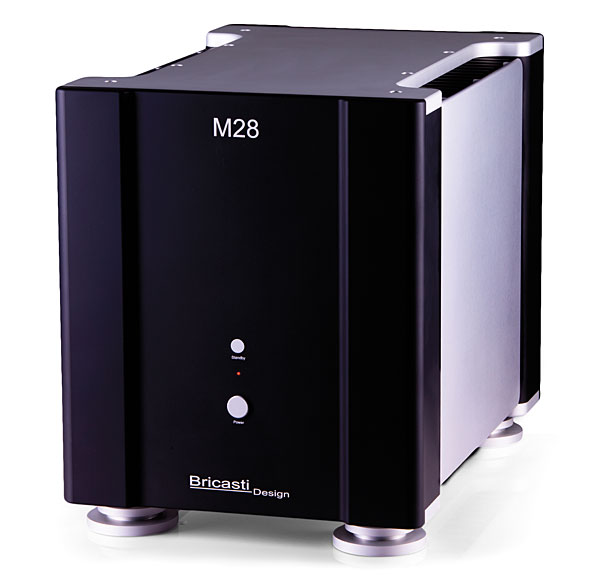
With its black faceplate and round, powder-gray buttons, the M28 monoblock's physical resemblance to a Mark Levinson product is neither surprising nor coincidental—nor is its premium build quality. The top, bottom, and side panels are each milled and CNC-machined from a block of aluminum 3" thick, then anodized; the labels and markings are laser etched. The nearly cubical M28 measures 11.9" wide by 13.8" high by 17.8" deep, weighs almost 80 lbs, and sits on four integral circular feet. Bricasti makes it—including all CNC milling and aluminum fabrication—in their factory in Shirley, Massachusetts. The M28 costs $30,000/pair. The M28's circuitry is fully balanced, dual-differential from its XLR input to its speaker outputs. It comprises two complete and separate signal paths—one inverting, one non-inverting—beginning with matched voltage-gain-stage components in the differential input stage, followed by a current gain stage of 24 bipolar transistors: 12 inverting, 12 non-inverting.
The M28's dual-bank power supply—two supplies in one—has a total of 240,000µF of capacitance and two separate transformer windings. "Each electronic element mates to a purpose-built location within the chassis," Bricasti proclaims on their website. "Thoughtful use of mass and passive ventilation assure the uniform distribution of heat and a cool touch under any load." The M28's claimed power output is 200W into 8 ohms or 400W into 4 ohms, with typically less than 0.005% total harmonic distortion at 1kHz at full rated power. The claimed frequency response is 1Hz–150kHz, ±0.1dB. The gain is 26dB, the signal/noise ratio greater than 100dB.
Setup and Use
The M28's flat, uncluttered rear panel made connections easy. The single-ended RCA and balanced XLR inputs are near the top, the speaker binding posts in the middle, and a 15A IEC jack near the bottom. Adjacent to the AC input is a trigger in/out jack, an RS422 port (for diagnostic monitoring, though not by the user), and an input trim control used for gain matching when the M28 is used with Bricasti's M1, or any other DAC equipped with a digital-domain volume control.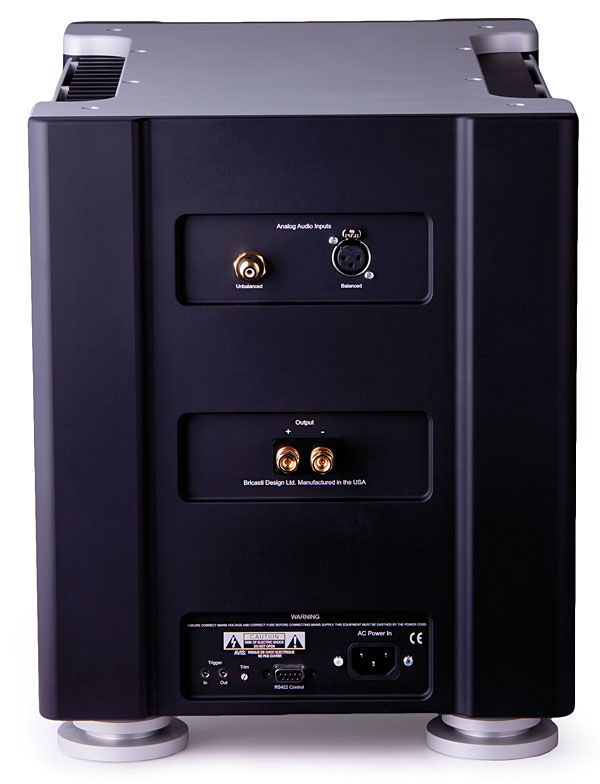 Unfortunately, the M28s and Boulder Amplifiers' fully balanced, dual-differential 2110 preamplifier, which I reviewed in the March 2015 issue, were ships passing in the night. The Bricastis arrived within days of the Boulder's heading off to John Atkinson's test bench to be measured, and from there to the 2015 Consumer Electronics Show. That mating would have taken full advantage of the M28's own fully balanced, dual-differential capabilities.
But having previously driven balanced amplifiers with the darTZeel NHB-18NS preamplifier, I didn't feel the M28s' performance would be in any way compromised. To be certain, during my listening I drove the Bricastis from both the darTZeel's single-ended outputs and from its transformer-coupled balanced outputs. Then, when comparing the M28s' sound with that of darTZeel's own NHB-458 monoblocks, I drove the latter both single-ended and from the preamp's balanced output (the darTZeel NHB-458s are also single-ended, and electronically reconfigure a balanced input to single-ended).
Though the darTZeel combo sounds best connected via its unique 50 ohm, transmission-line link terminated with BNC connectors, the single-ended and balanced connections produced no differences that I could hear. Nor did I hear any differences in tonality between 15' runs of single-ended and balanced interconnects between the darTZeel preamp and the M28s.
Out of the Box: The Unexpected
Unfortunately, the M28s and Boulder Amplifiers' fully balanced, dual-differential 2110 preamplifier, which I reviewed in the March 2015 issue, were ships passing in the night. The Bricastis arrived within days of the Boulder's heading off to John Atkinson's test bench to be measured, and from there to the 2015 Consumer Electronics Show. That mating would have taken full advantage of the M28's own fully balanced, dual-differential capabilities.
But having previously driven balanced amplifiers with the darTZeel NHB-18NS preamplifier, I didn't feel the M28s' performance would be in any way compromised. To be certain, during my listening I drove the Bricastis from both the darTZeel's single-ended outputs and from its transformer-coupled balanced outputs. Then, when comparing the M28s' sound with that of darTZeel's own NHB-458 monoblocks, I drove the latter both single-ended and from the preamp's balanced output (the darTZeel NHB-458s are also single-ended, and electronically reconfigure a balanced input to single-ended).
Though the darTZeel combo sounds best connected via its unique 50 ohm, transmission-line link terminated with BNC connectors, the single-ended and balanced connections produced no differences that I could hear. Nor did I hear any differences in tonality between 15' runs of single-ended and balanced interconnects between the darTZeel preamp and the M28s.
Out of the Box: The Unexpected
Before installing the M28s, I'd been repeatedly playing The New Standard, an all-analog recording of a jazz trio comprising pianist Jamie Saft, bassist Steve Swallow, and drummer Bobby Previte, and engineered by the great Joe Ferla (2 LPs, Rare Noise RNR 041 LP). (Following these sessions, Ferla retired from engineering to pursue a career singing and playing guitar.) The album was recorded live to two-track ½" tape using an Ampex recorder, with no equalization or compression and just a bit of reverb. Swallow's electric bass was plugged directly into the board, and Previte's drums were fairly close-miked in an isolation booth, with a Beyer M-88 mike for the kick drum. That kick drum produces thunder—with Swallow's direct-injected bass, the result is a Jurassic Park–like low end. The overall sound is thick and rich, with the warm, earthy textures only AAA production seems able to convey.
Reading the M28's specs and Bricasti's descriptions of it had led me to expect to hear certain things from it. The M28's huge current reserves are claimed to produce iron-fisted control of a speaker's woofers. Its ultrawide bandwidth, low distortion, and banks of transistors had primed me for something that sounded like the Soulution 710. As I said in my review of it in the August 2011 issue, that $50,000 stereo amp—at 176 lbs, it weighs more than two M28s—produced "unparalleled transparency, startling transient cleanness, and a level of overall refinement that easily surpassed that of any other amplifier I have heard. The 710 gripped my Wilson Audio MAXX 3 speakers as has no other amplifier in my experience, acting and reacting with effervescent speed."
However, out of the box and dead-of-winter-right-off-the-truck cold (but given a day to reach room temperature), the M28s sounded more tube-like, more "soft and loose" than "fast and tight." Though it was consistent in these and other regards from top to bottom, the M28s didn't exactly provide the woofer control advertised on Bricasti's website. Bass was soft and rhythmically bland. Privite's cymbals lacked the shimmer and definition I'd become accustomed to. While this recording's sound isn't airy, and doesn't leave generous amounts of space between notes, it has some of both. But both were now obscured by the M28s' sluggishness.
I tried plugging the Bricastis directly into the wall, instead of into my Shunyata Research combo of Hydra Triton and Typhon power conditioners. I also tried a variety of power cords in place of Shunyata's ZTron Alphas. While I heard differences, as I always do when I make such changes in a system, the sound was less coherent with the M28s plugged into the wall, and there was no improvement of control on the bottom or extension on top.
With its black faceplate and round, powder-gray buttons, the M28 monoblock's physical resemblance to a Mark Levinson product is neither surprising nor coincidental—nor is its premium build quality. The top, bottom, and side panels are each milled and CNC-machined from a block of aluminum 3" thick, then anodized; the labels and markings are laser etched. The nearly cubical M28 measures 11.9" wide by 13.8" high by 17.8" deep, weighs almost 80 lbs, and sits on four integral circular feet. Bricasti makes it—including all CNC milling and aluminum fabrication—in their factory in Shirley, Massachusetts. The M28 costs $30,000/pair. The M28's circuitry is fully balanced, dual-differential from its XLR input to its speaker outputs. It comprises two complete and separate signal paths—one inverting, one non-inverting—beginning with matched voltage-gain-stage components in the differential input stage, followed by a current gain stage of 24 bipolar transistors: 12 inverting, 12 non-inverting.
The M28's flat, uncluttered rear panel made connections easy. The single-ended RCA and balanced XLR inputs are near the top, the speaker binding posts in the middle, and a 15A IEC jack near the bottom. Adjacent to the AC input is a trigger in/out jack, an RS422 port (for diagnostic monitoring, though not by the user), and an input trim control used for gain matching when the M28 is used with Bricasti's M1, or any other DAC equipped with a digital-domain volume control.
Unfortunately, the M28s and Boulder Amplifiers' fully balanced, dual-differential 2110 preamplifier, which I reviewed in the March 2015 issue, were ships passing in the night. The Bricastis arrived within days of the Boulder's heading off to John Atkinson's test bench to be measured, and from there to the 2015 Consumer Electronics Show. That mating would have taken full advantage of the M28's own fully balanced, dual-differential capabilities.
Before installing the M28s, I'd been repeatedly playing The New Standard, an all-analog recording of a jazz trio comprising pianist Jamie Saft, bassist Steve Swallow, and drummer Bobby Previte, and engineered by the great Joe Ferla (2 LPs, Rare Noise RNR 041 LP). (Following these sessions, Ferla retired from engineering to pursue a career singing and playing guitar.) The album was recorded live to two-track ½" tape using an Ampex recorder, with no equalization or compression and just a bit of reverb. Swallow's electric bass was plugged directly into the board, and Previte's drums were fairly close-miked in an isolation booth, with a Beyer M-88 mike for the kick drum. That kick drum produces thunder—with Swallow's direct-injected bass, the result is a Jurassic Park–like low end. The overall sound is thick and rich, with the warm, earthy textures only AAA production seems able to convey.