The $1500/pair price point for loudspeakers is now very hot. Many manufacturers offer interesting models at or near this price, which gives the most creative designers an opportunity to show off: they can come up with interesting speakers that attempt to deliver a level of performance an order of magnitude beyond their entry-level wares by trickling down technology from their costlier floorstanding models. For the buyer, a $1500/pair speaker is a great way to start building a complete system for $4000–$5000 that can deliver extremely high sound quality for the dollar.
Although I've reviewed three excellent Wharfedale models—the Diamonds 9.1, 10.1, and 10.7—the Diamond line comprises the company's lowest-priced models. Wanting to hear what quality of sound Wharfedale could deliver for $1499/pair, I requested a pair of Jade 3s (footnote 1).
Design
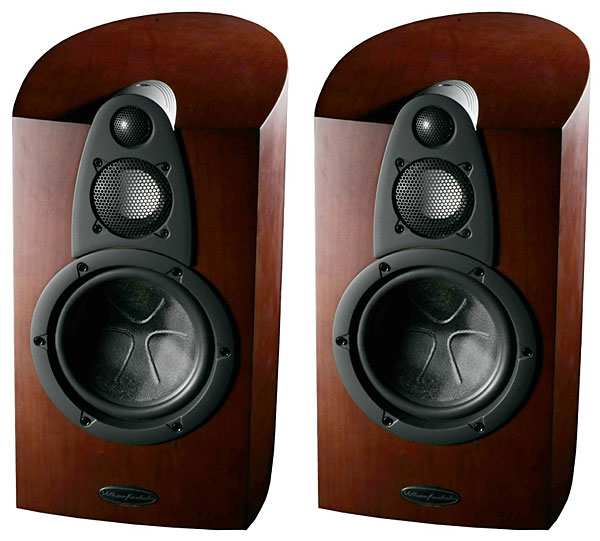
The Jade 3 is a three-way bookshelf speaker with a 1" (25mm) aluminum-dome tweeter, a 3" (76mm) aluminum-pulp composite-cone midrange unit, and a 6.5" (150mm) Acufibre-cone woofer. The drivers are mounted in a sleek, sealed cabinet with a horseshow cross section when viewed from above. My review samples' Vintage Cherry finish was gorgeous; the Jade 3 is also available in Black Oak, Rosewood, or, for $300 more per pair, Piano Black.
Wharfedale designer Peter Comeau explained to me his philosophy of cabinet construction and driver selection. He doesn't believe in bass-reflex bookshelf speakers. Although such systems have the benefits of high sensitivity and powerful bass, they also create a resonant system with a high Q factor, which Comeau feels imposes a ringing nature on the musical waveform. This can affect bass transients, curtail deep-bass extension, and make the best sound quality more dependent on the speakers' precise positions in the room. For the Jade 3, Comeau designed a sealed box with a fundamental bass resonance of 44Hz, below which the output falls at 12dB/octave. With typical room gain, he claims, this should provide useful bass extension down to around 30Hz.
Nor does Comeau believe in making speakers cabinets of medium-density fiberboard, feeling that MDF has a resonant quality that can result in a "honky" sound and peaks in the midrange. He prefers particleboard and plywood; in the Jade 3, he combines these wood types in a multilayer construction called Crystalam, designed to minimize midrange resonances.
The cones of the Jade 3's bass and midrange drive-units are made of Acufibre, a proprietary material that combines glass and carbon fibers in a self-damping woven matrix. A thin layer of aluminum is added to the front of the midrange cone to improve its radiation pattern. The dome tweeter has an elastomer mount to isolate it from cabinet vibrations.
I began by setting the Jade 3s atop my Celestion Si stands, but I didn't like how the speakers and stands mated. The Celestions' small, rectangular top plate didn't seem the ideal mechanical coupling for the Jade 3s' large, horseshoe-shaped bottom. The speakers wobbled, and I was concerned that one of my children or dogs might too easily topple them. So I requested a pair of Wharfedale's Jade Stands ($599/pair), which have a wide column that can accommodate wires, and two side columns. The columns sit on a heavy base of wood, and are capped by a wooden top plate. The Jade 3s worked very well on these stands, which, with their rugged construction and horseshoe top and bottom plates, made the combo an attractive package, though the potential price is now $2100, not $1500.
Sound
It's difficult to review a speaker that reveals no flaws or shortcomings over a wide range of recordings, and the Wharfedale Jade 3 was just such a speaker. With every recording I tried, I could find nothing to criticize in the areas of tonal balance, detail resolution, soundstaging, transient articulation, or dynamic range. Normally, in a situation such as this, I would find an area or two where the speaker outperformed competitors in its price range. For this review, I've done something a bit different: I found three areas in which the Jade 3 performed better than anything I'd heard at its price or size. Each area is worthy of detailed discussion, and in each, the Jade 3's performance can be summed up in one word: remarkable. Remarkable #1—Bass: In the midbass and upper bass—eg, a double bass in a good jazz recording—instruments sounded forceful and natural, with very prominent warmth. But that warmth never manifested itself as a midbass emphasis; and while the midbass had a relaxed quality, it was still clean, uncolored, and lightning fast. When I cranked up rock recordings close to concert level, the Jade 3s were able to kick me in the chest with transients with no hint of strain or compression. Asked to perform challenging tasks of bass reproduction, the Wharfedales never behaved as if they were working hard, and when reproducing deep bass, there was never a hint that they'd have a problem going even deeper if they had to.
Eberhard Weber's double bass on his Endless Days (CD, ECM 1748) sounded woody and uncolored, and each note he plucked bloomed on a bed of air. When keyboardist Rainer Brüninghaus produced a backwash of low-register synthesizer sounds, the combination of his and Weber's instruments produced low-frequency drama, air, and ease. The Spaceship movement of Philip Glass's Einstein on the Beach, with Michael Riesman leading the Philip Glass Ensemble (CD, Nonesuch 79323-2), includes some densely orchestrated, rapid-fire bass passages for multiple keyboards; through the Jade 3, these passages were reproduced effortlessly and with perfect clarity, but without excessive warmth and with no trace of overhang.
Footnote 1: I reviewed these Wharfedale speakers in these issues: Diamond 9.1 ($350/pair), November 2005; Diamond 10.1 ($349/pair), February, April, October 2011, and October 2013; Diamond 10.7 ($1299/pair), October 2013. Robert Deutsch reviewed the Jade 7 ($4199/pair) in May 2013. (All prices those at the time of the original review.)
The Jade 3 is a three-way bookshelf speaker with a 1" (25mm) aluminum-dome tweeter, a 3" (76mm) aluminum-pulp composite-cone midrange unit, and a 6.5" (150mm) Acufibre-cone woofer. The drivers are mounted in a sleek, sealed cabinet with a horseshow cross section when viewed from above. My review samples' Vintage Cherry finish was gorgeous; the Jade 3 is also available in Black Oak, Rosewood, or, for $300 more per pair, Piano Black.
It's difficult to review a speaker that reveals no flaws or shortcomings over a wide range of recordings, and the Wharfedale Jade 3 was just such a speaker. With every recording I tried, I could find nothing to criticize in the areas of tonal balance, detail resolution, soundstaging, transient articulation, or dynamic range. Normally, in a situation such as this, I would find an area or two where the speaker outperformed competitors in its price range. For this review, I've done something a bit different: I found three areas in which the Jade 3 performed better than anything I'd heard at its price or size. Each area is worthy of detailed discussion, and in each, the Jade 3's performance can be summed up in one word: remarkable. Remarkable #1—Bass: In the midbass and upper bass—eg, a double bass in a good jazz recording—instruments sounded forceful and natural, with very prominent warmth. But that warmth never manifested itself as a midbass emphasis; and while the midbass had a relaxed quality, it was still clean, uncolored, and lightning fast. When I cranked up rock recordings close to concert level, the Jade 3s were able to kick me in the chest with transients with no hint of strain or compression. Asked to perform challenging tasks of bass reproduction, the Wharfedales never behaved as if they were working hard, and when reproducing deep bass, there was never a hint that they'd have a problem going even deeper if they had to.
Footnote 1: I reviewed these Wharfedale speakers in these issues: Diamond 9.1 ($350/pair), November 2005; Diamond 10.1 ($349/pair), February, April, October 2011, and October 2013; Diamond 10.7 ($1299/pair), October 2013. Robert Deutsch reviewed the Jade 7 ($4199/pair) in May 2013. (All prices those at the time of the original review.)