Totem Acoustic was founded in 1987, in Montreal, Canada, by a former high school math teacher named Vince Bruzzese. The company's first product, the Model 1 loudspeaker, impressed me so much I bought a pair.
My old pal George Stanwick, who worked at Stereo Exchange, spotted me walking up Broadway through the store's window, whereupon he ran out and literally dragged me off the street pulling me by the arm—against my mumbled protests.
I followed George into Stereo Exchange's luxurious back room, where, spotlighted in front of me, I saw what looked like an expat's spin on trad-British "minimonitors." He busked me saying, "I know how you like Quads and Snells, so I know you'll like these Totems even more."
I loved George, so I sat and listened patiently—knowing that when he finished, I could laugh and tell him how wrong he was.
But he was right. These little boxes steered the music straight into my brain—just like Quads and Snells. I sat riveted, as George, who also worked at Tower Records, played a selection of genre-diverse recordings that he had just purchased (with my money) especially for me. (At that time, I was giving George $50 a week to buy me any records he thought I should have.) The Model 1s did not sound British, or American. But, like the best British speakers, the Totems preserved each record's unique flavor, a trait I regard as proof of truth.
Proof of truth is why I've always liked studio monitor type speakers, but at that time my BFF Altec 604s were feeling forward and noisy and fatiguing. That they lacked "pinpoint" imaging—which was the hi-fi fashion of the day—was stuck in my awareness. As was their shipping-crate bulk. I needed a radical change. George corralled me because he already knew I was shopping for something smaller and more laid-back. Something where the soundspace happens behind the speakers, where the speakers disappear while presenting a deep, wide, delicate soundstage. These new Totems did all that, and I used them until I bought my second pair of BBC LS3/5a's.
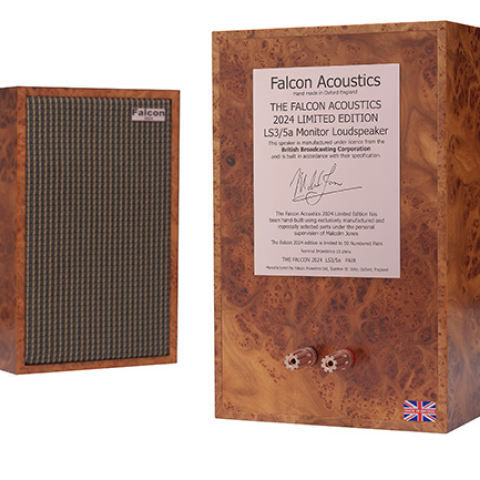
In 1993, I traded a homemade 300B tube amp for a heavily used pair of Rogers LS3/5a's from a sound engineer at CBS television studios. These scruffy rosewood boxes (which I still have) held my attention until 1997 when I bought a new "improved" version of Totem's Model 1.
My made-in-1984 Rogers each use a 0.75" Mylar-dome tweeter, crossed over at 3kHz to a 4.5" Bextrene-cone woofer. Frequency response at 1m with the grille on was specified as 80Hz–20kHz, ±3dB. Sensitivity: 82dB/W/m. Nominal impedance: 15 ohms (1977–1984); 11 ohms (1989 onward). Amplifier requirements: 25W maximum.
Totem's Model 1 from the late '90s used a bigger 1.2" (28mm) metal-dome SEAS tweeter, crossed over at 2.7kHz to a 4.9" (125mm) Dynaudio 15W75 cellulose-acrylate-cone woofer with a 3" voice coil. Nominal impedance: 4 ohms. Sensitivity: 87dB/W/m. Amplifier requirements: 20–200W.
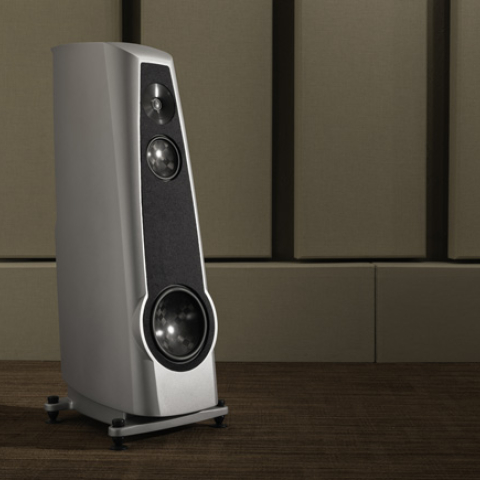
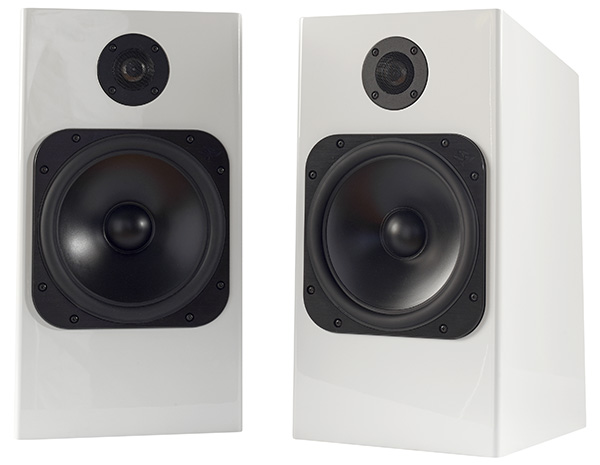
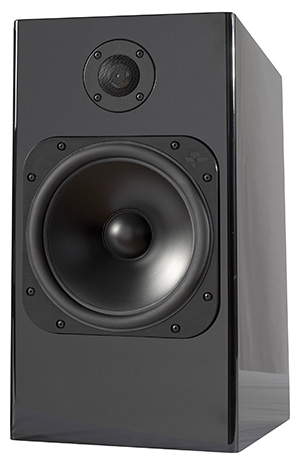
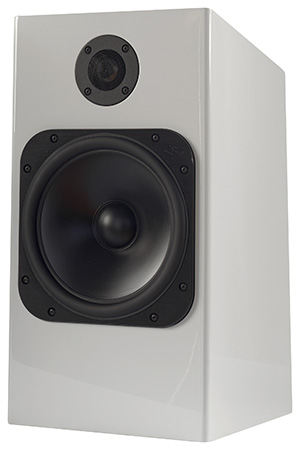
Today, both of those speakers look and sound like vintage pipe-and-slippers standmounts. This is especially true when compared to Totem Acoustic's brand-new Element Fire V2. Totem's new Fire looks Maybach-level glossy, and windswept, and trés moderne, but also smart and down-to-business, as befits its made-in-Canada roots.
 In my little room, the Element Fires played dramatically bigger and reached deeper into goosebump and hair-standing realms than any of my 12"-high speakers. And they do this deeper bass/ more fantastic imaging because unlike my old Totem's rubbery 4.9" woofer, the Element Fire's 7" Torrent driver has genuine room-energizing moxie.
According to Vince Bruzzese, "The first Torrent woofer was a 4" designed for the Tribe III and (also) to serve as a technology statement to celebrate Totem's 20th anniversary.
"The genesis for the Torrent's revolutionary application was our conviction that a driver could be made without using any active or passive crossover parts in the signal path of the woofer section. All speakers with Torrent drivers have only a simple crossover composed of as little as two components exclusively for the high-frequency section. We felt that a crossover-free network in the woofer path would allow for a more unfettered flow of information, sound, and energy."
Vince explained, "Our goal has always been to minimize crossover parts and maximize the phase relationship between the drivers." (my italics)
Readers will know that my ears are more sensitive to a loudspeaker's performance in the time domain than the amplitude domain. My brain easily spots and adjusts quickly to irregularities in frequency response, but is confused and distracted by phase shifting of all types. So naturally, I've been campaigning for speakers without crossovers since Totem Acoustic was founded in 1987.
In my little room, the Element Fires played dramatically bigger and reached deeper into goosebump and hair-standing realms than any of my 12"-high speakers. And they do this deeper bass/ more fantastic imaging because unlike my old Totem's rubbery 4.9" woofer, the Element Fire's 7" Torrent driver has genuine room-energizing moxie.
According to Vince Bruzzese, "The first Torrent woofer was a 4" designed for the Tribe III and (also) to serve as a technology statement to celebrate Totem's 20th anniversary.
"The genesis for the Torrent's revolutionary application was our conviction that a driver could be made without using any active or passive crossover parts in the signal path of the woofer section. All speakers with Torrent drivers have only a simple crossover composed of as little as two components exclusively for the high-frequency section. We felt that a crossover-free network in the woofer path would allow for a more unfettered flow of information, sound, and energy."
Vince explained, "Our goal has always been to minimize crossover parts and maximize the phase relationship between the drivers." (my italics)
Readers will know that my ears are more sensitive to a loudspeaker's performance in the time domain than the amplitude domain. My brain easily spots and adjusts quickly to irregularities in frequency response, but is confused and distracted by phase shifting of all types. So naturally, I've been campaigning for speakers without crossovers since Totem Acoustic was founded in 1987.
 Description
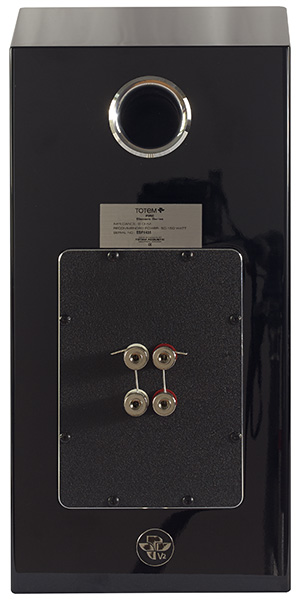
Totem's Element Fire V2 is 16.6" high, 8.8" wide, 11.7" deep, and weighs 32.4lb. On their gloss black backs, the Totem Element Fires each have a single round port accented by a chrome ring, and two pairs of WBT speaker wire binding posts attached to a black metal "skip plate" that declares it to be an 8 ohm speaker, requiring 50 to 150 watts, that's made in Canada by Totem Acoustic. According to its website specifications, Falcon's LS3/5a rolls off at 70Hz, –3dB, whereas the Totem Element Fire's 7" driver and three-times-larger ported box lets it go 40Hz lower to a claimed 30Hz. That's a significant difference. I asked Totem's super-personable PR rep, Lionel Goodfield, to break Totem's "proprietary" silence about what the Torrent driver is made of.
He texted me, "They are mineralized polypropylene but instead of putting damping agents on the front of the cone, we put a rubber/borosilicate mix on the rear outer edge with an additionally adhered 'O' ring which prevents excessive outer edge flex and contributes to cone stiffness—helping to maintain smooth response through the crossover frequency. (No crossover to control any cone breakup.)"
Totem's Element Fire V2 sells for $8450/pair; the Falcon Gold Badge is currently listed at $3990/pair. This means the Element Fire is three times as big and heavy, but only twice as expensive. I make these comparisons because the Fire's larger box, tuned rear port, and bigger piston (7" vs 4.5") changed every aspect of my sound system's sound.
 Setup
Setup
Historically, I've had listening rooms that took a full minute to walk from one side to another, with high ceilings and no walls to the right or left of the speakers. In those spaces, every speaker that was not a big horn sounded weak and distant because the room consumed 90% of the speaker's energy. My various LS3/5a's were always set up for nearfield listening on above-desk shelves or on Rogers' wall-mount brackets.
When I moved to this cubby in Bed Stuy, I got super lucky. While my studio here measures only 13' × 11' × 9', the sides of both speakers look off into hallways leading to other rooms. (Humorously, it's not subtle how much the sound quality changes—how much it muddies and compresses—if I close my bedroom door.)
Better still, when I started measuring with a real-time analyzer and experimented with subwoofer placement, I realized there were two dead spots, two sound holes, one on each side of the equipment shelves, where the ratio of direct-to-reflected sound lets me hear 90% speaker and only 10% room no matter where I'm sitting. I've come to think of these sound holes as magic circles drawn on my floor with white chalk to shield me from witches and demons.
When I placed Totem's Element Fire V2s at the front edges of those white circles, they crossed their chests and looked up gratefully towards heaven. This placed them 6' apart and 30" from their front faces to the wall behind them. When I sat in my seat, the tweeters were about 6' away. I followed the manual's recommendation not to toe in the Fire V2s to my listening seat. I was never distracted by wall sound interference.
In my little room, the Element Fires played dramatically bigger and reached deeper into goosebump and hair-standing realms than any of my 12"-high speakers. And they do this deeper bass/ more fantastic imaging because unlike my old Totem's rubbery 4.9" woofer, the Element Fire's 7" Torrent driver has genuine room-energizing moxie.
According to Vince Bruzzese, "The first Torrent woofer was a 4" designed for the Tribe III and (also) to serve as a technology statement to celebrate Totem's 20th anniversary.
DescriptionTotem's Element Fire V2 is 16.6" high, 8.8" wide, 11.7" deep, and weighs 32.4lb. On their gloss black backs, the Totem Element Fires each have a single round port accented by a chrome ring, and two pairs of WBT speaker wire binding posts attached to a black metal "skip plate" that declares it to be an 8 ohm speaker, requiring 50 to 150 watts, that's made in Canada by Totem Acoustic. According to its website specifications, Falcon's LS3/5a rolls off at 70Hz, –3dB, whereas the Totem Element Fire's 7" driver and three-times-larger ported box lets it go 40Hz lower to a claimed 30Hz. That's a significant difference. I asked Totem's super-personable PR rep, Lionel Goodfield, to break Totem's "proprietary" silence about what the Torrent driver is made of.
SetupHistorically, I've had listening rooms that took a full minute to walk from one side to another, with high ceilings and no walls to the right or left of the speakers. In those spaces, every speaker that was not a big horn sounded weak and distant because the room consumed 90% of the speaker's energy. My various LS3/5a's were always set up for nearfield listening on above-desk shelves or on Rogers' wall-mount brackets.