 For anyone who wants to be up to date on all the audio products available in North America, Audio's Annual Equipment Directory is an indispensable source of information. (So is the publication you're reading now, of course.) The 1992 Directory (aka Audio's October issue) arrived when I was finishing up the review of the Acarian Alón IV (see February 1993, Vol.16 No.2) and about to start seriously listening to the Unity Audio Signature 1s. As I leafed through the issue, I wondered how fledgling loudspeaker manufacturers feel reading the section on loudspeakers. According to the Directory, there are 329 makers of speakers (17 more than in 1991) producing no fewer than 2286 different models. How can a new loudspeaker manufacturer compete with the established makes and their marketing clout, brandname recognition, and economics of scale? You'd better have a really good product—or be a genius at promotion.
Unity Audio is a relative newcomer on the loudspeaker scene, first listed in the 1989 Audio Directory. Without any extraordinary promotional effort, they've built up a respectable dealership network and have acquired an up-and-coming reputation, including a following among members of the Westchester Audiophile Society, the gang whose escapades are occasionally chronicled in Sam Tellig's column. The Signature 1 is the third most expensive speaker in Unity Audio's line, after the $15,000/pair Professional Applications Reference Monitor (PARM) and the $5500/pair Fountainhead Signature (discussed by Sam last April in Vol.15 No.4). I've heard several of the Unity Audio models at various shows, including the Signature 1 at the Toronto CE-EX in 1990, and have been impressed by the high quality of sound they seemed to offer. I welcomed the chance to put the Signature 1 through its paces in my listening room.
Description & design
For anyone who wants to be up to date on all the audio products available in North America, Audio's Annual Equipment Directory is an indispensable source of information. (So is the publication you're reading now, of course.) The 1992 Directory (aka Audio's October issue) arrived when I was finishing up the review of the Acarian Alón IV (see February 1993, Vol.16 No.2) and about to start seriously listening to the Unity Audio Signature 1s. As I leafed through the issue, I wondered how fledgling loudspeaker manufacturers feel reading the section on loudspeakers. According to the Directory, there are 329 makers of speakers (17 more than in 1991) producing no fewer than 2286 different models. How can a new loudspeaker manufacturer compete with the established makes and their marketing clout, brandname recognition, and economics of scale? You'd better have a really good product—or be a genius at promotion.
Unity Audio is a relative newcomer on the loudspeaker scene, first listed in the 1989 Audio Directory. Without any extraordinary promotional effort, they've built up a respectable dealership network and have acquired an up-and-coming reputation, including a following among members of the Westchester Audiophile Society, the gang whose escapades are occasionally chronicled in Sam Tellig's column. The Signature 1 is the third most expensive speaker in Unity Audio's line, after the $15,000/pair Professional Applications Reference Monitor (PARM) and the $5500/pair Fountainhead Signature (discussed by Sam last April in Vol.15 No.4). I've heard several of the Unity Audio models at various shows, including the Signature 1 at the Toronto CE-EX in 1990, and have been impressed by the high quality of sound they seemed to offer. I welcomed the chance to put the Signature 1 through its paces in my listening room.
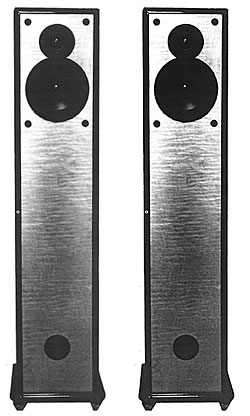
Description & designGorgeous. That's probably the best word to describe the speaker's appearance. (WordPerfect suggests "dazzling," "ravishing," "resplendent," "splendid," and "stunning" as synonyms, but I'll stick with my original choice.) These slim towers are finished in hand-picked wood veneers (the review samples were rosewood with birdseye maple trim), and would not look out of place in a store that sells "fine furniture." Of course, a speaker's appearance is of no concern to a real audiophile, but for others the Signature 1's high DAF (Decorator Acceptance Factor) will be an asset. The Signature 1 box is sturdy as well as attractive: those beautiful wood veneers cover a ¾" Medite cabinet braced every 6". The driver complement includes a front-mounted 1" Morel silk-dome tweeter, 7" Vifa cast-frame midrange, and a downward-firing SEAS 10" cast-frame woofer. Four sharp spikes are provided for mechanical grounding. The speaker can be supplied set up for bi-wiring, with solid copper Cardas binding posts; the internal wiring is Purist Audio Design silver. The grillecloth covering the tweeter and midrange is removable, and, like most manufacturers of audiophile-quality speakers, Unity Audio recommends you do exactly that for maximum performance.
If I had to choose a single word to characterize the Signature 1—and "musical" was already taken—it would be "quick." Plucked instruments such as guitars (check out the Bruce Dunlap track on the first Stereophile Test CD, and the Gavin Lurssen track on the second one), harp (eg, Susann McDonald, Klavier KCD-11004), and percussive sounds (eg, All Star Percussion Ensemble, MMG MCD-10007) had a clarity and lack of transient overhang that reminded me of my original Quad ESLs, speakers that are nearly unequaled in this area. They resembled the original Quads in another aspect: transparency. Throughout the broad midrange and the highs, there was a strong sense of "seeing through" to the program material, with little in the way of obscuring coloration or "grundge" from the speaker. The quickness and transparency allowed the fine detail of the ebb and flow of the musical performance—what some refer to as "microdynamics"—to be communicated very convincingly.