 Guess which cookie Alice ate
I'm referring to the Alice of Lewis Carroll, not the Alice of Gertrude Stein. Gertrude's Alice preferred brownies (footnote 3).
As Mahler's tragic march began to unfold, Ed and I immediately bolted upright, gazed at each other in amazement, and proclaimed, almost simultaneously, "Did you hear that?" Images increased significantly in size, and each percussive pound packed more wallop. The sound was smoother, the midrange more substantial. As we continued to listen, I found myself lowering the volume to accommodate dynamic contrasts, which seemed wider than before.
The effect reminded me of what I experienced when I first switched to aftermarket power cables, upgraded from the
dCS Rossini Apex to the
dCS Vivaldi Apex, and more recently replaced the discontinued
D'Agostino Momentum HD preamplifier with the top-of-the-line
D'Agostino Relentless preamp. With each upgrade, I heard much more
there there (with thanks to Gertrude Stein, with or without Alice and her brownies). Which begs the ultimate question: How many more "theres" can there be before we're finally
there? Not even my local Zen Priest, friend Scott Campbell, could answer that one. Which left me in the
there that many audiophiles know well. Just when I thought I had gone about as far as I could go with my system, upgrading the Stromtank power source propelled me forward once again.
After Ed and I got over being astounded, we remained flummoxed. What was it about the new Stromtank that was responsible for all these changes?
Given that the Stromtank was only powering front-end components that, together, consumed far less power than my amplifiers, a bigger soundstage with weightier, most substantial images was the last thing we expected. As much as I wanted to ask Meletzky for an explanation, I remembered that
Stereophile reviewers are prohibited by longstanding policy from discussing what we hear with manufacturers, at least while the review is ongoing. Perhaps after reading this, Meletzky can offer an explanation in his Manufacturer's Comment.
Amplifiers: Round one
Over the next few days, I discovered that the Stromtank S-4000 MK-II XT would not recharge. After many email and WhatsApp exchanges, DeVito returned with his toolkit and the Stromtank diagnostics box. With Meletzky, Managing Director Annett Dehmel, and Stromtank's research and engineering mastermind Sven Böttcher on a WhatsApp video call from Berlin, we opened the Stromtank and connected the box.
Once the folks in Germany could see what was going on, Dehmel sent a photo with a cable connection circled. When we looked inside, we confirmed that the cable was disconnected. A second photo led us to another disconnected cable (footnote 4). Once they were reconnected, and I executed, on request, two complete discharge/recharge cycles, the Stromtank seemed to reset itself and function as intended.
It was time to see if the Stromtank S-4000 MK-II XT could power power amplifiers without limitation. Which power amplifiers? In house, I had the
D'Agostino Momentum M400 MxVs, which can output up to 400W into 8 ohms and 800W into 4 ohms; the
Accuphase A-300s, which are rated at 125W into 8 ohms and 250W into 4 ohms, much of that power in class-A; and
Burmester 218 amplifiers in mono configuration, one for each channel; the Burmesters are capable of putting out 565Wpc into 8 ohms and 785W into 4 ohms. There was a lot to test.
I conducted three listening sessions, solo and with friends, going back and forth between pure Stromtank power and pure wall power. By the end of the longest listening session, I'd lost a pound moving six amplifiers back and forth.
Shortly after completing those tests, another issue arose. Nothing the folks in Germany tried could address a soft buzz that slowly grew from silence to an audible peak before buzzing down to silence, then repeating. Also, the unit would not recharge until it had discharged completely, and the row of LED charging indicators did not function properly. No amount of long-distance or on-site finagling could solve those problems.
I needed a properly functioning Stromtank S-4000 MK-II XT before I could trust the results of my listening tests.
Amplifiers: Round two
After a second Stromtank S-4000 MK-II XT arrived and was installed with DeVito's help—bless you, Ed DeVito—I confirmed that it worked properly. The Burmester amps had moved on, but the D'Agostino and Accuphase monoblocks remained in house.
Since day one, Dan D'Agostino has insisted that no Stromtank—indeed, nothing but wall power—can adequately power his amplifiers. That declaration may have preceded the development of the S-4000 MK-II XT, but what I heard with the Momentum 400 MxV monoblocks validated his claim. In sessions conducted both on my own and in the presence of EMM Labs' Shahin Al Rashid, who visited Port Townsend to help with the installation of the new
EMM Labs DA2i DAC, the S-4000 MK-II XT seemed to stifle some of the gloriousness I've come to expect to hear from the D'Agostino monoblocks. Colors seemed blanched, bass lost some focus, and the amplifiers' glorious transparency and radiance was dimmed. Rashid and I agreed that they sounded better plugged into the wall.
The Accuphase A-300s fared far better. Air and depth increased, colors and image size remained as impressive as before, but bass lost some of its tightness. Scott, who joined me for that listening session and helped move amps back and forth, said if he had to choose between the lesser of two evils, he'd sacrifice ultimate bass tautness for the extra air and depth that the Stromtank brought to the presentation. I wasn't so moved.
 Conclusion
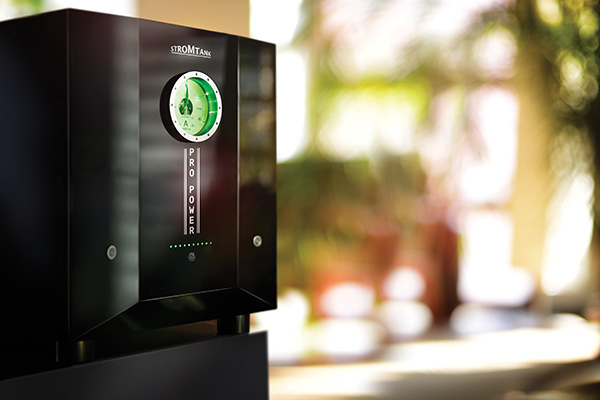
My front-end components, as well as every piece of music I play, benefit from the Stromtank S-4000 MK-II XT's battery power. The increased size, weight, and credibility it contributes to images greatly enhance music's communicative power. Since it arrived, I've experienced one "wow" moment after the other. With each listening session, my appreciation for the Stromtank S-4000 MK-II XT's gifts deepens.
It's difficult to know how satisfactorily a Stromtank S-4000 MK-II XT will power a particular amplifier. I expect that it depends at least in large part on the demands the amp places on the power source, but it may well be more complicated than that. It's also likely to depend on the ultimate resolution of the rest of your system, your room, your ears, and your expectations. Given so many variables and unknowns, I intend to try it with every new stereo, mono, or integrated amplifier that comes my way.
Footnote 3: See lithub.com/here-it-is-alice-b-toklass-recipe-for-hash-brownies.
Footnote 4: Skeptical that two cables could become dislodged during shipping, I consulted a neutral third party, Nuno Vitorino of Innuos. Vitorino, who ships product worldwide, assured me that if a product is dropped from a significant height at just the "right" angle, all the insulation in the world cannot prevent cables from disconnecting.