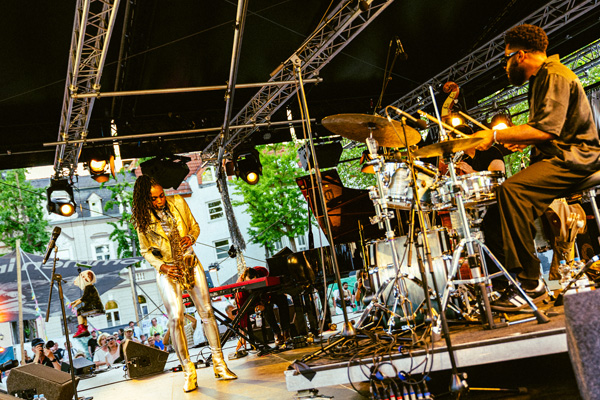
Lakecia Benjamin, Dorian Phelps. moers festival. (Photo by Dennis Hoeren.)
I started writing "On the Road Again" pieces for
Stereophile in 2022 (footnote 1). They are European jazz travelogues. The motivation behind them is to inspire others to make similar treks. No one needs an excuse to go to Europe. But European jazz festivals are a great thing to build a trip around. There are hundreds every year. Italy alone has more than 150. Many feature American headliners, but virtually all have programs filled with European artists.
In the 21st century, European jazz has exploded. Europe is now a crucial source of energy and innovation in the jazz art form. If you go on a European jazz jaunt, you are certain to make some mind-blowing discoveries.
moers
In summer 2026, I hit three festivals. The first was the "moers festival," in lower case. It no longer calls itself a jazz festival. More about that later. I had not been to Moers before. It is a clean, midsized town in western Germany. Its festival has existed for 55 years. In that time, it has had only three artistic directors. The current one (since 2017) is Tim Isfort. The most important jazz festivals tend to have their own personalities. Moers has long been known for its edgy programming and perhaps also for its political engagement.
Under Isfort, Moers does not believe that art and politics are separate. Between sets, the sound of Donald Trump's voice was piped into the square. His droning monotone, on the threshold of audibility, sounded vaguely menacing, which was apparently the intention.
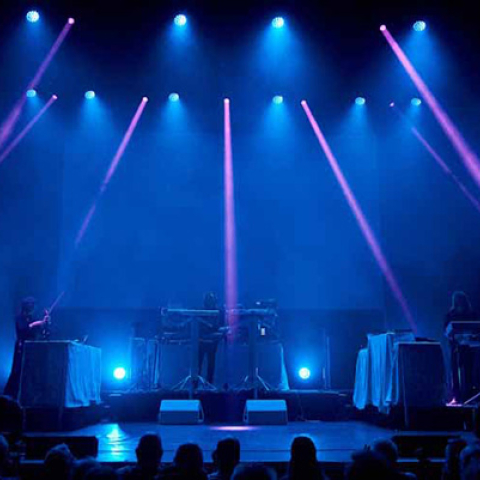
The main stage of the festival took over Kastellplatz, the central town square. Concerts were also held in several adjacent locations, including the courtyard of the town castle, two churches, and an art gallery. A "festival village" was created around the edges of Kastellplatz, with food trucks and stalls selling clothing and jewelry. (The German version of the hamburger rocks.) Moers was a communal hang. There was a "Pay What You Can" ticket model. The least expensive ticket to the entire festival cost 45 euros.
Speaking of mind-blowing European discoveries, on the opening night of Moers I was blindsided by Gellért Szabó's Ideal Orchestra. It contains 23 musicians from Leipzig, with reeds, brass, strings, accordion, six vocalists, and a rhythm section. The members come from the classical, jazz, and contemporary music worlds. Several of the vocalists are opera singers. Szabó is the conductor, composer, arranger, and frontman.
In avant-garde jazz, there have been few big bands. Free jazz and big bands do not ordinarily coincide. Szabó's project takes a radical approach to the blending of notation and improvisation in a large ensemble. A piece by the Ideal Orchestra often begins with slow tones from the entire band that are Wagnerian in their drama and solemnity. Then Szabó, standing at the front, begins to gesticulate. By means of hand signals, he prompts sections of the band to break off: Two bass clarinetists might erupt and fly free, or six singers might go wild, or violins and cellos might scrape and scream. As he waves his arms and pumps his fists, and 23 musicians respond variously, it is as if Szabó is sculpting sound in the air. Often several separate songs happen at once. Sometimes he signals the whole band to reassemble, and then, in a terrifying din, they roar as one. When there is sudden quietude and a haunting melody emerges, it was planned in advance. Or maybe not. The Ideal Orchestra appeared four times.
Once, Szabó conducted them from a boom lift 10 meters above Kastellplatz. What the band did in Moers was challenging, threatening, ugly, beautiful, and overwhelming. It was the most outrageous act in a festival that embraced the outrageous.
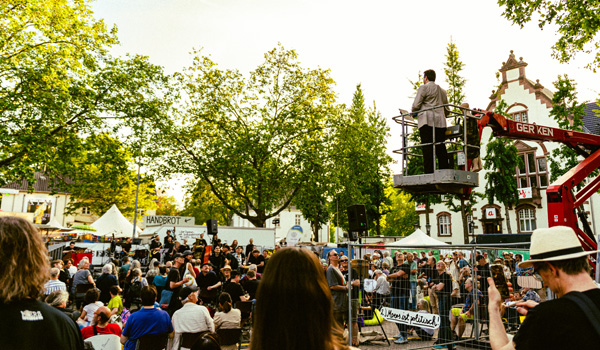
Gellért Szabó conducting. moers festival. (Photo by Dennis Hoeren.)
A sign in English hung from the front of the main stage: "Moers is not a jazz festival." I confess that it made me uncomfortable. I get that jazz has become such a huge tent, absorbing input from so many external genres and cultures, that perhaps a new term for it is needed. But the sign seemed to suggest that Moers had transcended jazz as an art form. If so, it is a need I don't share. Moers was a very mixed bag, especially in the world music acts that made it "not a jazz festival." Out of 100 concerts over five days by 200 artists from 20 countries, here is a highly selective list of bands that I saw and memories that stand out:
1) In Kastellplatz, on opening night, the WDR Big Band of Germany, one of the world's most respected large ensembles, performed with South African pianist and Blue Note recording artist Nduduzo Makhathini. They played Makhathini compositions arranged by one of the most important jazz arrangers, Vince Mendoza, who also conducted. Their set was deeply jazz, and impeccable. Mendoza expanded Makhathini's chants and rituals into vast soundscapes.
2) A quintet called SORBD also played opening night in Kastellplatz. It is named for the last initials of the players: clarinetist Edith Steyer of Germany, pianist Rieko Okuda of Japan, bassist Isabel Rössler of Germany, drummer Sofia Borges of Portugal, and alto saxophonist Mia Dyberg of Denmark. They embodied several major trends in current jazz: how the avant-garde can now include lyricism and humor; how heavy hitters are now as likely as not to be women; how globalization of the art form is now a fact.
3) A happy development was the last-minute addition of 20-year-old American Skylar Tang. She is the real deal on trumpet. Her music was straight ahead by Moers standards, but it was fresh and alive. Tang played her own intelligent originals, but the encore was a cool, reharmonized version of Jimmy Van Heusen's "Like Someone in Love." The other players, also very young badasses, were pianist William Schwartzman, bassist John Murray, and drummer Ethan Oliver. Watch for their names.
4) Moers's out-of-the-box programming was illustrated by not one but two solo drum concerts, both in the castle courtyard. Ches Smith was diverse, dynamic, and fascinating. Chris Corsano was less so.
5) Both Corsano and Smith were effective as the sole accompanists for Nate Wooley in a "secret concert" held in a venue in an industrial complex outside the town center. It was startling, after an evening of Wooley's patiently evolving fragmentary trumpet abstractions, to hear him, for the encore, blast out "Bye Bye Blackbird." (The Miles Davis centennial fell during the festival.)
6) Of the disappointing acts, three contained well-known names. Projects led or co-led by cellist Tomeka Reid, flutist Nicole Mitchell, and guitarist Gordon Grdina were only intermittently compelling. Grdina's sets failed to capitalize on the presence of one of the most talented young piano players in Europe, Elias Stemeseder.
7) The biggest name on the program was probably Lakecia Benjamin, the recipient of multiple Grammy nominations in 2024 and 2025. She hit Moers like a gold-lamé– clad tornado. In the closing concert of the festival, her opening alto saxophone shrieks were jolts of electricity, lighting up Kastellplatz. There are alto players with more interesting ideas, but none with more energy. Her blend of avant-garde abandon, down-and-dirty funk, and showmanship is unique. She blew apart "My Favorite Things." (John Coltrane would have forgiven her.) Crowds at Moers were mostly well-behaved beer-sipping middle-aged Germans. Benjamin got them to their feet. She got them shaking their asses.
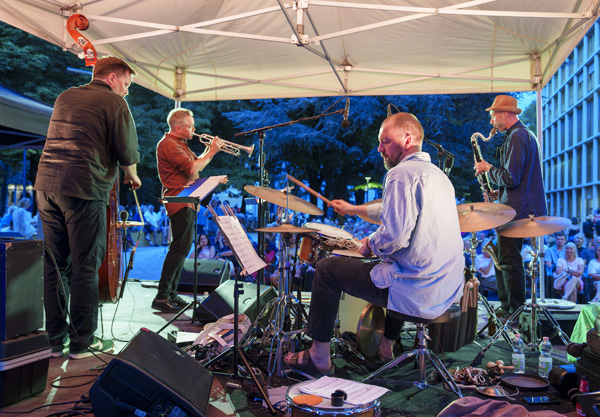
Team Hegdal: Ole Morten Vågan, Eivind Lønning, Gard Nilssen, Eirick Hegdal. Südtirol Jazzfestival. (Photo By Tim Dickeson.)
Südtirol
My next stop was the "Südtirol Jazzfestival Alto Adige," based in Bolzano, Italy. The name, like almost everything in this part of Italy close to the Austrian border, is bilingual. The region, dominated by the Dolomites and the Alps, is called "Südtirol" (South Tyrol) in German and "Alto Adige" (Upper Adige) in Italian. It is one of the most beautiful places on earth. Out every window, emerald-green sheer mountains loom, crowding the sky. The personality of this festival is inseparable from its physical setting. Südtirol is famous for where it puts music: Sometimes in mountain meadows at 6000 feet. Sometimes on a ledge in a rock quarry in moonlight. Sometimes in underground bunkers that were once Nazi air-raid shelters. Sometimes even in auditoriums.
I have returned to this festival many times because its vibe is magical. Buses are provided to take you up in the mountains. Sometimes, to reach the music, you ride cable cars and ski lifts. Crowds, mostly small, bond over the music. Most of the time, I have not heard of the musicians. The three people who run it (Max von Pretz, Stefan Festini Cucco, and Roberto Tubaro) tend to book just-emerging European musicians. There are exceptions. For example, on opening night, Gard Nilssen's Supersonic Orchestra played at an outdoor venue in Bolzano. It contains some of the most highly regarded jazz players in Scandinavia. The leader, Nilssen, is one of the premier drummers of Europe. The band he has operated off and on since 2019 has highly unusual instrumentation: three drummers, three bassists, six reeds, four brass. With no chordal instrument to get in the way, Nilssen's orchestra hits like a freight train. The six-man rhythm section is thunderous yet internally detailed. When it is time for solos, one ass-kicker after another stands up and kills. They include tenor saxophonist Eirik Hegdal, alto saxophonists Sissel Vera Pettersen and Maciej Obara, and trombonist Erik Johannessen. The Supersonic Orchestra got the festival off to an audacious start.
But the performance that can stand for the mystique of Südtirol took place on the morning of the third day. Eirik Hegdal and Sissel Vera Pettersen set up on a ridge on Monte San Vigilio, at 5700 feet. (The festival made full use of the A-list musicians of Gard Nilssen's Supersonic Orchestra. They kept reappearing in various configurations.) The audience was scattered on the sloping terrain around the musicians. Behind and below the ridge was a meadow of horses and cows. Behind and above the ridge, silver mountain peaks succeeded one another to the far horizon. Hegdal and Pettersen, using clarinet, tenor and alto saxophones, voice, and electronics, sent their sonic messages, their calls and whispers, into the vastness of the Alps. The experience of the music was dependent on the mountains. But the experience of the mountains was changed by the music. Südtirol embeds music in its physical environment, changing the perception of both. It was a morning from your dreams, but real.
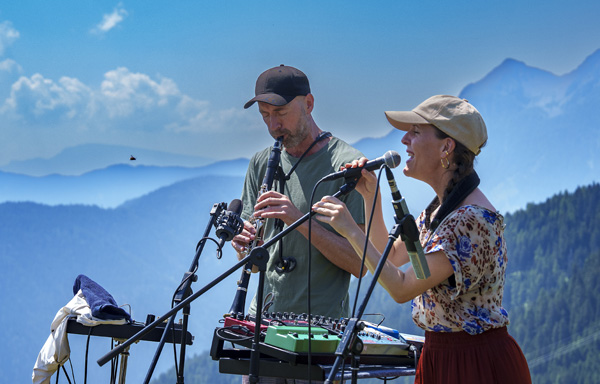
Eirick Hegdal, Sissel Vera Pettersen. Südtirol Jazzfestival. (Photo By Tim Dickeson.)
Here is my list, again highly selective, of memories chosen from the first six days of this 10-day festival:
1) Eirik Hegdal also appeared in his own established band, Team Hegdal, with Eivind Lønning on trumpet, Ole Morten Vågan on bass, and Gard Nilssen on drums. (All are members of the Supersonic Orchestra.) They played snappy, rollicking Ornette-ish music with urgent unisons, tricky themes, and slithering backbeats.
2) Francesco Diodati plays in Enrico Rava's various high-profile bands. He also operates several projects of his own. He unveiled a new one at the festival, a quartet with electric bassist and vocalist Ruth Goller. They played in layers. Layers of arcane melodies and complex, insinuating grooves, somehow all tinged in plaintiveness.
3) An example of Südtirol's unconventional programming was a series called "Sonic Reactions": duo concerts held in the tiny space of the festival's office. One was an encounter between British pianist Kit Downes (who also played cello) and Italian violin virtuoso Anaïs Drago. The impulsive creative permissiveness of their in-the-moment collaboration was quintessentially Südtirol.
4) One of the highlights of the festival was Downes's solo pipe organ recital in the Chiesa Parrocchiale di Gries, a grand 15th century Gothic church in Bolzano. It was a fully spontaneous performance, but Downes described his approach as "improvising compositionally." Sometimes, as themes evolved, you could hear suggestions of Bartók, Messiaen, or Ligeti. It was a unique experience at a jazz festival: to sit in a church pew, the organist out of sight above, while resounding, shattering, celestial organ sonorities rained down upon you.
5) A lot of hairy, in-your-face music is played at a Südtirol festival. Much of it happens late at night, in a basement club called the Batzen Sudwerk. Oasis Boom, for example, a French duo of drummer Mélissa Acchiardi and guitarist Vincent Duchosal, unleashed pure primal forces so deafening and raw they made you fear for your sanity.
6) But Südtirol also brings in bands that, while still freethinking, have a lighter touch. A long bus ride up a mountain led to a concert by Knobil, in a lovely hotel with a name that is funny in English: Bad Ratzes. Knobil is a Swiss trio with a clean, airy sound and an impish spirit. Another example is the French trio Spin & Spells. Rafaëlle Rinaudo plays electric harp, Simon Winsé plays a West African lute called the ngoni, and Raphaël Quenehen plays tenor saxophone. Their sound, with their atypical stringed instruments, was a warm, rich, quietly incisive blend. But Spin & Spells could generate grooves that made you twitch in your seat.
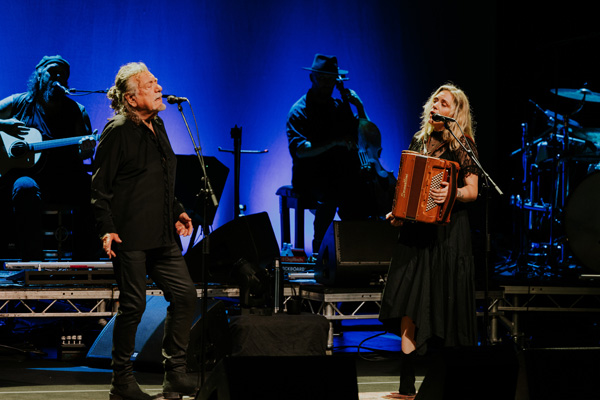
Matt Worley, Robert Plant, Barney Morse-Brown, Suzy Dian. Istanbul Jazz Festival. (Photo by Salih Ustundag.)
Istanbul
My next stop was the Istanbul Jazz Festival. In Istanbul, I was given the perfect way to see Robert Plant live for the first time. The festival picked me up at the airport. My flight was late, which meant that I had to go straight to the Plant concert from the airport. On the ride into town I saw, also for the first time, the incredible scene of the Istanbul streets. We crawled down bumper-to-bumper boulevards and inched our way along narrow, steep, twisting cobblestone lanes. I was immersed in a city that was a chaos of cars, motorcycles, scooters, and people overflowing sidewalks and spilling into the streets. (I had not yet noticed all the cats or heard my first screeching call to prayer.)
My driver finally pulled into a small open space off the street. It contained a few men in uniform, possibly police. I was led down a long walkway and through a door. I realized I was at the side of a stage. Plant, above me to my right, was crouched over a microphone, singing in that voice I had known for most of my life. I looked up to my left and saw that I was at the bottom of a semicircular Romanesque amphitheater. (I later learned it was built in the 1940s.) There were 4000 people above me, in seats that tiered steeply up.
The festival lasts for 14 days, but there is only one concert a day, in the evening. Marcus Miller opened the festival and Veronica Swift closed it. I didn't see them. I was there for six nights in the middle. Unlike most jazz festivals, the schedule makes sightseeing possible during the day. The visual experience of Istanbul is staggering. Sights like the Blue Mosque and Topkapi Palace are deservedly famous. So is the skyline itself, with its domes and minarets and hills and water. Simply walking the streets is a sensory overload of blinding color, jostling crowds, and kitties, kitties everywhere. (It is also an obstacle course of things to trip over.)
Robert Plant appeared with an excellent band, Saving Grace. They are Suzi Dian on vocals and accordion, Tony Kelsey on lead guitar, Matt Worley on rhythm guitar and vocals, Barney Morse-Brown on cello, and Oli Jefferson on drums. When, at one point in the concert, someone in the crowd inevitably screamed "Stairway to Heaven!" Plant responded, "But this is
jazz." What they played, though, was only slightly jazz. It was also folk, rock, blues, country, and Americana. "Stairway to Heaven" would not have fit, but some Led Zeppelin songs did, like "Ramble On" and "The Rain Song." Their acoustic transformations sounded surprisingly natural. Dian did an emotionally authentic rendition of a plainspoken song by Gillian Welch, "Orphan Girl." When Worley sang the traditional gospel song "Ain't No Grave Can Hold My Body Down," you believed him. Plant was in good voice. At a Plant concert, there is no escaping the awareness that you are in the presence of an icon. Plant cannot change that, but the version of himself that he has reinvented in his old age has its own validity.
I saw five concerts in Istanbul, in five venues. The most dramatic was the one where Plant played, the Harbiye Cemil Topuzlu Open Air Theatre. A Brazilian singer, Mari Froes, played at the Marmara Esma Sultan, a waterfront mansion. Behind the stage, you could see the 15 July Martyrs Bridge over the Bosphorus, which connects the European and Asian sides of Istanbul, and you could see passing boats. Another singer, Arooj Aftab, played at the classy, high-ceilinged, all-beige Atatürk Cultural Center, a major Istanbul performance hall. Singer Senem Diyici was the outlier. She played Salon I KSV, a tight, dark club space without seating.
All three vocalists had merit. Aftab, who won a Grammy in the "Global Music" category in 2022, has a pure, understated, directly affecting vocal instrument. Froes puts on an irresistible show. She sings and dances out of sheer joy. She is gorgeous, and her permanent openhearted smile enhances the celebration. Diyici, who drums while she sings, has had a long career as a major factor in the Turkish jazz world. She performed with Okay Temiz, an important Turkish percussionist known for bringing an Anatolian rhythmic sensibility into jazz. Together, Diyici and Temiz generated grooves that I found exotic but that already existed in my subconscious.
Istanbul was a jazz festival that was thin on jazz. That made the last concert I saw all the more exciting because it was unadulterated, hardcore, unapologetic jazz. Joe Lovano brought a new band to Istanbul. He calls it the "Explorations Quartet." They are pianist Antonio Faraò, bassist Ira Coleman, and drummer Johnathan Blake. Lovano, as one of our greatest living tenor saxophonists, is able to sustain a wide variety of projects and affiliations. But he rarely finds it necessary to depart from the rich, diverse creative resources of the jazz art form. He played in an outdoor venue that felt like
La Dolce Vita: the garden of the Consulate General of Italy. The first tune was a burner, and this summer night stayed mostly hot. Lovano's solos probably contain more rough edges than 20 years ago. It is not because he lacks control but because, in his passion to communicate, he allows himself more liberties now.
One of the highlights of my Istanbul experience was "Milestones." (This year, because of the Miles Davis centennial, Miles songs are popular.) Lovano's band smoked it. They played only one ballad, McCoy Tyner's "Search for Peace." Lovano opened thoughtfully, choosing notes carefully, but as variations engendered variations, his runs gathered intensity and eventually the ballad atmosphere was gone. As good as he is at both fast and slow tempi, his wheelhouse is a certain medium cruising speed that he owns. On his own tune, "Our Daily Bread," he settled into time and elegant ideas flowed from him, unhurried, as if beyond his own volition.
In recent years, Lovano has worked with some left-of-center pianists, like Marcin Wasilewski and Marilyn Crispell. Faraò is more straight ahead. He is extravagantly lyrical but also aggressive. He tends to pour gasoline on Lovano's ongoing fire. Coleman took bass solos of exceptional clarity. Blake is simply a monster. He somehow provides extraordinary quantities of inspirational percussive information without crowding ensemble space.
The Lovano concert confirmed what I already knew: The many derivatives and ancillary genres now often blended with jazz are fine. But there is nothing like the real thing.
Footnote 1: Reprinted
here and
here.