Photo by Tim Dickeson
The jazz world is accustomed to losing its greats too soon. Charlie Parker was gone at 34. John Coltrane at 40. Clifford Brown at 25. Rollins was, wonderfully, not one of them. He lived to 95.
Rollins made his first recording at 18, in 1949. His final recordings were made in 2012. In his large, 63-year discography, the acknowledged masterpieces came early. They include
Saxophone Colossus (Prestige),
A Night at the "Village Vanguard" (Blue Note),
Way Out West (Contemporary), and
The Bridge (RCA Victor). All were released in the 1950s except
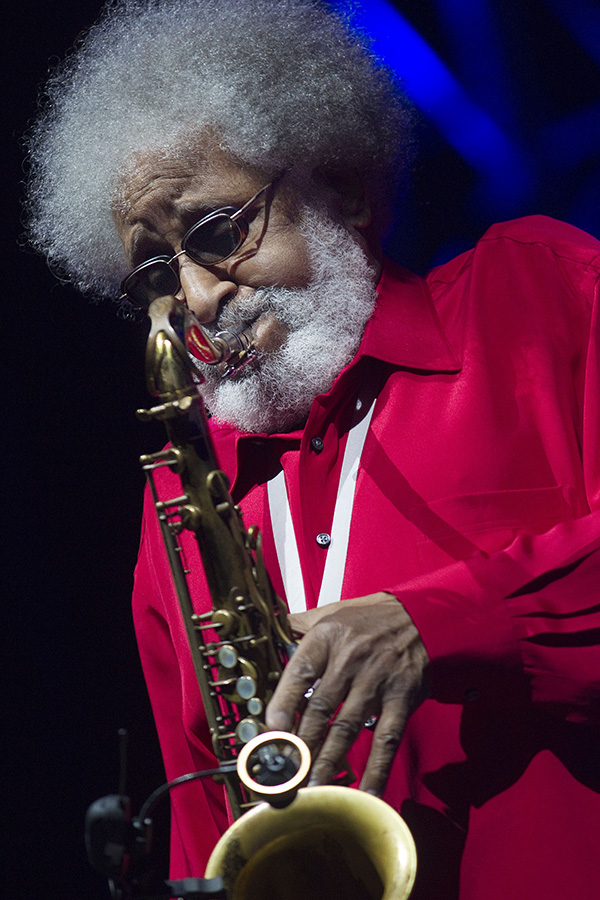
The Bridge, which came out in 1962. Through these works, Rollins became one of the founding fathers of modern jazz and (along with John Coltrane) inaugurated the post-bop tenor saxophone language. He had a huge, rich, commanding sound on his instrument. He composed permanent classics of the jazz canon like "St. Thomas" and "Oleo." He was a virtuoso of theme-and-variation. But many credible authorities, in their assessment of Rollins's achievement, go further. Important critics like Francis Davis and important musicians like Branford Marsalis are on record as believing that Rollins was the greatest improviser jazz ever produced. (Marsalis allows for one possible exception: Louis Armstrong.)
Rollins is almost as famous for his superhuman endurance as for his art. Music for him was not just a job. It was an all-consuming passion. Today we would call him OCD. Stories abound. He used to practice through the night on the Williamsburg Bridge in Brooklyn, sometimes for 16 hours. During a month-long engagement at Ronnie Scott's in London in 1966, he played four sets a night. When the club closed at 3am, he stayed in the locked club, alone, and practiced until 5:30. In 1985, he gave a solo concert at the Museum of Modern Art in New York where he improvised alone for two hours without a break. For most of his working life, he had freakish resources of creative energy that he could call upon at will.
He also had quirks, some of them self-sabotaging. He was weird about recording. Richard Corsello, who functioned essentially as Rollins's personal engineer for more than 30 years, once said, "Sonny hates to record, period. As soon as he knows he's being recorded, he's in a different mindset. He cannot stand to hear himself. He doesn't like to do sound checks. He doesn't care about sound. He cares only about the immediate performance." It is strange to hear of a major musician who could "not stand to hear himself." But Rollins was, famously, his own most withering critic. It made every recording session problematic. The reason there are so few high-quality, professional, live remote recordings of his concerts is that he wouldn't allow them.
In 1972, Rollins signed with the Milestone label, stayed 34 years, and made many albums, almost none of them truly representative of his stature. He was prone to hiring undistinguished sidemen. But his impossibly high standards for himself also applied to them, which meant that he kept firing them, which meant that he never had a long-term working band.
Many Rollins experts are convinced that in addition to his early masterpieces and his mostly underwhelming Milestone records, there is a "third Rollins." It is Rollins live in concert. Again, stories abound. They involve nights of legend, when Rollins, beside himself, took his audience to the promised land. Gary Giddins (a world-class, no-nonsense jazz critic but a Rollins true believer) calls such nights "musical séances that transcended jazz." This "third Rollins" had never been captured on record—until the
Road Shows series, on Rollins's own Doxy label, in four volumes. These four albums were recorded at live shows between 1979 and 2012 and released between 2008 and 2016. The music comes from airchecks and audience recordings and soundboard tapes.
Rollins resisted live remote recording setups but, starting in the late 1980s, he allowed Richard Corsello to make sound-board tapes. The sound on the
Road Shows albums is uneven. But thanks to the heroic efforts of Corsello, who spent hundreds of hours in his home studio cleaning up the original tapes, the sound is good enough. For anyone so unfortunate as to never have seen Sonny Rollins live, these albums are he next best thing. The tenor saxophone solo on the very first track of the series, "Best Wishes," is maniacal and sublime. Rollins powers through its 12-bar form 35 times in eight minutes, in waves, in towering arcs. And he is just warming up. There are 28 more tracks to come in the series.
For the last 14 years of his life, Rollins stopped performing in public because of pulmonary fibrosis. He had a home in lower Manhattan, and there has been much speculation that his respiratory problems originated with his proximity to Ground Zero in 2001. When Aidan Levy wrote one of the great jazz biographies (
Saxophone Colossus: The Life and Music of Sonny Rollins, published in 2022), he had the enormous advantage of access to its living subject. Levy's book (at 772 pages plus hundreds more pages of online footnotes) tells the whole story of an extraordinary American artist and a more extraordinary human being.
The term "titan" is probably thrown around too loosely these days. Sonny Rollins was a titan. No one like him is left. The world feels different without
Sonny Rollins in it.