Sidebar 3: Measurements
I performed a full set of measurements on the NAD M66 using my Audio Precision SYS2722 system,1 repeating some of the testing with the magazine's higher-performance APx555 analyzer. I used the BluOS app on my iPad mini to control the M66's volume and settings and select the inputs. Looking first at the M66's line inputs (turning off Dirac Live, tone controls, A/V mode, and Compressed Grouped Audio mode), the M66 preserved absolute polarity at the balanced and unbalanced outputs but inverted polarity at the headphone output. The line inputs have an Analog Direct setting, which bypasses the M66's A/D converters and DSP functions.
In this mode, with the volume control set to the maximum, "100," the voltage gain at 1kHz was 2.7dB from the balanced output with a balanced input and from the unbalanced output with an unbalanced input. The maximum gain from the headphone output was 6.25dB with both input types. Turning off the Analog Direct mode—engaging A-D-A conversion—increased the gain at all three output types by 6dB.
The single-ended line input impedance was 25k ohms at 20Hz and 1kHz, 19.7k ohms at 20kHz. While these values are lower than the specified 56k ohms, these are still usefully high. The balanced input impedance was 100k ohms at 20Hz and 1kHz, 93k ohms at 20kHz. The balanced output impedance was 44 ohms across the audioband; as expected, the unbalanced output impedance was half that value.
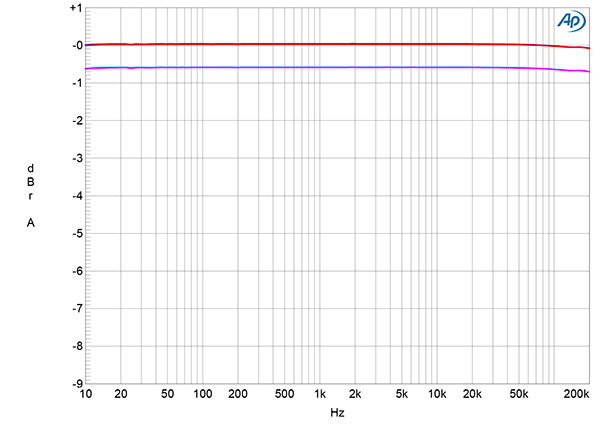
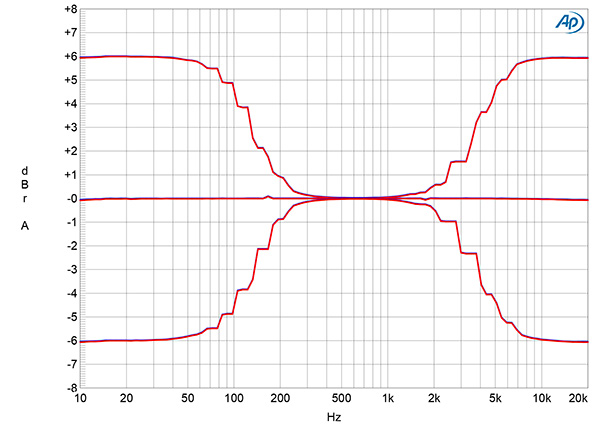
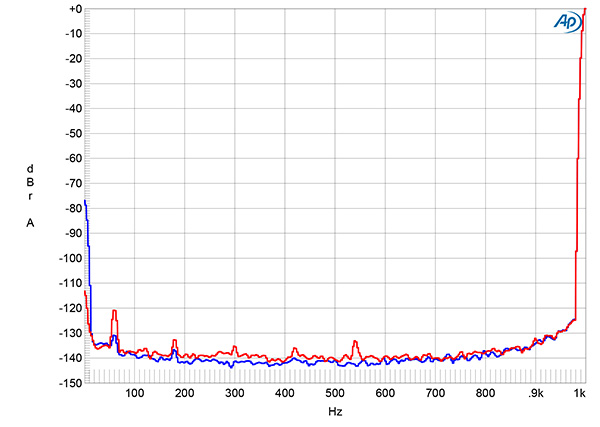
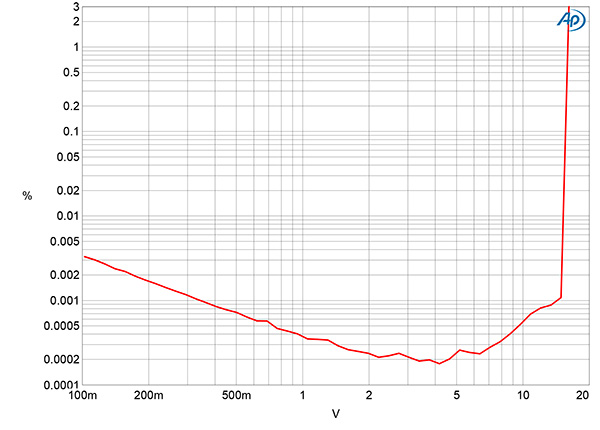
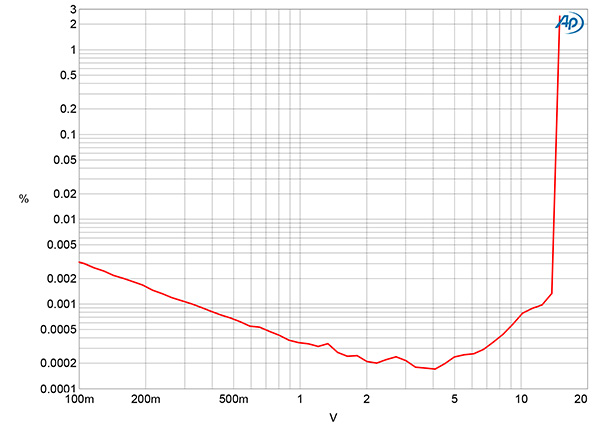
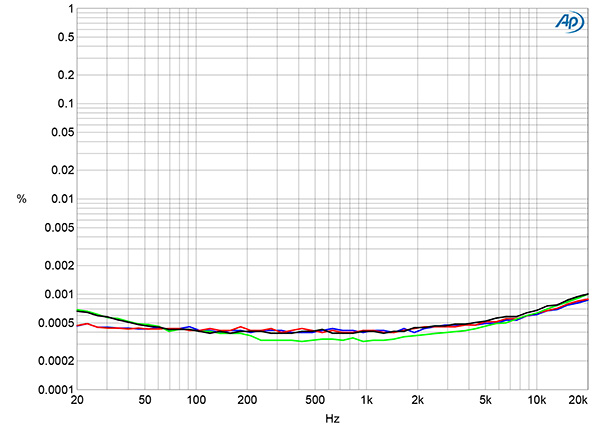
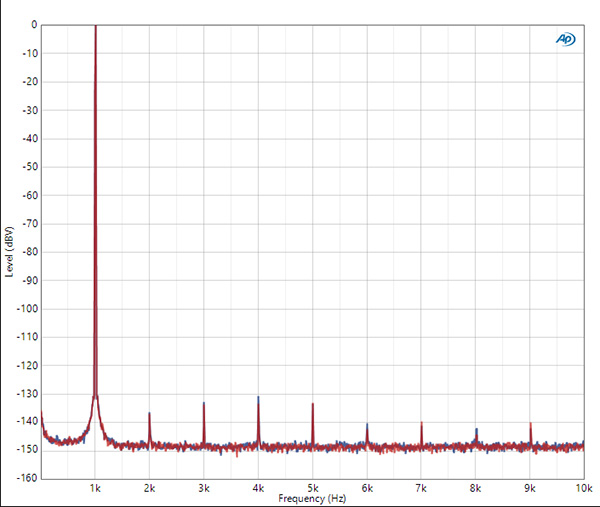
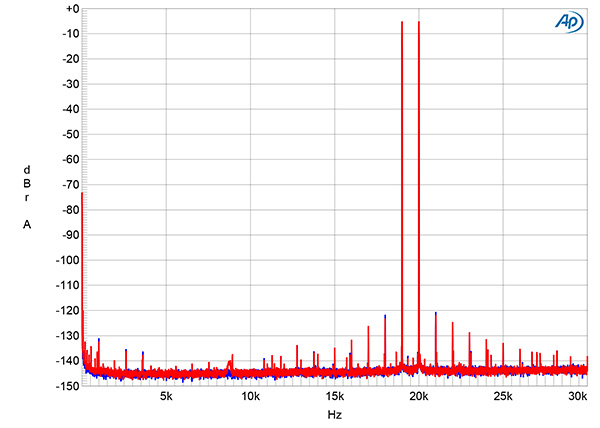
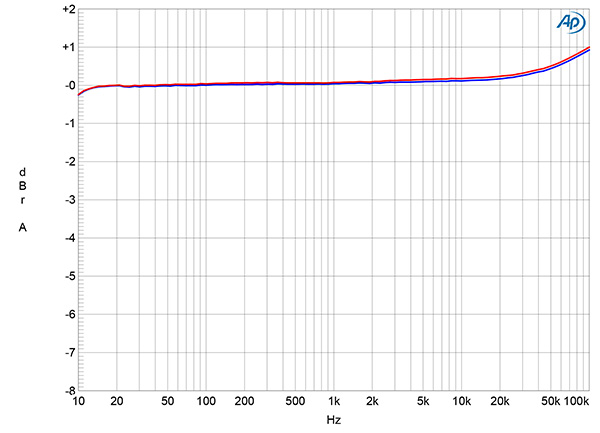
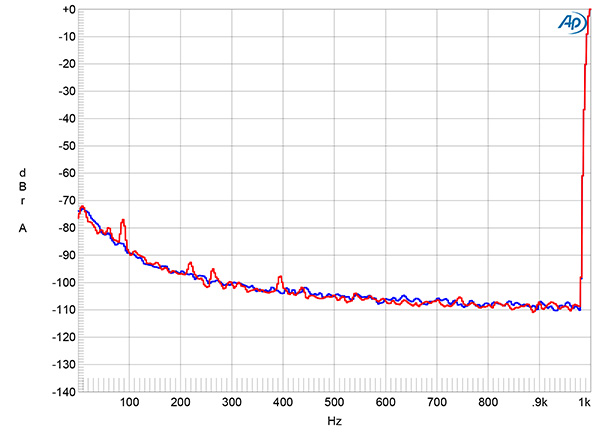
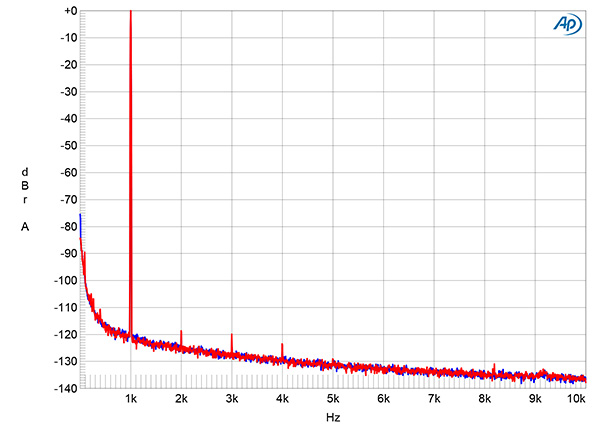
Fig.1 NAD M66, line input, balanced output, Analog Direct mode, frequency response at 2V into 100k ohms (left channel blue, right red) and 600 ohms (left cyan, right magenta) (1dB/vertical div.).
Fig.2 NAD M66, line input, balanced output, Analog Direct mode bypassed, frequency response at 2V into 100k ohms with bass and treble controls set to the maximum, center, and minimum positions (left channel blue, right red) (2dB/vertical div.).
The headphone output impedance was a very low 5 ohms at all audio frequencies. The balanced line frequency response in "Analog Direct" mode was flat up to 200kHz into 100k ohms and 600 ohms (fig.1). The channel balance was very close. These characteristics were preserved at lower settings of the volume control and from the headphone output. The response from the single-ended outputs was flat to 30kHz and down by 2.6dB at 200kHz. Bypassing Analog Direct restricted the line inputs' response to half the A/D converter's sample rate of 96kHz. The M66's DSP includes treble and bass controls. Fig.2 shows that these facilitate the specified ±6dB boost and cut in the bass and in the top audio octave.
Fig.3 NAD M66, line input, balanced output, Analog Direct mode, spectrum of 1kHz sinewave, DC–1kHz, at 2V into 100k ohms with volume control set to the maximum (left channel blue, right red; linear frequency scale).
Channel separation was astonishingly high, at >130dB in both directions below 3kHz and still 119dB at the top of the audioband. The wideband, unweighted signal/noise ratio, taken in Analog Direct mode with the unbalanced input shorted to ground and the volume control set to its maximum, was a superb 98.5dB ref. 2V in both channels. This ratio improved to 115dB when the measurement bandwidth was restricted to the audioband and to 117.5dB when A-weighted. Bypassing Analog Direct reduced these S/N ratios by 5dB. Fig.3 shows the spectrum of the NAD's balanced low-frequency noisefloor at 2V in Analog Direct mode with the volume control set to its maximum. The level of random noise is extremely low, and the only power supply– related spuriae visible in this graph lie at or below –120dB!
Fig.4 NAD M66, line input, balanced output, Analog Direct mode, THD+N (%) vs 1kHz output voltage into 100k ohms.
Fig.5 NAD M66, line input, balanced output, Analog Direct mode, THD+N (%) vs 1kHz output voltage into 600 ohms.
Figs.4 and 5 plot how the THD+noise percentage in the M66's balanced Analog Direct mode varies with output voltage into, respectively, 100k ohms and 600 ohms. The downward slope of the traces indicates that the distortion lies below the noise up to about 5V. At our usual definition of clipping, when the THD+N reaches 1%, the M66's balanced output clips at 15.5V into 100k ohms, 14.5V into 600 ohms. The single-ended output clips at half these voltages; the headphone output at 10.1V. Bypassing Analog Direct reduced the maximum balanced output voltage to 5.4V, still higher than the preamplifier will be required to deliver in practice.
Fig.6 NAD M66, line input, balanced output, Analog Direct mode, THD+N (%) vs frequency at 5V into: 100k ohms (left channel blue, right red), 600 ohms (left green, right gray).
Fig.7 NAD M66, line input, balanced output, Analog Direct mode, spectrum of 1kHz sinewave, DC–10kHz, at 3V into 100k ohms (left channel blue, right red, linear frequency scale).
Fig.8 NAD M66, line input, balanced output, Analog Direct mode, HF intermodulation spectrum, DC–30kHz, 19+20kHz at 2V peak into 600 ohms (left channel blue, right red, linear frequency scale).
Fig.6 shows how the THD+N percentage changed with frequency at 5V into 100k ohms (blue, red traces) and 600 ohms (green, gray traces). The distortion into both impedances is extraordinarily low, with only a slight rise in the top octave. Spectral analysis (fig.7) reveals that the distortion harmonics all lie at or below –120dB (0.0001%). Intermodulation distortion was superbly low in level, even into 600 ohms (fig.8).
To examine the performance of the M66's MM and MC phono inputs, I connected a wire from one of the Audio Precision's ground terminals to the grounding lug on the NAD's rear panel. Both input types preserved absolute polarity at the balanced and unbalanced outputs, but like the line inputs, the polarity at the headphone output was inverted. The MM input impedance is specified as 56k ohms; I measured 51k ohms at 20Hz and 1kHz, and 36.5k ohms at 20kHz. The MC input impedance was the specified 100 ohms at all audio frequencies. In Analog Direct mode, the MM input's maximum gain at 1kHz was 43.9dB from the balanced output, 37.9dB from the unbalanced output, and 47.4dB from the headphone output. The MC input's maximum gain was 22dB greater at all three input types. As with line inputs, bypassing Analog Direct increased these gains by 6dB.
Fig.9 NAD M66, MM input, balanced output, Analog Direct mode, response with RIAA correction (left channel blue, right red) (1dB/vertical div.).
Fig.10 NAD M66, phono input, balanced output, Analog Direct mode, spectrum of 1kHz sinewave, DC–1kHz, for 5mV input (left channel blue, right red, linear frequency scale).
The phono input's RIAA correction (fig.9) was well matched between the channels and extremely accurate in the audioband. The ultrasonic response rose slightly, reaching +1dB at 100kHz. The MM input's wideband, unweighted S/N ratio, ref. 1kHz at 5mV, assessed at the balanced output with the inputs shorted to ground and the volume control set to the maximum, was a good 67.5dB in both channels. Restricting the measurement bandwidth to 22Hz– 22kHz increased the ratio by 4dB; inserting an A-weighting filter resulted in a ratio of 83.5dB. The MC input's S/N ratios, ref. 1kHz at 500µV, were equally good. Spectral analysis of the MM input's low-frequency noisefloor (fig.10) indicated that no supply-related spuriae were present.
Fig.11 NAD M66, phono input, balanced output, Analog Direct mode, spectrum of 1kHz sinewave, DC–1kHz, for 20mV input (left channel blue, right red, linear frequency scale).
To be sure I wasn't prematurely clipping the output, I examined the phono input's overload margins with the volume control set to –12dB. Both the MM input's and MC input's margins were impressively high from 20Hz to 20kHz, at 25dB ref. 1kHz at 5mV and 23dB ref. 1kHz at 500µV, respectively. Even with an input around 12dB below the 1kHz overload level, all the distortion harmonics were at or below –120dB (0.0001%; fig.11). The levels of the intermodulation products with an equal mix of 19 and 20kHz tones were similarly inconsequentially low.—John Atkinson