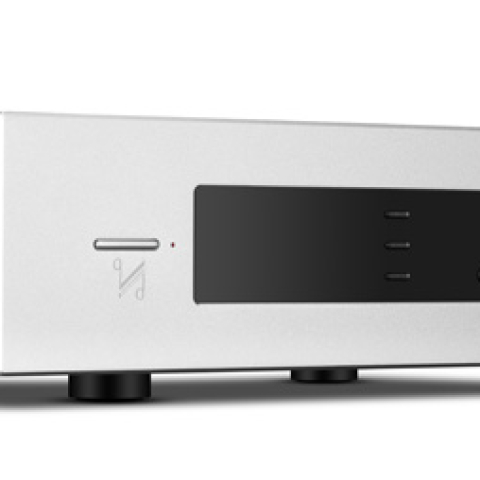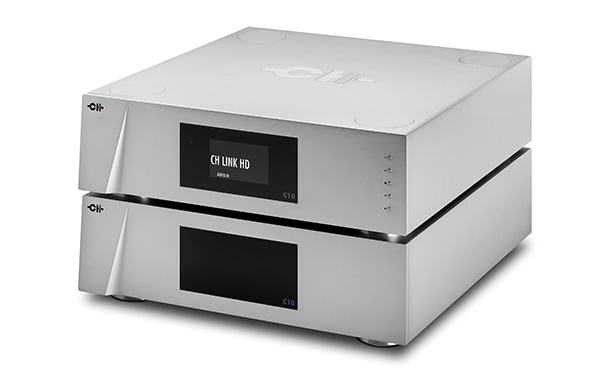
It takes audacity for a company that already builds one of the finest DACs on the planet, which is already expensive, to set out to build one that's so much better that it warrants an extra digit in the model number and a much higher price tag. But then CH Precision has never lacked audacity.
The Swiss company did exactly that not just with their DAC, but with almost their whole line. The newer, pricier 10 series currently includes an amplifier, preamplifier, a transport, an enhanced, redesigned power supply, and a new Master Clock, the T10. Like the 1-series components, the 10-series components are modular: You can get the base model, or you can upgrade to versions with channels separated (one chassis per channel), with the converter itself separated from all the other circuitry and with its own external power supply (the C10 Conductor), and so on.
I'm reviewing the basic, 10-series stereo D/A converter, which comprises a single-chassis two-channel DAC and an external power supply. This configuration costs $95,000 in its base stereo-DAC configuration, with a single input module (S/PDIF, AES3, TosLink, and CH-Link HD; the latter is CH Precision's proprietary I2S implementation). The review sample added Ethernet ($6000) and USB ($3000) input modules, so as reviewed the C10 DAC costs $104,000.
The base configuration of the C1.2 DAC, which I reviewed for the February 2023 Stereophile, was in a single chassis with its own internal power supply, though I reviewed it with (and without) the external power-supply option. Today, the base-model C1.2 costs $36,000. The C10, then, reflects a very considerable cost increment over a component that was already expensive. Adding the gold or anthracite finish adds $5000 to the price.
Swiss (timing) precision
CH Precision's DAC tech is based on assumptions about how people hear music. This was eloquently explained to me by the late Thierry Heeb, a DSP expert, lovely guy, and the "H" in "CH." Heeb sadly passed away about a year ago. In the reproduction of digitally recorded music, a digital signal is best thought of as analog. The digital notion of two independent states—ones and zeros, up and down—is an abstraction, useful for math but not real. In the real, hi-fi world, a digital signal takes the form of a voltage on a wire that changes with time. "Even if the electrical signals are supposed to be digital, basically just two levels, a zero and a one, as soon as you get into an electronic board, they are actually analog signals, current or voltage flowing through components," Heeb told me in a Zoom interview as I was reviewing the C1.2. (He later covered some of this territory at a meeting at CH headquarters.) "That is especially true, for instance, for clock signals. If you just consider clock signals as being a shift between two values between zero and one, you don't really get what clock is. The most important point in clocking is in the time domain, with finite resolution. Basically, it boils down to an analog signal again."
The time domain is where music happens, though frequency-domain phenomena are important (think chords). In each ear canal, there is only ever a single level of pressure at each instant, and it changes with time. It makes sense, then, for any designer of digital audio components to think very hard about what happens in the time domain.
What happens in the time domain (apart from all the good stuff) is two things: jitter, which arises from timing and voltage imperfections in the digital signal, and, as I put it back then, "an intrinsic lack of precision in D/A conversion, which Heeb (and others) call time smearing."
"Time smearing is basically if you put a single pulse through the system, if you have a filter with a very long impulse response, that single sample will extend over a large number of samples," Heeb said in that Zoom interview.
In the landmark work that lay the foundation for converting an analog signal into digital bytes, Claude Shannon employed the sinc function, sin(t)/t, as the conversion "kernel." The sinc function is very extended in time, from the beginning of history to the end—yet, as Heeb mentioned, there's no energy in real music before the song starts or after it finishes, so in the real world, a digital representation is only an approximation of the analog original.
Research subsequent to Shannon's has proposed other, shorter kernels, including splines, mathematical functions made up of polynomials patched together smoothly. "We prefer to use splines, which have a much more compact support," Heeb told me. "Compact support" is mathematics speak for "short." It means that they don't extend very far into the past or the future.
By using a conversion kernel with more compact support, such as splines, you can reduce the total error. This manifests most obviously as a reduction in time smearing. This is the fundamental concept behind CH Precision's D/A conversion.
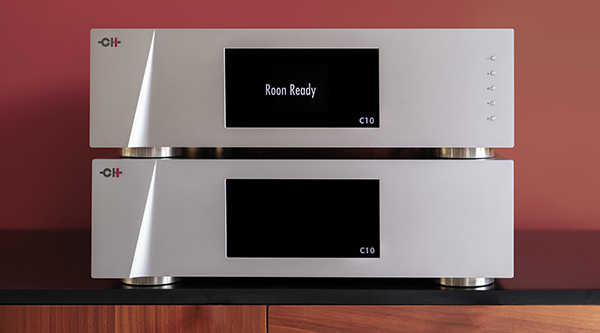 The CH Precision C10 D/A converter
In CH Precision's chosen approach, timing is key. Fast and accurate computing increases timing precision. CH's 1-series D/A converter, the C1.2, upsamples everything to 705.6kHz (for sample rates of 44.1kHz and its multiples) or 768kHz (for sample rates of 48kHz and its multiples). Their proprietary upsampling algorithm is called PEtER, short for Polynomial Equations to Enhance Resolution. Both the C1.2 and the C10 implement four DSP devices, but they're used differently. In both DACs, one DSP decodes MQA and another applies the PEtER algorithm to regular PCM data. After that, an FPGA chooses the correct datastream, sending the 16×-upsampled data to the remaining DSPs. In the C10—and this is the main difference from the C1.2—each channel has its own DSP, which applies the PEtER algorithm a second time, increasing the sampling rate by another 16×. Notably, PEtER upsampling is nondestructive. It keeps the original data and uses spline interpolation to insert new data points among the originals.
What is the point of all the upsampling? Those data points are not of course new music information. They do however have the effect of smoothing things out. In effect, you get greatly increased bandwidth even if those higher frequencies contain no authentic music information.
In the C10 (as in the C1.2), the actual conversion is carried out by a chip—and not just any DAC chip. Unusually for a DAC chip (circa 2025), the PCM1704 uses the R2R (resistor 2 resistor) conversion technique. R2R is conceptually simple. It uses a series of resistors to add to the signal the appropriate amount of voltage for each bit that's "on" (1 rather than 0), an amount that depends on that bit's "significance," from least to most. With precise resistors, R2R DACs are very accurate. They're especially good at preserving the integrity of low-level information. Many listeners—notably Herb Reichert—prefer the sound of R2R DACs to that of more modern delta-sigma DACs, though most of the ones Herb favors use actual resistors laid out on an actual circuit board; whether Herb appreciates chip-based R2Rs as much, I don't know.
Here's another interesting fact about the PCM1704: It was introduced some 30 years ago and discontinued in 2007. No need to worry about the supply, though: CH Precision told me they have enough to use "until we find something we think is better."
Why would a high-tech hi-fi manufacturer use a discontinued, 30-year-old chip? Because it does the job and does it well. Most modern DAC chips do other stuff in addition to the basic conversion, stuff like implementing reconstruction filters. (If you've ever wondered why many current DACs allow you to choose among the same several filters—linear phase, minimum-phase, and so on—it's probably because those filters are built into the DAC chip.)
If the PCM1704 did such a good job, why was it discontinued? Because relative to the alternatives, it was expensive to produce. An R2R DAC is only as good as its resistors are accurate, and "trimming" the resistors in the PCM1704 was a time-consuming and expensive business. Most DACs, including those ubiquitous modern chips from ESS, use the delta-sigma technique, which is technically very different and apparently more cost-effective.
It's rarely acknowledged, but to me it seems true: CH Precision takes a cutting-edge approach to D/A conversion—yet there's an old-school, vintage aspect to their approach, a bit of authenticity.
One more relevant fact about the PCM1704: It's a 24-bit chip. 32-bit math allows more accurate calculations, but once these calculations are finished, only the 24 most significant bits are sent to the DAC chip. The C1.2 DAC used eight PCM1704s, four in each channel, operating in differential mode, two up, two down. The C10 uses 16 PCM1704s, eight in each channel. In the C1.2, the chips run in parallel. In the C10, they are set up in what CH calls the "DSQ Phase Array"; each successive sample goes to a different DAC, increasing the final resolution to 64 times the sample rate.
Finally, high-frequency noise from the conversion to analog is filtered out using a single, gentle, third-order "Sallen-Key" Bessel function–based low-pass filter.
All this focus on algorithms has kept me from directing due attention toward the C10's heroic, perfectionist construction. The C10 maintains separate grounding planes for its digital (shared with the chassis), analog, and timing circuits. Moving the power supply to a separate chassis allowed more room for capacitors, filtering, and regulation and ensured that alternating current never come near the box where the action occurs.
The C10 utilizes LVDS—low-voltage differential signaling—which both lowers vulnerability to external electronic noise (that's the differential part) and reduces the emission of electronic noise (the low-voltage part).
Like other CH Precision components, the C10 allows you to play with feedback. With the C10, you get to decide whether to use global feedback at all—or, as CH Precision puts it, to choose whether the feedback is Global or Local.
Does the C10 play DSD files? Of course it does—although since that DAC chip is PCM-only, it must first convert DSD to PCM. It has an advantage in doing that, though: Its PCM-conversion system already operates at DSD frequencies, so the resulting conversion path is simple and direct.
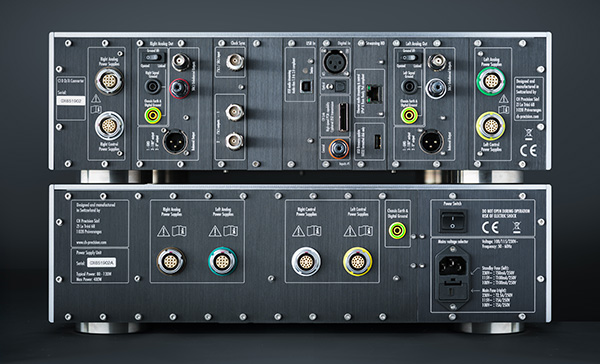 The C10 has separate, independent power-supply connections for the left and right channels; each PS unit has two independent supplies on board. Each one supplies 11 DC signals into four isolated C10 "zones," for digital circuitry, analog circuitry, and the L and R DACs. The L and R DACs are placed at the outer edges of the chassis and supplied there directly by separate umbilicals—one for the DAC itself and one for the control circuitry. (The input cards are in the middle.) Separate ground connections are provided on the rear panel for the digital/chassis and analog grounds, and there is one of each for each (L, R) channel.
In operation
The C10 has separate, independent power-supply connections for the left and right channels; each PS unit has two independent supplies on board. Each one supplies 11 DC signals into four isolated C10 "zones," for digital circuitry, analog circuitry, and the L and R DACs. The L and R DACs are placed at the outer edges of the chassis and supplied there directly by separate umbilicals—one for the DAC itself and one for the control circuitry. (The input cards are in the middle.) Separate ground connections are provided on the rear panel for the digital/chassis and analog grounds, and there is one of each for each (L, R) channel.
In operation
You can set up the C10 from the front panel via its menu system, though it's more convenient to use CH Precision's app, especially if you own more than one CH component, since the same app allows you to set up all of them. Currently, the app is available only for Android, but an iOS version is forthcoming, possibly as early as the fourth quarter of 2025 (footnote 1). Setup parameters include common, obvious things like labeling inputs and turning them on and off, but they also do more interesting things like allowing you to invert polarity and switch global feedback in and out to tune sonics. You can also play music from the app, though you may prefer one of the Connect options (Tidal or Qobuz—no Spotify). Qobuz and Tidal Connect do not, however, give you access to local files, direct-connected or on your network. The CH Precision app does; just make sure your NAS is running MinimServer. The app also supports internet radio via the TuneIn service. The C10 became Roon Ready with its second-most-recent firmware update, v1.1.
I played music with the C10 from the CH Precision app, with two different Innuos servers and the Innuos Sense app (with servers connected to the C10 by Ethernet and by USB), and with the lovely little Wattson Emerson Digital using its iOS app. I experienced no issues, ever (though see the discussion below about Qobuz Connect).
What the music sounds like
Nearly 25 years after I wrote my first review, my reviewing methodology has finally taken shape. I listen casually over a period of weeks to a mix of new and familiar music. During this extended period, any comparisons I'm making are implicit: against expectations, against what I'm used to, not against another device. The goal is, over time, to answer three related questions: "What does the component sound like?" "With this component in the system, how does music make me feel?" And, "What is it about the sound that causes the music to affect me in this way?" Satisfaction tends to map on to approximating what I hear at concerts and to what Herb Reichert eloquently calls "vividosity." After I've been listening for a while, I do real comparisons—not rapid A/B tests but switching out components, listening for differences, then coming back to the component under review. This helps solidify (and sometimes causes me to revise) the impressions I have as a result of long-term listening.
In this case, my comparisons were to the C1.2, a DAC I've already said I could live with forever, the best I'd previously heard in my system. An implied question in this process was, How much better could the C10 be?
During the early stages of this method, I compile a list of music I've found to show off aspects I've noticed of the performance of the component under review. The final step is to sit down and listen to those tracks, pen (or, more often, laptop keyboard) in hand. This is where the main content of the Listening section usually comes from.
This time, during my final days of auditioning, I was examining the C10's front-panel settings—have I overlooked anything?—when I noticed that the firmware installed was v.0.7. That would make it a prerelease version; the C10 had been set up in my NYC apartment before its commercial release. According to the website, production firmware was up to v1.2. 0.7 permitted almost full function; the only missing feature was Qobuz Connect, which became available after the C10 was delivered.
Eager to explore that feature, I attempted to update the firmware using files downloaded from the CH Precision website. 0.7, though, wasn't intended to be updated.
The update didn't work. The C10 was bricked. The device wasn't harmed, but it would need a trip to the factory, or at least to a dealer, before it could play music again.
 So I would be denied the opportunity to wax eloquent about the sound of the C10 with specific recordings—including, for example, the recent, extraordinary collection of Shostakovich string quartets by Cuarteto Casals. (See this issue's Recording of the Month.)
Yet, after months of listening, I am well-prepared to tell you what the C10 sounds like—or rather what music sounds like when reproduced via the C10. Through the C10, music sounds much as it does through the C1.2—see my listening report in that review—but with a bit more soundstage depth and width (especially depth) and transients that are a touch more natural, with (crucially) a greater sense of ease. None of these effects were especially large—see my comments in the conclusion below—yet were you to hear first one DAC and then the other, you would notice the differences right away.
Only modest differences? It would be alarming if differences I heard were large: One expects that at this level of D/A performance, we are asymptotically approaching if not perfection then at least a certain D/A-conversion ideal. The C10 made digital music that was richer, more precise, more natural and more compelling than that made by the C1.2—indeed, than by any D/A processor I've experienced in my system previously. But it wasn't dramatically better than the C1.2, which, again, was already very fine.
Surely you noticed that modifier: digital music. Am I implying that the C10 fell short of the best analog sound?
The short answer is no, but it requires explication. I recently got in for review the new SME Model 35 turntable with the Series Vi tonearm, on which I have mounted a Lyra Etna λ Lambda MC cartridge. The new 'table is a surprisingly large step up in sonic quality from the SME 30/12 I've used for years, and I am smitten.
It's awkward to compare a turntable to a digital music maker, on a number of levels, but please stay with me while I do it anyway. Listening to the same music (though not exactly the same engineering), I heard more music information via the C10. It wasn't close. I notice this most, as you would expect, when listening to complex recordings: symphonies, operas. In such music, a vinyl record on a very good vinyl front-end can be very enjoyable, but typically the sound is rounded off. A section—second violins, say—tends to sound like a single instrument; it's a simplified sound, but it works. Even the best digital fails to reproduce that section as 14 individual instruments—even my ears fail at that—but with good digital there is more of an impression of instruments playing together.
In simpler music—a small jazz combo, for instance—a good vinyl front-end, even a modest one, has a certain je ne sais quoi. The same music through digital isn't inferior to analog; it has its own virtues. But generalizing, vinyl records imbue small-group jazz in particular with a punchy, vibrant sound. I think digital is capable of capturing the sound of that vinyl record if the engineer were to commit it to bytes, but few engineers working in digital are aiming for that sound. So more than anything, it's a question of engineering for digital vs engineering for vinyl. If I hadn't just bricked the C10, I'd put on a needle-drop recording right now to investigate.
Conclusion
So I would be denied the opportunity to wax eloquent about the sound of the C10 with specific recordings—including, for example, the recent, extraordinary collection of Shostakovich string quartets by Cuarteto Casals. (See this issue's Recording of the Month.)
Yet, after months of listening, I am well-prepared to tell you what the C10 sounds like—or rather what music sounds like when reproduced via the C10. Through the C10, music sounds much as it does through the C1.2—see my listening report in that review—but with a bit more soundstage depth and width (especially depth) and transients that are a touch more natural, with (crucially) a greater sense of ease. None of these effects were especially large—see my comments in the conclusion below—yet were you to hear first one DAC and then the other, you would notice the differences right away.
Only modest differences? It would be alarming if differences I heard were large: One expects that at this level of D/A performance, we are asymptotically approaching if not perfection then at least a certain D/A-conversion ideal. The C10 made digital music that was richer, more precise, more natural and more compelling than that made by the C1.2—indeed, than by any D/A processor I've experienced in my system previously. But it wasn't dramatically better than the C1.2, which, again, was already very fine.
Surely you noticed that modifier: digital music. Am I implying that the C10 fell short of the best analog sound?
The short answer is no, but it requires explication. I recently got in for review the new SME Model 35 turntable with the Series Vi tonearm, on which I have mounted a Lyra Etna λ Lambda MC cartridge. The new 'table is a surprisingly large step up in sonic quality from the SME 30/12 I've used for years, and I am smitten.
It's awkward to compare a turntable to a digital music maker, on a number of levels, but please stay with me while I do it anyway. Listening to the same music (though not exactly the same engineering), I heard more music information via the C10. It wasn't close. I notice this most, as you would expect, when listening to complex recordings: symphonies, operas. In such music, a vinyl record on a very good vinyl front-end can be very enjoyable, but typically the sound is rounded off. A section—second violins, say—tends to sound like a single instrument; it's a simplified sound, but it works. Even the best digital fails to reproduce that section as 14 individual instruments—even my ears fail at that—but with good digital there is more of an impression of instruments playing together.
In simpler music—a small jazz combo, for instance—a good vinyl front-end, even a modest one, has a certain je ne sais quoi. The same music through digital isn't inferior to analog; it has its own virtues. But generalizing, vinyl records imbue small-group jazz in particular with a punchy, vibrant sound. I think digital is capable of capturing the sound of that vinyl record if the engineer were to commit it to bytes, but few engineers working in digital are aiming for that sound. So more than anything, it's a question of engineering for digital vs engineering for vinyl. If I hadn't just bricked the C10, I'd put on a needle-drop recording right now to investigate.
Conclusion
The C10 earns my highest recommendation. Any caveats are the obvious ones. The first one is price: Even the "base" C10, the version I reviewed, is very expensive, though far less so than the most expensive DACs on the market. At Stereophile, we don't make a big deal about price because we know your sense of value depends at least partly on your income. If you can afford it, you may not care how much it costs, though you still might. The other, related caveat is that what the extra money buys is a clear but modest improvement over the very fine C1.2—and why not? At this level of execution, a manufacturer can move either toward further refinement or intentional coloration—I can't think of another alternative—and intentional coloration isn't CH Precision's style. Nevertheless—and this is axiomatic in hi-fi, and a crucial point in this review—a small improvement in sound may yield a large improvement in an individual's experience of listening to music. That's the test right there: You should buy it if you can afford it and if you find the improvement it offers meaningful.
As for me, I did find the improvement musically meaningful, especially the extra sense of ease. I regret that I can't begin to afford it. If I could, it would be on my short list, as it ought to be on yours.
Considerations of value aside, I tend to think of a product like the C10 as simply an achievement, and an important one. CH Precision set out to take their approach to D/A conversion to its apotheosis; that, to me, is a valid endeavor. The decision whether to buy is, of course, up to you, and maybe your financial adviser.
Footnote 1: In principle, there's nothing wrong with Android except that it excludes the many iPad users. Also, I've never gotten on well with Android tablets mainly because of power-management issues. While most iOS apps running in the background don't use much power, Android apps—some of them at least—apparently do. Several times I left the Android app running when I wasn't using it, only to find my Samsung tablet was dead—out of power—the next time I needed it.
CH Precision's DAC tech is based on assumptions about how people hear music. This was eloquently explained to me by the late Thierry Heeb, a DSP expert, lovely guy, and the "H" in "CH." Heeb sadly passed away about a year ago. In the reproduction of digitally recorded music, a digital signal is best thought of as analog. The digital notion of two independent states—ones and zeros, up and down—is an abstraction, useful for math but not real. In the real, hi-fi world, a digital signal takes the form of a voltage on a wire that changes with time. "Even if the electrical signals are supposed to be digital, basically just two levels, a zero and a one, as soon as you get into an electronic board, they are actually analog signals, current or voltage flowing through components," Heeb told me in a Zoom interview as I was reviewing the C1.2. (He later covered some of this territory at a meeting at CH headquarters.) "That is especially true, for instance, for clock signals. If you just consider clock signals as being a shift between two values between zero and one, you don't really get what clock is. The most important point in clocking is in the time domain, with finite resolution. Basically, it boils down to an analog signal again."
The CH Precision C10 D/A converterIn CH Precision's chosen approach, timing is key. Fast and accurate computing increases timing precision. CH's 1-series D/A converter, the C1.2, upsamples everything to 705.6kHz (for sample rates of 44.1kHz and its multiples) or 768kHz (for sample rates of 48kHz and its multiples). Their proprietary upsampling algorithm is called PEtER, short for Polynomial Equations to Enhance Resolution. Both the C1.2 and the C10 implement four DSP devices, but they're used differently. In both DACs, one DSP decodes MQA and another applies the PEtER algorithm to regular PCM data. After that, an FPGA chooses the correct datastream, sending the 16×-upsampled data to the remaining DSPs. In the C10—and this is the main difference from the C1.2—each channel has its own DSP, which applies the PEtER algorithm a second time, increasing the sampling rate by another 16×. Notably, PEtER upsampling is nondestructive. It keeps the original data and uses spline interpolation to insert new data points among the originals.
The C10 has separate, independent power-supply connections for the left and right channels; each PS unit has two independent supplies on board. Each one supplies 11 DC signals into four isolated C10 "zones," for digital circuitry, analog circuitry, and the L and R DACs. The L and R DACs are placed at the outer edges of the chassis and supplied there directly by separate umbilicals—one for the DAC itself and one for the control circuitry. (The input cards are in the middle.) Separate ground connections are provided on the rear panel for the digital/chassis and analog grounds, and there is one of each for each (L, R) channel.
In operationYou can set up the C10 from the front panel via its menu system, though it's more convenient to use CH Precision's app, especially if you own more than one CH component, since the same app allows you to set up all of them. Currently, the app is available only for Android, but an iOS version is forthcoming, possibly as early as the fourth quarter of 2025 (footnote 1). Setup parameters include common, obvious things like labeling inputs and turning them on and off, but they also do more interesting things like allowing you to invert polarity and switch global feedback in and out to tune sonics. You can also play music from the app, though you may prefer one of the Connect options (Tidal or Qobuz—no Spotify). Qobuz and Tidal Connect do not, however, give you access to local files, direct-connected or on your network. The CH Precision app does; just make sure your NAS is running MinimServer. The app also supports internet radio via the TuneIn service. The C10 became Roon Ready with its second-most-recent firmware update, v1.1.
Nearly 25 years after I wrote my first review, my reviewing methodology has finally taken shape. I listen casually over a period of weeks to a mix of new and familiar music. During this extended period, any comparisons I'm making are implicit: against expectations, against what I'm used to, not against another device. The goal is, over time, to answer three related questions: "What does the component sound like?" "With this component in the system, how does music make me feel?" And, "What is it about the sound that causes the music to affect me in this way?" Satisfaction tends to map on to approximating what I hear at concerts and to what Herb Reichert eloquently calls "vividosity." After I've been listening for a while, I do real comparisons—not rapid A/B tests but switching out components, listening for differences, then coming back to the component under review. This helps solidify (and sometimes causes me to revise) the impressions I have as a result of long-term listening.
So I would be denied the opportunity to wax eloquent about the sound of the C10 with specific recordings—including, for example, the recent, extraordinary collection of Shostakovich string quartets by Cuarteto Casals. (See this issue's Recording of the Month.)
The C10 earns my highest recommendation. Any caveats are the obvious ones. The first one is price: Even the "base" C10, the version I reviewed, is very expensive, though far less so than the most expensive DACs on the market. At Stereophile, we don't make a big deal about price because we know your sense of value depends at least partly on your income. If you can afford it, you may not care how much it costs, though you still might. The other, related caveat is that what the extra money buys is a clear but modest improvement over the very fine C1.2—and why not? At this level of execution, a manufacturer can move either toward further refinement or intentional coloration—I can't think of another alternative—and intentional coloration isn't CH Precision's style. Nevertheless—and this is axiomatic in hi-fi, and a crucial point in this review—a small improvement in sound may yield a large improvement in an individual's experience of listening to music. That's the test right there: You should buy it if you can afford it and if you find the improvement it offers meaningful.
Footnote 1: In principle, there's nothing wrong with Android except that it excludes the many iPad users. Also, I've never gotten on well with Android tablets mainly because of power-management issues. While most iOS apps running in the background don't use much power, Android apps—some of them at least—apparently do. Several times I left the Android app running when I wasn't using it, only to find my Samsung tablet was dead—out of power—the next time I needed it.