For the past few months, I've been getting ready to move. Those of you who've looked for an apartment in New York City know that it may be the single most dismal thing about living here. Imagine spending months online, looking at "digitally staged" photos of dark, cramped, cheaply renovated apartments where you can hardly believe anyone would consent to live, all offered at prices that, elsewhere, can get you a Greek Revival manse with four acres of rolled lawns. To wade through these listings is also to partake of some of the most godawful words in the English language, all designed to make the reader feel poor. My least favorite may be "coveted," which brings to mind the kind of late–19th-century opera where a Sicilian villager gets knifed in the heart.
If and when you spot a home that might do, there will probably be a single 15-minute showing, and then there's the matter of competing with other hopefuls, sometimes more than a dozen of them, at least one of whom is certain to bid above the asking price. Given this gladiatorial level of competition, you can't afford to think about whether you really want the apartment before applying, but you also can't get too attached to the idea of getting it, because you probably won't. A coworker of mine recently remarked, "I think I'd rather break a bone than move again."
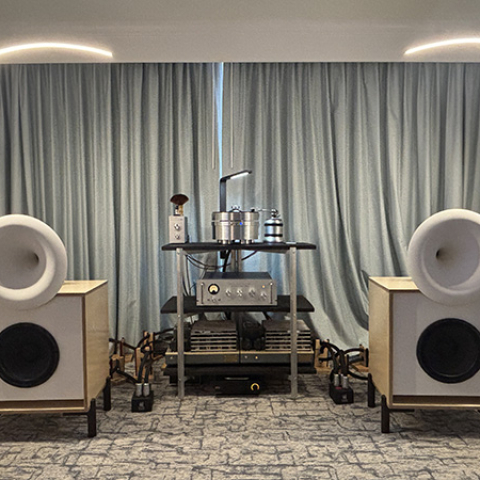
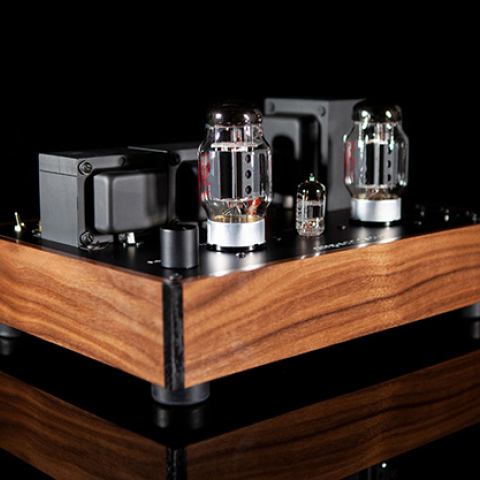
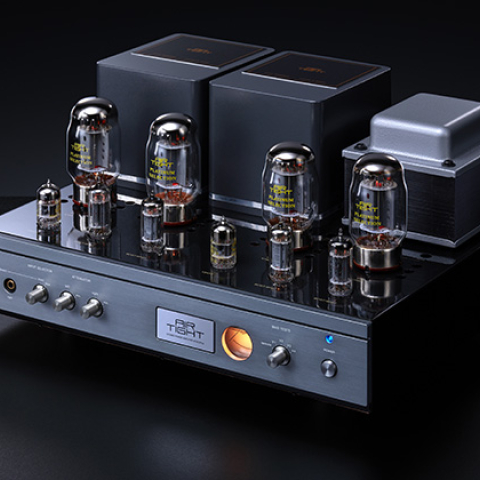
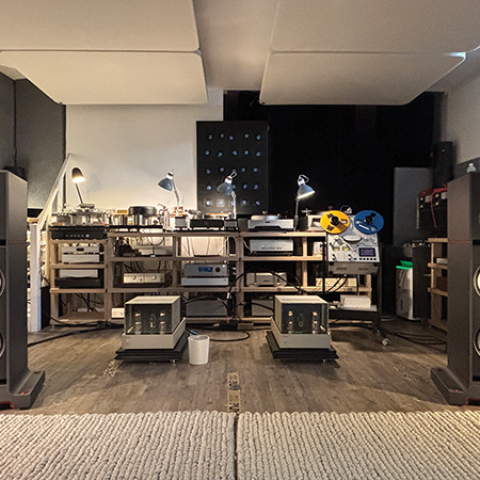
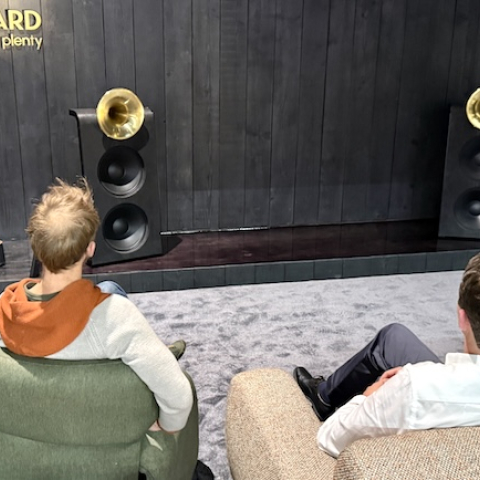
Is there a way to make this comically enervating experience even more stressful? Try moving while an audiophile. My partner is a classical musician, and when he thinks about our dream apartment, he's imagining a small practice room, hopefully with a window. But when I pore over a floor plan, I'm looking for a room large and symmetrical enough to allow for a sufficiently deep soundstage with a pair of 200lb horn speakers. A room preferably walled with pre-war brick, the better to insulate the neighbors from ZZ Top's "Waitin' for the Bus" played at 102dB (and if I happen to be comparing, say, stylus cleaners, probably played six times in a row). Sometimes I dream about a two-level apartment, with no neighbors above or below, but then I remember that my body doesn't contain enough plasma to pay for such a thing. Finally, when researching a potential home, I anxiously study Google Maps to make sure that my upsettingly loud sound system won't have to compete with a nearby highway, rave venue, or motocross arena. Because to be an audiophile in a large city is to generate a tsunami of noise while living in fear that someone around you might raise their voice above a whisper and lower the signal/noise ratio in your listening room. Wish me luck.
It's at times like these that I long for audio that doesn't require quite so much space. Over the years, I've listened to many headphones, beginning with the Grado SR60s I bought with my first paycheck. Since then, I've been lucky enough to sample many exotic cans, but I always return to the admittedly controversial realization that I happen to prefer ... earphones. Yes, I'm talking about those tiny things you wedge into your ears. I find that their increased isolation and more intimate, detailed sound gets me closer to a recording, and I don't mind giving up some of the scale and out-of-head imaging of over-ear headphones.
More importantly, many headphones require heroic, full-size amplifiers to sound their best, and I've never learned to enjoy having my head tethered to a stack of audio gear with a cable. Something about it makes me feel imprisoned. Earphones, on the other hand, move with me, allowing me to listen in bed or in a doctor's waiting room or while blanching green beans. Also, earphones perform well with even elatively modest (read: portable) source equipment, which is no small blessing.
My love for earphones was born decades ago, thanks to a pair of Etymotic ER4s. These tube-like things required "deep insertion" into the ear canal, a procedure that's just as squirm-inducing as it sounds, but they offered some of the most highly resolving sound I have heard. Variants of this classic balanced-armature design are still available today. More recently, my in-head listening has been dominated by the creations of a Portland, Oregon, outfit called Campfire Audio, which makes some of the most unusual earphones in existence (footnote 1).
Campfire was birthed a decade ago by Ken Ball, a painter and photographer who'd been working as a plant pathologist for the United States Department of Agriculture. From the beginning, the company's MO has been a little weird: They've introduced dozens of earphone models using a wide variety of driver technologies. Their tunings are guided not by the ethos of neutrality but rather by a desire to create emotional experiences, and some sound downright eccentric. Fans of the Harman target curve can pack it in and go home right now.
Surprising no one, this approach has managed to piss off some Reddit legends, but Ball remains unbowed. "We are known for going out on limbs," he wrote to me during a months-long email conversation. "I avoid trying to make safe tunings. We want to make an earphone for a specific group of people, a flavor. ... So almost all our offerings are going to hit the bullseye or totally miss—and that is our goal."
Equally distinctive is Campfire's endearingly quirky aesthetics. Many of the earphone housings are marvels of miniaturized industrial design, and then there are the memorable accessories. Take the first iteration of the Trifecta earphone (about which more later). The wooden box it comes in features a lid with picture of a sky, out of which a little golden metal arm with an extended index finger protrudes toward you. Also included are a genuinely attractive sky-blue leather carrying case and a discreet lapel pin with the company's logo. All this may sound a bit too Wes Anderson for some, but I find it delightful. And then there are the model names—Andromeda Emerald Sea, Solaris Stellar Horizon, Moon Rover, Alien Brain—which seem devised by an astronomy buff or possibly a power user of ketamine.
Recently, I've had a chance to live with three sets of Campfire earphones and wrap my head—literally, I suppose—around their sound. A quick caveat: while these earphones provide excellent passive isolation, it's not comparable to the active noise canceling found in the better wireless earbuds. I preferred using the Campfires in moderately quiet environments rather than amid the roar of the New York City subway, which averages around 80dB. As always, your ears may vary. With medium silicone tips attached, I found all three earphones comfortable to wear for hours at a time, without the itchiness and discomfort of less successful designs.
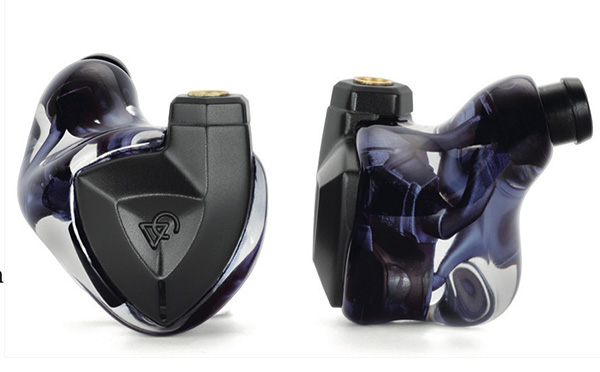
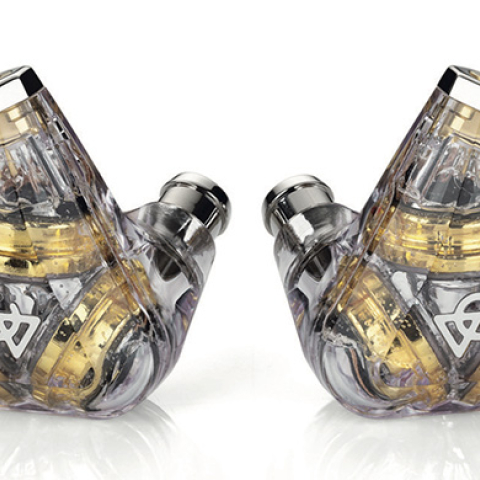
The first to arrive was the Clara ($1999), which was designed in collaboration with Alessandro Cortini, known best for being a member of Nine Inch Nails and the first Italian inducted into the Rock and Roll Hall of Fame. If you hold the acrylic-bodied ear phones up to the light, you can see the drivers, a combination of Knowles balanced armature drivers in the mids and highs and dynamic biocellulose drivers in the lows. It didn't take long to suss out the Clara's "flavor." While listening to a Qobuz stream of Merle Haggard's "Hungry Eyes," the earphones allowed me to hear that, like most of the singer's early sides on Capitol, the mix was slightly overcooked in the treble. Thing is, the Claras let me know this without actually reproducing the annoying peak. Cortini has said that he wanted to deemphasize the treble while maintaining a high level of detail. Like some moving coil cartridges, too many earphones and headphones have a treble response that sounds more like someone's idea of "high definition" and less like real music. The Clara's treble balance strikes me as just about right.
The Clara allowed me to hear admirably deep into the mix, but without tizz. Possibly my favorite thing about the Haggard track is the playing of Roy Nichols, one of the least heralded guitar masters of the last century. His signature virtue may be the economy of his playing, which is as terse and elegant as a paragraph by James M. Cain. On "Hungry Eyes," just before Haggard begins singing, Nichols plays a short figure that communicates more than some other guitarists' 32-bar solos. The Clara allowed me to hear that Nichols plays exactly eight notes, pulling them out of the mix without thinning out his instrument's bourbon-and-molasses tone.
As you might guess, nothing about this earphone—or any Campfire Audio product I've heard—sounds wispy or clinical. Nowhere is this more evident than in the Clara's bass response, which is as tenacious as a pit bull and superbly textured. It's also slightly but audibly emphasized. The Clara made listening to Michael Henderson's electric bass on "Right Off," from Miles Davis's A Tribute to Jack Johnson, irresistibly propulsive and fun. But on "Circle," from Davis's Miles Smiles, Ron Carter's acoustic bass sounded more prominent in the mix than I am used to.
Despite the fact that its sound stayed mainly within the confines of my head, and despite its rather exuberant bass section, I really enjoyed my time with the Clara, finding it to shine a bright light into the mix while remaining engaging. Yet it did little to prepare me for the next contender.
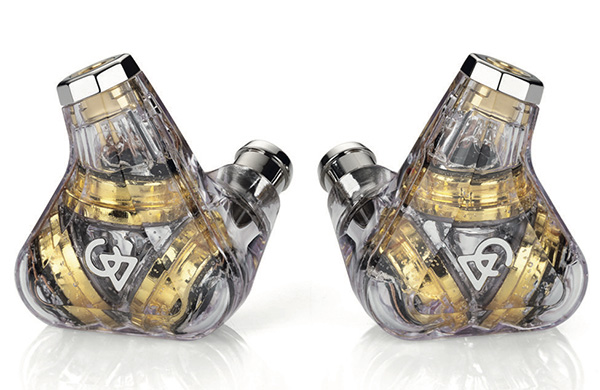
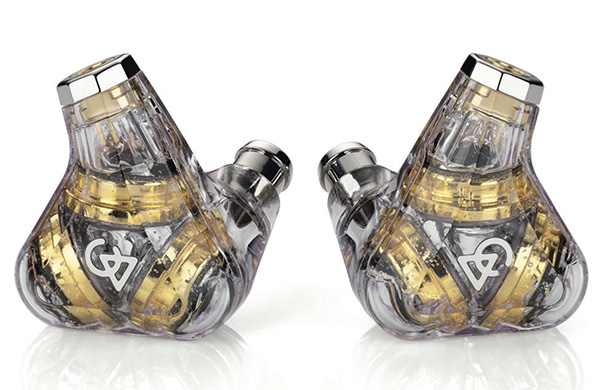
The Trifecta Amber Radiance ($3299) is probably the model that's most emblematic of Ball's "no safe tunings" philosophy. It is built around Campfire's 10mm dynamic driver, which is stiffened with an "Amorphous Diamond-Like Carbon" diaphragm. While previous models relied on one of these drivers to cover the entire audible range, Ball has somehow crammed three of them into each Trifecta shell, so that the earphone moves almost as much air as an over-ear headphone. The transparent nylon housings allow you to marvel at the innards, which look as intricate as the movement of a mechanical watch. Somehow the bulbous, slightly gaudy shells fit easily and securely in the ear. Right off, I was amazed at just how far beyond the confines of my head the Trifecta was able to project the sound: It has easily the largest soundstage I've heard from any device that sits in one's ears. On the final mix of "Time Has Told Me," from Nick Drake's The Making of Five Leaves Left, a box set released earlier this summer, I experienced Drake's voice as floating somewhere above my forehead, while the guitar and piano played well to the right and left of each ear. Aside from being a neat illusion, this vast three-dimensional space allowed me to hear deeper into the recording and make better sense of the music. Then there's the dense physicality of the sound, a quality no doubt attributable to the dynamic drivers, which move more air than their balanced armature or planar magnetic counterparts. The Trifecta plays with more meat on the bone than any earphones I've heard, and with greater dynamics, compounding the sense of presence created by the vast staging. Its gorgeous, colorful midrange, which gives guitars and voices so much vividness, definitely contributes, too. Most importantly, the Trifecta proved matchless at generating engagement and emotion. Its unrestrained, juicy sound is difficult to approach analytically; after a few minutes I usually forgot what I was supposed to be focusing on or comparing and got lost in listening.
The Campfire Audio website describes the Trifecta's sonic profile as "bombastic." The reason, once again, is likely to be the way this earphone reproduces bass. If the Clara's bass response can be called "unapologetic," I'd describe the Trifecta's as "savage." You would be right in assuming that it won't please every listener. It never bleeds into that lovely midrange, but neither does it ever take "no" for an answer. It can set tracks with a standout bass groove on fire: Just listen to the way it enlivens Robbie Shakespeare's electric bass on "Native Woman" from Gregory Isaacs's classic Cool Ruler. But on the Nick Drake track, which is all about the drama of the singer's voice and the lyrics, the Trifecta's way with bass sometimes detracted from the recording's meaning. And very, very occasionally, a certain note excited a distracting low bass rumble.
Would I have preferred a flatter bass response? I'm not sure. The admittedly expensive Trifecta does so many worthwhile, beautiful things I haven't heard from an earphone, and nothing about it is sensible or aimed at reaching a consensus. It is clearly not intended for studio use, and personally I'm grateful to Ball and his team for giving us such a distinctive, weird, and lovely way to listen. That it may not be for you is entirely okay, and rather beside the point. You may as well criticize Mondrian for painting too many right angles.
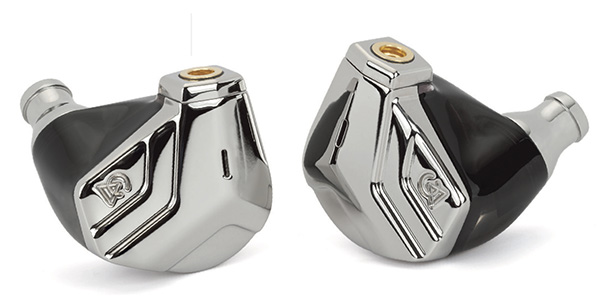
The third Campfire earphone, the Astrolith, brings planar magnetic drivers into the picture, using two per side. The first thing I noticed about the Astrolith was its beguiling liquidity, clarity, and speed, which reminded me of a great planar headphone like the Meze Elite. Listening to "Ghost Ship in A Storm" from Eureka, Jim O'Rourke's 1999 masterpiece that somehow manages to blend folk, prog, and bossa nova with Bacharach-like arrangements, I was also aware of what sounded like vanishingly low distortion. The resulting transparency and lack of smear allowed me to feel like I was walking through O'Rourke's complex soundscapes and taking in the scenery in a wondrous, unhurried manner, like a visitor to a garden. And the Astrolith managed to move the various sounds slightly beyond the confines of my cranium, though it lacks the planetarium-like aplomb of the Trifecta.
The Astrolith's tuning struck me as the most conventional of the three earphones, though it never came across as obvious or boring. Its bass response is bound to please many more listeners, sounding powerful and rich though never bumptious or disruptive, and it has a pleasing top-to-bottom coherence. What didn't I love about the Astrolith? Its Achilles' heel may be the way it reproduces textures. Compared to the hybrid Clara and especially to the dynamic Trifecta, it sometimes made instrumental and vocal textures sound slightly undifferentiated, disembodied, and electronic. This, again, tracks with my experiences of listening with planar magnetic headphones. No transducer can excel at everything.
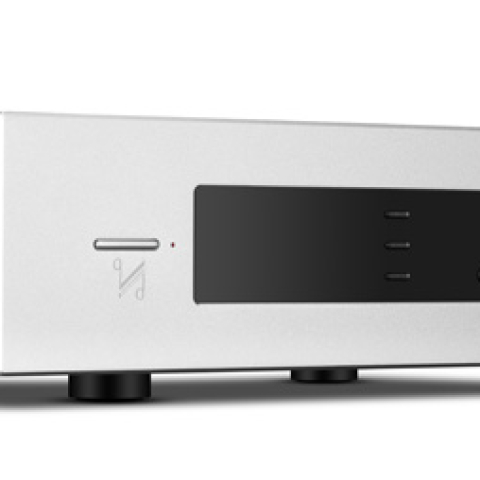
 Campfire Audio Relay DAC/amp
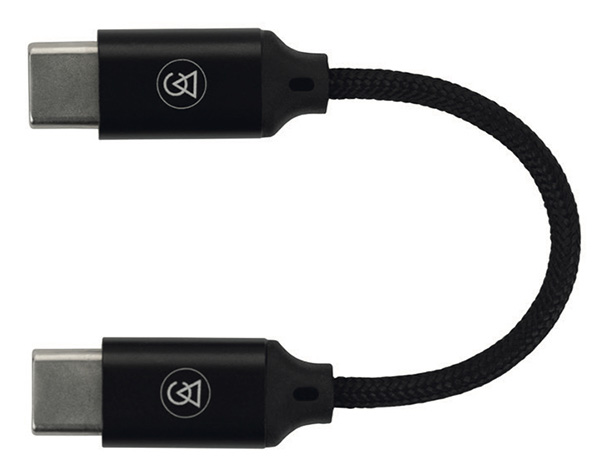
In the context of a system, headphones essentially behave like small speakers, as their sound depends an awful lot on the source and, especially, the amp. Some cans, like the Sennheiser HD 650, are thoroughly transformed when driven with a good speaker amp. Yet for reasons that aren't entirely clear to me, earphones seem considerably less picky. Back when iPhones had analog headphone jacks, I sometimes plugged an earphone directly into my phone; compared to listening through a portable DAC like the AudioQuest DragonFly Red, I often didn't notice a vast difference. So I wanted to get a clearer sense of just how much ancillary gear can affect the sound of an earphone. When I first opened the box containing the Campfire Clara, I discovered a minimalist dongle; it looked like a 3" cable with a 3.5mm input jack on one end and a USB-C plug on the other (above). This turned out to be the $99 Pilot DAC from ALO Audio, Ball's Portland neighbor. When I tried listening to the Clara using the Pilot with either the Apple MacBook Air or iPhone 15, I found that there was so much gain that I had little usable volume range. I related this to Ball, who told me that he was working on his own dongle DAC, and that it was nearly ready.
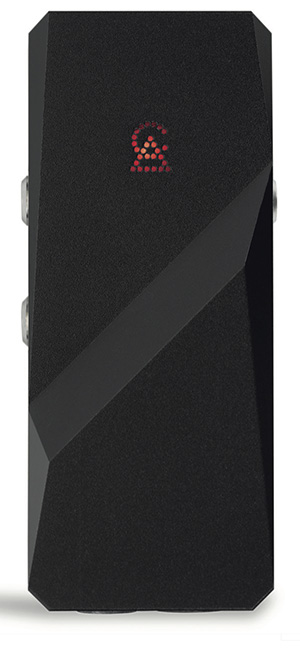 A few months later I received the Relay ($225; right). About the size of the DragonFly, Campfire's dongle is crammed with features: six digital filters, two gain levels, DSD capability, playback controls, and, in addition to the USB-C input and standard 3.5mm output, a balanced 4.4mm option. (Running the Campfire earphones with their included 4.4mm cables resulted in a bigger, more impactful sound.) The Relay also offers 60 usable volume settings and no more gain than I need. Thank you, Ken!
According to Ball, the Relay's AKM SEQ 4493 DAC provides the most analog tonality among the integrated-chip contenders. After about 20 hours of listening, I can report that the dongle sounds thoroughly enjoyable and is a dream to use. Compared to FiiO's similarly sized KA15 dongle ($99), the Relay sounds richer, smoother, and more powerful and plays with less fatigue over long stretches. Then again, the FiiO's display makes it look like a tiny cassette player, something I love maybe too much. Yet the Relay left me wondering whether I had reached the apex of earphone performance, or whether even more was possible. Can you guess the answer?
FiiO M15S digital audio player
A few months later I received the Relay ($225; right). About the size of the DragonFly, Campfire's dongle is crammed with features: six digital filters, two gain levels, DSD capability, playback controls, and, in addition to the USB-C input and standard 3.5mm output, a balanced 4.4mm option. (Running the Campfire earphones with their included 4.4mm cables resulted in a bigger, more impactful sound.) The Relay also offers 60 usable volume settings and no more gain than I need. Thank you, Ken!
According to Ball, the Relay's AKM SEQ 4493 DAC provides the most analog tonality among the integrated-chip contenders. After about 20 hours of listening, I can report that the dongle sounds thoroughly enjoyable and is a dream to use. Compared to FiiO's similarly sized KA15 dongle ($99), the Relay sounds richer, smoother, and more powerful and plays with less fatigue over long stretches. Then again, the FiiO's display makes it look like a tiny cassette player, something I love maybe too much. Yet the Relay left me wondering whether I had reached the apex of earphone performance, or whether even more was possible. Can you guess the answer?
FiiO M15S digital audio player
I wasn't about to plug the Campfire earphones into a stationary headphone amp; for me that defeats the point of putting things in your ears. That's where FiiO's M15S (currently $1352.39 post-tariff; footnote 2) came in. It's a chunky thing about the size of two iPhone 15s laid on top of one another; with its leather case, it weighs a non-trivial 13.92oz. It's probably not something you'd stick in a jeans pocket, but neither is it difficult to carry with you.
Listing all of the M15S's features would consume much of this column, but I will mention the full-size ESS 9038PRO DAC and power of up to 1.2W. What enamored me to this device are two less obvious features. One is the ability to convert all files to DSD before they reach the DAC, which I enjoyed and left on, though it drains the battery faster. The other feature, Second-Order Regulation, adds a bump of even-order harmonics to the output. The tube heads reading this won't be surprised that I left this on, too.
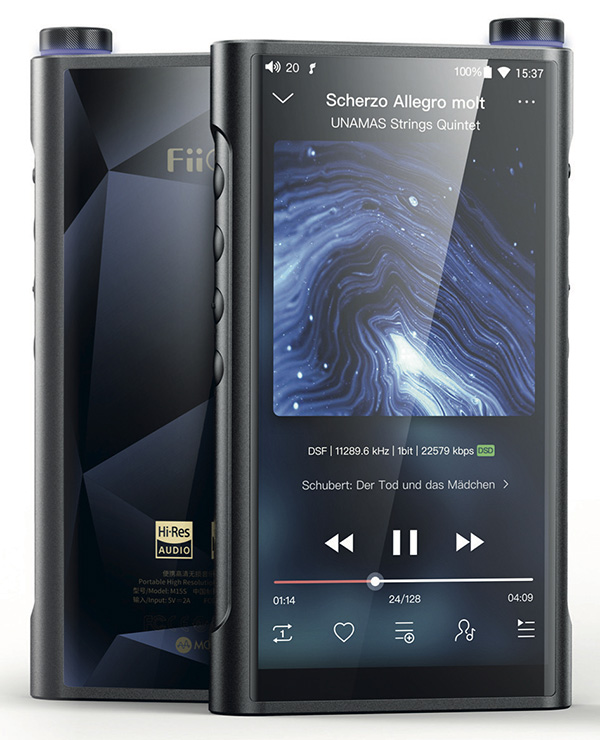 Listening to the Campfire earphones through the FiiO player proved simply glorious. Compared to the excellent Relay, the M15S offers more of everything—power, detail, drive, color, texture, and yes, engagement—and the differences aren't difficult to hear. Of course, it also adds an extra device to your life, costs nearly five times more, and I would hate to see what happens if you drop it. But as with everything in this hobby, your only mission is to make yourself happy, hopefully without driving your neighbors to violence. I wish you luck.
Footnote 1: Campfire Audio, 2400 SE Ankeny Street, Portland, Oregon, 97214. Tel: (971) 279-4357. Email: support@ campfireaudio.com. Web: campfireaudio.com.
Footnote 2: FiiO, No.21 Longliang Road, Xialiang village, Longgui Street, Baiyun District, Guangzhou city, China,510540. Email: support@fiio.com. Web: fiio.com.
The Campfire Clara's bass is "tenacious as a pit bull."
The Campfire ClaraThe first to arrive was the Clara ($1999), which was designed in collaboration with Alessandro Cortini, known best for being a member of Nine Inch Nails and the first Italian inducted into the Rock and Roll Hall of Fame. If you hold the acrylic-bodied ear phones up to the light, you can see the drivers, a combination of Knowles balanced armature drivers in the mids and highs and dynamic biocellulose drivers in the lows. It didn't take long to suss out the Clara's "flavor." While listening to a Qobuz stream of Merle Haggard's "Hungry Eyes," the earphones allowed me to hear that, like most of the singer's early sides on Capitol, the mix was slightly overcooked in the treble. Thing is, the Claras let me know this without actually reproducing the annoying peak. Cortini has said that he wanted to deemphasize the treble while maintaining a high level of detail. Like some moving coil cartridges, too many earphones and headphones have a treble response that sounds more like someone's idea of "high definition" and less like real music. The Clara's treble balance strikes me as just about right.
The Campfire Audio Trifecta
The Campfire TrifectaThe Trifecta Amber Radiance ($3299) is probably the model that's most emblematic of Ball's "no safe tunings" philosophy. It is built around Campfire's 10mm dynamic driver, which is stiffened with an "Amorphous Diamond-Like Carbon" diaphragm. While previous models relied on one of these drivers to cover the entire audible range, Ball has somehow crammed three of them into each Trifecta shell, so that the earphone moves almost as much air as an over-ear headphone. The transparent nylon housings allow you to marvel at the innards, which look as intricate as the movement of a mechanical watch. Somehow the bulbous, slightly gaudy shells fit easily and securely in the ear. Right off, I was amazed at just how far beyond the confines of my head the Trifecta was able to project the sound: It has easily the largest soundstage I've heard from any device that sits in one's ears. On the final mix of "Time Has Told Me," from Nick Drake's The Making of Five Leaves Left, a box set released earlier this summer, I experienced Drake's voice as floating somewhere above my forehead, while the guitar and piano played well to the right and left of each ear. Aside from being a neat illusion, this vast three-dimensional space allowed me to hear deeper into the recording and make better sense of the music. Then there's the dense physicality of the sound, a quality no doubt attributable to the dynamic drivers, which move more air than their balanced armature or planar magnetic counterparts. The Trifecta plays with more meat on the bone than any earphones I've heard, and with greater dynamics, compounding the sense of presence created by the vast staging. Its gorgeous, colorful midrange, which gives guitars and voices so much vividness, definitely contributes, too. Most importantly, the Trifecta proved matchless at generating engagement and emotion. Its unrestrained, juicy sound is difficult to approach analytically; after a few minutes I usually forgot what I was supposed to be focusing on or comparing and got lost in listening.
The Campfire Astrolith sounds liquid, clear, and fast.
The Campfire AstrolithThe third Campfire earphone, the Astrolith, brings planar magnetic drivers into the picture, using two per side. The first thing I noticed about the Astrolith was its beguiling liquidity, clarity, and speed, which reminded me of a great planar headphone like the Meze Elite. Listening to "Ghost Ship in A Storm" from Eureka, Jim O'Rourke's 1999 masterpiece that somehow manages to blend folk, prog, and bossa nova with Bacharach-like arrangements, I was also aware of what sounded like vanishingly low distortion. The resulting transparency and lack of smear allowed me to feel like I was walking through O'Rourke's complex soundscapes and taking in the scenery in a wondrous, unhurried manner, like a visitor to a garden. And the Astrolith managed to move the various sounds slightly beyond the confines of my cranium, though it lacks the planetarium-like aplomb of the Trifecta.
Campfire Audio Relay DAC/ampIn the context of a system, headphones essentially behave like small speakers, as their sound depends an awful lot on the source and, especially, the amp. Some cans, like the Sennheiser HD 650, are thoroughly transformed when driven with a good speaker amp. Yet for reasons that aren't entirely clear to me, earphones seem considerably less picky. Back when iPhones had analog headphone jacks, I sometimes plugged an earphone directly into my phone; compared to listening through a portable DAC like the AudioQuest DragonFly Red, I often didn't notice a vast difference. So I wanted to get a clearer sense of just how much ancillary gear can affect the sound of an earphone. When I first opened the box containing the Campfire Clara, I discovered a minimalist dongle; it looked like a 3" cable with a 3.5mm input jack on one end and a USB-C plug on the other (above). This turned out to be the $99 Pilot DAC from ALO Audio, Ball's Portland neighbor. When I tried listening to the Clara using the Pilot with either the Apple MacBook Air or iPhone 15, I found that there was so much gain that I had little usable volume range. I related this to Ball, who told me that he was working on his own dongle DAC, and that it was nearly ready.
A few months later I received the Relay ($225; right). About the size of the DragonFly, Campfire's dongle is crammed with features: six digital filters, two gain levels, DSD capability, playback controls, and, in addition to the USB-C input and standard 3.5mm output, a balanced 4.4mm option. (Running the Campfire earphones with their included 4.4mm cables resulted in a bigger, more impactful sound.) The Relay also offers 60 usable volume settings and no more gain than I need. Thank you, Ken!
According to Ball, the Relay's AKM SEQ 4493 DAC provides the most analog tonality among the integrated-chip contenders. After about 20 hours of listening, I can report that the dongle sounds thoroughly enjoyable and is a dream to use. Compared to FiiO's similarly sized KA15 dongle ($99), the Relay sounds richer, smoother, and more powerful and plays with less fatigue over long stretches. Then again, the FiiO's display makes it look like a tiny cassette player, something I love maybe too much. Yet the Relay left me wondering whether I had reached the apex of earphone performance, or whether even more was possible. Can you guess the answer?
FiiO M15S digital audio playerI wasn't about to plug the Campfire earphones into a stationary headphone amp; for me that defeats the point of putting things in your ears. That's where FiiO's M15S (currently $1352.39 post-tariff; footnote 2) came in. It's a chunky thing about the size of two iPhone 15s laid on top of one another; with its leather case, it weighs a non-trivial 13.92oz. It's probably not something you'd stick in a jeans pocket, but neither is it difficult to carry with you.
Listening to the Campfire earphones through the FiiO player proved simply glorious. Compared to the excellent Relay, the M15S offers more of everything—power, detail, drive, color, texture, and yes, engagement—and the differences aren't difficult to hear. Of course, it also adds an extra device to your life, costs nearly five times more, and I would hate to see what happens if you drop it. But as with everything in this hobby, your only mission is to make yourself happy, hopefully without driving your neighbors to violence. I wish you luck.
Footnote 1: Campfire Audio, 2400 SE Ankeny Street, Portland, Oregon, 97214. Tel: (971) 279-4357. Email: support@ campfireaudio.com. Web: campfireaudio.com.