Those of us who review audio equipment, and even audiophiles who don't, often talk about our reference systems. The term implies a certain level of consistency. If you are changing components every week, your system probably lacks the stability to be a true reference. In the case of reviewers, this presents an irony: Those most in need of a reference system are called on to change out components more frequently than other folks. Our reference systems are intrinsically unstable.
How do we deal with this? By maintaining as much stability as we can. When forced to change (as we are often), we change just one component at a time; that way we know exactly what's responsible for any changes we hear (footnote 1).
The longest-running component in my system is the Bricasti M1 D/A converter—which, however, has been through several upgrades to reach its current Series II status.
Bricasti Design started in 2004 as a pro-audio company, in Shirley, Massachusetts. Co-founders Brian Zolner and Casey Dowdell—the company name comes from joining the first letters of "Brian" and "Casey"—brought professional audio chops to the new endeavor. Both men came from Lexicon, which was known for pro audio, especially reverbs. At Lexicon, Zolner was the longtime vice president of international sales, and Dowdell was a DSP engineer.
Bricasti's first product was a reverb processor, the M7, released in 2007. Bricasti then made a play for the consumer market by releasing the M1 DAC. Today, Bricasti offers 22 consumer products, in two lines (footnote 2), and they continue to design and sell professional audio products, including the industry-standard M7 Stereo Reverb Processor. Dowdell designs and writes Bricasti's signal-processing software in-house. Zolner is Bricasti's chief designer and CEO.
Bricasti Design's team engages in what they call "Continuous Innovation." When they come up with something new, they offer it as an upgrade. My M1 Stereo D/A converter was first upgraded to SE MDX status, and later to Series II. I've stayed current without having to sell anything.
The Bricasti M1 has a long history in Stereophile. John Marks considered it first, in his August 2011 Fifth Element column. John Atkinson followed on with a full review the following March, then Marks wrote a series of follow-ups, culminating in December 2014, when he concluded, "Plain old 'Red Book' 16-bit/44.1kHz audio is so compelling that I, for one, don't feel shortchanged." I agreed, and I purchased an M1 for myself. I reviewed the Bricasti M1SE MDX in July 2021.
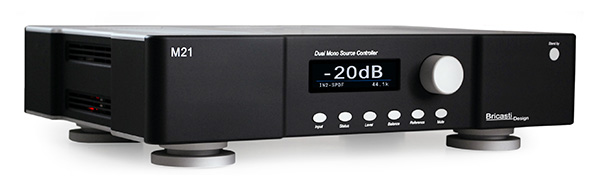
A successor to the M1, the Bricasti Design M21 Dual Mono D/A processor ($16,500), is the new element I'm introducing into my reference system for this review, in place of my much-upgraded M1. The two DACs share much DNA, but the M21 adds a cool new feature that the M1 lacks.
 Bento box
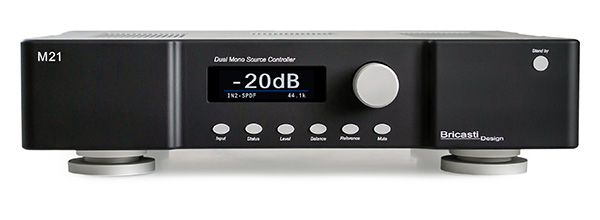
In terms of size and weight, the M21 is identical to my M1 Series II: Both are 17" × 12" × 4.5" and weigh a modest 15lb. The included remote control is thick and heavy, with a good feel. The front panel layout, too, is very similar to that of the M1. The handsomely beveled shape frames a smallish readout—there's no album cover display—and a rotary control knob. Below this are six buttons, the functions of which are duplicated by the remote control: Input, Status, Level, Balance, Reference, and Mute. Upper right, there is one more toggle button, for turning the unit on—or, more precisely, for switching it from Standby to Operate. When pressed, the Level button and rotary control knob activate an analog volume control, in single-dB increments. When the volume is set to its maximum—0dB—the output stage enters bypass mode; the volume control is out of the circuit. With the volume control engaged, the M21 can drive amplifiers directly from either its balanced or unbalanced outputs. Alternatively, it can operate in fixed-volume mode, sending its output to a preamplifier, which is how I used it for most of my auditions.
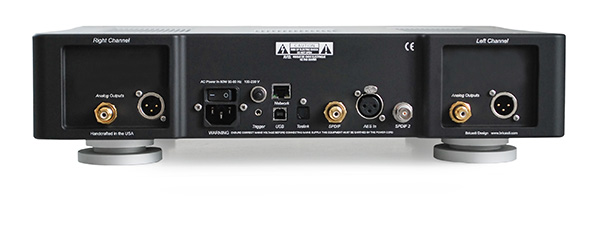
The M21's rear panel is framed by the L and R analog outputs, one pair unbalanced, one pair balanced. The center of the panel contains six digital inputs: AES3, two S/PDIF (one RCA, one BNC), one TosLink, a USB type 2 (asynchronous), and an RJ45 Ethernet jack. Beyond that, it's the usual stuff: IEC connector, on/off switch, a 5V trigger. Vibration isolation is provided by four self-leveling Stillpoints footers. The top and side panels are vented for heat dissipation.
If you open the M21 DAC, you see hardware that's meticulously arranged. It's a bit like looking into a precisely organized jewelry box; the mirrored left/right arrangement reflects the M21's dual-mono design. This is a key aspect of the M21: The left and right channels are as independent as they can be without occupying separate chassis. In the (digital) input stage, each channel has its own linear power supply. The same is true in the (analog) output stage.
Parts quality is notable. Those linear power supplies are built by hand, with capacitors from Nichicon and Illinois Capacitor and power transformers from Powertronix. The printed circuit boards are layered as carefully as fine French pastry. Analog and digital sections are well-separated to keep noise from the digital section away from the analog signal.
Bricasti has gone to great pains to minimize jitter. In a conversation, Zolner described Bricasti's approach. "A clocking method was designed for the M1, and we still use the same [direct digital synthesis] clock method in the M21. We do not sample rate convert as is done by many as a way to reduce jitter. In the M21, we create a new clock and discard the original clock, buffer it, and resync to our DDS-generated clock, reducing jitter without rate conversion."
 Paths to enlightenment
The M21's most interesting feature is that in terms of the underlying conversion technology, it's three DACs in one. "The M21 features 3 digital audio conversion paths," the company says, "2 for PCM, which utilize sigma delta or ladder DAC types, and for DSD, a true one-bit modulator of our own design and unique to the industry." The specifications sum it up: "PCM 24-bit sigma delta 8× oversampling, 384kHz ladder, DSD direct 1-bit." Of the three signal paths, the longest-running is probably the least familiar: the R2R (resistor-to-resistor) "ladder" DAC. The ladder imagery is appropriate, as designers refer to resistors paired in a series of "rungs" on a "resistor ladder." Inherent to this conversion approach is a geometric doubling of the resistor values; the quality and precision of the resistors is crucial to the sonic results.
The M21's alternative for PCM data is sigma-delta. Describing how a sigma-delta DAC works is beyond the scope of this review, except to say that it's a more complicated business requiring much upsampling and filtering, and that it uses Analog Devices AD1955 sigma-delta converter chips, one chip per channel. Whichever conversion method is chosen, the M21 offers a choice of linear and minimum-phase reconstruction filters, both written by Dowdell. (There's a second filter as well, in the analog realm, at around 80kHz.) The ladder DAC, too, uses a chip from Analog Devices.
That's fewer filter options than the M1. Why? "To make the M21 simple," Zolner replied. "There were too many in the M1. The ones in the M21 are chosen as the best of the M1."
I asked what sonic benefit there might be to utilizing the R2R approach—or, for that matter, the sigma-delta approach. Zolner commented, "The difference is subjective to the listener. Some find the presentation of the ladder to be more agreeable, others prefer the M21's Sigma-Delta DAC. The Sigma DAC is technically better in its ability to reconstruct low-level data. It can resolve all 16 bits from the CD down to the noisefloor of the analog circuits. To do this, the Sigma DAC has processing to in effect upsample to a five-bit DSD-rate modulator. The ladder does not do this, so people find the ladder to offer a more natural or relaxed sound."
What about DSD? When fed DSD data, the M21 deals with it in the purest possible way. "The M21 has a true one-bit modulator, all done in analog, so there is no digital signal processing applied," Zolner said. "DSD is one-bit, so it's on or off, 0 or 1. To make a converter, you have to make a fast way to switch on and off. To do this, we implemented a very high-speed, 10GHz analog switch, followed by an analog filter to create the analog waveform. Here there is no up- or down-sampling to PCM or multibit to create the analog signal—thus, a true DSD converter."
Here, too, Bricasti offers a choice. The "NDSD" option—that's short for "native DSD"—"is for using our pure 1-bit analog conversion," Zolner told me. The second option? "Those who prefer it can instead choose to convert DSD to PCM and use the sigma-delta and NDSD PCM is for using the AD1955 sigma-delta converter path."
As a reviewer of both music and audio hardware, I like very much having all these processing paths available.
 Keeping it real
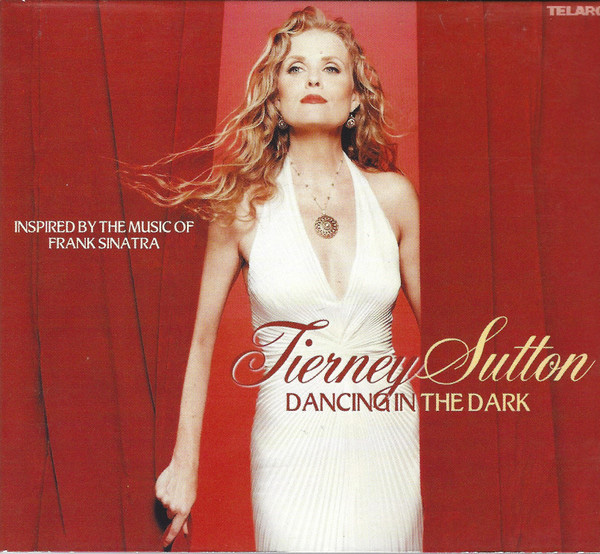
Tierney Sutton has been a vocal fave of mine for quite a while. It helped that she made high-quality recordings for Telarc Records during that label's peak years; you get great musicianship from Tierney and her band and Telarc's best-of-class production standards, all for the price of a single CD. Sutton released Dancing in the Dark, a tribute to Frank Sinatra, in 2004 (CD, Telarc/Concord CD-82592). I connected my Pro-Ject CD transport to the M21 using the AES3 input and an AudioQuest Diamond AES3 cable. I chose the R2R PCM conversion method and applied the minimum-phase filter, "Minimum1." "Without a Song" is a beautiful one, by Vincent Youmans. Sinatra covered it, hence its inclusion here. Via the M21 and R2R, Tierney sounded gorgeous. She possesses unerringly fine pitch, up there with Ella Fitzgerald.
There's no end to the subtleties in the reproduction of female vocals. I heard a tactile breathiness, which however never veered into sibilance. The background bed of the strings added an element of lushness. Mirroring John Marks's experience with the M1, I heard no sonic nor musical compromise relative to higher-rez sources: The M21 will make your best-sounding CDs and CD-rez streams sound as good as you could wish.
 Upping the resolution and setting physical media aside, I turned to Qobuz, connecting my laptop to the M21 by USB using the AudioQuest Coffee cable. Still utilizing the R2R conversion path, I cued up Stravinsky's Song of the Nightingale. This 1964 recording is part of a new, massive two-box release titled Antal Doráti in London - The Mercury Masters (Doráti, London Symphony Orchestra. Mercury Living Presence/Eloquence 484 7106. 2025), recently remastered by my Stereophile colleague Tom Fine. The original recording was produced by Harold Lawrence and made by Robert Eberenz. Tom filled me in. "This is my new, 3-to-2 channel mix of the original master tape (edited ½", 3-track)." The transfer was at 24/192, by Jared Hawkes of Abbey Road Studios. "I remixed and remastered and used modern digital tools to remove problems of the old tapes, like splice thumps." The M21 front panel confirmed the 24/192 resolution.
I heard a Technicolor smorgasbord of textures and timbres. Highly eclectic in their variety, Igor's complex orchestrational elements came across fully focused, precisely deployed on a soundstage that was wide and deep. When the vibraphone and glockenspiel start playing repeated motivic cells that expand and contract, creating meter changes and syncopations, we are in the same revolutionary territory as The Rite of Spring. The dynamic range was spectacular—a full spectrum of musical flavors, from the most delicate of sounds to huge outbursts. Lovely sound, literally entertaining, realized at a high technical level of reproduction.
I am a late adopter. When SACDs were first offered in 1999, I purchased a few, but all I had to play them on was an inexpensive Sony video deck we had bought for watching movies on DVD. Huge files, flaky, slow downloads—what's to like? Now, with radically more efficient home computers and faster internet speeds, things have changed. With the Bricasti M21 in the house, it was past time for me to get serious about listening to DSD recordings.
Audio writers I respect have pressed me to check out downloads offered by NativeDSD, the company founded in 2013 by Jared Sacks—also the founder of label Channel Classics—and his son Jonas. I have been very impressed by what I have learned, and by what I have now heard. The company states, "NativeDSD is closely policing the origins of recordings." This is a pet peeve. The RIAA and other music industry organizations should have long ago created labeling standards that put in place "truth in mastering" rules. "Remastered" on the label doesn't tell you anything. Remastered from what source? How many generations from the original? With what processing? At what resolution?
Upping the resolution and setting physical media aside, I turned to Qobuz, connecting my laptop to the M21 by USB using the AudioQuest Coffee cable. Still utilizing the R2R conversion path, I cued up Stravinsky's Song of the Nightingale. This 1964 recording is part of a new, massive two-box release titled Antal Doráti in London - The Mercury Masters (Doráti, London Symphony Orchestra. Mercury Living Presence/Eloquence 484 7106. 2025), recently remastered by my Stereophile colleague Tom Fine. The original recording was produced by Harold Lawrence and made by Robert Eberenz. Tom filled me in. "This is my new, 3-to-2 channel mix of the original master tape (edited ½", 3-track)." The transfer was at 24/192, by Jared Hawkes of Abbey Road Studios. "I remixed and remastered and used modern digital tools to remove problems of the old tapes, like splice thumps." The M21 front panel confirmed the 24/192 resolution.
I heard a Technicolor smorgasbord of textures and timbres. Highly eclectic in their variety, Igor's complex orchestrational elements came across fully focused, precisely deployed on a soundstage that was wide and deep. When the vibraphone and glockenspiel start playing repeated motivic cells that expand and contract, creating meter changes and syncopations, we are in the same revolutionary territory as The Rite of Spring. The dynamic range was spectacular—a full spectrum of musical flavors, from the most delicate of sounds to huge outbursts. Lovely sound, literally entertaining, realized at a high technical level of reproduction.
I am a late adopter. When SACDs were first offered in 1999, I purchased a few, but all I had to play them on was an inexpensive Sony video deck we had bought for watching movies on DVD. Huge files, flaky, slow downloads—what's to like? Now, with radically more efficient home computers and faster internet speeds, things have changed. With the Bricasti M21 in the house, it was past time for me to get serious about listening to DSD recordings.
Audio writers I respect have pressed me to check out downloads offered by NativeDSD, the company founded in 2013 by Jared Sacks—also the founder of label Channel Classics—and his son Jonas. I have been very impressed by what I have learned, and by what I have now heard. The company states, "NativeDSD is closely policing the origins of recordings." This is a pet peeve. The RIAA and other music industry organizations should have long ago created labeling standards that put in place "truth in mastering" rules. "Remastered" on the label doesn't tell you anything. Remastered from what source? How many generations from the original? With what processing? At what resolution?
 Playing back from Roon, I began with saxophonist Ben Webster's album Gentle Ben, recorded in 1972 in Barcelona, less than a year before Gentle Ben's passing. This is an example of a fine direct-to-stereo analog tape remastered and transferred direct to DSD. From among various format options, I chose to download the DSD128 version. Using the Status menu, I put the M21 into the NDSD DSD mode, for pure, 1-bit analog conversion, with filtering in the analog domain.
Superb! Ben Webster was standing before me blowin' soft and mellow on cuts like "Sweet Georgia Brown" and "Don't Blame Me." This sounded so sexy and silky, if Marilyn Monroe had walked into the room I would have said "Take a number." Someone in that Barcelona studio really knew their stuff; the Tete Montoliu Trio is perfectly balanced behind Ben's breathy, relaxed tenor, with great tone and detail all around, from piano, drums, and bass, grooves and swing pushing the beat forward. A joy to listen to via the Bricasti M21.
Turning to a big aural canvas again—the biggest—it was time for some Mahler. Channel Classics has recorded in DSD a complete Mahler symphony cycle, with conductor Iván Fischer leading his Budapest Festival Orchestra. In 2020, Das Lied von der Erde (Channel Classics CCS SA40020. 2020. DSD256) was added. These recordings are now offered as downloads by NativeDSD. The NativeDSD webpage for the Mahler stated: "Original Recording Format: DSD 256." They also tagged it as "Edit Master Sourced," which is explained on a separate page: "The Edit Master of an album is the final version of the recording before it is converted into various formats for release. ... The Edit Master includes a recording's final mix and tweaks." I downloaded the "native" DSD256 version.
Now I was listening to the same resolution with which this music was recorded. This is as close as a listener is going to get to the music without a certificate of authenticity and a congressional hearing. Playback via the NDSD DSD conversion path was flawless. With contralto Gerhild Romberger featured in the lengthy final movement, "Der Abschied," it was time to head to the dark side of the Force. Mahler practically invented those deep, low notes from the concert harp that start things off and the lengthy non-resolution at the end, as the melody finds itself incapable of finding the tonic root. This is one of the most heartbreaking and memorable passages in all Western music. The full rainbow of Mahler's musical paintbox left an imprint on my inner ear that persisted long after the final notes faded away.
Playing back from Roon, I began with saxophonist Ben Webster's album Gentle Ben, recorded in 1972 in Barcelona, less than a year before Gentle Ben's passing. This is an example of a fine direct-to-stereo analog tape remastered and transferred direct to DSD. From among various format options, I chose to download the DSD128 version. Using the Status menu, I put the M21 into the NDSD DSD mode, for pure, 1-bit analog conversion, with filtering in the analog domain.
Superb! Ben Webster was standing before me blowin' soft and mellow on cuts like "Sweet Georgia Brown" and "Don't Blame Me." This sounded so sexy and silky, if Marilyn Monroe had walked into the room I would have said "Take a number." Someone in that Barcelona studio really knew their stuff; the Tete Montoliu Trio is perfectly balanced behind Ben's breathy, relaxed tenor, with great tone and detail all around, from piano, drums, and bass, grooves and swing pushing the beat forward. A joy to listen to via the Bricasti M21.
Turning to a big aural canvas again—the biggest—it was time for some Mahler. Channel Classics has recorded in DSD a complete Mahler symphony cycle, with conductor Iván Fischer leading his Budapest Festival Orchestra. In 2020, Das Lied von der Erde (Channel Classics CCS SA40020. 2020. DSD256) was added. These recordings are now offered as downloads by NativeDSD. The NativeDSD webpage for the Mahler stated: "Original Recording Format: DSD 256." They also tagged it as "Edit Master Sourced," which is explained on a separate page: "The Edit Master of an album is the final version of the recording before it is converted into various formats for release. ... The Edit Master includes a recording's final mix and tweaks." I downloaded the "native" DSD256 version.
Now I was listening to the same resolution with which this music was recorded. This is as close as a listener is going to get to the music without a certificate of authenticity and a congressional hearing. Playback via the NDSD DSD conversion path was flawless. With contralto Gerhild Romberger featured in the lengthy final movement, "Der Abschied," it was time to head to the dark side of the Force. Mahler practically invented those deep, low notes from the concert harp that start things off and the lengthy non-resolution at the end, as the melody finds itself incapable of finding the tonic root. This is one of the most heartbreaking and memorable passages in all Western music. The full rainbow of Mahler's musical paintbox left an imprint on my inner ear that persisted long after the final notes faded away.
 Conductors have told me how fussy Mahler's score directions are. They feel like he is looking over their shoulder, telling them what to do as they conduct. I think even Gustav would have been satisfied with this reperformance, from Iván Fischer, the Budapest orchestra, producer-engineer Jared Sacks, the Bricasti M21, and the rest of my reference system.
I did most of my PCM listening via R2R, but I did try Sigma-Delta mode, with DXD. I downloaded Patricia Barber: Standards (24/352.8 download, Impex Records 07005), with the Sigma-Delta signal path and the Minimum1 filter. The M21 brought that low range of Barber's voice fully to life. Tactile bass, crisp, detailed drums. Easily the best playback of Patricia Barber recordings I've heard in my reference system.
So which did I prefer? I'll take either, or both. There is, as Zolner suggested, a certain ease about R2R that I found addictive, but this is strictly a matter of taste.
The event horizon
Conductors have told me how fussy Mahler's score directions are. They feel like he is looking over their shoulder, telling them what to do as they conduct. I think even Gustav would have been satisfied with this reperformance, from Iván Fischer, the Budapest orchestra, producer-engineer Jared Sacks, the Bricasti M21, and the rest of my reference system.
I did most of my PCM listening via R2R, but I did try Sigma-Delta mode, with DXD. I downloaded Patricia Barber: Standards (24/352.8 download, Impex Records 07005), with the Sigma-Delta signal path and the Minimum1 filter. The M21 brought that low range of Barber's voice fully to life. Tactile bass, crisp, detailed drums. Easily the best playback of Patricia Barber recordings I've heard in my reference system.
So which did I prefer? I'll take either, or both. There is, as Zolner suggested, a certain ease about R2R that I found addictive, but this is strictly a matter of taste.
The event horizon
With the M21, Bricasti Design brings the same high technical standards required in the professional audio world to a product intended for consumer use. Bricasti brings technology that's complex and cutting edge, but the Bricasti Design team has kept its eyes and ears on the musical prize: how music sounds. There is a palpability to the M21's sonics that is hard to describe but very pleasant to experience. You'll know it when you hear it. I am, among other things, a hi-fi critic. Am I supposed to find some shortcoming in order to show how objective I am? I heard much to like and nothing to dislike. One could I suppose object to the price, but while the M21 is expensive, when you consider its outstanding sonics and superior build quality, it is priced fairly or better compared to the rest of the market. Here's one more way of looking at it. I'm a longtime analog audio fan, a lover of vinyl and R2R tape (the other kind of R2R). For digital, achieving parity with those older formats has always been an elusive goal. Not anymore.
Footnote 1: Stereophile has a policy of reviewing one component at a time, for precisely this reason: If you change out more than one thing, you cannot know what's responsible for the changes you hear. Footnote 2: The M21 is available in both the Classic Series and the Platinum Series. Products in the two series share the same electronics. The Classic series has heavy casings of machined, anodized aluminum, finished in matte hi-fi black. The "Platinum" series exteriors are trimmed with just that—platinum—for an up-charge.
Bento boxIn terms of size and weight, the M21 is identical to my M1 Series II: Both are 17" × 12" × 4.5" and weigh a modest 15lb. The included remote control is thick and heavy, with a good feel. The front panel layout, too, is very similar to that of the M1. The handsomely beveled shape frames a smallish readout—there's no album cover display—and a rotary control knob. Below this are six buttons, the functions of which are duplicated by the remote control: Input, Status, Level, Balance, Reference, and Mute. Upper right, there is one more toggle button, for turning the unit on—or, more precisely, for switching it from Standby to Operate. When pressed, the Level button and rotary control knob activate an analog volume control, in single-dB increments. When the volume is set to its maximum—0dB—the output stage enters bypass mode; the volume control is out of the circuit. With the volume control engaged, the M21 can drive amplifiers directly from either its balanced or unbalanced outputs. Alternatively, it can operate in fixed-volume mode, sending its output to a preamplifier, which is how I used it for most of my auditions.
Paths to enlightenmentThe M21's most interesting feature is that in terms of the underlying conversion technology, it's three DACs in one. "The M21 features 3 digital audio conversion paths," the company says, "2 for PCM, which utilize sigma delta or ladder DAC types, and for DSD, a true one-bit modulator of our own design and unique to the industry." The specifications sum it up: "PCM 24-bit sigma delta 8× oversampling, 384kHz ladder, DSD direct 1-bit." Of the three signal paths, the longest-running is probably the least familiar: the R2R (resistor-to-resistor) "ladder" DAC. The ladder imagery is appropriate, as designers refer to resistors paired in a series of "rungs" on a "resistor ladder." Inherent to this conversion approach is a geometric doubling of the resistor values; the quality and precision of the resistors is crucial to the sonic results.
Keeping it realTierney Sutton has been a vocal fave of mine for quite a while. It helped that she made high-quality recordings for Telarc Records during that label's peak years; you get great musicianship from Tierney and her band and Telarc's best-of-class production standards, all for the price of a single CD. Sutton released Dancing in the Dark, a tribute to Frank Sinatra, in 2004 (CD, Telarc/Concord CD-82592). I connected my Pro-Ject CD transport to the M21 using the AES3 input and an AudioQuest Diamond AES3 cable. I chose the R2R PCM conversion method and applied the minimum-phase filter, "Minimum1." "Without a Song" is a beautiful one, by Vincent Youmans. Sinatra covered it, hence its inclusion here. Via the M21 and R2R, Tierney sounded gorgeous. She possesses unerringly fine pitch, up there with Ella Fitzgerald.
Upping the resolution and setting physical media aside, I turned to Qobuz, connecting my laptop to the M21 by USB using the AudioQuest Coffee cable. Still utilizing the R2R conversion path, I cued up Stravinsky's Song of the Nightingale. This 1964 recording is part of a new, massive two-box release titled Antal Doráti in London - The Mercury Masters (Doráti, London Symphony Orchestra. Mercury Living Presence/Eloquence 484 7106. 2025), recently remastered by my Stereophile colleague Tom Fine. The original recording was produced by Harold Lawrence and made by Robert Eberenz. Tom filled me in. "This is my new, 3-to-2 channel mix of the original master tape (edited ½", 3-track)." The transfer was at 24/192, by Jared Hawkes of Abbey Road Studios. "I remixed and remastered and used modern digital tools to remove problems of the old tapes, like splice thumps." The M21 front panel confirmed the 24/192 resolution.
I heard a Technicolor smorgasbord of textures and timbres. Highly eclectic in their variety, Igor's complex orchestrational elements came across fully focused, precisely deployed on a soundstage that was wide and deep. When the vibraphone and glockenspiel start playing repeated motivic cells that expand and contract, creating meter changes and syncopations, we are in the same revolutionary territory as The Rite of Spring. The dynamic range was spectacular—a full spectrum of musical flavors, from the most delicate of sounds to huge outbursts. Lovely sound, literally entertaining, realized at a high technical level of reproduction.
Playing back from Roon, I began with saxophonist Ben Webster's album Gentle Ben, recorded in 1972 in Barcelona, less than a year before Gentle Ben's passing. This is an example of a fine direct-to-stereo analog tape remastered and transferred direct to DSD. From among various format options, I chose to download the DSD128 version. Using the Status menu, I put the M21 into the NDSD DSD mode, for pure, 1-bit analog conversion, with filtering in the analog domain.
Conductors have told me how fussy Mahler's score directions are. They feel like he is looking over their shoulder, telling them what to do as they conduct. I think even Gustav would have been satisfied with this reperformance, from Iván Fischer, the Budapest orchestra, producer-engineer Jared Sacks, the Bricasti M21, and the rest of my reference system.
I did most of my PCM listening via R2R, but I did try Sigma-Delta mode, with DXD. I downloaded Patricia Barber: Standards (24/352.8 download, Impex Records 07005), with the Sigma-Delta signal path and the Minimum1 filter. The M21 brought that low range of Barber's voice fully to life. Tactile bass, crisp, detailed drums. Easily the best playback of Patricia Barber recordings I've heard in my reference system.
So which did I prefer? I'll take either, or both. There is, as Zolner suggested, a certain ease about R2R that I found addictive, but this is strictly a matter of taste.
With the M21, Bricasti Design brings the same high technical standards required in the professional audio world to a product intended for consumer use. Bricasti brings technology that's complex and cutting edge, but the Bricasti Design team has kept its eyes and ears on the musical prize: how music sounds. There is a palpability to the M21's sonics that is hard to describe but very pleasant to experience. You'll know it when you hear it. I am, among other things, a hi-fi critic. Am I supposed to find some shortcoming in order to show how objective I am? I heard much to like and nothing to dislike. One could I suppose object to the price, but while the M21 is expensive, when you consider its outstanding sonics and superior build quality, it is priced fairly or better compared to the rest of the market. Here's one more way of looking at it. I'm a longtime analog audio fan, a lover of vinyl and R2R tape (the other kind of R2R). For digital, achieving parity with those older formats has always been an elusive goal. Not anymore.
Footnote 1: Stereophile has a policy of reviewing one component at a time, for precisely this reason: If you change out more than one thing, you cannot know what's responsible for the changes you hear. Footnote 2: The M21 is available in both the Classic Series and the Platinum Series. Products in the two series share the same electronics. The Classic series has heavy casings of machined, anodized aluminum, finished in matte hi-fi black. The "Platinum" series exteriors are trimmed with just that—platinum—for an up-charge.