Recently I learned that a diner in Los Angeles had closed. I felt a pang of regret bordering on loss, even though I'd never set foot in the place. The Copper Penny was the La Brea Avenue greasy spoon Tom Waits mentions in the introduction to "Eggs and Sausage," on Nighthawks at the Diner. Apparently, in the back of my mind, I'd imagined that one day I'd sit at the counter at 2am and order a slice of apple pie from a careworn waitress who calls customers "hon." For an hour or so, I'd inhabit the Los Angeles that Waits conjured in 1975. Alas, gone.
One term for this is anemoia, a longing for a time or place you've not personally experienced. Movies and music especially do this to us. They can give an imagined past the emotional weight of memory and let us lament the loss of something we never had.
It's not just old Waits songs. I also feel this vicarious nostalgia for Weimar-era Berlin: Lotte Lenya, Kurt Weill, Marlene Dietrich, Walter Gropius, Fritz Lang. I miss it, which makes no sense to the brain but hurts the heart regardless.
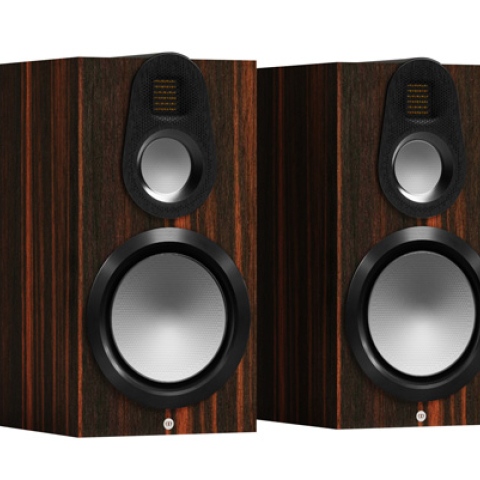
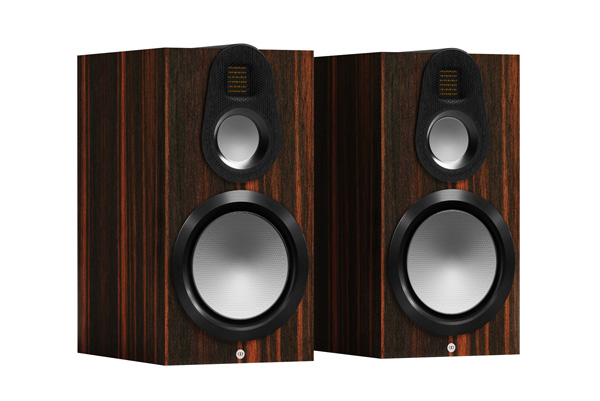
These thoughts occurred to me while I was listening to Waits's Nighthawks and Teresa Stratas's Stratas Sings Weill via the Monitor Audio Gold 100 6G loudspeakers. Reviewing speakers consists chiefly of describing the means while trying not to lose sight of the end. Timbre, dynamics, spatial cues, midrange purity, bass texture: They matter because in the right combination, they can make an old recording feel less like a remnant of a vanished world and more like a door that we can still open and walk through.
Trickle-down tech
Two summers earlier, I'd accidentally reminded myself how good Monitor Audio's products can be. A friend of a friend called to ask for speaker advice. He had a $500 budget and a preference for a pair of bookshelves. Though I steered him toward a retail purchase, I also mentioned that I had two pairs of speakers I'd be willing to part with, one being a pair of Monitor Audio Bronze 100s I'd bought a couple of years earlier for a bedroom setup that never materialized. The other pair, from another well-regarded brand, had been more of an impulse buy. The man came over, and we listened to both sets of speakers. It was the first time I'd heard them side by side. I half-wished he wouldn't pick the Monitors, because they excited me all over again. It wasn't even close: The Bronze 100s were punchier, more authoritative, and more engaging. $400 lighter, my guest carried the British speakers to his car, leaving me with $400 and the easily outclassed pair, which had cost me as much—$700—as the Monitor Bronzes.
At more than six times the price of the two-way Bronzes, the much beefier, three-way Golds ($4599/pair) promised to put in an even better performance. Their pedigree, of course, is the same. Monitor Audio has been building loudspeakers since 1972, when Mo Iqbal founded the company (footnote 1) in Teversham, a medieval village a stone's throw from Cambridge. (Today, Monitor is headquartered in Rayleigh, a market town some 30 miles east of Central London.) Across those 50-plus years, Monitor has become one of the more recognizable British loudspeaker brands, with products ranging from affordable ones like the Bronzes to the innovative, clothes-pin-shaped Hyphn statement speaker, a pair of which will set you back $99,000.
In Monitor Audio's speaker lineup, the Gold occupies serious territory without being on top of the mountain. The Hyphn stands apart as the company's flagship, while the Platinum Series 3G sits above the Gold; below are the Bronze Series 7G and the just-introduced Silver Series 8G.
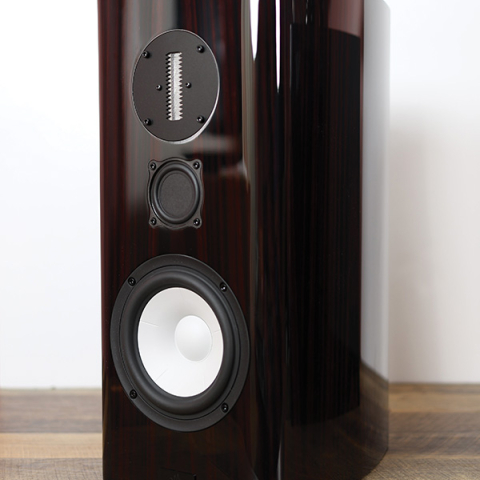
The Gold Series 6G comprises six models: the Gold 50 and Gold 100 standmounts, Gold 300 and Gold 500 floorstanders, a Gold C250 center channel, and a Gold On-Wall. The Gold 100 is the larger and more ambitious of the two standmounts. The Gold 50 is a conventional two-way; the 100 is a full three-way, with a woofer, a folded (AMT) tweeter, and a diminutive 3" midrange driver.
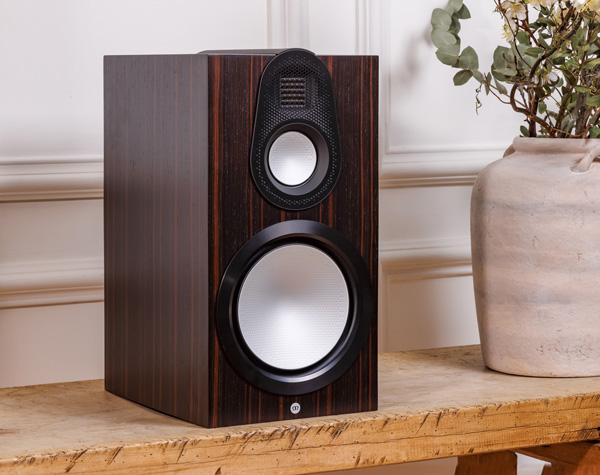
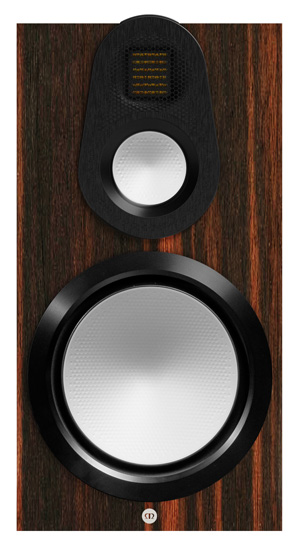 There's something almost defiantly traditional about the Gold 100s (and most other Monitor speakers). At a time when many high-end manufacturers are crafting cabinets with curved baffles and rounded edges, Monitor Audio has given us a good-looking six-sided box. That puts it in recognizably British company. Harbeth, Rogers, Spendor, and others have spent decades refining conventional enclosures. This BBC-derived school was hardly unaware of cabinet resonances or edge diffraction; its engineers studied both obsessively and controlled them through damping, bracing, felt, and so on. A rectangular cabinet isn't acoustically ideal, but its problems are predictable, and predictable problems can be engineered around. Consider that a rectangular enclosure is easier to build consistently, easier to veneer beautifully, and easier to accommodate in a living room than a cabinet that announces its acoustic ambitions from across the room. As standmounts go, the Gold 100 is up there in size and heft.
It measures 17 5/8" tall, 9 1/16" wide, and 14 1/16" deep and weighs just under 31 lb. The dark, handsome speakers I received were clad in a glossy Macassar veneer (with striping reminiscent of zebrawood) that was probably more forgiving of fingerprints than the gloss black version but attracted them nonetheless. A white satin version is also available.
Inside that furniture-grade cabinet is a design that neatly illustrates Monitor Audio's usual approach: develop expensive driver ideas at the top of the range, then find ways of applying some of them farther down. The Gold 100 6G gets the tweeter technology used in the Platinum and Hyphn, while its HDT C-CAM midrange and woofer build on the RDT III cone technology developed for those more expensive models. It also uses dedicated midrange loading, substantial motors, through-bolted drivers, and a genuinely three-way topology in a standmount enclosure. That combination, more than any single exotic material, is what makes the Gold 100 technically unusual.
 Port and drivers
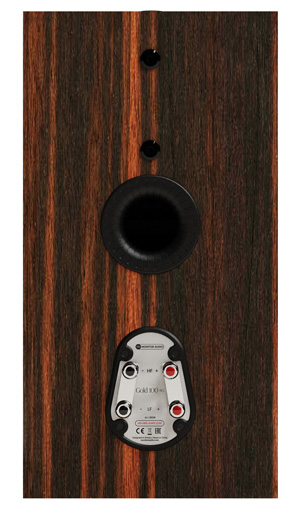
Monitor Audio calls the rear reflex port a "HiVe II" design (short for "high velocity"). The port's inside surface has "rifling," the company says: grooves intended to help manage airflow. The term is borrowed from a gun barrel, an analogy that's useful visually but imperfect physically: A bullet travels one way down a barrel and is spun by the rifling, whereas the air in a bass-reflex port oscillates back and forth. The point is not to make the air spin like a projectile but to keep high-velocity airflow through the port more orderly and reduce noisy turbulence (the dreaded "chuffing"). The Gold 100 6G's tweeter and midrange driver together occupy a metal enclosure. Monitor Audio calls it a "mid-pod." The pod is fronted by a die-cast aluminum baffle and sits high on the cabinet, with the midrange driver extending slightly above the cabinet's top edge, softening the boxy look. The midrange operates in its own acoustically isolated chamber, separate from the volume used by the 8" woofer. The drivers employ Monitor Audio's through-bolt mounting system: Rather than being screwed conventionally into the front baffle, they are pulled tight from the rear with long bolts. Besides leaving the front free of visible fasteners, that arrangement increases mechanical rigidity by clamping the drivers securely to the enclosure. The 8" woofer and 3" midrange use Monitor Audio's C-CAM (Ceramic-Coated Aluminium Magnesium) diaphragm material, combined here with a new treatment called HDT, for Hexagonal Diaphragm Technology. The visible pattern of hexagonal dimples isn't just decorative. Monitor Audio says it disrupts the symmetry of the cone's breakup modes, pushing breakup higher in frequency. The company describes HDT as a development of the RDT III cone technology used in the Hyphn and Platinum. The design team also revised the bass drivers' motors, surrounds, spiders, and voice coils for the Gold 6G; the woofer uses a longer coil and a Finite-Element-Analysis–optimized surround and spider, while the 3" midrange employs a powerful motor with a neodymium bucking magnet and increased voice-coil ventilation. The goal is greater linearity and lower distortion, keeping the drivers in check as they're asked to move farther and play louder.
Treble comes from Monitor Audio's Micro Pleated Diaphragm tweeter (MPD III), another technology with direct ties to the Platinum 3G and Hyphn speakers. An MPD works on the same principle as an Air Motion Transformer. Instead of a conventional dome that moves forward and backward, a very light pleated diaphragm expands and contracts, squeezing air from between its folds. In this latest version, Monitor Audio uses a roughly square radiating area and has worked on the rear chamber and front waveguide to smooth the response and control dispersion in both planes. The Gold 100's specified upper frequency limit is 60kHz at –6dB. Of course this is far beyond human hearing. The point is to keep the tweeter operating comfortably within the audible band, with resonances and breakup pushed well above it.
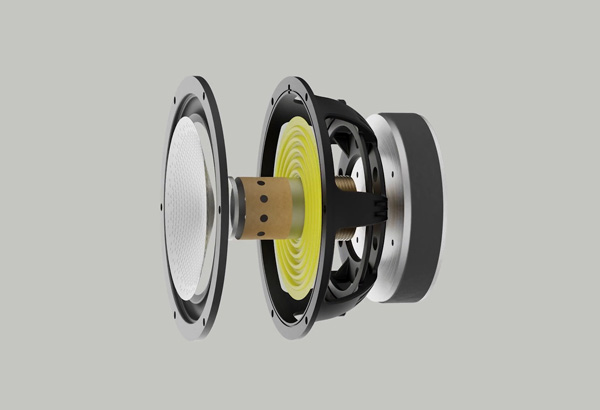 The crossover hands the 8" woofer to the 3" midrange at 700Hz and the midrange to the MPD III at 2.6kHz. As Monitor Audio's Technical Director Michael Hedges explained to me in an email, "By using a 700Hz bass-to-midrange crossover we can reduce the size of the midrange, better matching its directivity to the tweeter and pushing its breakup higher. The 8" bass driver can handle up to 700Hz extremely well, ensuring there's no compression in the lower midrange, and the midrange driver can then smoothly take this on to the tweeter."
Regarding the tweeter, Hedges says its wide bandwidth is intended to produce an especially smooth frequency balance. "That smooth response helps us with our crossover integration to the midrange driver. The extended response of the high frequencies is enabled by the tightly packed pleats of the MPD. It also targets low harmonic and intermodulation distortion as well as high power handling, all of which exceed the measurements of typical dome tweeters."
Monitor Audio describes the crossover as a new design using high-quality capacitors: It's a mixture of metallized polyester and metallized polypropylene film caps, custom-spec cemented resistors, and silver-plated internal wiring. That's a nice step above the inexpensive electrolytics and generic wire found in less ambitious designs.
Electrically, this is a nominal 4 ohm loudspeaker, with a specified minimum impedance of 3.9 ohms at 140Hz and a relatively low sensitivity of 86.5dB/2.83V/m. Flea-watt amplifiers need not apply. Monitor Audio recommends amps rated from 130 to 500Wpc into 4 ohms.
 Mojo? Working!
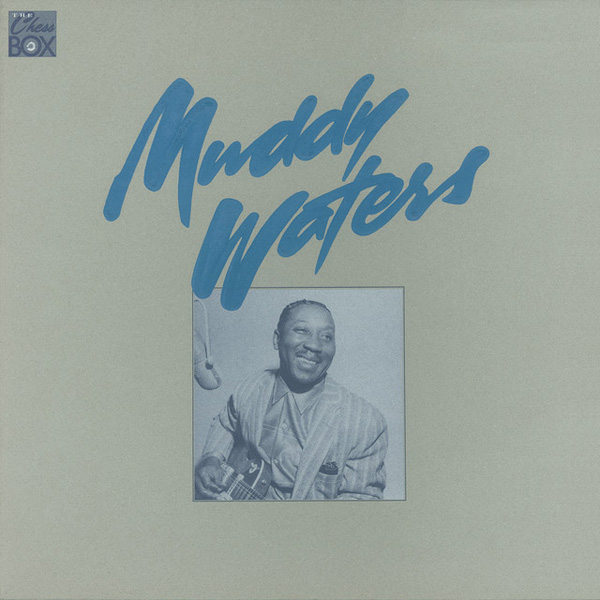
After letting the speakers break in for about a week, I started listening in earnest, with Lightnin' Hopkins's "Mojo Hand," from his album of the same name (24/44.1 FLAC, Fire Records/Qobuz). Muddy Waters's "Got My Mojo Working," off The Chess Box (16/44.1 FLAC, Geffen/Qobuz), approaches the same hoodoo talisman from the opposite direction: Hopkins wants a mojo powerful enough to keep his woman from another man, while Muddy boasts that his already works on everyone except the woman he wants.
The Gold 100s made both performances easy to like. The speakers have a knack for getting out of the way of music like this, where groove, voice, and personality matter more than audiophile spectacle. Hopkins sounded intimate and unforced, even as the lyrics took on a chilling tone ("I'm gonna fix my woman so she can't have no other man"); Muddy's swagger came through with the wit intact. The analytical part of my brain had less and less to do.
With audiophile fare, too, the Monitors did far more than their basic duty. Yello's "Takla Makan" (off Touch Yello, 16/44.1 FLAC, Polydor/Tidal) sounded open, wide, and precise. Bernard Herrmann's noir theme from Taxi Driver (off the Sax and Violence compilation, 16/44.1 FLAC, Varèse Sarabande/Qobuz) had me swooning to the sexy horns, and 10 minutes later, Infected Mushroom's mighty "Avratz" (16/44.1 FLAC, HOMmega/Qobuz) unfolded in my room with ease and a beautifully rendered spaciousness, the güiro and other percussion instruments inducing pleasure that tipped into joy.
 The two-LP version of Massive Attack's trip-hop masterpiece Mezzanine (LP, Virgin 0602537540433) was almost equally wonderful, but the Gold 100s are not floorstanders, and with a claimed 32Hz in-room bass response (–6dB), what they gain in imaging, they give up in bottom-octave extension and control. It was one of the few times that I wished for a couple of high-end subwoofers, like the REL No.31 I reviewed for Stereophile's March 2025 issue.
When I played XTC's Oranges & Lemons (LP, Ape House APELPX109), the experience was a bit like listening with good headphones. The Monitors made it a cinch to follow any musical thread I chose to focus on in XTC's rich sonic tapestry, be it Colin Moulding's serpentine bass lines, Pat Mastelotto's surefire toms, or the band's marvelously intricate vocal harmonies on "Chalkhills and Children." This clarity was partially due to the very good-sounding double-disc version of the album (remastered in 2020 and pressed on 200gm vinyl), but the Monitors certainly didn't put anything in the music's way.
 The Gold 100s also reproduced Thomas Dolby's "Dissidents," from The Flat Earth (LP, Music On Vinyl MOVLP3793), with satisfying force. The synth bass and digital drums sound remarkably fresh even in 2026, and the speakers gave them real weight and depth. On "Screen Kiss," the fretless bass had that appealing combination of body and lyricism. "I Scare Myself " offered a subtler pleasure. I listened to the acoustic guitar's attack and realized I could tell something about the pick: It was made of relatively thin pliable plastic, raked across the strings at a sharp angle, probably close to the capo. That the Monitors conveyed enough information to make such a tiny physical detail apparent was impressive.
The Gold 100s are revealing of everything upstream. I'd been using an excellent $500 phono stage that a fellow audiophile had justifiably raved about. Then the newly released $2395 Rega AOS phono stage arrived. I'd bought it sight unseen for my Rega P10 turntable and Apheta 3 cartridge. Through the reasonably priced Monitors, it wasn't hard to identify the particulars of the elevated performance: a bit more air around the instruments, a rise in spaciousness, a touch more life to the colors.
 Shy to solid to seductive
Compared to various high-octane floorstanders that preceded the Gold 100s in my listening room, including Magico S2s, Rockport Lynxes, and Estelon X Diamond Mk IIs, the British standmounts had seemed a bit shy at first. The words I played with in my head during the first week were adjectives like satisfying, solid, accomplished. I half-resolved to say, truthfully, that buyers would get their money's worth. But these tame formulations sidestepped whether the speakers could offer something more elusive than satisfaction. Did the Monitors inspire passion fired by beauty? Were they capable of inducing trance, transcendence even? After 20, 30 hours, when they'd come into their own, the answer was an unequivocal yes. Like turned to love. The effect was of a TV whose previously too-low saturation level had gradually been boosted. Here's another way of putting it: I've lived with speakers costing 10–25 times the Monitors' price, but once the Gold 100s were broken in and properly positioned, at no point did I think "This'll do"; only "Damn this is good!" One evening I put on Led Zeppelin's Houses of the Holy (LP, Atlantic R1-535344), and soon I was air-drumming so hard that my Apple Watch got triggered and offered to call 911. I can think of worse ways for a pair of speakers to earn my keen recommendation

Footnote 1: Stereophile Contributing Editor Martin Colloms was the company's founding technical director and chief designer. Martin left the company in 1976.
Two summers earlier, I'd accidentally reminded myself how good Monitor Audio's products can be. A friend of a friend called to ask for speaker advice. He had a $500 budget and a preference for a pair of bookshelves. Though I steered him toward a retail purchase, I also mentioned that I had two pairs of speakers I'd be willing to part with, one being a pair of Monitor Audio Bronze 100s I'd bought a couple of years earlier for a bedroom setup that never materialized. The other pair, from another well-regarded brand, had been more of an impulse buy. The man came over, and we listened to both sets of speakers. It was the first time I'd heard them side by side. I half-wished he wouldn't pick the Monitors, because they excited me all over again. It wasn't even close: The Bronze 100s were punchier, more authoritative, and more engaging. $400 lighter, my guest carried the British speakers to his car, leaving me with $400 and the easily outclassed pair, which had cost me as much—$700—as the Monitor Bronzes.
There's something almost defiantly traditional about the Gold 100s (and most other Monitor speakers). At a time when many high-end manufacturers are crafting cabinets with curved baffles and rounded edges, Monitor Audio has given us a good-looking six-sided box. That puts it in recognizably British company. Harbeth, Rogers, Spendor, and others have spent decades refining conventional enclosures. This BBC-derived school was hardly unaware of cabinet resonances or edge diffraction; its engineers studied both obsessively and controlled them through damping, bracing, felt, and so on. A rectangular cabinet isn't acoustically ideal, but its problems are predictable, and predictable problems can be engineered around. Consider that a rectangular enclosure is easier to build consistently, easier to veneer beautifully, and easier to accommodate in a living room than a cabinet that announces its acoustic ambitions from across the room. As standmounts go, the Gold 100 is up there in size and heft.
It measures 17 5/8" tall, 9 1/16" wide, and 14 1/16" deep and weighs just under 31 lb. The dark, handsome speakers I received were clad in a glossy Macassar veneer (with striping reminiscent of zebrawood) that was probably more forgiving of fingerprints than the gloss black version but attracted them nonetheless. A white satin version is also available.
Inside that furniture-grade cabinet is a design that neatly illustrates Monitor Audio's usual approach: develop expensive driver ideas at the top of the range, then find ways of applying some of them farther down. The Gold 100 6G gets the tweeter technology used in the Platinum and Hyphn, while its HDT C-CAM midrange and woofer build on the RDT III cone technology developed for those more expensive models. It also uses dedicated midrange loading, substantial motors, through-bolted drivers, and a genuinely three-way topology in a standmount enclosure. That combination, more than any single exotic material, is what makes the Gold 100 technically unusual.
Port and driversMonitor Audio calls the rear reflex port a "HiVe II" design (short for "high velocity"). The port's inside surface has "rifling," the company says: grooves intended to help manage airflow. The term is borrowed from a gun barrel, an analogy that's useful visually but imperfect physically: A bullet travels one way down a barrel and is spun by the rifling, whereas the air in a bass-reflex port oscillates back and forth. The point is not to make the air spin like a projectile but to keep high-velocity airflow through the port more orderly and reduce noisy turbulence (the dreaded "chuffing"). The Gold 100 6G's tweeter and midrange driver together occupy a metal enclosure. Monitor Audio calls it a "mid-pod." The pod is fronted by a die-cast aluminum baffle and sits high on the cabinet, with the midrange driver extending slightly above the cabinet's top edge, softening the boxy look. The midrange operates in its own acoustically isolated chamber, separate from the volume used by the 8" woofer. The drivers employ Monitor Audio's through-bolt mounting system: Rather than being screwed conventionally into the front baffle, they are pulled tight from the rear with long bolts. Besides leaving the front free of visible fasteners, that arrangement increases mechanical rigidity by clamping the drivers securely to the enclosure. The 8" woofer and 3" midrange use Monitor Audio's C-CAM (Ceramic-Coated Aluminium Magnesium) diaphragm material, combined here with a new treatment called HDT, for Hexagonal Diaphragm Technology. The visible pattern of hexagonal dimples isn't just decorative. Monitor Audio says it disrupts the symmetry of the cone's breakup modes, pushing breakup higher in frequency. The company describes HDT as a development of the RDT III cone technology used in the Hyphn and Platinum. The design team also revised the bass drivers' motors, surrounds, spiders, and voice coils for the Gold 6G; the woofer uses a longer coil and a Finite-Element-Analysis–optimized surround and spider, while the 3" midrange employs a powerful motor with a neodymium bucking magnet and increased voice-coil ventilation. The goal is greater linearity and lower distortion, keeping the drivers in check as they're asked to move farther and play louder.
The crossover hands the 8" woofer to the 3" midrange at 700Hz and the midrange to the MPD III at 2.6kHz. As Monitor Audio's Technical Director Michael Hedges explained to me in an email, "By using a 700Hz bass-to-midrange crossover we can reduce the size of the midrange, better matching its directivity to the tweeter and pushing its breakup higher. The 8" bass driver can handle up to 700Hz extremely well, ensuring there's no compression in the lower midrange, and the midrange driver can then smoothly take this on to the tweeter."
Regarding the tweeter, Hedges says its wide bandwidth is intended to produce an especially smooth frequency balance. "That smooth response helps us with our crossover integration to the midrange driver. The extended response of the high frequencies is enabled by the tightly packed pleats of the MPD. It also targets low harmonic and intermodulation distortion as well as high power handling, all of which exceed the measurements of typical dome tweeters."
Mojo? Working!After letting the speakers break in for about a week, I started listening in earnest, with Lightnin' Hopkins's "Mojo Hand," from his album of the same name (24/44.1 FLAC, Fire Records/Qobuz). Muddy Waters's "Got My Mojo Working," off The Chess Box (16/44.1 FLAC, Geffen/Qobuz), approaches the same hoodoo talisman from the opposite direction: Hopkins wants a mojo powerful enough to keep his woman from another man, while Muddy boasts that his already works on everyone except the woman he wants.
The two-LP version of Massive Attack's trip-hop masterpiece Mezzanine (LP, Virgin 0602537540433) was almost equally wonderful, but the Gold 100s are not floorstanders, and with a claimed 32Hz in-room bass response (–6dB), what they gain in imaging, they give up in bottom-octave extension and control. It was one of the few times that I wished for a couple of high-end subwoofers, like the REL No.31 I reviewed for Stereophile's March 2025 issue.
The Gold 100s also reproduced Thomas Dolby's "Dissidents," from The Flat Earth (LP, Music On Vinyl MOVLP3793), with satisfying force. The synth bass and digital drums sound remarkably fresh even in 2026, and the speakers gave them real weight and depth. On "Screen Kiss," the fretless bass had that appealing combination of body and lyricism. "I Scare Myself " offered a subtler pleasure. I listened to the acoustic guitar's attack and realized I could tell something about the pick: It was made of relatively thin pliable plastic, raked across the strings at a sharp angle, probably close to the capo. That the Monitors conveyed enough information to make such a tiny physical detail apparent was impressive.
The Gold 100s are revealing of everything upstream. I'd been using an excellent $500 phono stage that a fellow audiophile had justifiably raved about. Then the newly released $2395 Rega AOS phono stage arrived. I'd bought it sight unseen for my Rega P10 turntable and Apheta 3 cartridge. Through the reasonably priced Monitors, it wasn't hard to identify the particulars of the elevated performance: a bit more air around the instruments, a rise in spaciousness, a touch more life to the colors.
Shy to solid to seductiveCompared to various high-octane floorstanders that preceded the Gold 100s in my listening room, including Magico S2s, Rockport Lynxes, and Estelon X Diamond Mk IIs, the British standmounts had seemed a bit shy at first. The words I played with in my head during the first week were adjectives like satisfying, solid, accomplished. I half-resolved to say, truthfully, that buyers would get their money's worth. But these tame formulations sidestepped whether the speakers could offer something more elusive than satisfaction. Did the Monitors inspire passion fired by beauty? Were they capable of inducing trance, transcendence even? After 20, 30 hours, when they'd come into their own, the answer was an unequivocal yes. Like turned to love. The effect was of a TV whose previously too-low saturation level had gradually been boosted. Here's another way of putting it: I've lived with speakers costing 10–25 times the Monitors' price, but once the Gold 100s were broken in and properly positioned, at no point did I think "This'll do"; only "Damn this is good!" One evening I put on Led Zeppelin's Houses of the Holy (LP, Atlantic R1-535344), and soon I was air-drumming so hard that my Apple Watch got triggered and offered to call 911. I can think of worse ways for a pair of speakers to earn my keen recommendation
Footnote 1: Stereophile Contributing Editor Martin Colloms was the company's founding technical director and chief designer. Martin left the company in 1976.