 Feedback issues
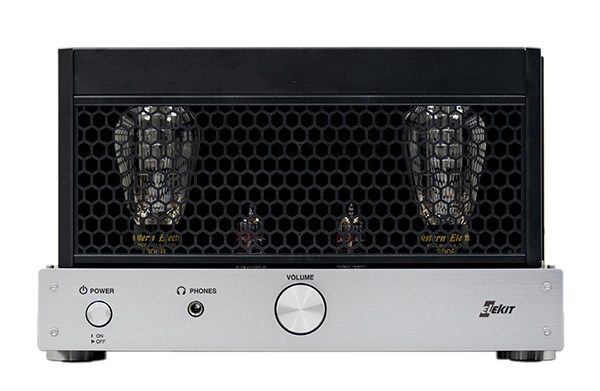
I am glad I listened for five straight months without disconnecting the TU-8900's feedback. During that time, I never forgot the feedback was connected, but everything sounded so alive and energized that I never felt motivated to remove it—never, that is, until I began to write this report. When I finally took the feedback out, I was surprised how much rawer the sound became. Without feedback, a deep-and-silent, wet-look transparency appeared. The amp actually got quieter into my 97dB/2.83V/m– sensitive Heretic AD614s. I found these new, raw, uncorrected sonics quite appealing, especially in the upper octaves and especially on flute, harp, and violin. But at first, despite some effort, I could not grasp what effect the absence of feedback was having on the lower octaves. I thought my favorite piano recordings would make it obvious, but they didn't. Imagine a hammer hitting a low-octave piano string. A wavefront is produced by that string, followed by a delayed reaction from the sound board; these sound energies combine to produce a complex wavefront, the time alignment of which is critical for full-pleasure listening. Only the best amplifier-speaker pairings get this wavefront alignment right. Push-pull amps need feedback to even get close to preserving this complex phenomenon. Single-ended amps without feedback can capture it, but too often their puny damping factors round the leading edge of bass transients and mute reverb crispness. This is why many single-ended triode amp users like a little "touch-up" feedback to tighten up the bass and make it more tuneful. My Line Magnetic LM-518IA and Elekit's TU-8600S both use such "touch-up" feedback to keep sounds taut and moving fast.
 Sequence is everything (again)
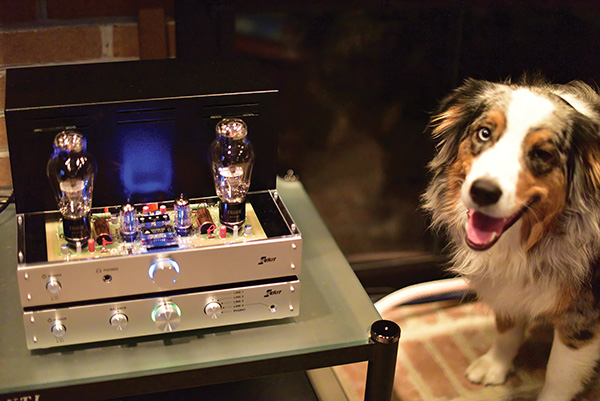
When I replaced the tiny 83dB/2.83V/m–sensitive, 15 ohm Falcons with the barrel-chested, 8 ohm, 97dB/2.83V/m–sensitive, $7290/pair Heretic AD614 coaxials, the no-feedback 300B Elekit experience became more physical and less dynamically restrained. The projected soundspace went from deep and tall to shallow and wide. (I picture speakers as camera lenses, with different speakers generating soundspace effects analogous to changes in aperture and focal length.) The Heretics are sharp-focused but with a shallow depth of field. The bulk of their stout cabinets appears to flatten and broaden the soundstage and reduce the experience of three-dimensionality. Nevertheless, the larger-scale images and the intensity of the Heretics' energy delivery is something I've needed, something I've craved emotionally. For my listening pleasure, I am willing to sacrifice some soundstage depth for image density and what feels like electrified intensity, with singers and instruments presented closer to full size. The river was whisky and I was a divin' duck ...
I am attracted to the Heretic speakers because nothing else I've been using plays artists like R. L. Burnside in a manner that feels strong enough, textured enough, and tangible enough for this kind of raw musical art. Burnside's 1998 anthology The King of Hill Country Blues: Rollin' & Tumblin' (16/44.1 FLAC, Wolf Records/Tidal) needs big paper cones, fat boxes (and possibly multicell horns) to properly launch his voice and rough-textured guitar into the room.
Western Electric's 300B was used primarily in audio-frequency amplifiers in commercial applications and as a pass tube in regulated power supplies. The 2A3 was the premier console-radio tube of the 1930s and '40s, famous for its clarity and the naturalness of voice reproduction. The Cossor LinLai WE300Bs were my preferred 300B for the TU-8900, but every time I tried the LinLai 2A3s, I'd end up switching to the richer, earthier-sounding 1940s RCA 2A3s (which I sorta collect). In the TU-8900, the RCAs generated more realistic tone and denser body. In my system, driving the Heretic AD614s, the no-feedback Elekit TU-8900 with the vintage RCA 2A3s excelled at playing Gregorian chant recordings. Playing my beloved "Mare Nostrum" Orient – Occident: Dialogues, a 2011 recording by Jordi Savall, Montserrat Figueras, and Hespèrion XXI (16/44.1 FLAC, Alia Vox/Qubuz), in which Sephardic, Turkish, and Christian chants overlap and complement each other, the sound via 2A3s showcased a coercive intimacy coupled with startling jump factor. I enjoyed how the 2A3 Elekit–Heretic combo played this record in a manner that exposed every drop of Jordi Savall's and Montserrat Figueras's beauty and talent as well as the recording's myriad sonic wonders.
While I'm turning you on to a supervalue SET amp, I may as well give you a quick introduction to a supervalue headphone that I am in the process of reviewing. It's a new model from HiFiMan that, before I knew its price, I assumed was in the $5000 range because it looks expensive and dances sonically with the best: the $1999 Audivina. The 20 ohm, 97dB/mW Audivina is a wood-shelled closed-back with a "NEO supernano" planar-magnetic diaphragm that played crazy clear when powered by the TU-8900's front-panel headphone jack. I chose the Audivina for this report because I wanted to see how the TU-8900 would drive low impedances and because it was the headphone I'd been auditioning when I started this report.
 My ears scanning for problems, I used the Audivina closed-backs to listen to Danza Española played by Andrés Segovia (16/44.1 FLAC, Masar/Tidal). More than with XIAudio's Broadway or HeadAmp's GS-X mini, the sound coming through was vivid and lustrous in a lush, microfocused manner reminiscent of the TAD CE1TX loudspeakers. The beauty of headphones like this is how the amp is connected directly to the headset's raw, responsive full-range drivers with no crossovers or filtering. This allows listeners to experience an unmolested view of the recording. You know how much the purist in me loves that.
Over the last three decades, I've enjoyed an enviable cadre of famously expensive 300B amplifiers. I wouldn't tease you with these Elekit stories if I did not believe Victor Kung and Yoshitsugu Fujita had created a uniquely interesting product, one that delivers large amounts of engagement factor, serious tube-rolling fun, and extraordinary sonics at a very reasonable price.