I have a peephole in the door to my first-floor apartment. It looks down a straight hall to a glass wall framing the front door of my building. For 13 years, its job has been to let me see who is ringing my buzzer and who is making a racket in the hall.
Over time, however, the peephole's lens turned amber-yellow and frosted-foggy like those headlight protectors on cars. In recent years, it became so clouded that all I could make out were unidentifiable Sasquatch figures moving in a blurry space.
I was startled one day when I peered through the peephole and recognized my UPS person. The view was still blurry, but it was much brighter and clearer than before. Then I realized: I was spying with my right eye. When I switched to my left—the one I normally use—the hole appeared completely blurred, frosted, and yellow. That's when it hit me: The peephole hadn't changed; my eyes had. That was the moment I stopped denying I had cataracts. I was functionally blind, I realized, in my left eye. That same hour, I made an appointment with an eye surgeon.
Next thing I knew, I was lying on the operating table. As the doctor removed that Clockwork Orange rig from my eye, I spied the eye-tech gear above me and the lights on the operating room ceiling. Everything was incredibly sharp-focused, aggressively three-dimensional. The white walls looked blue-white and unnaturally bright.
The next morning, the doctor tested my eyes. "Before surgery, you could not see the big 'E' at the top of the chart," the doctor said. "Now you can speed-read the bottom line."
"Yes Doc, oh my God! Thank you—this new luminous clarity is beyond my wildest dreams. I never thought anyone could see like this. But Doc, nothing looks real! I feel like I am looking through a plastic camera lens. Why is that?" That's when he told me, "The new lens is clearer than a natural lens," even when the natural lens is fresh and new.
I got my second new lens on June 8. My mind is slowly adapting. Soon, I will forget that my eyes are new. For now, the world looks so much brighter and so overtly three-dimensional that I can't stop staring at it.
I am telling this story because in my brain, seeing and hearing are tightly connected—nay, inseparable. And because these new lenses make the outside world look disarmingly similar to the worlds I see with my eyes closed listening to recorded music, where, with the most engaging component groupings, depth, three-dimensionality, color saturation, and the brilliance of light dominate my listening experience.
Meze Audio Elite headphones
As I study a work of art in a museum, I am constantly aware that I am looking at the combined effects of an infinite number of decisions—inventions by the artist—about how the object should present itself. The artwork does its prime job by declaring the artist's intentions: "Look! This is how I believe art should be made. And these are the pleasures I have decided to give you."
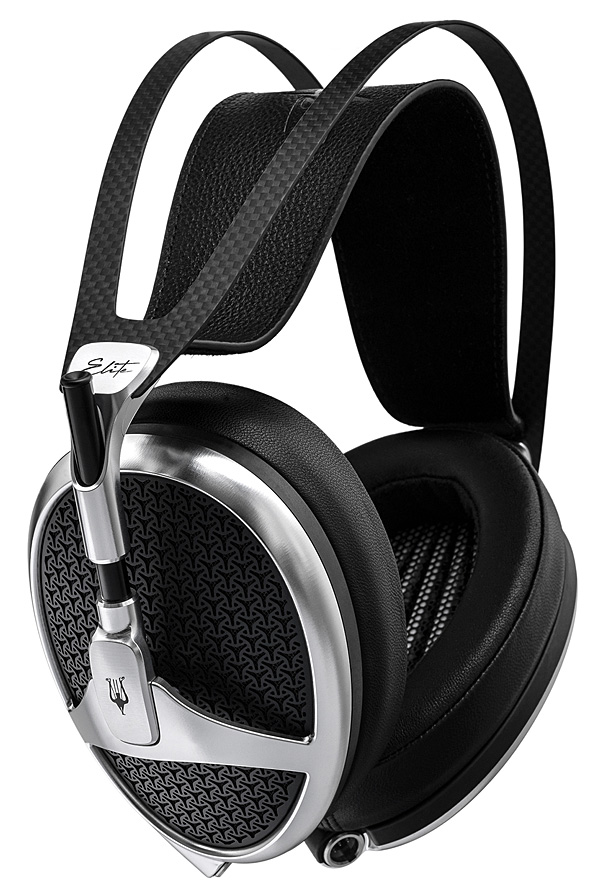 I have that same awareness whenever I audition a pair of Meze headphones (footnote 1). Very few manufacturers declare their viewpoint about how their headphones should look, and feel, and sound as clearly as those I've auditioned from the Meze lineup.
I realized this back in 2015, when I encountered Meze's elegant-looking, dynamic closed-back, the 99 Classic (footnote 2). Its round, luxuriously finished wood cups and the brass-gold detailing on the spring-steel headband perfectly highlighted its smooth, well-tempered sound. More than any competing budget headphone, the 99 Classic boldly announced: This is what its creator—industrial designer and Meze Audio founder Antonio Meze—believes a $309 headphone should be. The upscale-looking Meze 99 Classic became the first headphone I felt comfortable recommending to hip, style-conscious nonaudiophiles.
When I auditioned Meze's 10-times-more-expensive ($2999) open-back planar-magnetic Empyrean headphones, I thought: "These Meze folks have gone from a fashionable entry-level headphone all the way to a top-tier audiophile model with no stops in between." Had anyone ever done that before? The Empyrean looked, felt, and sounded like a completely realized design, capable of pleasing the most discerning audiophile. It struck me as a statement product that would be around a long time.
To my ears, the Empyrean specialized in rich tones and sensuous textures. So unabashedly, I recommended the Empyrean to every audiophile that didn't have a resolution fetish (like I do).
Meze Audio's headphones are manufactured in Baia Mare, Romania, a region that showcases some of the most historically diverse and distinctively styled architecture in Eastern Europe. Baia Mare is located on the banks of the Sãsar river, 373 miles northwest of Bucharest, 43 miles from the border of Hungary, and only 31 miles from the border with Ukraine. Meze was founded in 2011 and operates in partnership with Ukrainian acoustical engineering firm Rinaro Isodynamics, the company that designs and manufactures the planar-magnetic drive units used in Meze designs. Rinaro has been around for more than 30 years.
The core aspect of Meze's planar-magnetic driver technology is what Rinaro calls an "Isodynamic Hybrid Array." This unique diaphragm/magnet assembly is manufactured exclusively for Meze and used in the $2000 Liric, the $3000 Empyrean, and the new, $4000 Elite.
I have that same awareness whenever I audition a pair of Meze headphones (footnote 1). Very few manufacturers declare their viewpoint about how their headphones should look, and feel, and sound as clearly as those I've auditioned from the Meze lineup.
I realized this back in 2015, when I encountered Meze's elegant-looking, dynamic closed-back, the 99 Classic (footnote 2). Its round, luxuriously finished wood cups and the brass-gold detailing on the spring-steel headband perfectly highlighted its smooth, well-tempered sound. More than any competing budget headphone, the 99 Classic boldly announced: This is what its creator—industrial designer and Meze Audio founder Antonio Meze—believes a $309 headphone should be. The upscale-looking Meze 99 Classic became the first headphone I felt comfortable recommending to hip, style-conscious nonaudiophiles.
When I auditioned Meze's 10-times-more-expensive ($2999) open-back planar-magnetic Empyrean headphones, I thought: "These Meze folks have gone from a fashionable entry-level headphone all the way to a top-tier audiophile model with no stops in between." Had anyone ever done that before? The Empyrean looked, felt, and sounded like a completely realized design, capable of pleasing the most discerning audiophile. It struck me as a statement product that would be around a long time.
To my ears, the Empyrean specialized in rich tones and sensuous textures. So unabashedly, I recommended the Empyrean to every audiophile that didn't have a resolution fetish (like I do).
Meze Audio's headphones are manufactured in Baia Mare, Romania, a region that showcases some of the most historically diverse and distinctively styled architecture in Eastern Europe. Baia Mare is located on the banks of the Sãsar river, 373 miles northwest of Bucharest, 43 miles from the border of Hungary, and only 31 miles from the border with Ukraine. Meze was founded in 2011 and operates in partnership with Ukrainian acoustical engineering firm Rinaro Isodynamics, the company that designs and manufactures the planar-magnetic drive units used in Meze designs. Rinaro has been around for more than 30 years.
The core aspect of Meze's planar-magnetic driver technology is what Rinaro calls an "Isodynamic Hybrid Array." This unique diaphragm/magnet assembly is manufactured exclusively for Meze and used in the $2000 Liric, the $3000 Empyrean, and the new, $4000 Elite.
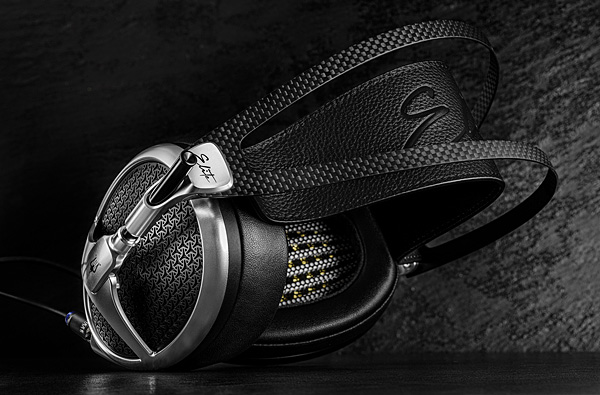
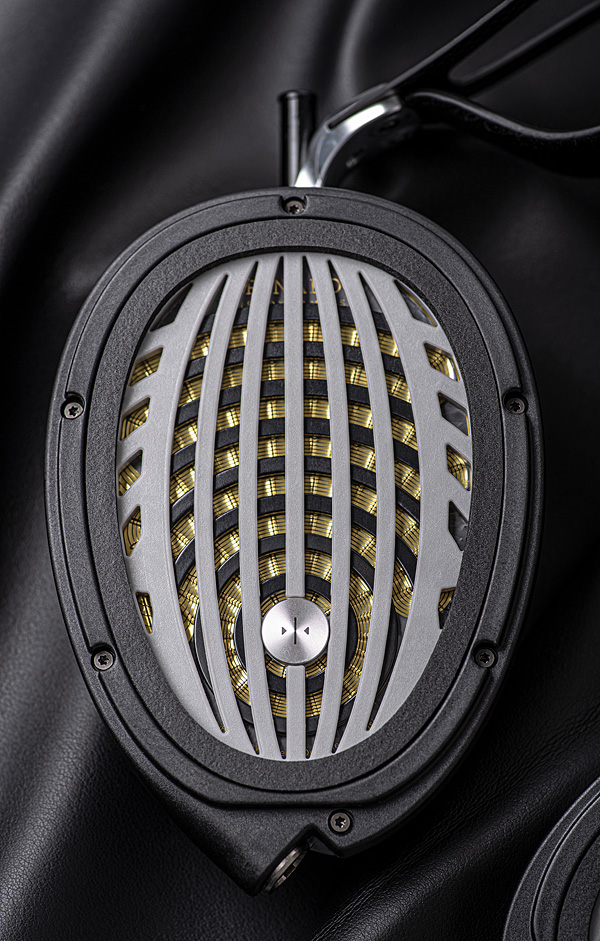 The Meze Audio Elite ($4000) displays the same smooth sonics as the Empyrean but with a slightly sharper focus and a clearer view of what's happening on recordings.
I sent an email to Meze's marketing and social media person, Alexandra Rizolu, asking her to describe the technology and material differences that distinguish the Elite from the Empyrean.
"The Elite's newly designed Rinaro Isodynamics' Parus diaphragm allowed us to make the headphone faster in sound when compared to the Empyrean. Built on an ultra-thin, biaxially oriented semicrystalline polymer film, this low-mass acoustic diaphragm weighs only 0.11gm, while the Empyrean's diaphragm reaches 0.16gm. The polymer in the Elite driver is stretched diagonally, at elevated temperatures, to improve structural performance. This makes the driver faster and more responsive, and it gives the Elite its cleaner characteristics. For Empyrean, THD [total harmonic distortion] measures under 0.1% in the whole frequency range, while for the Elite, THD measures under 0.05%. "The casing for Elite's driver is made from reinforced polymer designed to withstand the demanding, 12.7N load generated by the Hybrid Magnet Array. In the Empyrean's case, the driver casing is made from fiberglass-infused ABS.
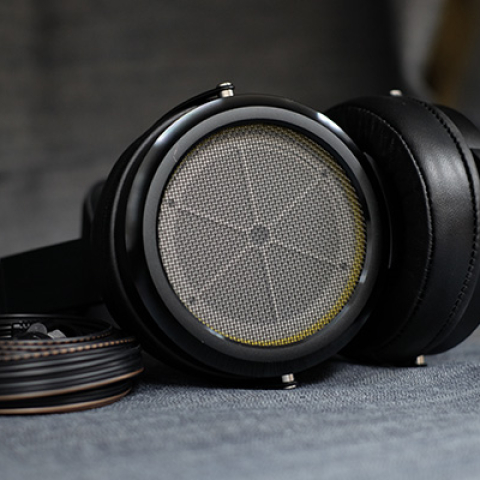
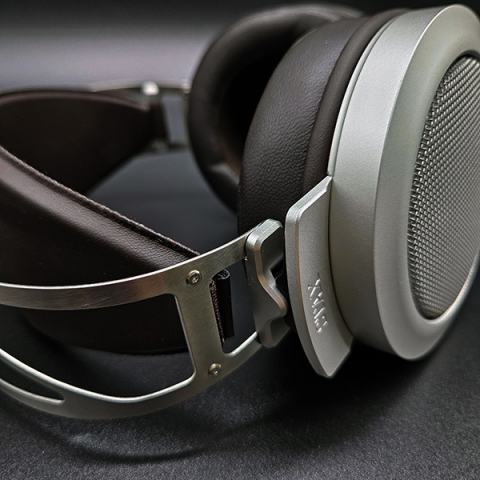
"Design-wise, the Elite features a change in color, showcasing the unmistakable silver texture of raw aluminum, delicately carved by CNC.
"The Elite also comes with Meze's newly developed hybrid earpads, a thinner leather-Alcantara mix that creates a distinct improvement in sound. These 25mm-deep pads are designed to give the Elite a cleaner, lighter, more neutral sound signature when compared to Empyrean."
The Elite's Rinaro MZ3SE Parus acoustic diaphragm measures 102mm × 73mm The specified sensitivity is 101dB/mW measured at 1kHz—same as the Empyrean.
Apart from its lightweight diaphragms, obvious beauty, and extraordinary build quality, Meze Audio's signature engineering feature is its use of two driver coils. First, there's a larger, longer "switchback coil," which winds back and forth covering the wide part of the ovoid diaphragm above the wearer's ear canal. The switchback coil specializes in bass. Just below it is a smaller, concentric "spiral coil" that is optimized to reproduce middle and high frequencies. According to Meze Audio, "The spiral coil is positioned directly over the ear canal, enabling more direct sound waves to enter the ear without time delays."
The Meze Audio Elite ($4000) displays the same smooth sonics as the Empyrean but with a slightly sharper focus and a clearer view of what's happening on recordings.
I sent an email to Meze's marketing and social media person, Alexandra Rizolu, asking her to describe the technology and material differences that distinguish the Elite from the Empyrean.
"The Elite's newly designed Rinaro Isodynamics' Parus diaphragm allowed us to make the headphone faster in sound when compared to the Empyrean. Built on an ultra-thin, biaxially oriented semicrystalline polymer film, this low-mass acoustic diaphragm weighs only 0.11gm, while the Empyrean's diaphragm reaches 0.16gm. The polymer in the Elite driver is stretched diagonally, at elevated temperatures, to improve structural performance. This makes the driver faster and more responsive, and it gives the Elite its cleaner characteristics. For Empyrean, THD [total harmonic distortion] measures under 0.1% in the whole frequency range, while for the Elite, THD measures under 0.05%. "The casing for Elite's driver is made from reinforced polymer designed to withstand the demanding, 12.7N load generated by the Hybrid Magnet Array. In the Empyrean's case, the driver casing is made from fiberglass-infused ABS.
"Design-wise, the Elite features a change in color, showcasing the unmistakable silver texture of raw aluminum, delicately carved by CNC.
"The Elite also comes with Meze's newly developed hybrid earpads, a thinner leather-Alcantara mix that creates a distinct improvement in sound. These 25mm-deep pads are designed to give the Elite a cleaner, lighter, more neutral sound signature when compared to Empyrean."
The Elite's Rinaro MZ3SE Parus acoustic diaphragm measures 102mm × 73mm The specified sensitivity is 101dB/mW measured at 1kHz—same as the Empyrean.
Apart from its lightweight diaphragms, obvious beauty, and extraordinary build quality, Meze Audio's signature engineering feature is its use of two driver coils. First, there's a larger, longer "switchback coil," which winds back and forth covering the wide part of the ovoid diaphragm above the wearer's ear canal. The switchback coil specializes in bass. Just below it is a smaller, concentric "spiral coil" that is optimized to reproduce middle and high frequencies. According to Meze Audio, "The spiral coil is positioned directly over the ear canal, enabling more direct sound waves to enter the ear without time delays."
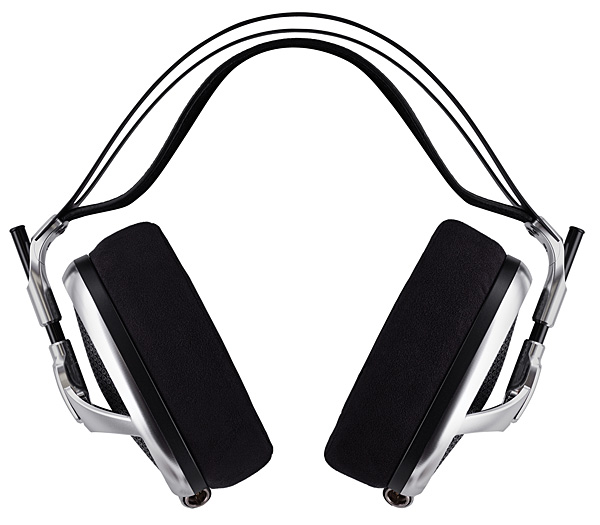 The Elite headset weighs 430gm. Its headband is made of carbon fiber, its headrest of leather. Inside the Elite's leather headrest, on each end, where it joins the sliding earcup pillars, are springy metal leaves that Meze calls "pressure distribution wings." According to Meze, these wings relieve pressure points (on the user's head) by encouraging the Elite's headband to conform to a greater length of the head's circumference.
My Elite review sample came packed in an aluminum briefcase, with two sets of earpads (one real leather, the other a leather-Alcantara hybrid), held in place magnetically with Meze's own "Isomagnetic earpad coupling technology," and a 2.5m cable that attaches to the headset with four-pin mini-XLR plugs and to my amplifiers with a 6.3mm plug. The Elite's cable may be ordered with 3.5mm or XLR input terminations. Meze also offers two types of upgrade cables, each with four termination options, one made of braided "Furukawa PCUHD copper" wire, which Alexandra Rizolu says "adds warmth and smoothness," the other silver-plated PCUHD copper that is said to add spaciousness.
The Elite headset weighs 430gm. Its headband is made of carbon fiber, its headrest of leather. Inside the Elite's leather headrest, on each end, where it joins the sliding earcup pillars, are springy metal leaves that Meze calls "pressure distribution wings." According to Meze, these wings relieve pressure points (on the user's head) by encouraging the Elite's headband to conform to a greater length of the head's circumference.
My Elite review sample came packed in an aluminum briefcase, with two sets of earpads (one real leather, the other a leather-Alcantara hybrid), held in place magnetically with Meze's own "Isomagnetic earpad coupling technology," and a 2.5m cable that attaches to the headset with four-pin mini-XLR plugs and to my amplifiers with a 6.3mm plug. The Elite's cable may be ordered with 3.5mm or XLR input terminations. Meze also offers two types of upgrade cables, each with four termination options, one made of braided "Furukawa PCUHD copper" wire, which Alexandra Rizolu says "adds warmth and smoothness," the other silver-plated PCUHD copper that is said to add spaciousness.
 Elite listening
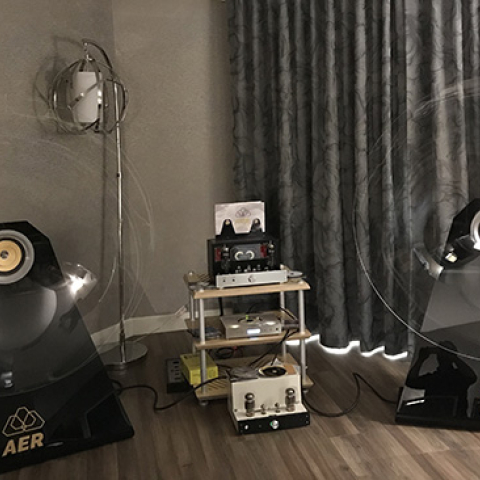
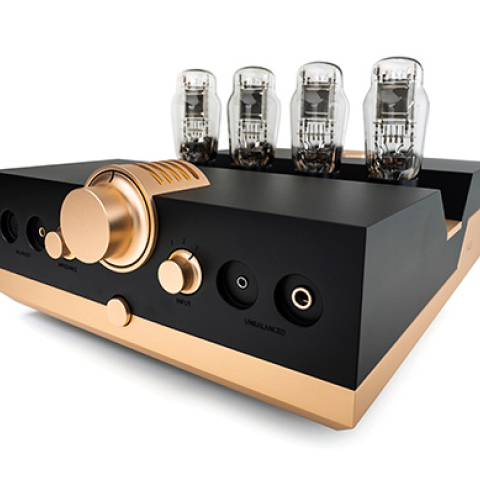
After scores of comfortable, good-sounding YouTube and Criterion Channel hours, I began my serious Elite auditions listening to the extremely difficult-to-reproduce, sounds-best-on-headphones "It Took the Night to Believe," from Sun O)))'s 2005 album Black One (16/44.1 FLAC, Southern Lord Records/Tidal). While playing this dark, densely textured track through the dCS Bartók DAC (with 2.0 software and using DSDX2 upsampling), driving Linear Tube Audio's Z10e, I smiled at how effectively the Elite sorted all that packed-tight, close-toned, multitracked layering. On Black One, the level of my listening pleasure is always set by the chosen transducer's ability to reproduce it with high levels of purity at high and low frequencies and low levels of intermodulation distortion. The Meze Elite did not disappoint: It delivered the full measure of dystopian anxiety and microdetailed doom-sonics with an appropriate feeling of high-voltage power. Still curious about the Elite's sorting talents, I tried Roxy Music's eponymous 1972 debut disc (LP, Polydor 2310 552). When the Elite played the first track, "Re-Make/ Re-Model," it was obvious that this new Meze is a cleaner, lower-distortion lens than the Empyrean, with a sharper focus. Time for a room change
Most observations described in this report were made using the Elite's all-leather earpads. After two weeks of listening with leather, I tried the thicker "hybrid" pads, which feature higher-volume chambers, a perforated Alcantara interior, and a leather exterior.
Footnote 1: Meze Audio, Iuliu Maniu str., no. 38, 1st fl., ap. 2, Baia Mare, 430131, Romania. Email: info@mezeaudio.com. Web: mezeaudio.com Footnote 2: See Tyll Hertsens's InnerFidelity review here and Ken Micallef's Stereophile review here.
As I study a work of art in a museum, I am constantly aware that I am looking at the combined effects of an infinite number of decisions—inventions by the artist—about how the object should present itself. The artwork does its prime job by declaring the artist's intentions: "Look! This is how I believe art should be made. And these are the pleasures I have decided to give you."
I have that same awareness whenever I audition a pair of Meze headphones (footnote 1). Very few manufacturers declare their viewpoint about how their headphones should look, and feel, and sound as clearly as those I've auditioned from the Meze lineup.
I realized this back in 2015, when I encountered Meze's elegant-looking, dynamic closed-back, the 99 Classic (footnote 2). Its round, luxuriously finished wood cups and the brass-gold detailing on the spring-steel headband perfectly highlighted its smooth, well-tempered sound. More than any competing budget headphone, the 99 Classic boldly announced: This is what its creator—industrial designer and Meze Audio founder Antonio Meze—believes a $309 headphone should be. The upscale-looking Meze 99 Classic became the first headphone I felt comfortable recommending to hip, style-conscious nonaudiophiles.
When I auditioned Meze's 10-times-more-expensive ($2999) open-back planar-magnetic Empyrean headphones, I thought: "These Meze folks have gone from a fashionable entry-level headphone all the way to a top-tier audiophile model with no stops in between." Had anyone ever done that before? The Empyrean looked, felt, and sounded like a completely realized design, capable of pleasing the most discerning audiophile. It struck me as a statement product that would be around a long time.
The Meze Audio Elite ($4000) displays the same smooth sonics as the Empyrean but with a slightly sharper focus and a clearer view of what's happening on recordings.
I sent an email to Meze's marketing and social media person, Alexandra Rizolu, asking her to describe the technology and material differences that distinguish the Elite from the Empyrean.
"The Elite's newly designed Rinaro Isodynamics' Parus diaphragm allowed us to make the headphone faster in sound when compared to the Empyrean. Built on an ultra-thin, biaxially oriented semicrystalline polymer film, this low-mass acoustic diaphragm weighs only 0.11gm, while the Empyrean's diaphragm reaches 0.16gm. The polymer in the Elite driver is stretched diagonally, at elevated temperatures, to improve structural performance. This makes the driver faster and more responsive, and it gives the Elite its cleaner characteristics. For Empyrean, THD [total harmonic distortion] measures under 0.1% in the whole frequency range, while for the Elite, THD measures under 0.05%. "The casing for Elite's driver is made from reinforced polymer designed to withstand the demanding, 12.7N load generated by the Hybrid Magnet Array. In the Empyrean's case, the driver casing is made from fiberglass-infused ABS.
The Elite headset weighs 430gm. Its headband is made of carbon fiber, its headrest of leather. Inside the Elite's leather headrest, on each end, where it joins the sliding earcup pillars, are springy metal leaves that Meze calls "pressure distribution wings." According to Meze, these wings relieve pressure points (on the user's head) by encouraging the Elite's headband to conform to a greater length of the head's circumference.
My Elite review sample came packed in an aluminum briefcase, with two sets of earpads (one real leather, the other a leather-Alcantara hybrid), held in place magnetically with Meze's own "Isomagnetic earpad coupling technology," and a 2.5m cable that attaches to the headset with four-pin mini-XLR plugs and to my amplifiers with a 6.3mm plug. The Elite's cable may be ordered with 3.5mm or XLR input terminations. Meze also offers two types of upgrade cables, each with four termination options, one made of braided "Furukawa PCUHD copper" wire, which Alexandra Rizolu says "adds warmth and smoothness," the other silver-plated PCUHD copper that is said to add spaciousness.
Elite listeningAfter scores of comfortable, good-sounding YouTube and Criterion Channel hours, I began my serious Elite auditions listening to the extremely difficult-to-reproduce, sounds-best-on-headphones "It Took the Night to Believe," from Sun O)))'s 2005 album Black One (16/44.1 FLAC, Southern Lord Records/Tidal). While playing this dark, densely textured track through the dCS Bartók DAC (with 2.0 software and using DSDX2 upsampling), driving Linear Tube Audio's Z10e, I smiled at how effectively the Elite sorted all that packed-tight, close-toned, multitracked layering. On Black One, the level of my listening pleasure is always set by the chosen transducer's ability to reproduce it with high levels of purity at high and low frequencies and low levels of intermodulation distortion. The Meze Elite did not disappoint: It delivered the full measure of dystopian anxiety and microdetailed doom-sonics with an appropriate feeling of high-voltage power. Still curious about the Elite's sorting talents, I tried Roxy Music's eponymous 1972 debut disc (LP, Polydor 2310 552). When the Elite played the first track, "Re-Make/ Re-Model," it was obvious that this new Meze is a cleaner, lower-distortion lens than the Empyrean, with a sharper focus. Time for a room change
Most observations described in this report were made using the Elite's all-leather earpads. After two weeks of listening with leather, I tried the thicker "hybrid" pads, which feature higher-volume chambers, a perforated Alcantara interior, and a leather exterior.
Footnote 1: Meze Audio, Iuliu Maniu str., no. 38, 1st fl., ap. 2, Baia Mare, 430131, Romania. Email: info@mezeaudio.com. Web: mezeaudio.com Footnote 2: See Tyll Hertsens's InnerFidelity review here and Ken Micallef's Stereophile review here.