 The Robyatt Audio SUTs
I have known Robin Wyatt since forever. As anyone will tell you, he's always low key, shy, and retiring. Soft spoken. He blends in with the crowd—except for his brightly patterned "yank" shirts by American tailor Robert Graham (footnote 2). Robin is tall, and I am short, so when we meet, I invariably find myself staring at a chest adorned with silks of many colors.
The chief reason I like Robin is that I admire his taste—in shirts, cologne, dogs, and polo ponies, but most especially in audio. In any ABX tournament, I would bet half my bicycles on his listening acumen. His distribution company, Robyatt Audio, represents fireside brands I could retire peacefully with (footnote 3).
Speaking of retirement: Robin recently introduced me to retired wizard Mike Mazurs, who lives in Pittsburgh. Robin said, "He hates publicity. That's why he picked me to represent him." I think he hates success, too, because he makes a confusing array of moving coil transformer stuff and doesn't tell people how it is made or what it is made of.
Mike's step-up transformers present as DIY
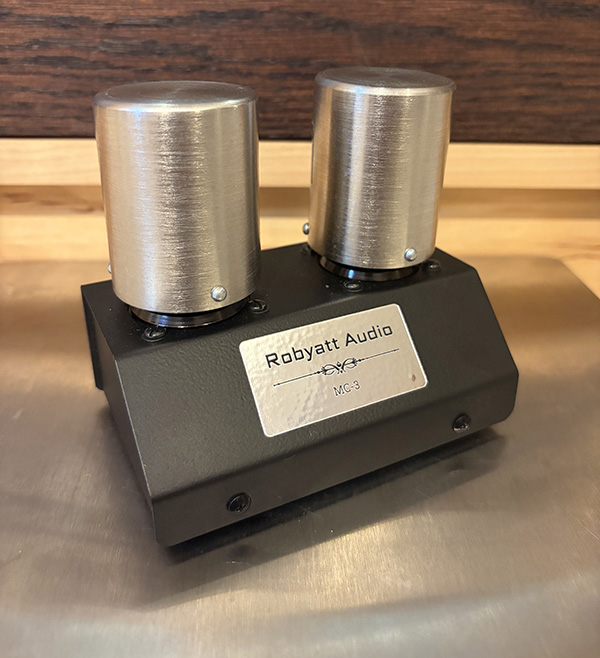
a la carte. He uses flimsy, Bud Industries chassis—$195 for mono, $275 for stereo—into which are plugged heavy, apparently well-shielded transformers featuring gold pins that squeeze tightly into the chassis's octal tube sockets. These tube sockets will also accept Peerless/Altec plugin SUTs.
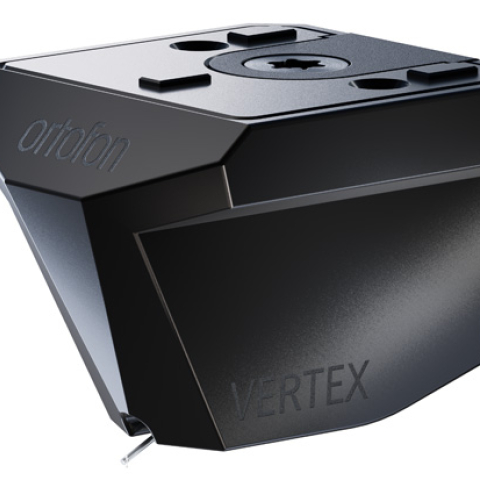
To start my auditions, I affixed two MC-2 transformers in a stereo chassis. There is no spec, but with the 6 ohm, 0.4mV MC X40, the MC-2 sounded like it had a 1:20 turns ratio, or 400× gain. Each MC-2 costs $360. For stereo, I needed two, so the total price was $995—not bad considering how well it performs.
"We do not state specs such as loading or gain ratios," Mazurs told me. "Instead, we advise users to use their ears: the best sounding one to you is always the correct value." Which is exactly what I think about moving coil cartridge loading. The more step-up transformers, transimpedance head-amps, and JFET and tube MC gain stages I use, the more I'm sure getting an MC load right is an unpredictable, trial-and-error business. Mathematical calculations are nearly useless. That's why I like it when cartridge manufacturers design and manufacture their own SUTs, as Ortofon does. Why should your customers have to use trial-and-error to find the proper load for your cartridge?
I didn't plan it that way, but during these auditions, the Classic Records RCA
Swan Lake became my litmus-test recording. Every loading and phono stage change I made with Ortofon's MC X40 had an easy-to-notice effect on how Tchaikovsky's swans presented. Playing
Swan Lake showed me right away how different the X40 sounded through the Robyatt Audio MC-2 step-up: quieter, less hi-fi, more relaxed, more tactile, more spacious, with more natural timbres, but less brightly lit than via the MasterPhono's voltage-amplifier input.

Each MC-3 transformer costs $410: $50 more than the MC-2, or $100 extra for a stereo pair. I knew nothing about the MC-3's gain or step-up ratio either, but wired to "common," it seemed to deliver a darker, deeper, wetter soundspace, with more dramatic separation of the orchestra parts, though the MC-3's sound was very close to the MC-2's. I heard scads of tiny, newly excavated details all around the back of the soundspace. Reproducing volumes of air and distance between instruments were the MC-3's leading talents. This combo had irrepressible boogie factor, so I thought I'd exploit it for fun and enjoy Roy Acuff 's "I'm Movin' On" performed by Matt Lucas on a big-hole 45 (Smash 45 S-1813, footnote 4).
Wind it up, Baby
Oh, shake it for your Daddy
Most of my life, I've willfully ignored the lyrics to songs. Songs about love and loss seemed silly and self-centered. I craved rhythm and beat to rev me up with their forces. Songs with thoughtful lyrics put me off, except for those by Hank Williams, Little Richard, Chuck Berry, John Lennon, Bob Dylan, David Byrne, and Lou Reed. Now that I'm old and slowly catching on to how humans operate, songs and their lyrics have achieved supreme importance in my life. I regard songwriting as humanity's greatest creative achievement. Therefore, I need to understand more forms of lyrics and the people who wrote them.
Lately I've been sprinkling lyrics into my
Stereophile reports. I do that to break the fourth wall, interrupt my droning pace, and add a few side thoughts to a potentially boring hardware narrative. Speaking of which ...
This is not a jukebox: With Ortofon's X40, and Mike M's MC-3 SUT going into MoFi's MasterPhono, Matt Lucas's "I'm Movin' On" did not sound as feet-shuffling wisecracky as it does coming out of a roadhouse jukebox or as motivating as it does coming out of a dashboard radio at night.
But! In my apartment, this combo conveyed a goodly amount of that wheels-rolling dashboard-radio vibe, and the sound in my room was more refined and detail-forward than from any dashboard speakers I've heard. Playing 7" 45s with a Shibata tip and boron cantilever through a pair of LS3/5a's sounds like that.
One of my issues with the
Ortofon 2M Black was that it didn't frolic with those Catholic girls or scorch the blacktop. The MC X40 did both things. The X40 with the MC-3 into the MoFi MasterPhono's MM input made jukebox 45s sound clear, smooth, and refined, but that refinement never diminished that 45rpm vigor or glossed over their communicative power. The X40 + MC-3 followed the first rule in all audio design: Do no harm.
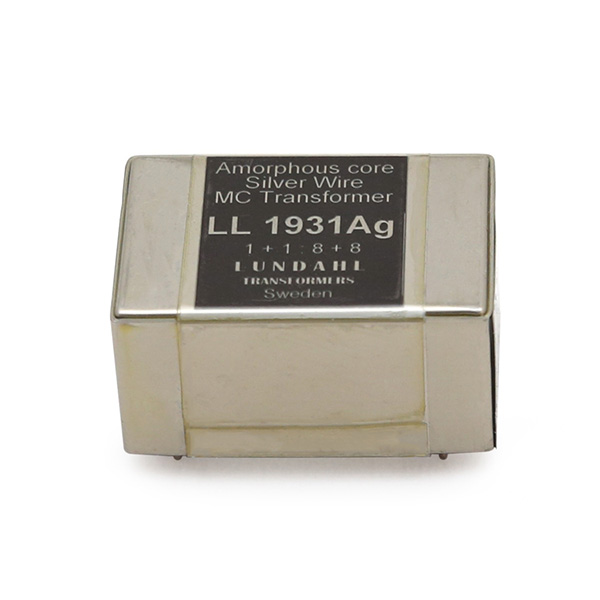 Lundahl LL 1931Ag
Ortofon says that all its X-series cartridges have coils wound with pure silver wire, so I wondered if replacing Mike's MC-3, which presumably is copper-wound, with Lundahl's silver-wired LL 1931Ag SUT ($2400 for an assembled stereo kit from US importer Erhard Audio, footnote 5) would make the X40's vanishingly faint glow factor come out and show itself more.
The first record I played with the silver SUT was the litmus-test
Swan Lake. The first thing I noticed was how orchestral sounds I had previously heard as stiff, bright, or hard now had an elegant elasticity and a darkish, tone-saturated atmosphere that audiophiles who came of listening age in the '60s will appreciate. With the
LTA Z10e powering my
Falcon Gold Badges, what came out of the LS3/5a's reminded me of the RCA LC-1 coaxial driver. The basic sound was darn nigh the same. That said, compared to Robyatt's MC-3, Lundahl's LL 1931Ag sounded rolled off on top.
With the Lundahl LL 1931Ag transformer, the X40 displayed near-perfect timbre, fronting oceans of detail, gently displayed. In this combination, the X40's sound was softish, smooth, and slippery—more colorful and moody than with Mike's MC-3. This is a beautiful combo, though some listeners would say it lacks bite.
Load is the mode: Month after month, reviewing one product after another while constantly scouting for tasty new prey has caused my taste in audio engineering to morph and shift with the times, sometimes quickly. My first
Stereophile review was of the
Rogue Sphinx class-D integrated amplifier. Since then, class-D has remained a powerful curiosity but not something I am drawn to.
Similarly, not too long after that first review—in
Gramophone Dreams #10, in 2016—I reviewed the Dynavector P75 MK3 Phono Preamplifier and Phono Enhancer.
The Phono Enhancer was a transimpedance (current drive) MC gain stage. That was my first exposure to current drive, and I thought that with just the right cartridge it could sound pretty damned amazing. Today I am still fascinated by transimpedance, but I am no longer enamored. As time passed, it didn't jibe with me. But I keep revisiting it, and the 6 ohm MC X40 seemed like a good reason to plug my tonearm wires into the current-drive inputs of the MoFi MasterPhono. I played Maria Callas, Edith Piaf, and Johnny Cash. This hardware combination showed off these classic voices with their full, correct tone, maybe richer and more correct than with any of the other loads I tried with the X40. Tempo and texture were good, but I wished for more clarity and brightness, and crisper transients. I heard exactly what John Curl says he and Mark Levinson thought about transimpedance in Curl's Mark Levinson JC-1 phono stage: "It sounds a little under water." (footnote 6)
What I discovered
Reviewing phono bits is Sisyphean. The variables are beyond reckoning. I was hoping to discover what traits the new Ortofon MC X40 exhibited with every load I could throw at it. Fortunately, that was not a difficult task. What never changed was the X40's illusion of speed and agility, its conspicuous neutrality, and its ability to disappear behind whatever music I played. Only the best cartridges do that.
As for Robin Wyatt and Mike Mazurs's step-up transformers, they disappeared, too. All three products—the X40, the MasterPhono's moving magnet input, and these SUTs—championed invisibility.
Next, I'll try the MC-2 and MC-3 with some expensive cartridges I know well. Until then, keep your diamonds clean.
Footnote 2: Not the engineer behind the excellent Graham Engineering tonearms.
Footnote 3: Robyatt Audio. Tel: (908) 334-3241. Email:
info@robyattaudio.com Web: robyattaudio.com
Footnote 4: See youtube.com/watch?v=8C2r8D10pdI.
Footnote 5: Lundahl Transformers AB. Tibeliusgatan 7, 761 50 Norrtälje, Sweden. Tel: +46 176 139 30. Web: lundahltransformers.com. US distributor: Erhard Audio, Ennis, Montana. Tel: (406) 589 2251. E-mail:
erhardaudio@gmail.com. Web: erhardaudio.com.
Footnote 6: See youtube.com/watch?v=cIBxJjmsAAk.