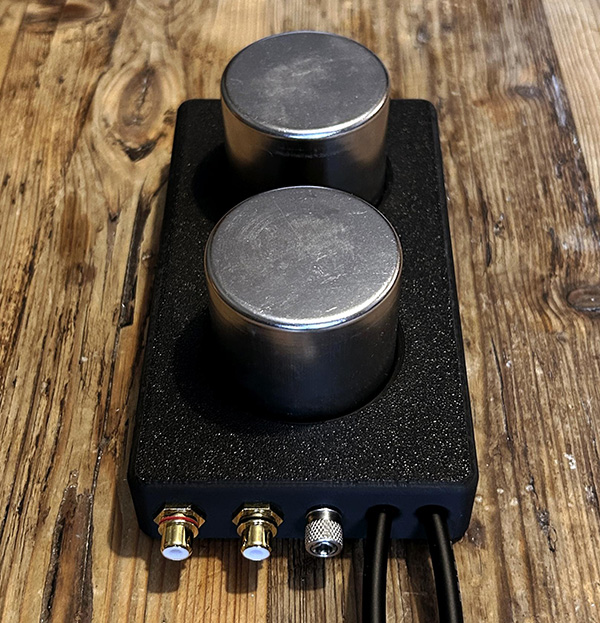
 The EM/IA 103 SUT
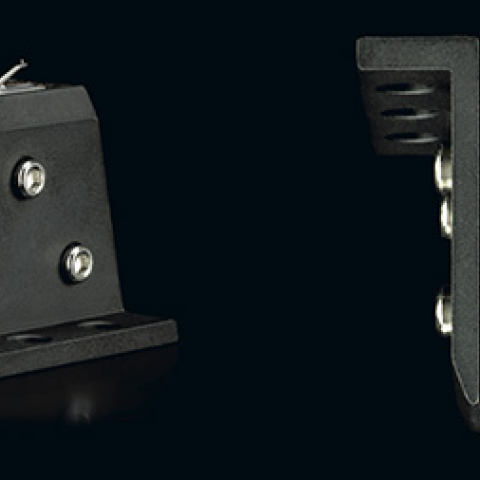
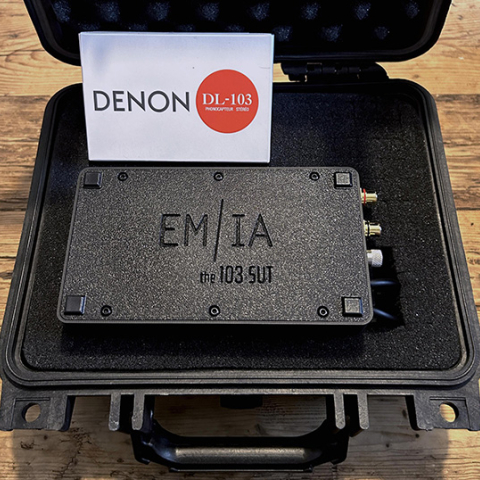
As I mentioned earlier, this Dream was inspired by watching Jana Dagdagan's YouTube video. It was also inspired by my brothers from the Fraternal Triode Lodge, Jeffrey Jackson of Experience Music (EM) and Dave Slagle of Intact Audio (IA), who recently introduced the EM/IA 103 SUT, a copper-wired, nickel-cored step-up transformer designed specifically for use with Denon's DL-103 (footnote 6). I smiled as Brother Jackson explained. "This Pelican-cased package consisting of a hand-wound nickel-cored EM/IA SUT ($1500) with a hard-wired cable leadout, a denuded DL-103 mounted on a threaded brass platform with a 3D-printed apron ($300), and a black wood headshell ($100) was conceived to be a gateway drug for deejays. Its purpose was to take all the guesswork out of the move from moving magnet deejay cartridges to the world of moving coils. We have several deejay friends who have moved on from their Ortofon Concords and are using 103s with a SUT for their gigs and are not looking back. We have a hunch there are lots of people in [audiophile] audio who are scared to make the jump to MC. We're just making it easy." Because I don't totally understand the complex gain-and-load reality of a 0.3mV signal impressed on the primary of a high-turns-ratio transformer, I asked SUT builder Slagle what makes the 103 SUT especially well-suited to the Denon 103.
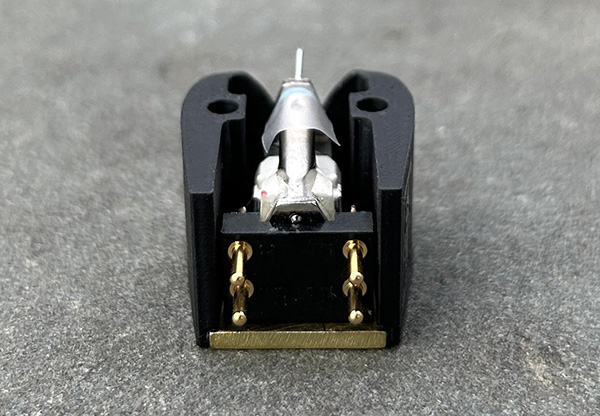 About the denuded DL-103
The cartridge in EM/IA's 103 SUT set is a DL-103 that has been removed from its plastic body—denuded—and anchored with epoxy to a brass plate with threaded holes for fastening to a headshell. Attached to the brass plate and nude cartridge is a 3D-printed apron that looks trés contemporary. Dave said, "The 3D-printed part is to simply provide protection, since a completely denuded 103 on a brass plate sounds great but doesn't last long in simian hands."
 Listening with the denuded DL-103 and the EM/IA 103 SUT
With the EM/IA 103 SUT and the denuded 103 installed, I put on a 1970 French-EMI recording of the Chicago Symphony Orchestra playing Igor Stravinsky's Pétrouchka (version corrigée de 1947) (La Voix De Son Maitre 2C 069 – 0.2070). I chose this record to describe first because I wanted to find the limits of what a spherical stylus could scrape out of a dense piece of orchestral music. What it scraped out was charged concert hall atmosphere, nanosize detail, and stereo-miked three-dimensionality. I heard spot-miked instruments close up, others far back, some to my right, others left. The instruments sounded farther apart than they would from any seat in the hall. This extreme three-dimensionality felt like it came from an augmented Decca tree. This dramatic spatiality is clearly what the producers were after, and I ate it up like a child slurping warm pudding.
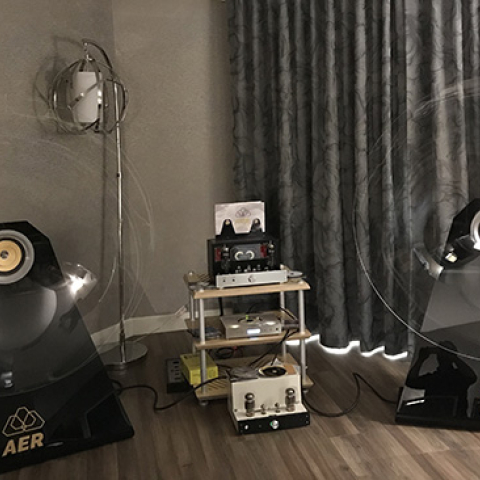
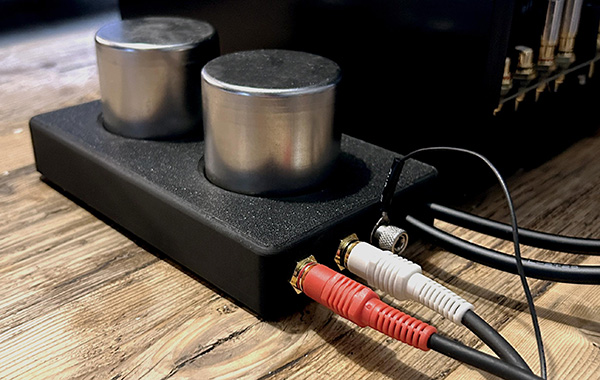 I used the 103 SUT with Voxativ's crossoverless Hagen2 speakers. The overt speed and transparency of this combo showed me focused detail and significant extra acreage at the back of the EMI-Pétrouchka's soundfield. Well set up, premium MCs resolve this stage-back acreage. Moving magnets and poorly aligned MCs rarely do. The presence or absence of this shadowy acreage is one of my litmus tests for cartridges at the $2000 price level.
 I smile contentedly when a cartridge plays a recording with its full reverb-y presence intact, especially when it's a live piano recording, like Bill Evans's The Paris Concert: Edition Two (Elektra/Musician LP 60311-1-E), where the pulsing reverb reaches out and tickles my skin then shows me the qualities of touch and mind state Evans was putting down. During The Paris Concert, there were charming little moments when, as the music moved forward, I sensed Evans feeling pleased with himself about what he had just played. I was impressed how such internal, human content snuck through. Moments like that reminded me how much delicacy and communicative power Denon's almost-free 103 could generate.
For more than a month, I've been obsessively playing a 1958 blue-label, British-pressed Columbia disc featuring Michael Rabin playing violin with the Philharmonia Orchestra conducted by Sir Adrian Boult performing Mendelssohn's Concerto in E Minor (Op.64) and Ravel's Tzigane (Columbia 33CX 1597). This mono microgroove is a riveting hi-fi spectacular. With the stock DL-103 + EM/IA's 103 SUT, its mass and complexity came through incredibly well sorted and image defined.
I smile contentedly when a cartridge plays a recording with its full reverb-y presence intact, especially when it's a live piano recording, like Bill Evans's The Paris Concert: Edition Two (Elektra/Musician LP 60311-1-E), where the pulsing reverb reaches out and tickles my skin then shows me the qualities of touch and mind state Evans was putting down. During The Paris Concert, there were charming little moments when, as the music moved forward, I sensed Evans feeling pleased with himself about what he had just played. I was impressed how such internal, human content snuck through. Moments like that reminded me how much delicacy and communicative power Denon's almost-free 103 could generate.
For more than a month, I've been obsessively playing a 1958 blue-label, British-pressed Columbia disc featuring Michael Rabin playing violin with the Philharmonia Orchestra conducted by Sir Adrian Boult performing Mendelssohn's Concerto in E Minor (Op.64) and Ravel's Tzigane (Columbia 33CX 1597). This mono microgroove is a riveting hi-fi spectacular. With the stock DL-103 + EM/IA's 103 SUT, its mass and complexity came through incredibly well sorted and image defined.
 In order to sound completely rendered and kinetically charged, the compositions on Beethoven – Sämtliche Klaviertrios (EMI 1C 163–02 046/50) needed to be scraped out by a nude line-contact diamond at the end of a boron cantilever. The recordings in this five-disc, pressed-in-Germany set featuring Pinchas Zukerman (violin), Jacqueline du Pré (cello), Gervase de Peyer (clarinet), and Daniel Barenboim (piano) delivered more vivid excitement when rendered by the controlled dynamism of the Lyra Delos, the Dynavector XX2A, and the Audio-Technica ART20. Playing these discs with these upscale cartridges showed me the limits of what the Denon 103's aluminum cantilever and spherical stylus can do.
The 103 scraped out plenty of Beethoven-EMI marvelousness, but after listening with those more-expensive cartridges with line-contact styli, via the 103, Zukerman and Du Pré sounded low-contrast and generalized. These German EMIs exposed the 103's subliminal blurring, which my brain reads as a slight loss of sharp focus but also (don't laugh) as an appealing grainlessness.
In order to sound completely rendered and kinetically charged, the compositions on Beethoven – Sämtliche Klaviertrios (EMI 1C 163–02 046/50) needed to be scraped out by a nude line-contact diamond at the end of a boron cantilever. The recordings in this five-disc, pressed-in-Germany set featuring Pinchas Zukerman (violin), Jacqueline du Pré (cello), Gervase de Peyer (clarinet), and Daniel Barenboim (piano) delivered more vivid excitement when rendered by the controlled dynamism of the Lyra Delos, the Dynavector XX2A, and the Audio-Technica ART20. Playing these discs with these upscale cartridges showed me the limits of what the Denon 103's aluminum cantilever and spherical stylus can do.
The 103 scraped out plenty of Beethoven-EMI marvelousness, but after listening with those more-expensive cartridges with line-contact styli, via the 103, Zukerman and Du Pré sounded low-contrast and generalized. These German EMIs exposed the 103's subliminal blurring, which my brain reads as a slight loss of sharp focus but also (don't laugh) as an appealing grainlessness.
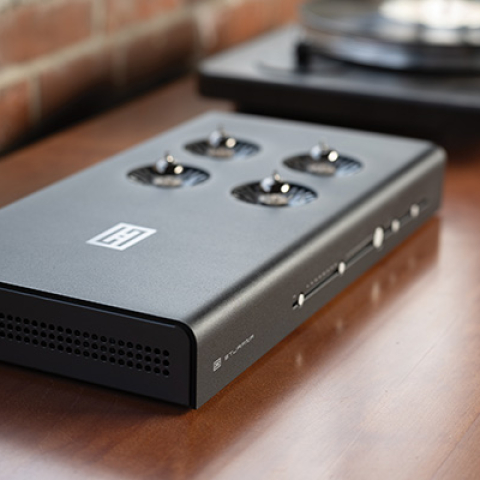
Before I run, let me add a few rah-rah thoughts about Schiit Audio's Stjarna phono stage. For a second month, it has been a fun companion. I enjoy the ritual of turning it on in the morning and off at night. Whenever it's on, it nags me to play records. Tonewise, the Schiit Stjarna is reference-level neutral, so I never think about that. What I notice most about the Stjarna's sound is its fresh, vibey clarity. With every MM or MC cartridge I tried, I viewed through the Stjarna's transparency solidly cast dimensional forms in well-described, energy-charged spaces with just the right blush of tube allure. Schiit has spawned another proletarian wonder.
Footnote 6: See 103sut.cargo.site. EM/IA, Email: Dave Slagle: slaglephoto@gmail.com; Jeffrey Jackson: experiencemusic@hotmail.com. Web: myemia.com.