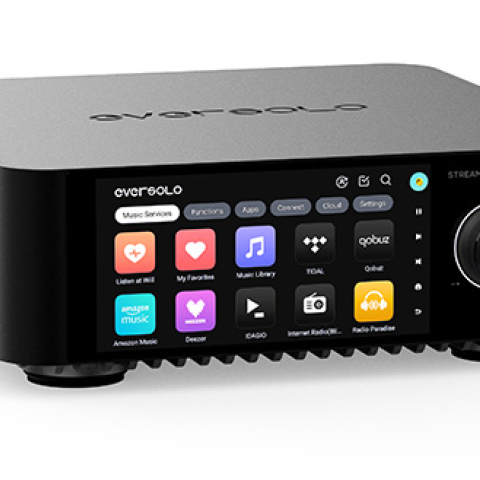
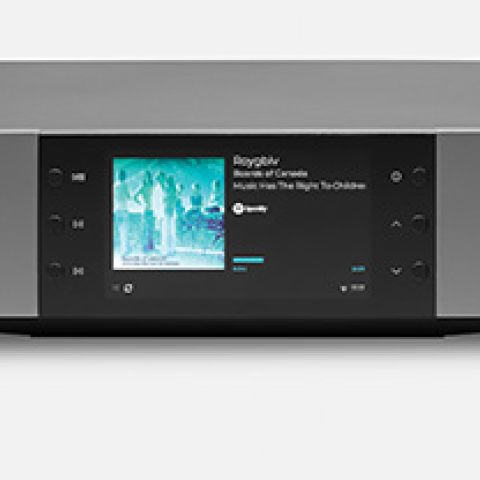
I examined the behavior of the Eversolo's D/A conversion circuitry with one of the optical inputs. This locked to S/PDIF data with sample rates up to 192kHz. With the volume control set to "0dB," a 1kHz digital signal at 0dBFS resulted in an output level of 4.36V from the balanced outputs, 2.18V from the single-ended outputs. The DMP-A8's digital inputs preserved absolute polarity from both output types with the XLR jacks set to Positive Port Polarity. (The polarity setting is fixed as positive for the analog inputs.)
Footnote 1: See, for example, fig.11 here. Footnote 2: See, for example, fig.2 here.
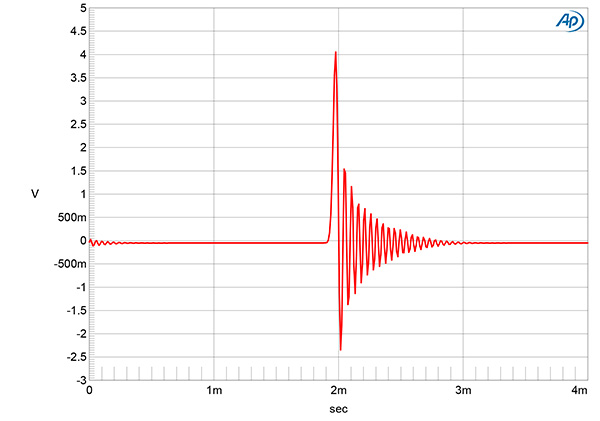
Fig.8 Eversolo DMP-A8, Short Delay, Sharp Rolloff filter, impulse response (one sample at 0dBFS, 44.1kHz sampling, 4ms time window).
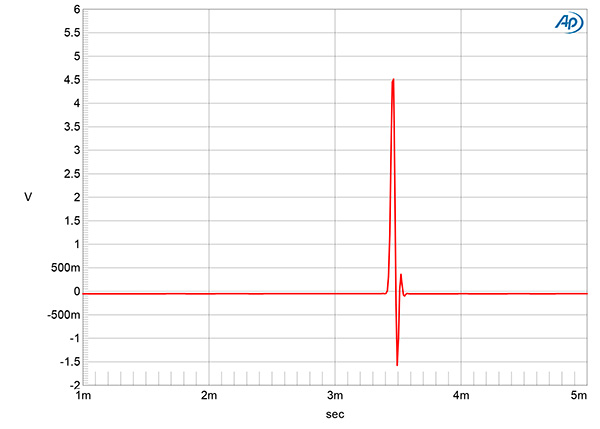
Fig.9 Eversolo DMP-A8, Short Delay, Slow Rolloff filter, impulse response (one sample at 0dBFS, 44.1kHz sampling, 4ms time window).
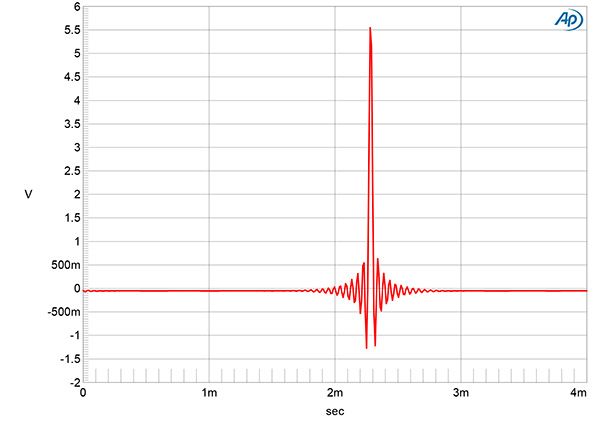
Fig.10 Eversolo DMP-A8, Sharp Rolloff filter, impulse response (one sample at 0dBFS, 44.1kHz sampling, 4ms time window).
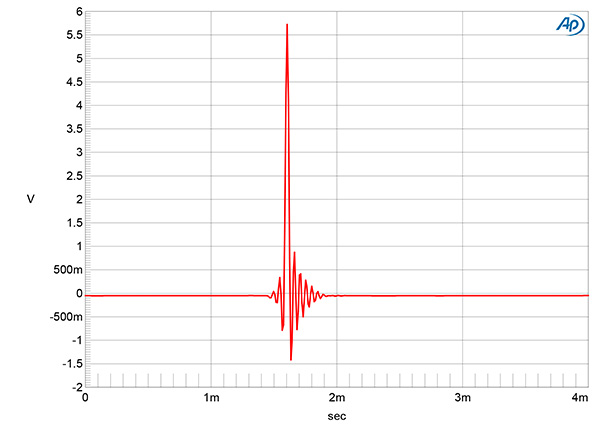
Fig.11 Eversolo DMP-A8, Low Dispersion, Short Delay filter, impulse response (one sample at 0dBFS, 44.1kHz sampling, 4ms time window).
The DMP-A8's AKM DAC offers a choice of six reconstruction filters: Sharp Rolloff; Slow Rolloff; Short Delay, Sharp Rolloff; Short Delay, Slow Rolloff; Super Slow; and Low Dispersion, Short Delay. Short Delay, Sharp Rolloff is the default filter; its impulse response with 44.1kHz data (fig.8) indicates that this filter is a fairly long minimum-phase type, with all the ringing following the single sample at 0dBFS. The Short Delay, Slow Rolloff filter is also a minimum-phase type but is very short (fig.9), while the Sharp Rolloff filter is a conventional linear-phase type, with time-symmetrical ringing on either side of the single full-scale sample (fig.10). The Slow Rolloff filter (not shown) is also linear-phase but very short, while the Low Dispersion, Short Delay filter's impulse response (fig.11) is very similar to the hybrid type offered by the ESS DACs (footnote 1).
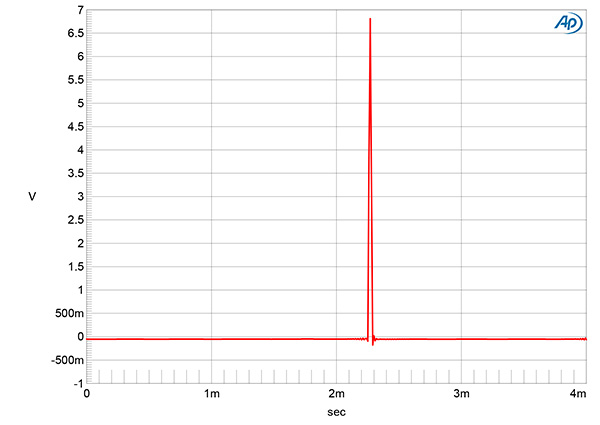
Fig.12 Eversolo DMP-A8, Super Slow filter, impulse response (one sample at 0dBFS, 44.1kHz sampling, 4ms time window).
The odd man out is the Super Slow filter, as its impulse response (fig.12) suggests that it is not a filter at all. (This was confirmed by the oscilloscope screen, which showed with a 1kHz tone that the DMP-A8 was simply outputting the individual sample voltages; footnote 2.) The very small amount of linear-phase ringing in this graph is due to the Audio Precision A/D converter's antialiasing filter operating with 200kHz sampling.
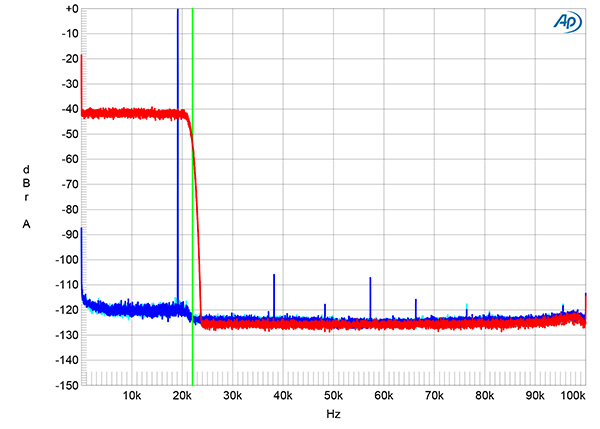
Fig.13 Eversolo DMP-A8, Short Delay, Sharp Rolloff filter, wideband spectrum of white noise at –4dBFS (left channel red, right magenta) and 19.1kHz tone at 0dBFS (left blue, right cyan), with data sampled at 44.1kHz (20dB/vertical div.).
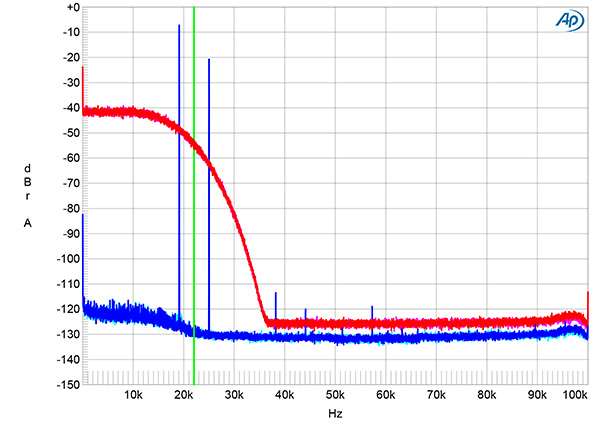
Fig.14 Eversolo DMP-A8, Short Delay, Slow Rolloff filter, wideband spectrum of white noise at –4dBFS (left channel red, right magenta) and 19.1kHz tone at 0dBFS (left blue, right cyan), with data sampled at 44.1kHz (20dB/vertical div.).
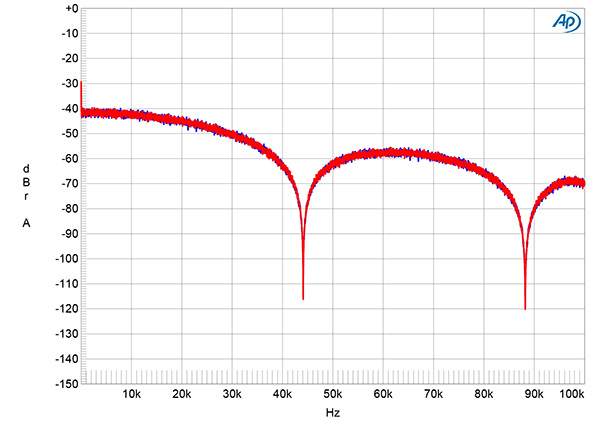
Fig.15 Eversolo DMP-A8, Super Slow filter, wideband spectrum of white noise at –4dBFS (left channel red, right magenta) with data sampled at 44.1kHz (20dB/vertical div.).
With 44.1kHz-sampled white noise and the Short Delay, Sharp Rolloff filter, the DMP-A8's response rolled off sharply above 20kHz (fig.13, red and magenta traces), reaching full stop-band suppression at 24kHz. No aliased images of a full-scale tone at 19.1kHz are visible (blue and cyan traces), and the distortion harmonics are all extremely low in level. The Sharp Rolloff filter behaved identically with this signal, while the Short Delay, Slow Rolloff and Slow Rolloff filters didn't reach full stop-band attenuation with the white noise signal until 37kHz (fig.14, red and magenta traces), with a strong aliased image of the 19.1kHz tone present at 25kHz (blue and cyan traces). The rolloff was faster with the Low Dispersion, Short Delay filter (not shown), and again, the Super Slow filter was the odd man out, as its white-noise spectrum (fig.15) had nulls at integer multiples of the sample rate, between which are mirrored images of the audioband signal.
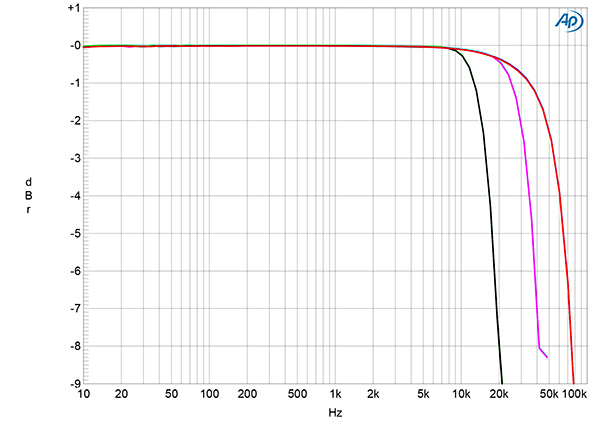
Fig16 Eversolo DMP-A8, Slow Rolloff filter, frequency response at –12dBFS into 100k ohms with data sampled at: 44.1kHz (left channel green, right gray), 96kHz (left cyan, right magenta), and 192kHz (left blue, right red) (1dB/vertical div.).
The Eversolo's frequency response with data sampled at 44.1, 96, and 192kHz dropped off sharply just below half of each sample rate with the Sharp Rolloff, Short Delay, Sharp Rolloff, and Low Dispersion, Short Delay filters (not shown). As expected, the rolloff started earlier with the Slow Rolloff and Short Delay, Slow Rolloff filters (fig.16), and with 44.1kHz data (green, gray traces), the output at 20kHz was down by 8dB at 20kHz. Channel separation (not shown) ranged from >130dB at low frequencies to a still-excellent 97dB at the top of the audioband.
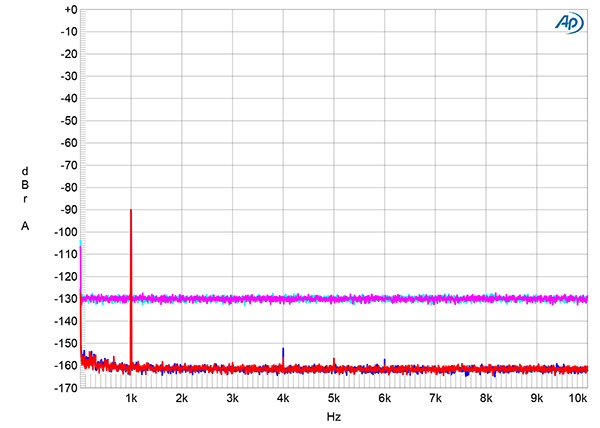
Fig.17 Eversolo DMP-A8, spectrum with noise and spuriae of dithered 1kHz tone at –90dBFS with 16-bit data (left channel cyan, right magenta) and 24-bit data (left blue, right red) (20dB/vertical div.).
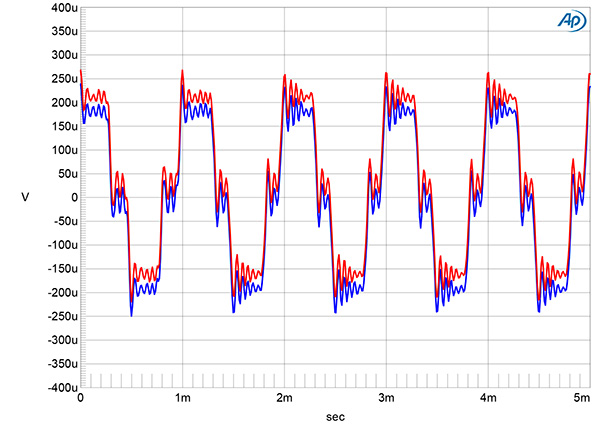
Fig.18 Eversolo DMP-A8, waveform of undithered 1kHz sinewave at –90.31dBFS, 16-bit data (left channel blue, right red).
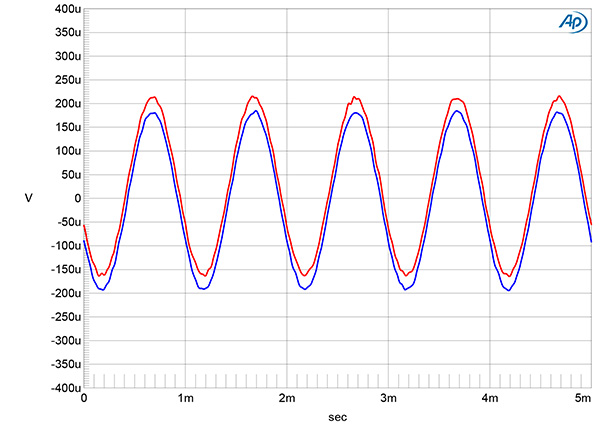
Fig.19 Eversolo DMP-A8, waveform of undithered 1kHz sinewave at –90.31dBFS, 24-bit data (left channel blue, right red).
Fig.17 shows the spectrum of the Eversolo's output while it decoded dithered data representing a 1kHz tone at –90dBFS with 16-bit and 24-bit data. The increase in bit depth lowers the noisefloor level by 30dB, which suggest that the DMP-A8's DAC offers a superb 21 bits of resolution. With undithered 16-bit data representing a tone at exactly –90.31dBFS, the three DC voltage levels described by the data were cleanly reproduced (fig.18), and with undithered 24-bit data, the Eversolo output a clean sinewave, despite the very low signal level (fig.19).
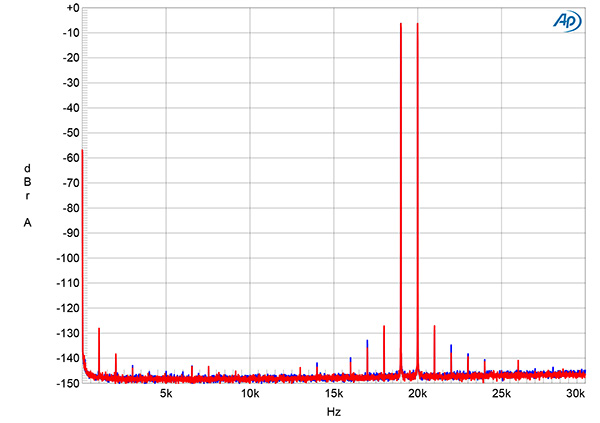
Fig.20 Eversolo DMP-A8, Sharp Rolloff filter, 24-bit data, HF intermodulation spectrum, DC–30kHz, 19+20kHz at 0dBFS peak, sampled at 44.1kHz.
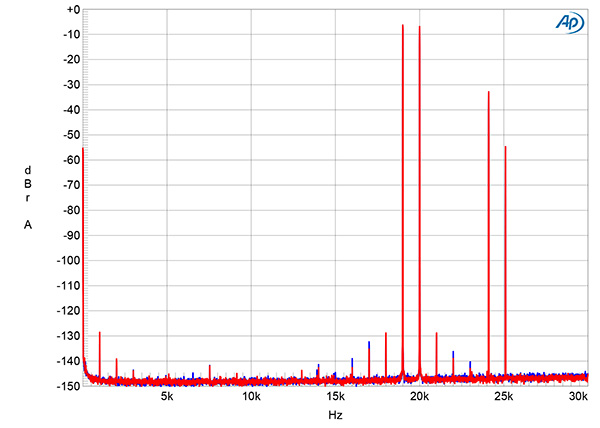
Fig.21 Eversolo DMP-A8, Low Dispersion, Short Delay filter, 24-bit data, HF intermodulation spectrum, DC–30kHz, 19+20kHz at 0dBFS peak, sampled at 44.1kHz.
As suggested by fig.13, the third was the dominant distortion harmonic, but it lay at a negligible –117dB (0.00014%). Intermodulation distortion with an equal mix of 19kHz and 20kHz tones sampled at 44.1kHz and the Sharp Rolloff filter was very low (fig.20), but aliasing products at 24.1kHz and 25.1kHz were present with the two Slow Rolloff filters and the Low Dispersion, Short Delay filter (fig.21). With the Super Slow setting, the two high-frequency tones gave rise to a complicated mess of aliasing products in the audioband, even if I reduced the signal level by 6dB.
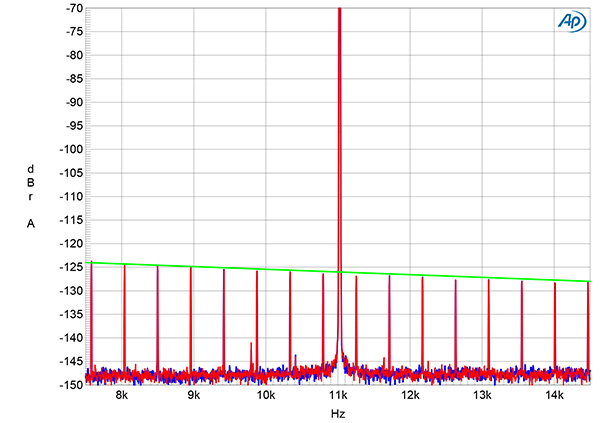
Fig.22 Eversolo DMP-A8, high-resolution jitter spectrum of analog output signal, 11.025kHz at –6dBFS, sampled at 44.1kHz with LSB toggled at 229Hz: 16-bit Toslink data (left channel blue, right red). Center frequency of trace, 11.025kHz; frequency range, ±3.5kHz.
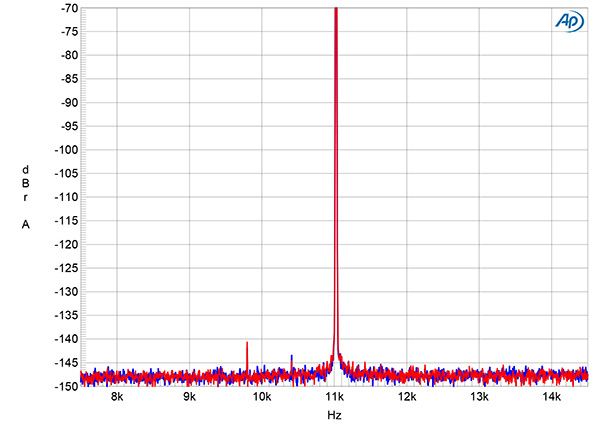
Fig.23 Eversolo DMP-A8, high-resolution jitter spectrum of analog output signal, 11.025kHz at –6dBFS, sampled at 44.1kHz with LSB toggled at 229Hz: 24-bit Toslink data (left channel blue, right red). Center frequency of trace, 11.025kHz; frequency range, ±3.5kHz.
The DMP-A8 offered superb rejection of word-clock jitter. Fig.20 was taken with 16-bit optical J-Test data. All the odd-order harmonics of the LSB-level, low-frequency squarewave lay at the correct levels, shown by the sloping green line, there are no supply-related sidebands present, and there is no broadening of the spectral spike at one-quarter the sample rate.
Despite its affordable price, the Eversolo DMP-A8's measured performance is state-of-the-art in both analog and digital domains.—John Atkinson
Footnote 1: See, for example, fig.11 here. Footnote 2: See, for example, fig.2 here.