

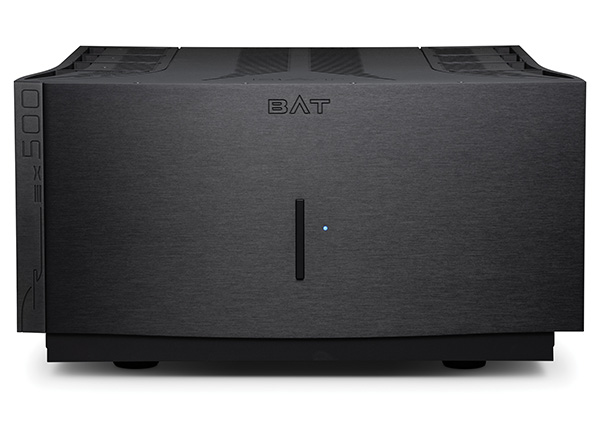
 Is it me, or is it hot in here?
The REX 500 is a class-AB amplifier that uses 24 high-current output devices per channel, giving it stupendous power: 500Wpc into 8 ohms, 1000Wpc into 4 ohms. (There's no official rating into 2 ohms.) Considering that amplifiers have to produce only a few continuous watts to make most speakers sing (very low-sensitivity and low-impedance loads excluded), you might think that such specs are overkill. To justify such a beast, Bednarski cited JA's measurements of Wilson Audio's Alexx V speakers, whose equivalent peak dissipation resistance (EPDR) drops below 2 ohms over most of the midrange and mid-treble, with minimum values elsewhere in the 1 ohm neighborhood. "That's the type of load for which an amplifier like the REX 500 will be a requirement," Bednarski said. He allowed that for most speakers, "you'll never need the power" that his amp delivers—but that doesn't mean that speakers with 4 to 8 ohm specs and 90+dB sensitivity won't benefit from a little of that REX elixir. In that application, "the speakers can reproduce the dynamics of a drum kit or the crescendo of a symphony orchestra with greater realism." Think of it this way, Bednarski proposed: "I've driven to the top of Pikes Peak a number of times. It's humbling how little power you have in reserve. You can think of the dynamic peaks in music as scaling mountains. The current delivery of the REX 500 allows peaks to be scaled with ease." As you might expect, the REX is quite the space heater, using 400W at idle and 3000W full tilt. After a day's worth of music in the 80–85dB range at the listening position, I brought out my touchless infrared thermometer and measured 111°F on the top cover and 124°F around the fins. That's about 10°–12° hotter than my Krell but well within BAT's operating standards.
To learn more about BAT's design approach and about the REX 500 in particular, I read the very informative white paper that Bednarski emailed me (footnote 4). These are the principles on which the REX 500 was designed. Don't restrict the signal. Restricting signal flow, BAT says, results in "loss of detail, anemic bass, and lackluster dynamics." Other amplifiers restrict signal flow by having too many voltage-gain stages, each with too little quiescent current—as little as 2–4mA. That keeps those products affordable, because boosting quiescent current means an increase in the required power; that in turn necessitates bigger and more expensive power transformers and filters. The REX 500 contains only two gain stages, one of which runs at a whopping 200mA per channel. Who needs negative feedback? Some years ago, Bednarski and his business partner, audio designer Victor Khomenko, built a prototype amplifier with feedback controls. They and a cadre of testers found that as little as 3dB of negative feedback audibly shrank the soundstage and restricted air around reproduced voices. "Notwithstanding the improvements that negative feedback brings to an amplifier's measured performance, every listener preferred the zero feedback position," BAT says. Consequently, the REX 500 uses no global feedback.
 Getting an earful
Specsmanship aside, how does the REX 500 perform as a music-making machine? Did it please the ear and gladden the heart?
 Elevated levels of transparency and resolution were also evident on Paddy McAloon's masterful I Trawl the Megahertz (24/44.1 FLAC, Sony Music UK/Qobuz, footnote 7). I could hear every word of American guest Yvonne Connor's spoken part on the 22-minute title track—not necessarily a given. The BAT seemed to improve her enunciation. Soundstaging, too, was stellar. You could circle each instrument with a fine-tip Sharpie.
 The upshot
The BAT REX 500 walks that happy line between reticence and bombast, giving preference to neither and varnishing nothing. It doesn't insert its own drama, but it renders sound that's both dramatic and refined—if that's what the recording calls for. Not to get too cute about it, but the REX is balanced in more than just topology.
Footnote 4: You'll find it at shorturl.at/emBY3. Footnote 5: Trying desperately to remember semiconductor physics, which I learned 30 years ago: Charge-carrier mobility is much higher in an N-type MOSFET (in which the carriers are electrons) than in a P-type MOSFET (in which the carriers are holes), so an N-type switches faster and has lower resistivity.—Jim Austin Footnote 6: I've never been thrilled about German jazz cognoscenti calling the genre yats (luckily, most say tschezz, which is close enough. That yats pronunciation should be as much of a crime as calling a nipple a Brustwarze ("breast wart"). It's an interesting language, nicht wahr? Footnote 7: The album is often credited to McAloon's old band, Prefab Sprout, but it's very much a solo effort, with little involvement from others.















