 Side 1 of Thelonious Monk's The London Collection: Volume 1 (Black Lion/ORG Music 1052) made clear the L-1's grip and control, but I listened to all four sides of this 45rpm reissue because the Sperling also produced realistic transients, generous sustain, and stable decays into very black backgrounds, all of which helped produce a three-dimensional image of a piano floating in space: Monk in my room, playing for me. The L-1 is one of the very quietest turntables I've heard—it well hid the mechanical nature of vinyl playback.
It's difficult to believe that more than a decade has passed since Mobile Fidelity Sound Lab reissued Patricia Barber's Nightclub as two 45rpm LPs mastered by Paul Stubblebine, but already it's been out of print for a while. Barber's original label recently reissued it on two 180gm LPs (Premonition 907631)—three sides at 33 1/3, one at 45—this time mastered by Bob Ludwig and cut to lacquer from the high-resolution digital master files by the late Doug Sax (the original recording, by Jim Anderson, was digital multitrack). The Lyra-Kuzma-Sperling combo easily laid bare the differences between the two versions, and the new one is superior in every way: deeper, better-textured bass; cleaner piano transients and vocal sibilants; better focus overall; and a richer, more intimate listening experience.
Side 1 of Thelonious Monk's The London Collection: Volume 1 (Black Lion/ORG Music 1052) made clear the L-1's grip and control, but I listened to all four sides of this 45rpm reissue because the Sperling also produced realistic transients, generous sustain, and stable decays into very black backgrounds, all of which helped produce a three-dimensional image of a piano floating in space: Monk in my room, playing for me. The L-1 is one of the very quietest turntables I've heard—it well hid the mechanical nature of vinyl playback.
It's difficult to believe that more than a decade has passed since Mobile Fidelity Sound Lab reissued Patricia Barber's Nightclub as two 45rpm LPs mastered by Paul Stubblebine, but already it's been out of print for a while. Barber's original label recently reissued it on two 180gm LPs (Premonition 907631)—three sides at 33 1/3, one at 45—this time mastered by Bob Ludwig and cut to lacquer from the high-resolution digital master files by the late Doug Sax (the original recording, by Jim Anderson, was digital multitrack). The Lyra-Kuzma-Sperling combo easily laid bare the differences between the two versions, and the new one is superior in every way: deeper, better-textured bass; cleaner piano transients and vocal sibilants; better focus overall; and a richer, more intimate listening experience.
 The armboard for the Swedish Analogue Technologies tonearm that I reviewed in July arrived from Sperling, and in it went. That took the L-1 to an even higher level of performance in terms of retrieval of low-level detail, resolution of textures, bottom-end authority, and stability of images and soundstaging. Only the very best turntables produce this kind of bass control, combined with the fast recovery and settling time required to produce rhythmic nimbleness.
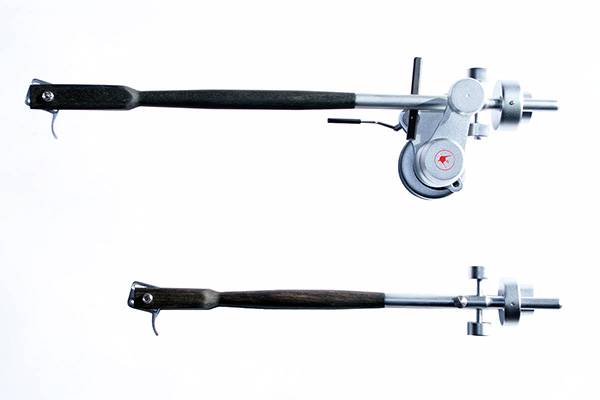 Sperling's TA-1 tonearm swings
Once I'd gotten a handle on the Sperling L-1 with the two familiar tonearms, it was time to set up Sperling's unusual TA-1 arm (patent pending), designed by Robert Fuchs in cooperation with Sperling-Audio. The TA-1 costs $9750 with 10" or 12" armtube; additional armtubes of either length cost $2975. The TA-1 is an unusual, hanging-unipivot design: The arm is suspended from a single metal point atop an armtube of wood and metal that's attracted to the dimpled magnetic bottom of a massive chromed screw threaded into an even more massive chromed base. A similar threaded arrangement, but from below, is adjusted via magnetic attraction—there's no physical contact between the arm and base—to damp and to some degree control the usual single-point wobble. A small threaded rod behind the pivot point, with weights on each end, adjusts azimuth.
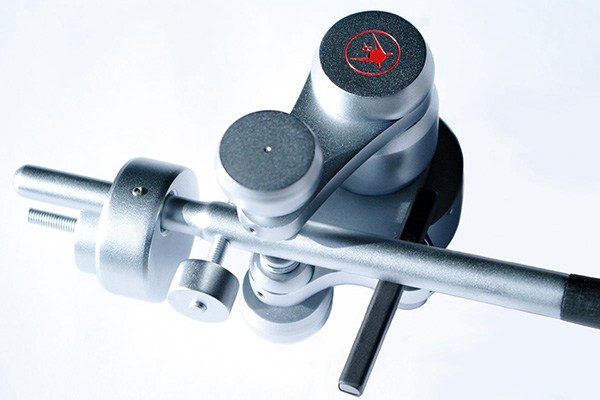 Once that's complete, you adjust VTF, vertical tracking angle (VTA), and stylus rake angle (SRA)—the latter two by adjusting the mounting base height—azimuth, and, finally, the amount of magnetic attraction anti-wobble damping; after which you must recheck VTF, which will have been affected by the damping magnet. The TA-1 has no antiskating mechanism, which means the stylus will ride the groove's inner wall as it nears the lead-out groove. The offset angle makes that a 100% certainty, though the 12" version will skate less because its offset angle is smaller. The advantage of this system is that you can pre-mount a variety of cartridges on armtubes and easily swap them out (though each time, you'll have to deal with the lack of strain relief and carefully reroute the wire). Sperling offers a variety of armtube woods for further tuning, and a 12" armtube well as the standard 10" one. Because of Sperling's unique mounting-plate system, even swapping a 10" for a 12" arm should take only a few minutes.
Once I got the hang of it, setting up the Sperling arm wasn't all that difficult, but it was harder than with many arms—and setting VTA and SRA weren't exactly user-friendly or repeatable. I'm also less than enthused by the three unsecured threaded weights: one at the back of the counterweight, two on the azimuth adjustment bar. Unsecured, they could be prone to resonate.
Once that's complete, you adjust VTF, vertical tracking angle (VTA), and stylus rake angle (SRA)—the latter two by adjusting the mounting base height—azimuth, and, finally, the amount of magnetic attraction anti-wobble damping; after which you must recheck VTF, which will have been affected by the damping magnet. The TA-1 has no antiskating mechanism, which means the stylus will ride the groove's inner wall as it nears the lead-out groove. The offset angle makes that a 100% certainty, though the 12" version will skate less because its offset angle is smaller. The advantage of this system is that you can pre-mount a variety of cartridges on armtubes and easily swap them out (though each time, you'll have to deal with the lack of strain relief and carefully reroute the wire). Sperling offers a variety of armtube woods for further tuning, and a 12" armtube well as the standard 10" one. Because of Sperling's unique mounting-plate system, even swapping a 10" for a 12" arm should take only a few minutes.
Once I got the hang of it, setting up the Sperling arm wasn't all that difficult, but it was harder than with many arms—and setting VTA and SRA weren't exactly user-friendly or repeatable. I'm also less than enthused by the three unsecured threaded weights: one at the back of the counterweight, two on the azimuth adjustment bar. Unsecured, they could be prone to resonate.
Despite my solid skepticism about its design, the TA-1 tracked very well, according to Image Hifi's Vinyl Essentials: The Ultimate Pickup Test Record (LP, Image Hifi LP003). Of course, this is as much, if not more, a function of the cartridge as of the tonearm, but it takes two to tango, and the TA-1 proved to be a good tracker, though I didn't experiment with warped records. A friend believes that I like Kuzma's 4Point arm because I'm a reviewer and want a more "analytical" sound. That's true. But an analytical sound is also what I'll want when I retire. I don't want an arm to "sound" at all. I want it to not sound, and to leave any sounding to the cartridge. The less an arm sounds, the more true detail it will reveal—at the very least, the more it will reveal the character of the transducer connected to it. The fact that not everyone feels that way is why we have tonearms that can be tuned.
 I'm in the midst of reviewing a new boxed set, Roxy Music's The Complete Studio Albums (8 LPs, Virgin EGBSX 1). "Sunset," the last track on Stranded, features piano and a double bass played by Chris Laurence. This album's many wonderful details have slowly revealed themselves over the 40 years (!) I've been playing it. Regardless of cartridge, the TA-1 accentuated the bass's resonant body but shortchanged the string textures when Laurence bows it. It did likewise with the piano, softening transient attacks and accentuating the soundboard. My brain rode the gliding warmth, which also magnified the image size. When this is done as unobtrusively as the TA-1 managed it, the results are indeed "magical"—and intoxicating. When I switched to the SAT tonearm, attacks tightened, and there was even more bottom-end weight in a more compacted space. The plucked bass notes stood out more, as did the percussion. The feeling of physical space between instruments intensified, along with the mix's three-dimensionality.
Not everyone cares about such things. There are even those who claim that these sorts of imaging, space, and three-dimensionality are artifacts of the recording and playback processes, and are not part of the experience of hearing live music. For them, there are arms like the TA-1, which produce "magic" and make a most pleasing sound. Inept wooden arms just sound warm, soggy, and lifeless. Inept metal arms sound bright, hard, and amusical.
I'm in the midst of reviewing a new boxed set, Roxy Music's The Complete Studio Albums (8 LPs, Virgin EGBSX 1). "Sunset," the last track on Stranded, features piano and a double bass played by Chris Laurence. This album's many wonderful details have slowly revealed themselves over the 40 years (!) I've been playing it. Regardless of cartridge, the TA-1 accentuated the bass's resonant body but shortchanged the string textures when Laurence bows it. It did likewise with the piano, softening transient attacks and accentuating the soundboard. My brain rode the gliding warmth, which also magnified the image size. When this is done as unobtrusively as the TA-1 managed it, the results are indeed "magical"—and intoxicating. When I switched to the SAT tonearm, attacks tightened, and there was even more bottom-end weight in a more compacted space. The plucked bass notes stood out more, as did the percussion. The feeling of physical space between instruments intensified, along with the mix's three-dimensionality.
Not everyone cares about such things. There are even those who claim that these sorts of imaging, space, and three-dimensionality are artifacts of the recording and playback processes, and are not part of the experience of hearing live music. For them, there are arms like the TA-1, which produce "magic" and make a most pleasing sound. Inept wooden arms just sound warm, soggy, and lifeless. Inept metal arms sound bright, hard, and amusical.
Were I to buy a Sperling-Audio L-1 turntable, I'd surely also opt for a TA-1 tonearm to install on one wing. I ultimately concluded that, despite its high-mass platter and plinth, the sound of the L-1 was somewhat stingy in the very area where the TA-1 was generous. You could always install an "analytical" arm on the L-1's other wing—even one temporarily borrowed from a friend—and check out those "recording artifacts." You might like them—or you might not!