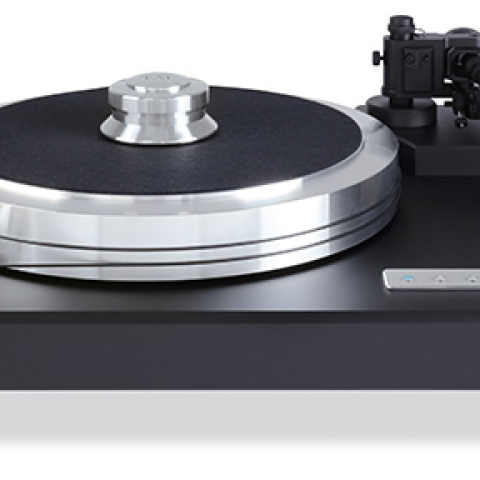
Previous experience with the brand tells me that VPI sees their record clamp more as a means of flattening warped records than of enhancing playback quality. If so, that's fine by me: The few times I tried it, the clamp was indeed a decent flattener. But in every case, I disliked the clamp's effect on the sound, which I heard as a fairly drastic decrease in spatial scale and an increase in that most difficult to describe of all sonic shortcomings: fussiness. (Someone else may hear those things as an increase in soundstaging accuracy. Each to his own.) Consequently, all of the listening I've described below was done clamplessly.
Calling Dr. Feickert
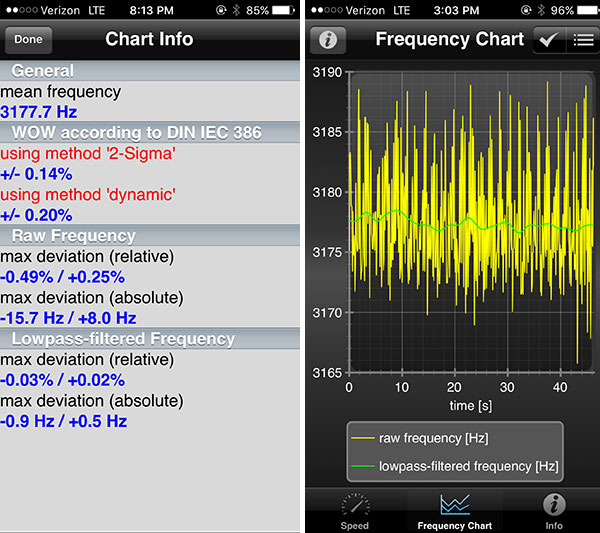
Near the end of my listening, I measured the Prime Scout with Dr. Feickert Analogue's Adjust+ test record and PlatterSpeed software for Apple iOS, with the MusiKraft Denon DL-103 cartridge, on which I'd relied most heavily. I observed a mean frequency of 3177.4Hz for a 3150Hz groove modulation (figs. 1 & 2): obviously, a little high. I also observed ±0.16% dynamic wow and ±0.22% 2-sigma wow. When I ran the same tests with the VPI's rubber platter washer and record clamp (figs. 3 & 4), the speed remained almost exactly the same, but dynamic wow increased to ±0.20%, and 2-sigma wow decreased to ±0.14%. Similarly, the Prime Scout's negative maximum speed deviation went up considerably, positive maximum speed deviation, down. For the record (haw), this was later in the afternoon, with higher ambient temperatures and humidity than when I took the readings without the washer and clamp—conditions to which these small and crazy changes could be attributed. It may be worth noting that, at its best, the Prime Scout exhibited roughly twice as much wow as I measured in my 1950s Garrard 301 (with its original idler wheel).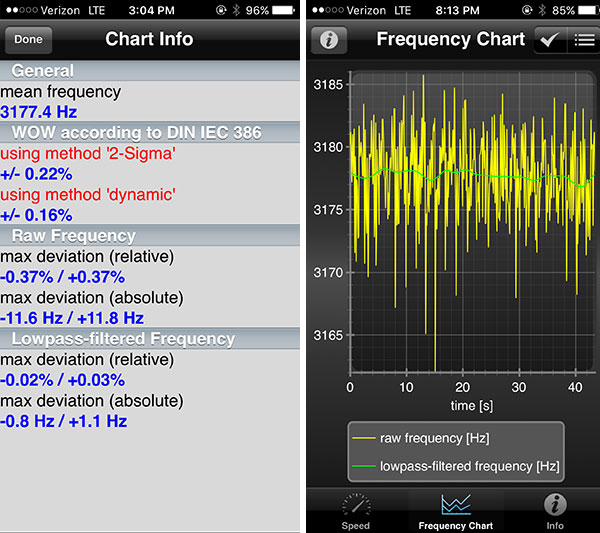
 Listening
The Prime Scout didn't just sound good in my system—it played music with excellent momentum and, when called for, swing. The first record I tried was the Original Jazz Classics reissue of The Thelonious Monk Orchestra at Town Hall (Riverside/OJC-135)—a disc that, through less sympathetic gear, can sound lightweight. (I've never heard an original Riverside copy.) On the Prime Scout, with the MusiKraft Denon DL-103 cartridge, the music's eccentric, relentless drive came through loud and clear—and, happily, Sam Jones's double-bass lines were both audible and colorful. Listening through to the next number, "Crepuscule with Nellie," I was no less happy to hear abundant texture and color from the alto, tenor, and baritone saxes, and from Monk's piano—that, and a beautifully realistic sense of touch. In fact, I was so impressed by the sound of the piano in the Monk recording that I moved right on to Claude Helffer's recording of Schoenberg's complete works for solo piano (Harmonia Mundi HM 752). This is the sort of music my family doesn't care for—it is, in a word, noisy—so I don't trot it out very often. On this outing, it sounded impressive overall: there was a purposefulness about the performances that escapes lesser turntable-tonearm combinations—in whose hands the disc really is little more than noise—and the piano's tone had sufficient meat. Very early in the album, near the record's edge, I heard some pitch instability—which, on closer examination, seemed to spring (sorry) from a jiggling cartridge. I carefully re-cued the track to hear if there was some basic incompatibility between the MusiKraft-Denon and the VPI arm (this was before I'd made the measurements described above), or if the cartridge was just having a hard time finding its poise when first set in the groove. The latter proved true; with the JMW 9 more than with, say, the Naim Aro unipivot arm, I found that in cueing LPs, extra care was rewarded and haste punished. I may not be a soundstaging freak, but the importance of good spatial performance to the high-end audio experience in general—and to high-end phonography in particular—is not lost on me. I had a delightful time playing on the Prime Scout a few sonic spectaculars known for their impressive spatial content, including the famous recording, by Ernest Ansermet and the Swiss Romande Orchestra, of Falla's The Three-Cornered Hat, on a US pressing (London CS 6224). Reproduced well, this recording throws a remarkably big, spacious, convincingly detailed soundstage—all of which qualities the VPI 'table and arm served up in spades, including, early in the piece, a very convincing portrayal of the offstage voice of soprano Teresa Berganza. Even more impressive were the believable weight and resonance of the kettledrums, the forceful and well-textured thrum of the massed strings, the perfect tones of all woodwind instruments—piccolos and flutes sounded as hard as they should, but no harder—and the fine sense of musical drive overall.
Speaking of drive and force, the VPI player did a pretty good job with Captain Beefheart and the Magic Band's Clear Spot (Reprise MS 2115), a brilliant, groove-rich record that disappoints only in using bassist Roy Estrada (aka Oréjon) on most numbers, instead of the group's far more talented Mark Boston (aka Rockette Morton), who on this album plays second guitar gamely but unspectacularly. But Boston's electric bass is featured on "Golden Birdies," the album's final number, and the Prime Scout delivered a good measure of the tone and touch that are typical of his brilliant playing, though those qualities stand out better on my old idler-wheel Garrard 301.
At the other end of intensity spectrum, yet no less in need of a player capable of communicating touch, is Ricky Skaggs and Tony Rice's Skaggs & Rice (Sugar Hill SH-3711), a well-recorded program of 10 old-time country and bluegrass standards, picked and sung to perfection. The VPI player nailed the sounds of Skaggs's extremely precise vocal intonation and brisk mandolin breaks—he borrowed David Grisman's Gibson F-5 "Lloyd Loar" mandolin for this record, and through the VPI, the instrument's power and tone came through loud and clear—and Rice's slightly mellower, richer voice and incomparably fluid flatpicking. Especially with "Where the Soul of Man Never Dies," in which Skaggs and Rice channel Bill and Charlie Monroe, the Prime Scout plus modified Denon cartridge played the music with unerring momentum and complete emotional immersion: It would have been impossible not to listen to both sides, straight through.
At one point I switched from the MusiKraft Denon cartridge to my Miyajima Premium BE Mono, the low compliance of which usually ensures good performance with higher-mass tonearms, and I began my mono listening with the title song of June Christy's Something Cool. (Although I enjoy the excellent Classic Records reissue of the full album, this time out I played my original 10" LP from 1955, Capitol H516.) From the descending arpeggio of double bassist Harry Babasin's entrance, it was obvious that the combination of Prime Scout and Miyajima cartridge was a very musical one: that bass was as taut as it should be, with exceptional touch and color—and, on the very lowest notes, impressive power. Even at their loudest, the horns retained their composure, and Christy's up-front voice had very good presence and body—and, especially in such up-tempo numbers as "It Could Happen to You," this combination swung.
 My favorite piano recordings are mostly mono LPs from the late 1940s through the early 1960s, and I couldn't let the Prime Scout leave the house without playing a few. With the Miyajima cartridge along for the ride, the VPI player communicated Walter Gieseking's spirited playing and technical mastery in his recording of Beethoven's Sonata 4 (Angel 35655), and reminded me of how brilliantly good—tonally well balanced and full, with plenty of force and spatial presence—his recordings from this era sound. And the VPI was sufficiently insightful that the musical distinctions between the versions of Chopin's 24 Preludes by Alexander Brailowsky (Columbia ML 5444, in a nice "six-eyes" pressing) and Samson François (UK Columbia 33CX 1877) were clearer than ever: With Prelude 2, for example, Brailowsky was precise but emotionally shallow (and he goes overboard on the pedal), while François sounded hypnotic in an absinthe-soaked way that seemed appropriate in the extreme. Time and again, the VPI found those elements that distinguish a transcendent recorded performance from the run of the mill, and put them across to great effect.
Conclusions
My favorite piano recordings are mostly mono LPs from the late 1940s through the early 1960s, and I couldn't let the Prime Scout leave the house without playing a few. With the Miyajima cartridge along for the ride, the VPI player communicated Walter Gieseking's spirited playing and technical mastery in his recording of Beethoven's Sonata 4 (Angel 35655), and reminded me of how brilliantly good—tonally well balanced and full, with plenty of force and spatial presence—his recordings from this era sound. And the VPI was sufficiently insightful that the musical distinctions between the versions of Chopin's 24 Preludes by Alexander Brailowsky (Columbia ML 5444, in a nice "six-eyes" pressing) and Samson François (UK Columbia 33CX 1877) were clearer than ever: With Prelude 2, for example, Brailowsky was precise but emotionally shallow (and he goes overboard on the pedal), while François sounded hypnotic in an absinthe-soaked way that seemed appropriate in the extreme. Time and again, the VPI found those elements that distinguish a transcendent recorded performance from the run of the mill, and put them across to great effect.
Conclusions
How did VPI's Prime Scout stack up against the Scout? The Scout is gone from their line, and my review sample long gone from my home, so I'm forced to rely on memory—and memory suggests that the new model sounds like a clearer, tightened-up, altogether more engaging version of the old. If you liked the Scout, you'll really like the Prime Scout, which seems to offer good value, both comparatively and in and of itself. Competition? In addition to the products mentioned at the start of this review, in recent years my recommendations to friends have expanded to include a few other reliably musical players, especially Well Tempered Labs' entry-level models—and, for people who have a taste for the performance attributes associated with vintage record players, the PTP Solid12 with a Thomas Schick tonearm and an Ortofon SPU or EMT TSD 15 pickup.
I could suggest those and sleep easy: They were—and still are—really good recommendations, albeit as distinct from each other as a KT88 tube is from a 6L6 is from a 300B is from an EL34. No less worthy, and no less distinct, is VPI's Prime Scout (an EL84?), which combines compelling musicality with semi-turnkey ease of use—and, as its platter mat reminds us, is made in usa. As they say in New Jersey, what's not to like?
Near the end of my listening, I measured the Prime Scout with Dr. Feickert Analogue's Adjust+ test record and PlatterSpeed software for Apple iOS, with the MusiKraft Denon DL-103 cartridge, on which I'd relied most heavily. I observed a mean frequency of 3177.4Hz for a 3150Hz groove modulation (figs. 1 & 2): obviously, a little high. I also observed ±0.16% dynamic wow and ±0.22% 2-sigma wow. When I ran the same tests with the VPI's rubber platter washer and record clamp (figs. 3 & 4), the speed remained almost exactly the same, but dynamic wow increased to ±0.20%, and 2-sigma wow decreased to ±0.14%. Similarly, the Prime Scout's negative maximum speed deviation went up considerably, positive maximum speed deviation, down. For the record (haw), this was later in the afternoon, with higher ambient temperatures and humidity than when I took the readings without the washer and clamp—conditions to which these small and crazy changes could be attributed. It may be worth noting that, at its best, the Prime Scout exhibited roughly twice as much wow as I measured in my 1950s Garrard 301 (with its original idler wheel).
Fig.1 (left) VPI Prime Scout, speed stability data without clamp.
Fig.2 (right) VPI Prime Scout, speed stability (raw frequency yellow; low-pass filtered frequency green) without clamp.
Fig.3 (left) VPI Prime Scout, speed stability data with clamp.
Fig.4 (right) VPI Prime Scout, speed stability (raw frequency yellow; low-pass filtered frequency green) with clamp.
I also used Hi-Fi News & Record Review's Test Record (Hi-Fi News HFN 001) to evaluate the compatibility between the VPI's tonearm and the MusiKraft/Denon DL-103 cartridge, and measured a strong lateral-plane resonance at 9Hz—though not so strong that the stylus lost contact with the groove—with "sidebands" at 7 and 11Hz, and a pronounced 10Hz resonance in the vertical plane. Those numbers suggested a solidly good match of cartridge to arm, as I'd expected from the moderately low-compliance Denon and the empirically high-mass VPI. (VPI specifies for the JMW 9 an effective mass of 10.2gm, which strikes me as a little low.)
I was impressed by the VPI player's build quality, thinking this iteration of the JMW 9 is perhaps the best-finished I've seen. More important, the machining evident in the Prime Scout's aluminum platter was superb: It ran impressively true. The only visible shortcoming was a slight amount of wobble in the motor's polymer pulley, which came into focus when I slipped a 0.5"-thick strip of wood between the top of the motor body and the underside of the pulley, and watched as the tiny gap between the two fluctuated in size. I also heard, with slight annoyance, a faint, brief screech every time I switched on the motor; the thorough instruction manual mentions that this might happen, and recommends talcum powder on the belt as a cure. I had none at hand (remarkably, given that I'm writing this in July), so, as Leonard Cohen once sang, I never tried.
The Prime Scout didn't just sound good in my system—it played music with excellent momentum and, when called for, swing. The first record I tried was the Original Jazz Classics reissue of The Thelonious Monk Orchestra at Town Hall (Riverside/OJC-135)—a disc that, through less sympathetic gear, can sound lightweight. (I've never heard an original Riverside copy.) On the Prime Scout, with the MusiKraft Denon DL-103 cartridge, the music's eccentric, relentless drive came through loud and clear—and, happily, Sam Jones's double-bass lines were both audible and colorful. Listening through to the next number, "Crepuscule with Nellie," I was no less happy to hear abundant texture and color from the alto, tenor, and baritone saxes, and from Monk's piano—that, and a beautifully realistic sense of touch. In fact, I was so impressed by the sound of the piano in the Monk recording that I moved right on to Claude Helffer's recording of Schoenberg's complete works for solo piano (Harmonia Mundi HM 752). This is the sort of music my family doesn't care for—it is, in a word, noisy—so I don't trot it out very often. On this outing, it sounded impressive overall: there was a purposefulness about the performances that escapes lesser turntable-tonearm combinations—in whose hands the disc really is little more than noise—and the piano's tone had sufficient meat. Very early in the album, near the record's edge, I heard some pitch instability—which, on closer examination, seemed to spring (sorry) from a jiggling cartridge. I carefully re-cued the track to hear if there was some basic incompatibility between the MusiKraft-Denon and the VPI arm (this was before I'd made the measurements described above), or if the cartridge was just having a hard time finding its poise when first set in the groove. The latter proved true; with the JMW 9 more than with, say, the Naim Aro unipivot arm, I found that in cueing LPs, extra care was rewarded and haste punished. I may not be a soundstaging freak, but the importance of good spatial performance to the high-end audio experience in general—and to high-end phonography in particular—is not lost on me. I had a delightful time playing on the Prime Scout a few sonic spectaculars known for their impressive spatial content, including the famous recording, by Ernest Ansermet and the Swiss Romande Orchestra, of Falla's The Three-Cornered Hat, on a US pressing (London CS 6224). Reproduced well, this recording throws a remarkably big, spacious, convincingly detailed soundstage—all of which qualities the VPI 'table and arm served up in spades, including, early in the piece, a very convincing portrayal of the offstage voice of soprano Teresa Berganza. Even more impressive were the believable weight and resonance of the kettledrums, the forceful and well-textured thrum of the massed strings, the perfect tones of all woodwind instruments—piccolos and flutes sounded as hard as they should, but no harder—and the fine sense of musical drive overall.
My favorite piano recordings are mostly mono LPs from the late 1940s through the early 1960s, and I couldn't let the Prime Scout leave the house without playing a few. With the Miyajima cartridge along for the ride, the VPI player communicated Walter Gieseking's spirited playing and technical mastery in his recording of Beethoven's Sonata 4 (Angel 35655), and reminded me of how brilliantly good—tonally well balanced and full, with plenty of force and spatial presence—his recordings from this era sound. And the VPI was sufficiently insightful that the musical distinctions between the versions of Chopin's 24 Preludes by Alexander Brailowsky (Columbia ML 5444, in a nice "six-eyes" pressing) and Samson François (UK Columbia 33CX 1877) were clearer than ever: With Prelude 2, for example, Brailowsky was precise but emotionally shallow (and he goes overboard on the pedal), while François sounded hypnotic in an absinthe-soaked way that seemed appropriate in the extreme. Time and again, the VPI found those elements that distinguish a transcendent recorded performance from the run of the mill, and put them across to great effect.
ConclusionsHow did VPI's Prime Scout stack up against the Scout? The Scout is gone from their line, and my review sample long gone from my home, so I'm forced to rely on memory—and memory suggests that the new model sounds like a clearer, tightened-up, altogether more engaging version of the old. If you liked the Scout, you'll really like the Prime Scout, which seems to offer good value, both comparatively and in and of itself. Competition? In addition to the products mentioned at the start of this review, in recent years my recommendations to friends have expanded to include a few other reliably musical players, especially Well Tempered Labs' entry-level models—and, for people who have a taste for the performance attributes associated with vintage record players, the PTP Solid12 with a Thomas Schick tonearm and an Ortofon SPU or EMT TSD 15 pickup.