The largest regularly scheduled choral singing event in the world is the Estonian National Song Festival, or Laulupidu, which comes around about once every five years in Tallinn, Estonia's capital city. The numbers are pretty mind blowing. Two all-day concerts are held over a weekend in early July, and this year, at its peak, the number of singers on stage at one time reached 32,022, performing to an audience of 100,000. Pretty amazing for a small country of just 1.4 million people. This is truly Choral Woodstock. I wrote about my first trip to the 1985 Laulupidu in Spin Doctor #9, which took place in what at the time was occupied Soviet Estonia. Since then, I have attended four more times.
It's impossible to overstate the importance of singing in Estonian culture. The 1991 revolution that brought Estonia its independence from Soviet occupation is commonly known as the Singing Revolution due to the use of song as a form of protest. Almost every town, village, school, and social club in the country has its own choir. The 990 choirs that participated in this year's festival had to audition to be selected: If your choir doesn't meet the standards of the selection committee, you'll be watching from the audience. As in the last festival in 2019, my sister Lisa and one of her daughters were in choirs that passed muster and were able to participate.
It's hard to describe the sound produced by 32,000 well-trained singers going full tilt. Surprisingly, it's not about volume. Because Laulupidu is held in a bowl-like outdoor setting, when I pulled up an app to measure the sound pressure level from my position about 300' behind the conductor, it was reaching peaks of only about 104dB. What's harder to wrap your head around is the sheer nature-force created by the perfect blend of all of those voices. In a way, it's kind of analogous to watching a 4K video image vs a 480i one: As the number of singers goes up, the blend of the voices becomes more homogeneous. Such massive numbers make it impossible for a single voice to stand out. Timing is critical, because some singers are as much as 350' from each other. It takes a third of a second for the sound from one end of the choir to reach the other end. The musicians are instructed to rely entirely on visual cues from the conductor instead of listening to each other.
For me, choral music is a bit of a guilty pleasure, but exactly where this passion comes from, I really can't say. I was roped into choral singing as a teenager at school in England long before I fully embraced my Estonian heritage (which didn't happen until I was an adult). The assistant housemaster of my boarding house was one of the school's music directors, and somehow he cajoled me into signing up for one of the school's choirs—not the big, 70-person chorus that people just did for a lark during Thursday lunch breaks but the elite, 15-member Motet Choir, which went on tour during the summer break and performed on the BBC. Quite why he thought I would be good enough I had no idea, but I managed to fake my way through it for my final two years at school.
Choral music, I find, is the most difficult genre to record and reproduce convincingly, especially on vinyl. That nature-force blend of voices I mentioned, like I heard at the song festival, often ends up sounding like a congested ball of mush, with little clarity or definition. This is why when I'm evaluating record-playing gear, I will often talk about its ability to unravel and separate out the mush.
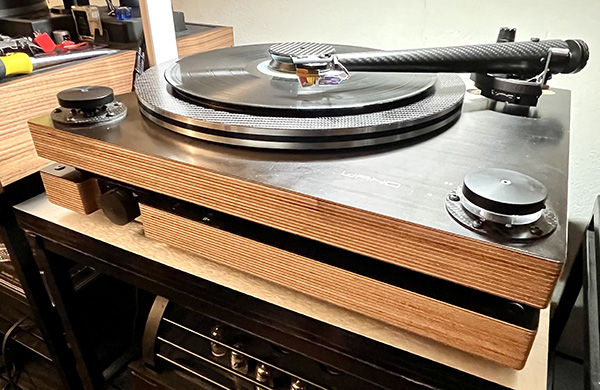 The Wand Master turntable and Dark-Light tonearm
In Spin Doctor #8, I wrote about how The Wand 14-4 turntable "managed to unravel" the "thicket of sound" that is Laibach's album Let It Be, "clarifying and opening things up." Then in Spin Doctor #12, I performed several upgrades to the 14-4, including their battery motor drive and improved isolation feet. I described how these changes clicked the performance up a few notches.
Never one to rest on his laurels, Wand designer Simon Brown has pushed the ball even further with his new turntable, the 14-4 Master ($8450) and the Wand Dark-Light tonearm ($8500). When you buy them together, the combination costs $15,255 (footnote 1).
The Master turntable takes all the piecemeal upgrades I added to the original 14-4 and combines them into a much more elegant package, along with some additional improvements. The plinth is now a two-layer affair. The bottom level incorporates the battery motor–drive circuitry that had been an option via a separate outboard box. The top layer is basically a standard 14-4, but now it's isolated further by the lower plinth. There's a place on the lower plinth for mounting a second armboard, for a second tonearm. Unusually, mounted as it is on the isolated lower plinth, the second arm will not be rigidly coupled to the platter. This flies in the face of most conventional thinking about the importance of rigid arm-platter coupling. I didn't have an extra arm to make a comparison.
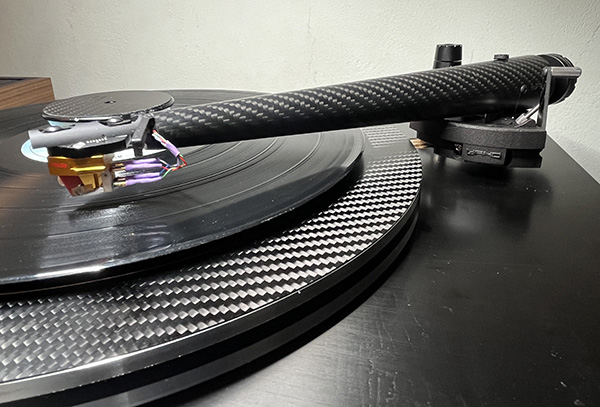 The Dark-Light tonearm is the most visually striking part of the new package with its steeply tapered profile. Brown says the taper creates a more rigid structure than the tubular armtube, but more importantly, it distributes the resonant modes of the arm more evenly, minimizing their sonic fingerprint. Brown calls it a "musical taper" due to its low coloration. The name Dark-Light describes how the arm and cartridge manage to extract music from the dark depths of the record groove, bringing it into the light with vibrant color.
The setup and adjustment of the Dark-Light is much less convoluted than the standard Wand arm, and it now has a VTA tower and a much better anti-skating device. Yet this is still clearly the work of an independent thinker, with quirks that make setup and adjustment non-intuitive. You'll need to study the manual and online videos first. I had a big advantage: I received the review turntable fully assembled, with a Lyra Delos cartridge installed. I was able to work from there to fine-tune things. In addition to the Delos, I also installed my Ortofon MC 90X cartridge, which I bought after reviewing it in Spin Doctor #26.
The Dark-Light tonearm is the most visually striking part of the new package with its steeply tapered profile. Brown says the taper creates a more rigid structure than the tubular armtube, but more importantly, it distributes the resonant modes of the arm more evenly, minimizing their sonic fingerprint. Brown calls it a "musical taper" due to its low coloration. The name Dark-Light describes how the arm and cartridge manage to extract music from the dark depths of the record groove, bringing it into the light with vibrant color.
The setup and adjustment of the Dark-Light is much less convoluted than the standard Wand arm, and it now has a VTA tower and a much better anti-skating device. Yet this is still clearly the work of an independent thinker, with quirks that make setup and adjustment non-intuitive. You'll need to study the manual and online videos first. I had a big advantage: I received the review turntable fully assembled, with a Lyra Delos cartridge installed. I was able to work from there to fine-tune things. In addition to the Delos, I also installed my Ortofon MC 90X cartridge, which I bought after reviewing it in Spin Doctor #26.
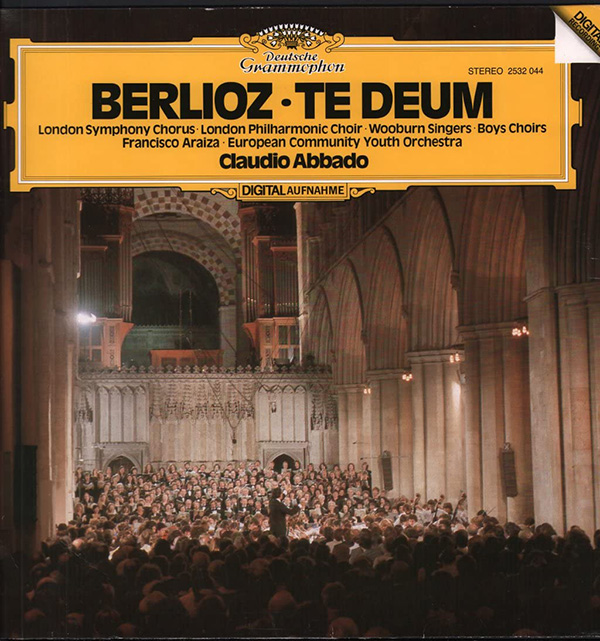 I don't own any recordings of the Estonian Song Festival on vinyl, and a quick search on Discogs shows that only one or two are available. A large-scale choral work I do have is the 1981 recording of Berlioz's Te Deum (Deutsche Grammophon 2532 044) with Claudio Abbado conducting the European Community Youth Orchestra, a big pipe organ, and the combined voices of nine choirs including the London Symphony Chorus and the London Philharmonic Choir. In contrast to that Estonian outdoor venue, everyone here was jammed together with an audience inside St Alban's Cathedral near London. There is a video of this performance on YouTube; there you can see how tightly packed together everyone was. This is an early digital recording, and as such it can sound a bit opaque, but with the Wand combo it was refreshingly uncongested. When things really get cooking during the final movement, "Judex crederis," the dynamic swings were startling at times. My subwoofer rattled the windows with bass from the organ.
One of my favorite choral recordings (though it doesn't boast the massive forces of Te Deum) is Handel's coronation anthem Dixit Dominus performed by the King's College Choir from 1966 (HMV Concert Classics SXLP 30444). When I bought this record at Princeton Record Exchange about 15 years ago, I spotted a yellow Post-it note attached to the inner sleeve which read "REG you'll like this one HP"; surely this was a present from longtime editor of The Absolute Sound Harry Pearson to writer Robert E. Greene. Apparently, though, Mr. Greene didn't agree with HP's assessment, considering that it was now for sale at Princeton Record Exchange.
I don't own any recordings of the Estonian Song Festival on vinyl, and a quick search on Discogs shows that only one or two are available. A large-scale choral work I do have is the 1981 recording of Berlioz's Te Deum (Deutsche Grammophon 2532 044) with Claudio Abbado conducting the European Community Youth Orchestra, a big pipe organ, and the combined voices of nine choirs including the London Symphony Chorus and the London Philharmonic Choir. In contrast to that Estonian outdoor venue, everyone here was jammed together with an audience inside St Alban's Cathedral near London. There is a video of this performance on YouTube; there you can see how tightly packed together everyone was. This is an early digital recording, and as such it can sound a bit opaque, but with the Wand combo it was refreshingly uncongested. When things really get cooking during the final movement, "Judex crederis," the dynamic swings were startling at times. My subwoofer rattled the windows with bass from the organ.
One of my favorite choral recordings (though it doesn't boast the massive forces of Te Deum) is Handel's coronation anthem Dixit Dominus performed by the King's College Choir from 1966 (HMV Concert Classics SXLP 30444). When I bought this record at Princeton Record Exchange about 15 years ago, I spotted a yellow Post-it note attached to the inner sleeve which read "REG you'll like this one HP"; surely this was a present from longtime editor of The Absolute Sound Harry Pearson to writer Robert E. Greene. Apparently, though, Mr. Greene didn't agree with HP's assessment, considering that it was now for sale at Princeton Record Exchange.
 Assuming that's true, I'm inclined to agree with HP. The recording is rich and vibrant, highlighting the splendid acoustics of the King's College Chapel. King's is probably the finest all-male choir in existence in the English-Anglican tradition, with incredibly well-trained boys singing the treble and alto parts. Through the Wand, this record soared, with powerful dynamics from the top parts and a well-rounded accompaniment from the English Chamber Orchestra. This is one of those records where, once it starts, I sit through it at least to the end of the side, luxuriating in the beauty of it all. The Wand drives that point home even more, making me wish it wouldn't end.
I didn't want this to be an all-choral-music piece, so I returned to jazz bassist Gary Peacock's album Tales of Another (ECM 1-1101), which I had used while assessing the original Wand turntable and tonearm early last year. The track "Vignette" opens with drummer Jack DeJohnette making subtle percussive sounds on various cymbals before Keith Jarrett comes in with a beautiful, flowing piano line. At first, Peacock stays out of the way, underpinning the sound, but then he moves into a heartfelt solo, playing high up on his instrument. I no longer have the original Wand 14-4 player here for comparison, but with the Master and Dark-Light, I heard a level of refinement, clarity, and beauty of tone that I don't recall hearing back then.
More than almost any other turntable and arm I can think of, Simon Brown's recent designs reflect his individualistic approach and outside-the-box thinking. In some ways, his creations remind me of Saabs—the cars—in that so many different features are off beat, but when you analyze the results, you realize that his choices are entirely valid. Definitely recommended.
The static cure
Assuming that's true, I'm inclined to agree with HP. The recording is rich and vibrant, highlighting the splendid acoustics of the King's College Chapel. King's is probably the finest all-male choir in existence in the English-Anglican tradition, with incredibly well-trained boys singing the treble and alto parts. Through the Wand, this record soared, with powerful dynamics from the top parts and a well-rounded accompaniment from the English Chamber Orchestra. This is one of those records where, once it starts, I sit through it at least to the end of the side, luxuriating in the beauty of it all. The Wand drives that point home even more, making me wish it wouldn't end.
I didn't want this to be an all-choral-music piece, so I returned to jazz bassist Gary Peacock's album Tales of Another (ECM 1-1101), which I had used while assessing the original Wand turntable and tonearm early last year. The track "Vignette" opens with drummer Jack DeJohnette making subtle percussive sounds on various cymbals before Keith Jarrett comes in with a beautiful, flowing piano line. At first, Peacock stays out of the way, underpinning the sound, but then he moves into a heartfelt solo, playing high up on his instrument. I no longer have the original Wand 14-4 player here for comparison, but with the Master and Dark-Light, I heard a level of refinement, clarity, and beauty of tone that I don't recall hearing back then.
More than almost any other turntable and arm I can think of, Simon Brown's recent designs reflect his individualistic approach and outside-the-box thinking. In some ways, his creations remind me of Saabs—the cars—in that so many different features are off beat, but when you analyze the results, you realize that his choices are entirely valid. Definitely recommended.
The static cure
I received a text from one of my setup clients in Brooklyn saying that the $18,000 cartridge I had recently installed for him was suffering from loud static popping. Before heading over to evaluate the problem, I figured I should collect and pack up a few possible solutions. I called Gary Koh from Genesis Advanced Technologies, the cartridge's distributor, to brainstorm some possible fixes. Gary suggested checking the turntable's grounding scheme and recommended some adhesive copper strips along with a grounded carbon-fiber sweep arm, a 21st century version of the Dust Bug people used in the 1970s. The task of neutralizing static buildup on records has challenged turntable accessory makers for decades. Several devices have used ion emissions with varying degrees of success. The client with the crackly $18,000 cartridge had already tried the venerable Zerostat, which has been around for decades, but it didn't help. I suggested to Gary that we try a DS Audio ION-001 vinyl ionizer. This $1800 tower-shaped device sits off to the side of your turntable, silently wafting a constant flow of ions—negative and positive—toward the record on the turntable. Negative ions are attracted to accumulated positive charge, positive ions to accumulated negative charge, canceling and neutralizing static. I have seen people using these devices at shows, but I haven't tried one myself. I was game, but Gary nixed the idea out of concern that the ion bath could affect the delicate elastic damper in the pricey cartridge. (Ionizers are well-known to degrade rubber.) DS Audio makes some of the finest cartridges on the planet, so if this was a problem, I figure they wouldn't make the ION-001, but I wasn't going to argue against Gary's fine instincts. So I proposed a different ion-wafting device, the Orbit, which is made by HumminGuru, the people who made the Nova ultrasonic record cleaner I covered in Spin Doctor #22. The Orbit is different from the ION-001 in that it isn't intended to deliver a constant flow of ions. Rather, you use the Orbit to treat the record for a minute or two before you play it, like a higher-tech version of the Zerostat.
After my discussions with Gary, I ordered all the proposed solutions and, armed with my static remedy kit, headed over to the client's place.
After all of that careful prep, it turned out that the problem he was experiencing was something completely different, nothing to do with static buildup. So much for that! But now I had a cool new toy to check out.
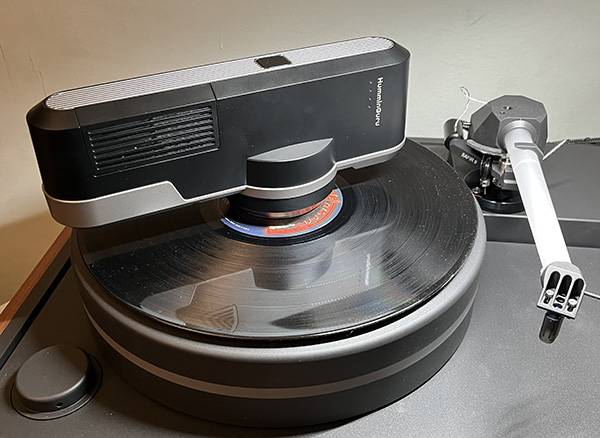 HumminGuru Orbit HG03 Vinyl Record Static Remover
Looking a bit like some kind of electronic kitchen gadget from the 1990s, the Orbit is a $300 oblong plastic and metal block a little shorter than a record is wide. With the platter stopped, you position the Orbit on top of your record using a hole that accepts the platter spindle, then you simply press a button on the top and let it do its job. After a couple of seconds, it starts to rotate counterclockwise with the ion outlet passing about an inch above the record surface. It makes 10 rotations in about 90 seconds. An internal fan directs the positive and negative ions toward the record surface, bathing it evenly across the playing surface. The spindle hole in the base of the Orbit isn't very deep, so with turntables that have a tallish spindle, you'll need to use the included spacers—why didn't they just make the spindle hole deeper? That isn't clear.
A turntable where static can be a problem is the Linn Sondek LP12. Often I find that its thin felt mat will lift up as you remove a record from the platter, stuck to the vinyl by a strong static charge. Many Linn owners use double-stick tape to hold the mat in place, but that is hardly an elegant solution. I don't have an LP12 on hand to test the Orbit on, but I do have plenty of Linn felt mats. Static really isn't a problem in the humid New York City summer heat, so to recreate the mat static sticking effect, I put a Linn mat on the Kuzma Stabi M turntable then rubbed both sides of a record with a synthetic microfiber cloth. The resulting static charge was powerful enough to lift the mat; in fact, I felt it attracting the hairs on my arm as I moved it near the record. After a 90-second cycle with the Orbit, the static was completely gone, with no attraction to the mat or my arm hair. I call that a complete success.
In the owner's manual, HumminGuru says you should use the supplied brush to dust off the fan blades and ion pins after each use. That seems like overkill tome.I saw no sign of dust buildup after destaticking several records. An internal rechargeable battery powers the Orbit. There's a USB-C socket to recharge it.
As is usual with HumminGuru, the factory-direct price varies with exchange rates. Now you can add tariffs to the mix. As I write this, the US direct price is $247 plus shipping (footnote 2). I paid extra to avoid uncertainty, a penny less than $300 at the HumminGuru Amazon store. The Orbit costs a little bit more than double the price of a Zerostat, but I found it much easier to use and far more effective. Definitely recommended if you play records in a static-prone environment.
Footnote 1: The Wand, manufactured by Design Build Listen, PO Box 32, Motueka 7143, New Zealand. Tel: +64 21-502037. Email: info@designbuildlisten. com. Web: designbuildlisten.com. US importer: Profundo, 2051 Gattis School Rd. Suite 540/123, Round Rock, TX 78664. Tel: (510) 375-8651. Email: info@profundo.us. Web: profundo.us. Footnote 2: HumminGuru, Happy Well International Enterprise, Ltd. Rm. 1202. 12/F New Mandarin Plaza, Tower B, No. 14 Science Museum Rd., Tsim Sha Tsui East, Kowloon, Hong Kong. Email: support@ happywell.com.hk. Web: humminguru. com.
The Wand Master turntable and Dark-Light tonearmIn Spin Doctor #8, I wrote about how The Wand 14-4 turntable "managed to unravel" the "thicket of sound" that is Laibach's album Let It Be, "clarifying and opening things up." Then in Spin Doctor #12, I performed several upgrades to the 14-4, including their battery motor drive and improved isolation feet. I described how these changes clicked the performance up a few notches.
The Dark-Light tonearm is the most visually striking part of the new package with its steeply tapered profile. Brown says the taper creates a more rigid structure than the tubular armtube, but more importantly, it distributes the resonant modes of the arm more evenly, minimizing their sonic fingerprint. Brown calls it a "musical taper" due to its low coloration. The name Dark-Light describes how the arm and cartridge manage to extract music from the dark depths of the record groove, bringing it into the light with vibrant color.
I don't own any recordings of the Estonian Song Festival on vinyl, and a quick search on Discogs shows that only one or two are available. A large-scale choral work I do have is the 1981 recording of Berlioz's Te Deum (Deutsche Grammophon 2532 044) with Claudio Abbado conducting the European Community Youth Orchestra, a big pipe organ, and the combined voices of nine choirs including the London Symphony Chorus and the London Philharmonic Choir. In contrast to that Estonian outdoor venue, everyone here was jammed together with an audience inside St Alban's Cathedral near London. There is a video of this performance on YouTube; there you can see how tightly packed together everyone was. This is an early digital recording, and as such it can sound a bit opaque, but with the Wand combo it was refreshingly uncongested. When things really get cooking during the final movement, "Judex crederis," the dynamic swings were startling at times. My subwoofer rattled the windows with bass from the organ.
One of my favorite choral recordings (though it doesn't boast the massive forces of Te Deum) is Handel's coronation anthem Dixit Dominus performed by the King's College Choir from 1966 (HMV Concert Classics SXLP 30444). When I bought this record at Princeton Record Exchange about 15 years ago, I spotted a yellow Post-it note attached to the inner sleeve which read "REG you'll like this one HP"; surely this was a present from longtime editor of The Absolute Sound Harry Pearson to writer Robert E. Greene. Apparently, though, Mr. Greene didn't agree with HP's assessment, considering that it was now for sale at Princeton Record Exchange.
Assuming that's true, I'm inclined to agree with HP. The recording is rich and vibrant, highlighting the splendid acoustics of the King's College Chapel. King's is probably the finest all-male choir in existence in the English-Anglican tradition, with incredibly well-trained boys singing the treble and alto parts. Through the Wand, this record soared, with powerful dynamics from the top parts and a well-rounded accompaniment from the English Chamber Orchestra. This is one of those records where, once it starts, I sit through it at least to the end of the side, luxuriating in the beauty of it all. The Wand drives that point home even more, making me wish it wouldn't end.
I didn't want this to be an all-choral-music piece, so I returned to jazz bassist Gary Peacock's album Tales of Another (ECM 1-1101), which I had used while assessing the original Wand turntable and tonearm early last year. The track "Vignette" opens with drummer Jack DeJohnette making subtle percussive sounds on various cymbals before Keith Jarrett comes in with a beautiful, flowing piano line. At first, Peacock stays out of the way, underpinning the sound, but then he moves into a heartfelt solo, playing high up on his instrument. I no longer have the original Wand 14-4 player here for comparison, but with the Master and Dark-Light, I heard a level of refinement, clarity, and beauty of tone that I don't recall hearing back then.
More than almost any other turntable and arm I can think of, Simon Brown's recent designs reflect his individualistic approach and outside-the-box thinking. In some ways, his creations remind me of Saabs—the cars—in that so many different features are off beat, but when you analyze the results, you realize that his choices are entirely valid. Definitely recommended.
I received a text from one of my setup clients in Brooklyn saying that the $18,000 cartridge I had recently installed for him was suffering from loud static popping. Before heading over to evaluate the problem, I figured I should collect and pack up a few possible solutions. I called Gary Koh from Genesis Advanced Technologies, the cartridge's distributor, to brainstorm some possible fixes. Gary suggested checking the turntable's grounding scheme and recommended some adhesive copper strips along with a grounded carbon-fiber sweep arm, a 21st century version of the Dust Bug people used in the 1970s. The task of neutralizing static buildup on records has challenged turntable accessory makers for decades. Several devices have used ion emissions with varying degrees of success. The client with the crackly $18,000 cartridge had already tried the venerable Zerostat, which has been around for decades, but it didn't help. I suggested to Gary that we try a DS Audio ION-001 vinyl ionizer. This $1800 tower-shaped device sits off to the side of your turntable, silently wafting a constant flow of ions—negative and positive—toward the record on the turntable. Negative ions are attracted to accumulated positive charge, positive ions to accumulated negative charge, canceling and neutralizing static. I have seen people using these devices at shows, but I haven't tried one myself. I was game, but Gary nixed the idea out of concern that the ion bath could affect the delicate elastic damper in the pricey cartridge. (Ionizers are well-known to degrade rubber.) DS Audio makes some of the finest cartridges on the planet, so if this was a problem, I figure they wouldn't make the ION-001, but I wasn't going to argue against Gary's fine instincts. So I proposed a different ion-wafting device, the Orbit, which is made by HumminGuru, the people who made the Nova ultrasonic record cleaner I covered in Spin Doctor #22. The Orbit is different from the ION-001 in that it isn't intended to deliver a constant flow of ions. Rather, you use the Orbit to treat the record for a minute or two before you play it, like a higher-tech version of the Zerostat.
HumminGuru Orbit HG03 Vinyl Record Static RemoverLooking a bit like some kind of electronic kitchen gadget from the 1990s, the Orbit is a $300 oblong plastic and metal block a little shorter than a record is wide. With the platter stopped, you position the Orbit on top of your record using a hole that accepts the platter spindle, then you simply press a button on the top and let it do its job. After a couple of seconds, it starts to rotate counterclockwise with the ion outlet passing about an inch above the record surface. It makes 10 rotations in about 90 seconds. An internal fan directs the positive and negative ions toward the record surface, bathing it evenly across the playing surface. The spindle hole in the base of the Orbit isn't very deep, so with turntables that have a tallish spindle, you'll need to use the included spacers—why didn't they just make the spindle hole deeper? That isn't clear.
Footnote 1: The Wand, manufactured by Design Build Listen, PO Box 32, Motueka 7143, New Zealand. Tel: +64 21-502037. Email: info@designbuildlisten. com. Web: designbuildlisten.com. US importer: Profundo, 2051 Gattis School Rd. Suite 540/123, Round Rock, TX 78664. Tel: (510) 375-8651. Email: info@profundo.us. Web: profundo.us. Footnote 2: HumminGuru, Happy Well International Enterprise, Ltd. Rm. 1202. 12/F New Mandarin Plaza, Tower B, No. 14 Science Museum Rd., Tsim Sha Tsui East, Kowloon, Hong Kong. Email: support@ happywell.com.hk. Web: humminguru. com.