In the high-end audio industry, the representation of women in professional roles is strikingly low. Yet these women are integral to every facet of the industry, from engineering and design to leadership, proving that their contributions are vital. To name just a few: There's EveAnna Dauray Manley, who recently sold her company, Manley Laboratories, Inc., to music tech entrepreneur Dirk Ulrich. There's Inès Adler of Voxativ, whose "contagious passion for audio is built right into her components," which "makes every Voxativ visit a blast," I wrote about the Voxativ room at High End Munich 2025. Voxativ's founder and chief engineer, Adler holds patents in engine design for Daimler Mercedes-Benz. She even started her own electric vehicle charging company.
Carolyn Counnas is the industrial designer for Zesto Audio; she and husband George Counnas manufacture an extensive line of preamps, amplifiers, phono stages, and transformers. The Zesto Bia 200 Select Power Amplifier and Zesto Leto Ultra II preamplifier have won high marks in Stereophile reviews—in the process gaining notice for their unique look.
There's Ofra Gershman, Gershman's "Director of International Marketing at Tecno-Logic." Angela Cardas is chief operations officer at Cardas Audio, whose cables connect thousands of systems across the globe. Cardas's tenure of 38 years, seven months, must be some kind of hi-fi record, beating out even John Atkinson's 33 1/3 years as editor of Stereophile. Britta Mogensen founded Denmark's AVA Group A/S, the company behind Vitus Audio. Gabi Rynveld cofounded Crystal Cable and GR Audio Art and now works with VinnieRossi. When cable company Transparent Audio was started up 45 years ago (!), Karen Sumner was one of the three founders.
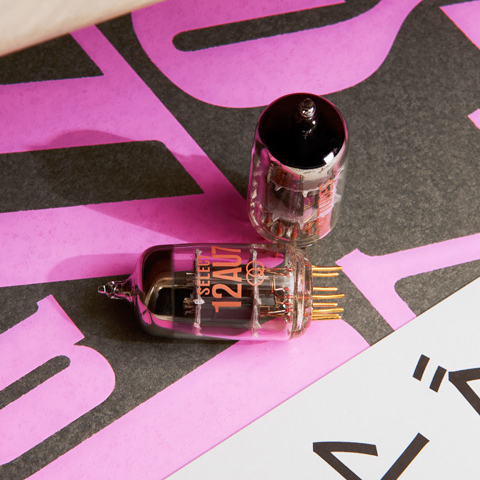
And then there's Jozefína Lichtenegger, CEO, owner, and brain behind European Audio Team (EAT), which makes vacuum tubes, electronics, tonearms, and turntables. I enthusiastically reviewed the tubed E-Glo I integrated amplifier in 2020 (footnote 1).
During her MBA studies at the University of Economics in Bratislava, Slovakia, Lichtenegger (née Krahulkova) sold vacuum tubes for her brother-in-law, Alesa Vaic, owner of the Czech tube brand VAIC. When VAIC closed, she launched her own business, partnering with century-old manufacturer Tesla to produce 300B and KT88 tubes to her specification at the Vrovice plant in Prague. Upon the owner's retirement, she acquired the plant and rebranded the tubes EAT.
Jozefína Krahulkova and Heinz Lichtenegger were married in 2010, a true hi-fi power couple. EAT and Pro-Ject share production facilities. That collaboration allowed EAT to expand its line. Once the preserve of vacuum tubes, EAT became a full-on analog assault: cartridges. Phono stages. Amplifiers. Turntables.
First came the EAT E-Glo ($6995), then the E-Glo S ($2995), and E-Glo Petit ($1495) phono preamplifiers. EAT makes seven turntables, including the C-Major ($2545), E-Flat ($6000), and Forte S ($8495). And tubes: EAT continues to employ three dedicated artisan tube builders.
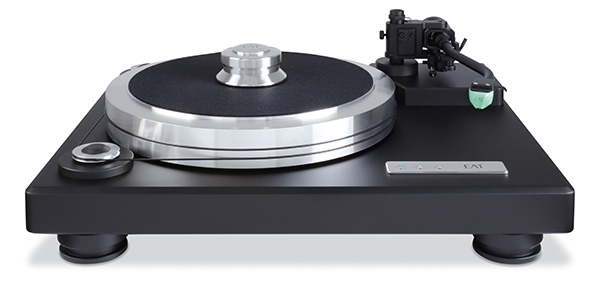
The EAT F-Dur turntable ("F-Major" in English) is sold without a tonearm for $5999. With the EAT C-Note tonearm, it costs $8499. With a 12" EAT F-Note tonearm—as equipped—the F-Dur sells for $11,499.
 An Austrian enterprise
Jozefína Lichtenegger was unavailable to field questions, so Roy Feldstein of Vana, Ltd., EAT's US distributor, explained the design goals of the F-Dur.
The main goal was "to create a turntable that brings many of EAT's Reference-level features into a more compact, home-friendly form factor," he responded over email. "Key elements of our reference tables include a high-mass chassis, an oversized platter for high inertia, a partially magnetically supported inverted main bearing that reduces mechanical load on the bearing, dual AC motors to produce the required torque and minimize vibration, compatibility with 12" tonearms like the C-Note and especially our F-Note, with a dedicated high mass base.
"The EAT turntables and arms are all produced in Pro-Ject plants," Roy continued. "The designs are exclusive to EAT. The various motors are selected from Pro-Ject's catalog. These have been fine-tuned and improved over the years. The EAT cartridges and electronics are produced in different factories." All those factories are located in Europe.
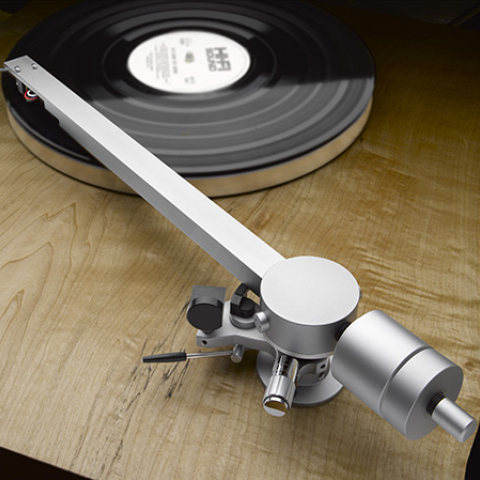
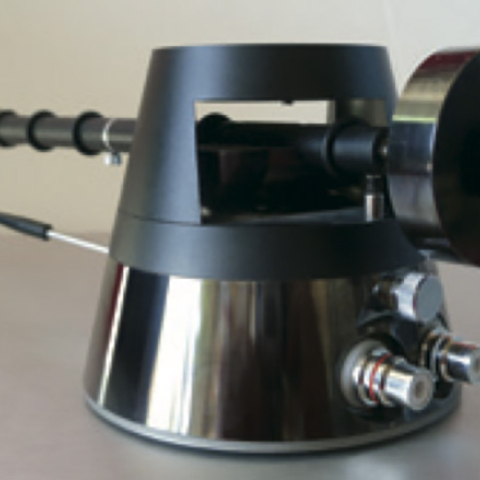
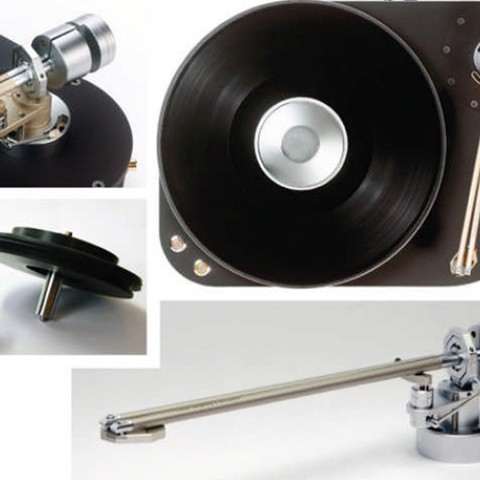
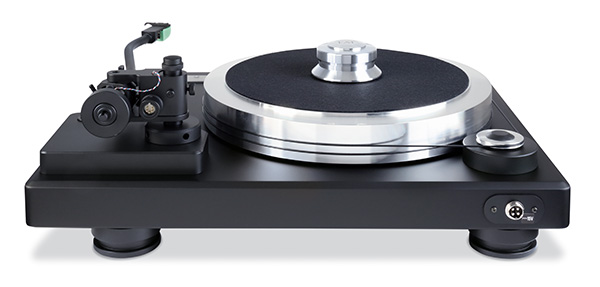
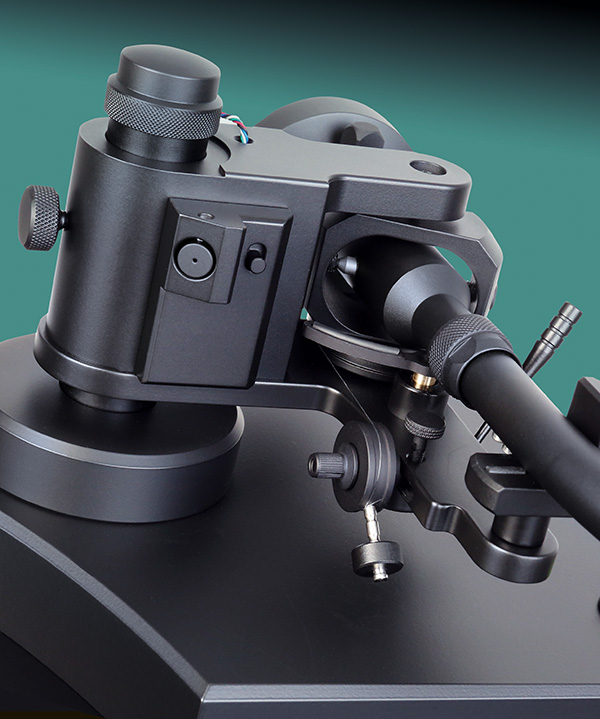
The F-Note tonearm uses four low-friction gimbal bearings in a "cardanic" design, which means there are four pinpoint bearings configured in a cross (footnote 2). It has a variable VTA tower and adjustable azimuth, in addition to the usual VTF and antiskate adjustments. The F-Note's large, solid aluminum base helps isolate the tonearm from vibrations. The F-Note can be used with different armtubes, either straight or S-shaped.
The F-Dur's 14" diameter, 25lb, CNC-machined aluminum platter contains a TPE (thermoplastic elastomer) damping ring on its underside for resonance control, said to "absorb resonances and deliver clearer, more detailed audio playback." EAT says the over-sized platter's "maximum mass and balance [enhances] rotational consistency"—which means less wow and flutter—"and minimizes vibration." The larger platter diameter improves the flywheel effect and "offers better horizontal stability without compromising performance."
I asked Roy Feldstein about the merits of an oversized platter. Inertia is proportional to the mass times the radius squared, he explained, which means that the farther the mass is from the center, the more it contributes to inertia. It follows that making the platter larger than a record helps with rotational stability. No matter where it's located, extra mass puts a larger burden on the bearing, which could increase rumble. The F-Dur's platter is stationed on a magnetically supported, inverted main bearing, supported by a ceramic ball chosen for its hardness and low friction. EAT says the magnetic support "significantly [reduces] mechanical load on the bearing itself." This "reliev[es] pressure on the contact point," which reduces rumble, minimizes wear, and "ensures ultra-smooth rotation." Meanwhile, a "heavy, solid bearing block acts as an energy sink, effectively absorbing and dissipating vibrations."
Two AC motors, made by Pro-Ject and using only the highest-performing samples from batches of more than 100,000 units, drive the platter. EAT says using two motors "increases the number of magnetic poles, which significantly reduces motor cogging." Maybe—but it certainly "results in smoother, more stable rotation," as claimed. A DC-driven, AC power generator supplies a precise sinewave to drive the motors, improving precision and reducing vibration.
Two motors, two belts—and not just any belts. The F-Dur's belts are round and incorporate carbon fibers. This "unique material blend makes the belt conductive, effectively eliminating static buildup during operation," EAT claims. "Designed as a single seamless ring with no glued joints, the belt ensures smooth, consistent motion and improved reliability." The absence of a joint in the belt will certainly improve performance, in my experience.
A "premium leather mat [is] included," the press release said, and presumably it's true, though my review sample—first of the production run—included only a standard felt mat.
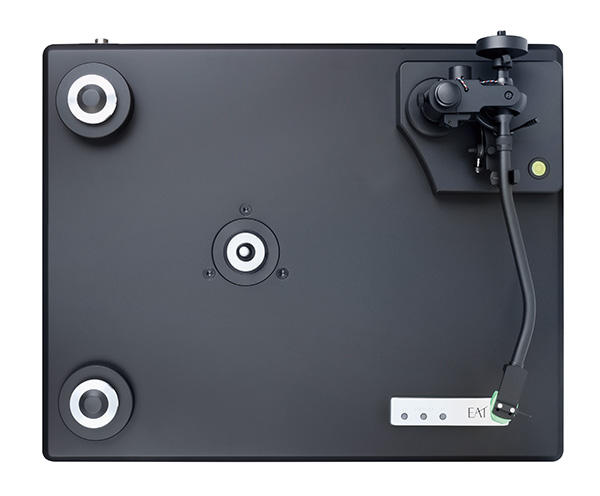 The plinth of the F-Dur is constructed of solid MDF, "with no hollow spaces." The plinth is supported by four TPE-damped, height-adjustable aluminum feet. TPE damping inside the feet is said to absorb vibrations, "isolating the turntable from external interference and enhancing overall sound clarity." A five-pin to RCA tonearm cable is included.
The F-Dur's cosmetic design sparked a debate among those who visited my penthouse pad, especially the mint-green EAT Jo No.5 MC cartridge, which was found to be striking or stricken depending on the viewpoint. (At least it's small.) The plinth's black satin finish, the dual silver-aluminum pulleys, and the oversized platter—which to my eye pays homage to the transcription turntables of the 1950s—garnered admiration. However, I'm a confirmed bachelor, and I don't care how a component looks; for me, it's all about the sound.
Setup
The plinth of the F-Dur is constructed of solid MDF, "with no hollow spaces." The plinth is supported by four TPE-damped, height-adjustable aluminum feet. TPE damping inside the feet is said to absorb vibrations, "isolating the turntable from external interference and enhancing overall sound clarity." A five-pin to RCA tonearm cable is included.
The F-Dur's cosmetic design sparked a debate among those who visited my penthouse pad, especially the mint-green EAT Jo No.5 MC cartridge, which was found to be striking or stricken depending on the viewpoint. (At least it's small.) The plinth's black satin finish, the dual silver-aluminum pulleys, and the oversized platter—which to my eye pays homage to the transcription turntables of the 1950s—garnered admiration. However, I'm a confirmed bachelor, and I don't care how a component looks; for me, it's all about the sound.
Setup
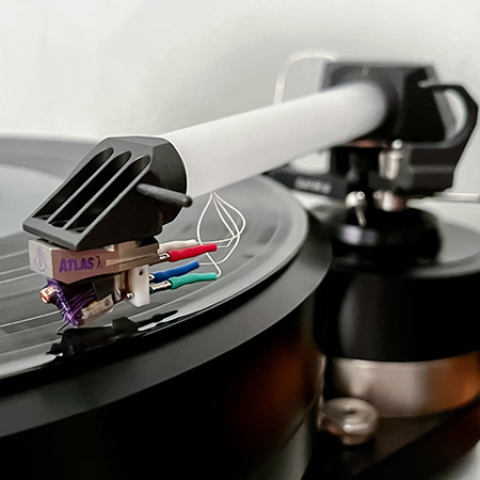
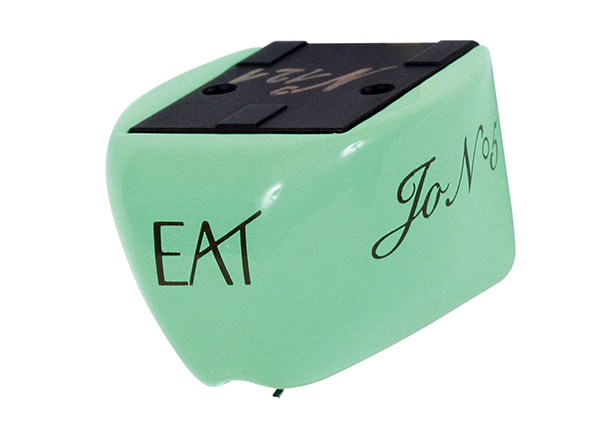
Roy Feldstein brought the 100lb F-Dur up seven floors to my Greenwich Village lair. Once he was somewhat recovered and fully rehydrated, he set up the turntable, leaving precise cartridge setup to me. I attempted to dial in the F-Note tonearm using my Dr. Feickert Next Generation Universal Protractor, but determining the pivot point precisely was complicated by the fact that no reference point is indicated for the bearing center. (Two small indents straddle a middle point). Roy arranged to have the the EAT Tonearm Alignment Tool Universal (299) sent to me. Once it arrived, I was able to align the cartridge easily and precisely. The EAT Jo No.5 MC cart ($1199; not included in the turntable's price) rides low in the groove, its stylus barely visible beneath its mint-green body. The nude, fine-line stylus gathered dust quickly but was easy to clean.
 Listening
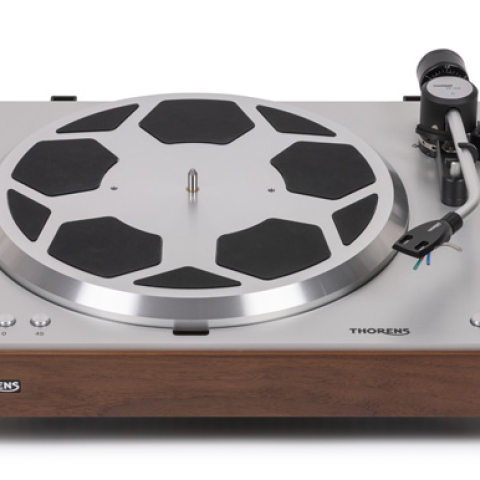
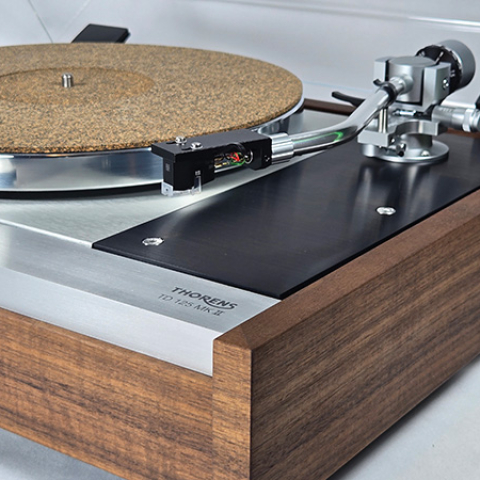
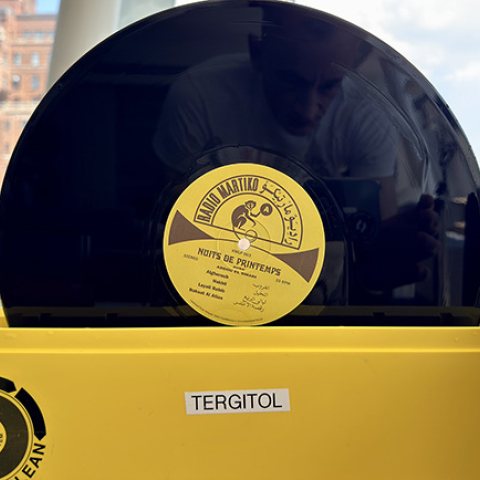
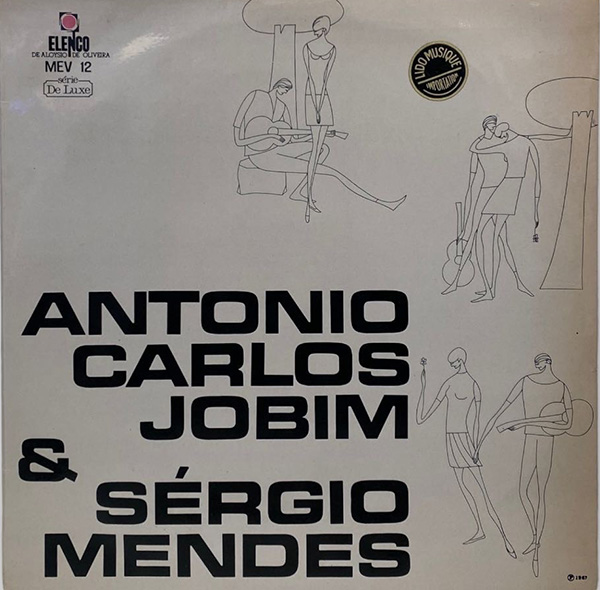
I started my review by playing some music on my vintage Thorens TD 124 (with Korf TA-SF9 tonearm and Ortofon 2M Black LVB 250 MM cartridge) to establish a baseline. While the Thorens TD 124 is known for its relentless rhythmic drive, uncanny pacing, and dazzling dynamics, it's not the last word in refinement or sonic weight. I was curious to see how a 68-year-old Swiss turntable would stack up against a new, high-level, Austrian-designed, Czech-made F-Dur/F-Note tonearm combination. I'm a longtime collector of Brazilian records, and I often spin them at my various jazz kissa nights across New York City. The response is always surprising and positive. There is no more sophisticated, joyous, romantic, or rhythmically compelling music than that recorded in Brazil, especially during the late '50s to mid-'70s on such labels as Elenco, Som Livre, RGE, Dutch Philips, and Fontana. Brazilian music is a universe of its own, celebrated for its poetic depth, fiery passion, and lyrical beauty. Unmatched in richness yet still underappreciated outside its homeland. I don't know what rationale I could provide for using Brazilian records for this review—Brazil and Austria have very different cultures—other than the fact that the music is great (footnote 3). For this review, I listened to Elis Regina's Como & Porque (Philips R-765.080-L, 1969) and Elis (Philips 6349-334, 1977), Quarteto Em Cy's Querelas Do Brasil (Philips 6349-351, 1978), Antônio Carlos Jobim & Sérgio Mendes (Elenco MEV-12, 1967), Gal Costa's Índia (Philips 6349077, 1973), Robertinho Silva's Robertinho Silva MPBC (Philips 6328-299, 1981), and Rosa Passos's Recriação (Chantecler 2-08-404-101, 1978).
 The Thorens played the Brazilian discs with notable layering and separation and a vivid sense of rhythm that made my old body want to dance. The presentation offered such clarity and depth that I felt I was glimpsing the heart of the recording sessions, peering into the subtleties of the musicians' artistry. A well-restored, well-set-up TD 124 is a formidable 'table.
The TD 124 also had a knack for historical context: The late '70s Elis Regina albums shimmered with a glossy sheen, influenced by American pop production, while her 1969 work sounded raw and unvarnished in comparison. Paired with the Allnic H-5500 phono stage, the Thorens displayed its drive and rhythmic acuity, the Allnic adding its signature sweetness, adding tube warmth without obscuring the music's clarity.
I connected the Allnic phono stage to Jo—the cartridge mounted on the EAT player. On Quarteto Em Cy's close four-part sibling harmonies, the EAT F-Dur turntable lacked the exceptional separation and razor-sharp definition of the Thorens/Korf/Ortofon trio. But the EAT killed the Thorens combo for sheer presence: Voices carried more weight, the soundstage swelled and filled out, and the presentation felt richer. The EAT was unmistakably modern, displaying all the sonic virtues with authority.
For decades, Robertinho Silva stood as one of Brazil's premier session drummers, lending his talents to albums by Milton Nascimento, Wayne Shorter, Egberto Gismonti, and many others. His 1981 debut album radiates Tropicalia-infused psychedelia, with drums recorded in stereo and panned hard left and right, evoking that distinctive ethereality of 1970's ECM. On the Thorens combo, the soundstage was wide, the timbres rich. The EAT stage was more recessed, and there was less immediacy and drive. But again what I heard was fuller, weightier, and more 3D. On the other hand, transients and fine details seemed slightly softer.
The Thorens played the Brazilian discs with notable layering and separation and a vivid sense of rhythm that made my old body want to dance. The presentation offered such clarity and depth that I felt I was glimpsing the heart of the recording sessions, peering into the subtleties of the musicians' artistry. A well-restored, well-set-up TD 124 is a formidable 'table.
The TD 124 also had a knack for historical context: The late '70s Elis Regina albums shimmered with a glossy sheen, influenced by American pop production, while her 1969 work sounded raw and unvarnished in comparison. Paired with the Allnic H-5500 phono stage, the Thorens displayed its drive and rhythmic acuity, the Allnic adding its signature sweetness, adding tube warmth without obscuring the music's clarity.
I connected the Allnic phono stage to Jo—the cartridge mounted on the EAT player. On Quarteto Em Cy's close four-part sibling harmonies, the EAT F-Dur turntable lacked the exceptional separation and razor-sharp definition of the Thorens/Korf/Ortofon trio. But the EAT killed the Thorens combo for sheer presence: Voices carried more weight, the soundstage swelled and filled out, and the presentation felt richer. The EAT was unmistakably modern, displaying all the sonic virtues with authority.
For decades, Robertinho Silva stood as one of Brazil's premier session drummers, lending his talents to albums by Milton Nascimento, Wayne Shorter, Egberto Gismonti, and many others. His 1981 debut album radiates Tropicalia-infused psychedelia, with drums recorded in stereo and panned hard left and right, evoking that distinctive ethereality of 1970's ECM. On the Thorens combo, the soundstage was wide, the timbres rich. The EAT stage was more recessed, and there was less immediacy and drive. But again what I heard was fuller, weightier, and more 3D. On the other hand, transients and fine details seemed slightly softer.
 Even when my Crown Heights kissa is humming with rowdy drinkers, the genius of Elis Regina makes them stop and listen. Perhaps Brazil's greatest vocalist, Regina is both angel and sprite, a supercharged talent with the energy of a tornado—she's known as the "little hurricane" in Brazil—and the delicate vocal beauty of a coloratura soprano. Regina made many albums before she died in 1982 at the age of just 36. The documentary Elis & Tom provides a rare glimpse of the singer at work with another Brazilian great, Antônio Carlos Jobim.
The Thorens extracted detail and rhythmic nuance from both records used here; the EAT presented them in a vast hall, expanding scale and enriching instruments and vocals. Images grew larger, and the substance behind them—meat and bones—was amplified more often than not. The Thorens crackled with funk, drive, and untamed energy—qualities the EAT traded for a grander, more immersive soundstage, richer textures, and a physicality that left me feeling fat, sassy, and a little sleepy.
Even when my Crown Heights kissa is humming with rowdy drinkers, the genius of Elis Regina makes them stop and listen. Perhaps Brazil's greatest vocalist, Regina is both angel and sprite, a supercharged talent with the energy of a tornado—she's known as the "little hurricane" in Brazil—and the delicate vocal beauty of a coloratura soprano. Regina made many albums before she died in 1982 at the age of just 36. The documentary Elis & Tom provides a rare glimpse of the singer at work with another Brazilian great, Antônio Carlos Jobim.
The Thorens extracted detail and rhythmic nuance from both records used here; the EAT presented them in a vast hall, expanding scale and enriching instruments and vocals. Images grew larger, and the substance behind them—meat and bones—was amplified more often than not. The Thorens crackled with funk, drive, and untamed energy—qualities the EAT traded for a grander, more immersive soundstage, richer textures, and a physicality that left me feeling fat, sassy, and a little sleepy.
 One of the latest Brazilian singers to crash the world party, Rosa Passos has a voice to approach (if not quite equal) Elis Regina's, and her folk roots, sincerity, and joy in making music is infectious. Passos's debut LP crackles with the energy of the Amazon. Her liquid, startling, elastic voice recalls a jubilant child one moment, a wise elder the next, always framed by passion, fire, and playfulness. With the Thorens/Korf/Ortofon combo, Passos's sound extended into my room like the bow of a boat, loaded with musicians. Passos was in my room. The sound was live and electric.
The EAT gave Passos's voice more haunting depth. It sorted the music better and enlarged its scale. The F-Dur consistently surprised me with its ability to surprise. Even as it expanded the soundstage, it assembled the many elements of a recording into a well-polished, cohesive, refined whole. Hearing this, I felt that the Thorens combo, for all its many virtues, was generalizing some. With the EAT, I heard more specificity—more of what's on the record, moment to moment.
When I swapped out phono stages, the EAT let each shine with its own character: the Tavish Audio Design Adagio's lush, tube warmth; the Manley Chinook's razor-sharp attack and punch; and the PrimaLuna EVO 100's balanced, composed refinement.
One of the latest Brazilian singers to crash the world party, Rosa Passos has a voice to approach (if not quite equal) Elis Regina's, and her folk roots, sincerity, and joy in making music is infectious. Passos's debut LP crackles with the energy of the Amazon. Her liquid, startling, elastic voice recalls a jubilant child one moment, a wise elder the next, always framed by passion, fire, and playfulness. With the Thorens/Korf/Ortofon combo, Passos's sound extended into my room like the bow of a boat, loaded with musicians. Passos was in my room. The sound was live and electric.
The EAT gave Passos's voice more haunting depth. It sorted the music better and enlarged its scale. The F-Dur consistently surprised me with its ability to surprise. Even as it expanded the soundstage, it assembled the many elements of a recording into a well-polished, cohesive, refined whole. Hearing this, I felt that the Thorens combo, for all its many virtues, was generalizing some. With the EAT, I heard more specificity—more of what's on the record, moment to moment.
When I swapped out phono stages, the EAT let each shine with its own character: the Tavish Audio Design Adagio's lush, tube warmth; the Manley Chinook's razor-sharp attack and punch; and the PrimaLuna EVO 100's balanced, composed refinement.
 Conclusion
You can find some extraordinary turntables in the $10,000–$15,000 range. It's evidently a sweet spot for elite turntables. If that's your price point, the EAT F-Dur belongs in this company and deserves an audition.
Footnote 1: EAT recently announced the new E-Glo 2. Footnote 2: "Cardanic" is taken from the "cardan," or universal, joint. Footnote 3: That's a good enough reason in my book.—Jim Austin
An Austrian enterpriseJozefína Lichtenegger was unavailable to field questions, so Roy Feldstein of Vana, Ltd., EAT's US distributor, explained the design goals of the F-Dur.
The plinth of the F-Dur is constructed of solid MDF, "with no hollow spaces." The plinth is supported by four TPE-damped, height-adjustable aluminum feet. TPE damping inside the feet is said to absorb vibrations, "isolating the turntable from external interference and enhancing overall sound clarity." A five-pin to RCA tonearm cable is included.
Roy Feldstein brought the 100lb F-Dur up seven floors to my Greenwich Village lair. Once he was somewhat recovered and fully rehydrated, he set up the turntable, leaving precise cartridge setup to me. I attempted to dial in the F-Note tonearm using my Dr. Feickert Next Generation Universal Protractor, but determining the pivot point precisely was complicated by the fact that no reference point is indicated for the bearing center. (Two small indents straddle a middle point). Roy arranged to have the the EAT Tonearm Alignment Tool Universal (299) sent to me. Once it arrived, I was able to align the cartridge easily and precisely. The EAT Jo No.5 MC cart ($1199; not included in the turntable's price) rides low in the groove, its stylus barely visible beneath its mint-green body. The nude, fine-line stylus gathered dust quickly but was easy to clean.
ListeningI started my review by playing some music on my vintage Thorens TD 124 (with Korf TA-SF9 tonearm and Ortofon 2M Black LVB 250 MM cartridge) to establish a baseline. While the Thorens TD 124 is known for its relentless rhythmic drive, uncanny pacing, and dazzling dynamics, it's not the last word in refinement or sonic weight. I was curious to see how a 68-year-old Swiss turntable would stack up against a new, high-level, Austrian-designed, Czech-made F-Dur/F-Note tonearm combination. I'm a longtime collector of Brazilian records, and I often spin them at my various jazz kissa nights across New York City. The response is always surprising and positive. There is no more sophisticated, joyous, romantic, or rhythmically compelling music than that recorded in Brazil, especially during the late '50s to mid-'70s on such labels as Elenco, Som Livre, RGE, Dutch Philips, and Fontana. Brazilian music is a universe of its own, celebrated for its poetic depth, fiery passion, and lyrical beauty. Unmatched in richness yet still underappreciated outside its homeland. I don't know what rationale I could provide for using Brazilian records for this review—Brazil and Austria have very different cultures—other than the fact that the music is great (footnote 3). For this review, I listened to Elis Regina's Como & Porque (Philips R-765.080-L, 1969) and Elis (Philips 6349-334, 1977), Quarteto Em Cy's Querelas Do Brasil (Philips 6349-351, 1978), Antônio Carlos Jobim & Sérgio Mendes (Elenco MEV-12, 1967), Gal Costa's Índia (Philips 6349077, 1973), Robertinho Silva's Robertinho Silva MPBC (Philips 6328-299, 1981), and Rosa Passos's Recriação (Chantecler 2-08-404-101, 1978).
The Thorens played the Brazilian discs with notable layering and separation and a vivid sense of rhythm that made my old body want to dance. The presentation offered such clarity and depth that I felt I was glimpsing the heart of the recording sessions, peering into the subtleties of the musicians' artistry. A well-restored, well-set-up TD 124 is a formidable 'table.
The TD 124 also had a knack for historical context: The late '70s Elis Regina albums shimmered with a glossy sheen, influenced by American pop production, while her 1969 work sounded raw and unvarnished in comparison. Paired with the Allnic H-5500 phono stage, the Thorens displayed its drive and rhythmic acuity, the Allnic adding its signature sweetness, adding tube warmth without obscuring the music's clarity.
I connected the Allnic phono stage to Jo—the cartridge mounted on the EAT player. On Quarteto Em Cy's close four-part sibling harmonies, the EAT F-Dur turntable lacked the exceptional separation and razor-sharp definition of the Thorens/Korf/Ortofon trio. But the EAT killed the Thorens combo for sheer presence: Voices carried more weight, the soundstage swelled and filled out, and the presentation felt richer. The EAT was unmistakably modern, displaying all the sonic virtues with authority.
Even when my Crown Heights kissa is humming with rowdy drinkers, the genius of Elis Regina makes them stop and listen. Perhaps Brazil's greatest vocalist, Regina is both angel and sprite, a supercharged talent with the energy of a tornado—she's known as the "little hurricane" in Brazil—and the delicate vocal beauty of a coloratura soprano. Regina made many albums before she died in 1982 at the age of just 36. The documentary Elis & Tom provides a rare glimpse of the singer at work with another Brazilian great, Antônio Carlos Jobim.
The Thorens extracted detail and rhythmic nuance from both records used here; the EAT presented them in a vast hall, expanding scale and enriching instruments and vocals. Images grew larger, and the substance behind them—meat and bones—was amplified more often than not. The Thorens crackled with funk, drive, and untamed energy—qualities the EAT traded for a grander, more immersive soundstage, richer textures, and a physicality that left me feeling fat, sassy, and a little sleepy.
One of the latest Brazilian singers to crash the world party, Rosa Passos has a voice to approach (if not quite equal) Elis Regina's, and her folk roots, sincerity, and joy in making music is infectious. Passos's debut LP crackles with the energy of the Amazon. Her liquid, startling, elastic voice recalls a jubilant child one moment, a wise elder the next, always framed by passion, fire, and playfulness. With the Thorens/Korf/Ortofon combo, Passos's sound extended into my room like the bow of a boat, loaded with musicians. Passos was in my room. The sound was live and electric.
The EAT gave Passos's voice more haunting depth. It sorted the music better and enlarged its scale. The F-Dur consistently surprised me with its ability to surprise. Even as it expanded the soundstage, it assembled the many elements of a recording into a well-polished, cohesive, refined whole. Hearing this, I felt that the Thorens combo, for all its many virtues, was generalizing some. With the EAT, I heard more specificity—more of what's on the record, moment to moment.
When I swapped out phono stages, the EAT let each shine with its own character: the Tavish Audio Design Adagio's lush, tube warmth; the Manley Chinook's razor-sharp attack and punch; and the PrimaLuna EVO 100's balanced, composed refinement.
ConclusionYou can find some extraordinary turntables in the $10,000–$15,000 range. It's evidently a sweet spot for elite turntables. If that's your price point, the EAT F-Dur belongs in this company and deserves an audition.
Footnote 1: EAT recently announced the new E-Glo 2. Footnote 2: "Cardanic" is taken from the "cardan," or universal, joint. Footnote 3: That's a good enough reason in my book.—Jim Austin