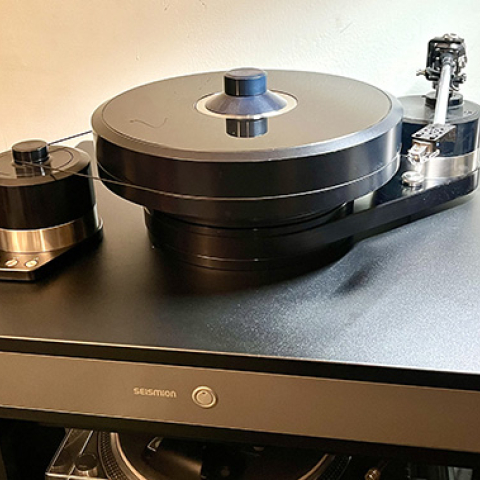
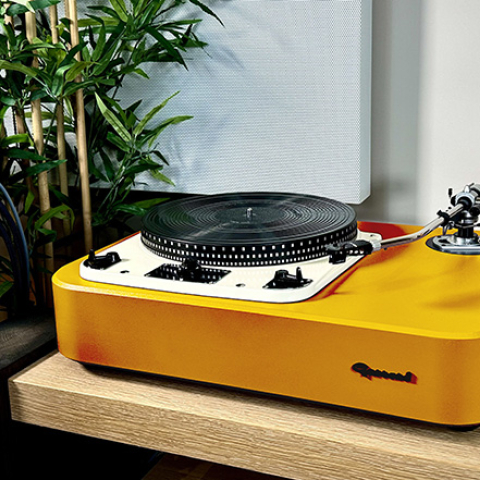
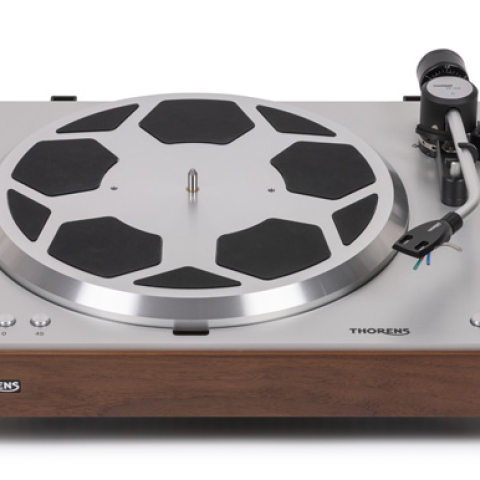
While I was coming to grips with this month's review subject, the idler drive Garrard 301 Advanced, I began to think about the various methods that have been used to spin turntable platters over the years. Since the transition a century ago from wind-up clockwork to electric motors, there have basically been three ways to spin a turntable platter: idler drive, belt drive, and direct drive. True, there have also been a few designs that go their own unique ways, such as the rare, water-driven Oasis made by David Gillespie of Saturn Audio in the late 1970s and the gear-driven H.H. Scott 710 I once owned and foolishly sold. But almost everything made since the 1950s uses one of the three main drive systems. Even the Omega Drive system, which was used by Wilson Benesch on their extraordinary GMT One turntable, is at its core a direct drive design.
For a long time, I had the mistaken belief that pretty much every turntable made before the mid-1950s used an idler wheel to drive the platter. While that's mostly true, some professional turntables well before that time could be accurately described as direct drive, coming more than 30 years before the Technics SP-10 was introduced in 1970. These professional transcription turntables were used mostly by radio stations and other professionals and came in a waist-high metal cabinet that probably weighed more than the radio-station engineer who operated it. One of the most popular of these was the RCA 70-D transcription turntable. Its massive 16" platter was connected by a long metal rod to a grapefruit-sized motor at the bottom of the cabinet. Motor noise and rumble breakthrough could be an issue, but because they were playing mono records, the cartridges had little sensitivity to the mostly vertical vibrations.
When stereo records arrived, in 1958, those vertical vibrations became a big problem, because the new stereo cartridges measured both vertical and lateral movement to create a stereo signal. Belt-drive turntables isolated the motor from the platter, so they quickly became the standard.
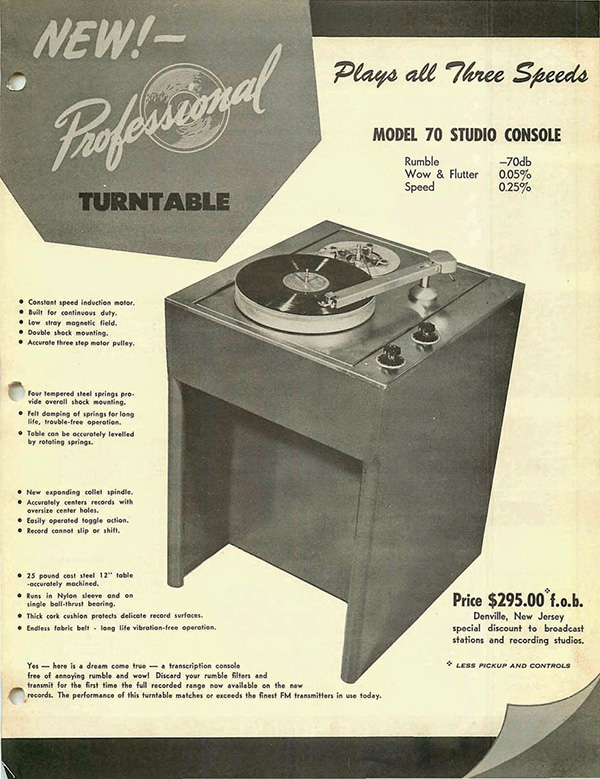 While the first belt-drive turntable was one of those big transcription jobs with a 16" platter—it was called the Components Corporation Model 70, introduced in 1954—it was the 1961 Acoustic Research AR that set the path for consumers. The budget-priced AR with its belt drive and three-point spring suspension became a legend, and even 20 years later, when I was in college, I knew several students who had brought their parents' old AR with them for their dorm systems.
Back when I was a budding teenage audiophile kid in England, I was taught by the British audiophile press of the day that the only proper way to propel a turntable platter was with a belt. Idler drive was rejected as old, obsolete technology, still used for the cheapest record changers but for hi-fi use banished to the dustbin of history along with slide rules and fountain pens. Those same magazines preached that the direct-drive 'tables coming from Japan were the devil's work and that they couldn't deliver a musical sound due to cogging, whatever that was, and other types of pitch instability. This was mostly a lie, and by the late 1970s there was a weird split in the market where the big corporate mass market brands like Sony and Technics used belt drive for their entry-level models and direct drive for their premium models, while at the same time the smaller companies catering to audio enthusiasts offered belt-drive turntables almost exclusively. There are always exceptions, and brands such as Mitchell A Cotter in the US, Switzerland's Goldmund, and a short-lived British company called JBE flew the audiophile direct-drive flag.
In the decades since, I have come to understand that the real reason a lot of smaller companies made belt-drive turntables is that making a direct-drive turntable mechanism is hard. The fundamental building blocks of a direct-drive motor are integrated into the platter itself. If you look at the history of direct-drive turntables from small, specialist companies, you'll find that most of them borrow parts from direct-drive models built by big corporate manufacturers, which had the resources to develop the motors and the associated control circuitry, just as the $3 million Pagani Huayra hypercar uses an engine made by Mercedes AMG. With fewer than 200 employees, the Italian carmaker simply doesn't have the resources to build their own engines. This practice of borrowing direct-drive drives continues to this day, although a handful of companies including Wilson Benesch and VPI have developed their own direct-drive solutions more or less in house.
While the first belt-drive turntable was one of those big transcription jobs with a 16" platter—it was called the Components Corporation Model 70, introduced in 1954—it was the 1961 Acoustic Research AR that set the path for consumers. The budget-priced AR with its belt drive and three-point spring suspension became a legend, and even 20 years later, when I was in college, I knew several students who had brought their parents' old AR with them for their dorm systems.
Back when I was a budding teenage audiophile kid in England, I was taught by the British audiophile press of the day that the only proper way to propel a turntable platter was with a belt. Idler drive was rejected as old, obsolete technology, still used for the cheapest record changers but for hi-fi use banished to the dustbin of history along with slide rules and fountain pens. Those same magazines preached that the direct-drive 'tables coming from Japan were the devil's work and that they couldn't deliver a musical sound due to cogging, whatever that was, and other types of pitch instability. This was mostly a lie, and by the late 1970s there was a weird split in the market where the big corporate mass market brands like Sony and Technics used belt drive for their entry-level models and direct drive for their premium models, while at the same time the smaller companies catering to audio enthusiasts offered belt-drive turntables almost exclusively. There are always exceptions, and brands such as Mitchell A Cotter in the US, Switzerland's Goldmund, and a short-lived British company called JBE flew the audiophile direct-drive flag.
In the decades since, I have come to understand that the real reason a lot of smaller companies made belt-drive turntables is that making a direct-drive turntable mechanism is hard. The fundamental building blocks of a direct-drive motor are integrated into the platter itself. If you look at the history of direct-drive turntables from small, specialist companies, you'll find that most of them borrow parts from direct-drive models built by big corporate manufacturers, which had the resources to develop the motors and the associated control circuitry, just as the $3 million Pagani Huayra hypercar uses an engine made by Mercedes AMG. With fewer than 200 employees, the Italian carmaker simply doesn't have the resources to build their own engines. This practice of borrowing direct-drive drives continues to this day, although a handful of companies including Wilson Benesch and VPI have developed their own direct-drive solutions more or less in house.
 The legendary 1979 direct drive vs belt drive shootout
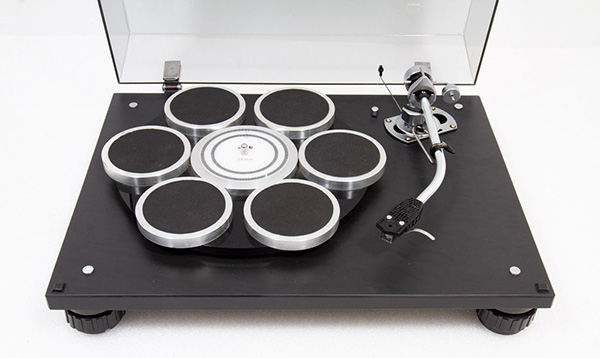
Britain's JBE was particularly bold in claiming that a direct-drive design was superior when they launched their Series 3 turntable (above) in 1977, just as Linn LP12-mania was getting into full swing. (The LP12 is of course a belt-drive 'table.) Made from a heavy slab of dark gray Welsh slate fitted with a Matsushita direct-drive motor and topped with an unusual platter made from six linked discs, the JBE really looked the business. In a true case of putting their money where their mouth was, they set up a three-way blind comparison at High Fidelity '79 in London, the leading UK hi-fi show of the day. Going up against the JBE was the venerable Linn Sondek LP12 and the unfortunately named STD 305M. (STD is an acronym for Strathclyde Transcription Developments. In 1977, sexually transmitted diseases were commonly referred to as "VD."). All three were fitted with SME Series III tonearms and Stanton moving magnet cartridges. Cheekily, JBE invited representatives from the other two turntable manufacturers to verify the setup of their turntables and even allowed them to pick which of the three supposedly identical cartridges they wanted on their babies. Writing in the September 1979 issue of Practical Hi-Fi magazine, Carl Anthony reported that at first people's preferences were pretty random, but by day three about 80% were picking the JBE. A few reviewers, including the late Paul Messenger, were able to pick out the LP12 every time. Unfortunately, this moment of greatness for JBE would not last long, and by the end of 1981, the company had vanished. Sadly, I wasn't at HiFi '79 to hear the comparison for myself, but a while back I was able to snag a Series 3 on eBay, and I hope to get it running, with an SME Series III tonearm of course. I don't have an STD (heh), but perhaps someday I can locate a 305M or two or use a different cartridge and recreate a two-way version of the shootout with my LP12.
In 1981, I visited a high-end audio shop near where I was living in Geneva, Switzerland, and was discussing turntables with the owner. This was the same visit I described in Spin Doctor #22, where I first got to see the Keith Monks record cleaner in action. I was still under the spell of the British audio press, and I didn't think there was a turntable on the planet that could beat the belt-drive Linn Sondek LP12. The owner suggested I check out a French turntable called the Goldmund Studio, which used direct drive, though he didn't have one in the store. I thought, how could that be any good? What about all that cogging?
I didn't hear a Goldmund Studio until several years later, but the store owner's comment planted a seed, challenging the fundamental dogma I had been taught. I was still toeing the line with my turntable purchases: Dual 506, Rega Planar 3, then an LP12 for my 21st birthday in 1982. In secret, though, I was drooling over big, heavy direct-drive monsters like the Technics SL-1000 Mk2. That's another itch I eventually was able to scratch.
The Garrard 301 Advanced
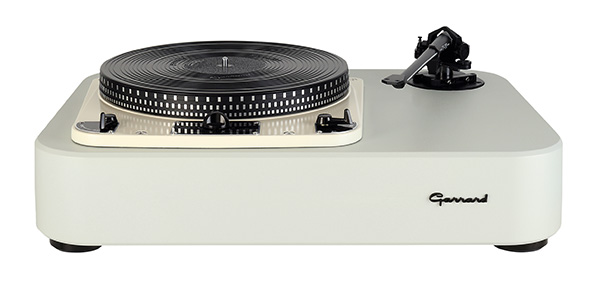
Six months ago, in Spin Doctor #25, I wrote about the Garrard 301 Advanced turntable, a painstakingly restored original Garrard 301 from the 1960s mounted in a heavy plinth made from advanced polymer resin (APR) and partnered with a 12" tonearm from SME, Garrard's sister company (footnote 1). All was going well until I attempted to measure its performance, when I discovered that the review sample—serial number G022—had internal shipping damage that was affecting the motor-drive system.
 At the time, I promised to follow up in the following month's Spin Doctor, but that proved to be wildly optimistic. I received a replacement 301 Advanced a couple of weeks after I discovered the problem with G022. This time it was a unit—serial number G018—that had just been used without any problems at the AXPONA show in Chicago, so everything should have been fine, right? Sadly, by the time it had bumped its way in a truck along 800 miles of I-80 and arrived chez Trei in NYC, it had suffered the same type of damage as the first one, only that time it was worse.
Things went quiet for a while, as Garrard changed its US distribution partner. I headed off to Europe for the final High End Munich Show, and Garrard worked to figure out a less-destructive way to ship a turntable to New York. Was it the notoriously rough New York City freight handlers rolling the 301 off the truck, up the stairs, and into my apartment? The answer wasn't clear, but for 301 Advanced number three, shipped directly from England, the answer was to add a large wooden crate, inside of which the earlier cardboard box was better protected. This solution worked, and number three—serial number G024—complete with its spiffy-looking mauve paint, arrived pretty much intact. I say pretty much because despite the new precautions, one of the special protective plugs used to keep all of the motor parts in place had become dislodged, and the spring that pulls the idler wheel against the motor pulley had managed to detach itself at one end. But no real damage was done, and it was easy to reattach the spring after removing the idler wheel.
Best of all, this time when I measured it, the results were superb.
At the time, I promised to follow up in the following month's Spin Doctor, but that proved to be wildly optimistic. I received a replacement 301 Advanced a couple of weeks after I discovered the problem with G022. This time it was a unit—serial number G018—that had just been used without any problems at the AXPONA show in Chicago, so everything should have been fine, right? Sadly, by the time it had bumped its way in a truck along 800 miles of I-80 and arrived chez Trei in NYC, it had suffered the same type of damage as the first one, only that time it was worse.
Things went quiet for a while, as Garrard changed its US distribution partner. I headed off to Europe for the final High End Munich Show, and Garrard worked to figure out a less-destructive way to ship a turntable to New York. Was it the notoriously rough New York City freight handlers rolling the 301 off the truck, up the stairs, and into my apartment? The answer wasn't clear, but for 301 Advanced number three, shipped directly from England, the answer was to add a large wooden crate, inside of which the earlier cardboard box was better protected. This solution worked, and number three—serial number G024—complete with its spiffy-looking mauve paint, arrived pretty much intact. I say pretty much because despite the new precautions, one of the special protective plugs used to keep all of the motor parts in place had become dislodged, and the spring that pulls the idler wheel against the motor pulley had managed to detach itself at one end. But no real damage was done, and it was easy to reattach the spring after removing the idler wheel.
Best of all, this time when I measured it, the results were superb.
 I'm not going to repeat the basic information I provided about the 301 back in Spin Doctor #25. Instead, consider this the second part of a two-part extended review. I will pick up right where I left off. Please look for the other part in the June 2025 issue, or on the Stereophile website, to get the complete picture.
A few words about pricing: There's no question that at $65,000, the Garrard 301 Advanced is firmly in the luxury goods category. Hermès sells some of their Birkin handbags for well north of $100k, and a Patek Philippe Tourbillon watch can set you back millions, so for the right customer, $65k for a vintage turntable is not really an issue.
Because Garrard sells the 301 in a few different configurations, we can do a little math to figure out what they are asking for the various components. Art Dudley reviewed the 301 Classic in Listening #204 in 2019. That version comes in a less high-tech walnut plinth with the more affordable SME M2-12R tonearm. Currently that version sells for $43,000, almost $20k more than when Art reviewed it six years ago, but hey, someone needs to pay those pesky tariffs. The 301 Advanced with the APR plinth is also available with the SME M2-12R tonearm; configured that way, it's $60k, or $5k less than with the VA-12. Finally, the M2-12R tonearm can be purchased separately for $5199. By running the numbers, we learn that the VA-12 arm is valued at $10,199 and that the APR plinth is $17,000 more than the walnut Classic plinth. Garrard does not sell the plinths, VA-12, or restored 301 motor unit separately, so there's no way to break it down any further than that, but it's pretty clear that APR plinth is a pricey hunk of polymer.
I auditioned the 301 Advanced mostly using my Lyra Atlas λ Lambda cartridge, but I also mounted the Audio Technica AT-ART1000X to leverage that cartridge's whip-crack dynamics and speed. As with all SME tonearms, the VA-12 is beautifully thought out and easy to use and align, with the caveat that like most of the top SME arms, there is no easy way to adjust azimuth. Every tool needed to do a serviceable cartridge alignment is provided, although further optimization is possible with additional equipment.
I'm not going to repeat the basic information I provided about the 301 back in Spin Doctor #25. Instead, consider this the second part of a two-part extended review. I will pick up right where I left off. Please look for the other part in the June 2025 issue, or on the Stereophile website, to get the complete picture.
A few words about pricing: There's no question that at $65,000, the Garrard 301 Advanced is firmly in the luxury goods category. Hermès sells some of their Birkin handbags for well north of $100k, and a Patek Philippe Tourbillon watch can set you back millions, so for the right customer, $65k for a vintage turntable is not really an issue.
Because Garrard sells the 301 in a few different configurations, we can do a little math to figure out what they are asking for the various components. Art Dudley reviewed the 301 Classic in Listening #204 in 2019. That version comes in a less high-tech walnut plinth with the more affordable SME M2-12R tonearm. Currently that version sells for $43,000, almost $20k more than when Art reviewed it six years ago, but hey, someone needs to pay those pesky tariffs. The 301 Advanced with the APR plinth is also available with the SME M2-12R tonearm; configured that way, it's $60k, or $5k less than with the VA-12. Finally, the M2-12R tonearm can be purchased separately for $5199. By running the numbers, we learn that the VA-12 arm is valued at $10,199 and that the APR plinth is $17,000 more than the walnut Classic plinth. Garrard does not sell the plinths, VA-12, or restored 301 motor unit separately, so there's no way to break it down any further than that, but it's pretty clear that APR plinth is a pricey hunk of polymer.
I auditioned the 301 Advanced mostly using my Lyra Atlas λ Lambda cartridge, but I also mounted the Audio Technica AT-ART1000X to leverage that cartridge's whip-crack dynamics and speed. As with all SME tonearms, the VA-12 is beautifully thought out and easy to use and align, with the caveat that like most of the top SME arms, there is no easy way to adjust azimuth. Every tool needed to do a serviceable cartridge alignment is provided, although further optimization is possible with additional equipment.
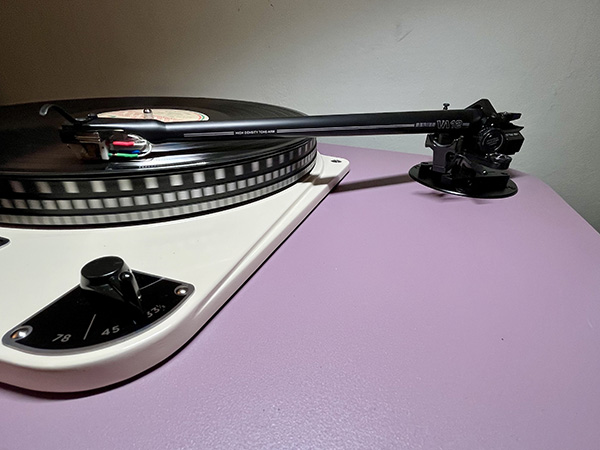 The 301 Advanced comes out of the box almost ready to go, with the arm in place and the 301 motor premounted in the plinth. All you need to do is to level the plinth using the adjustable feet, release the motor cage's transit screws, remove the aforementioned shipping protectors, and lower the platter onto the bearing. Tonearm connections are via a pair of RCA jacks with a ground post on the back panel; XLR outputs are available on request.
Plug in the IEC power cable and install the cartridge, and you're ready to spin.
The 301 Advanced comes out of the box almost ready to go, with the arm in place and the 301 motor premounted in the plinth. All you need to do is to level the plinth using the adjustable feet, release the motor cage's transit screws, remove the aforementioned shipping protectors, and lower the platter onto the bearing. Tonearm connections are via a pair of RCA jacks with a ground post on the back panel; XLR outputs are available on request.
Plug in the IEC power cable and install the cartridge, and you're ready to spin.
 For a classic British turntable with roots in the 1960s, I figured some English music for strings was in order, so I played Elgar's Introduction and Allegro for Strings from Britten Conducts English Music for Strings conducted by Benjamin Britten (London CS 6618). This is the American release of Decca SXL-6405, but it's still an English pressing made from the same metalwork as the Decca. Here, Britten's ability to draw a lush string tone from the English Chamber Orchestra was on full display, and my attention was drawn particularly to the cellos and basses, which were presented with both detail and warmth in spades. One of the 301's greatest strengths is its ability to convey the forward momentum of the music and what the British like to call PRaT (pace, rhythm, and timing). The 301 Advanced does as good of a job of this as any turntable I've heard, making it easy to understand why people persevere with these vintage designs.
To really kick things into gear, I played "The Robots" by Kraftwerk from The Mix (Elektra 60869-1) using the ART1000X cartridge. This is a 1991 rework of the 1977 original from the Man-Machine album, with added beats and sounds to make the track more danceable. The 301 Advanced is perfect for this type of music, and while nobody needs to see me dancing, it certainly had my foot bouncing enthusiastically. What was so good is how the 301 was able to play the track with fluidity and body and no artificial mechanical character despite the music itself being about as mechanical as it gets. Transients were fast and as clean as a whistle, allowing the cartridge to track this dynamic track with complete security and not a hint of brittleness.
For a classic British turntable with roots in the 1960s, I figured some English music for strings was in order, so I played Elgar's Introduction and Allegro for Strings from Britten Conducts English Music for Strings conducted by Benjamin Britten (London CS 6618). This is the American release of Decca SXL-6405, but it's still an English pressing made from the same metalwork as the Decca. Here, Britten's ability to draw a lush string tone from the English Chamber Orchestra was on full display, and my attention was drawn particularly to the cellos and basses, which were presented with both detail and warmth in spades. One of the 301's greatest strengths is its ability to convey the forward momentum of the music and what the British like to call PRaT (pace, rhythm, and timing). The 301 Advanced does as good of a job of this as any turntable I've heard, making it easy to understand why people persevere with these vintage designs.
To really kick things into gear, I played "The Robots" by Kraftwerk from The Mix (Elektra 60869-1) using the ART1000X cartridge. This is a 1991 rework of the 1977 original from the Man-Machine album, with added beats and sounds to make the track more danceable. The 301 Advanced is perfect for this type of music, and while nobody needs to see me dancing, it certainly had my foot bouncing enthusiastically. What was so good is how the 301 was able to play the track with fluidity and body and no artificial mechanical character despite the music itself being about as mechanical as it gets. Transients were fast and as clean as a whistle, allowing the cartridge to track this dynamic track with complete security and not a hint of brittleness.
 Switching back to the Lyra, I played "Moose the Mooche" from At the Village Vanguard by The Great Jazz Trio (East Wind EW-8053). This is not one of the Japanese label's direct-to-disc albums; it was recorded to tape in New York in 1977. This trio features Tony Williams on drums, Ron Carter on bass, and Hank Jones on piano. Jones's piano is recorded up close and personal in the mix, while Williams's drums are set back a ways. It almost sounds like you're sitting next to the piano, with Carter's bass just on the other side of it. It's an unusual perspective but a lot like what you hear at a real live event, with low-level details like the reflections in the room allowing you to clearly hear the space. Such subtle details aren't always in the wheelhouse of an idler-drive 'table like the 301, but the 301 Advanced again shows how it manages to combine many of the qualities of a top-class belt-drive turntable with the pace and drive the 301 is famous for.
I have long felt that while the 301 sets an enviable standard for drive and pace, other turntables can better it when it comes to extracting the maximum amount of information from the record groove. By refining the 301's performance to the max through meticulous remanufacturing and exceptional plinth design, this 301 goes a long way toward closing that gap. The engineers at Garrard/SME have done an extraordinary job of making this 60-year turntable look and sound brand new. I just wish its pricing didn't leave it out of reach for so many people.
Switching back to the Lyra, I played "Moose the Mooche" from At the Village Vanguard by The Great Jazz Trio (East Wind EW-8053). This is not one of the Japanese label's direct-to-disc albums; it was recorded to tape in New York in 1977. This trio features Tony Williams on drums, Ron Carter on bass, and Hank Jones on piano. Jones's piano is recorded up close and personal in the mix, while Williams's drums are set back a ways. It almost sounds like you're sitting next to the piano, with Carter's bass just on the other side of it. It's an unusual perspective but a lot like what you hear at a real live event, with low-level details like the reflections in the room allowing you to clearly hear the space. Such subtle details aren't always in the wheelhouse of an idler-drive 'table like the 301, but the 301 Advanced again shows how it manages to combine many of the qualities of a top-class belt-drive turntable with the pace and drive the 301 is famous for.
I have long felt that while the 301 sets an enviable standard for drive and pace, other turntables can better it when it comes to extracting the maximum amount of information from the record groove. By refining the 301's performance to the max through meticulous remanufacturing and exceptional plinth design, this 301 goes a long way toward closing that gap. The engineers at Garrard/SME have done an extraordinary job of making this 60-year turntable look and sound brand new. I just wish its pricing didn't leave it out of reach for so many people.

Footnote 1: Garrard Turntables, No.1 New Finches, Baydon Rd., Baydon, Marlborough, Wiltshire SN8 2XA, England. Tel: +44 (0) 1223 653199. Email: sales@sme.ltd.uk. Web: garrardturntables.co.uk. US distributor: Monarch Systems Distribution. Tel: (720) 399 0072. Email: info@monarch-systems.com. Web: monarch-systems.com.
While the first belt-drive turntable was one of those big transcription jobs with a 16" platter—it was called the Components Corporation Model 70, introduced in 1954—it was the 1961 Acoustic Research AR that set the path for consumers. The budget-priced AR with its belt drive and three-point spring suspension became a legend, and even 20 years later, when I was in college, I knew several students who had brought their parents' old AR with them for their dorm systems.
Back when I was a budding teenage audiophile kid in England, I was taught by the British audiophile press of the day that the only proper way to propel a turntable platter was with a belt. Idler drive was rejected as old, obsolete technology, still used for the cheapest record changers but for hi-fi use banished to the dustbin of history along with slide rules and fountain pens. Those same magazines preached that the direct-drive 'tables coming from Japan were the devil's work and that they couldn't deliver a musical sound due to cogging, whatever that was, and other types of pitch instability. This was mostly a lie, and by the late 1970s there was a weird split in the market where the big corporate mass market brands like Sony and Technics used belt drive for their entry-level models and direct drive for their premium models, while at the same time the smaller companies catering to audio enthusiasts offered belt-drive turntables almost exclusively. There are always exceptions, and brands such as Mitchell A Cotter in the US, Switzerland's Goldmund, and a short-lived British company called JBE flew the audiophile direct-drive flag.
In the decades since, I have come to understand that the real reason a lot of smaller companies made belt-drive turntables is that making a direct-drive turntable mechanism is hard. The fundamental building blocks of a direct-drive motor are integrated into the platter itself. If you look at the history of direct-drive turntables from small, specialist companies, you'll find that most of them borrow parts from direct-drive models built by big corporate manufacturers, which had the resources to develop the motors and the associated control circuitry, just as the $3 million Pagani Huayra hypercar uses an engine made by Mercedes AMG. With fewer than 200 employees, the Italian carmaker simply doesn't have the resources to build their own engines. This practice of borrowing direct-drive drives continues to this day, although a handful of companies including Wilson Benesch and VPI have developed their own direct-drive solutions more or less in house.
The legendary 1979 direct drive vs belt drive shootoutBritain's JBE was particularly bold in claiming that a direct-drive design was superior when they launched their Series 3 turntable (above) in 1977, just as Linn LP12-mania was getting into full swing. (The LP12 is of course a belt-drive 'table.) Made from a heavy slab of dark gray Welsh slate fitted with a Matsushita direct-drive motor and topped with an unusual platter made from six linked discs, the JBE really looked the business. In a true case of putting their money where their mouth was, they set up a three-way blind comparison at High Fidelity '79 in London, the leading UK hi-fi show of the day. Going up against the JBE was the venerable Linn Sondek LP12 and the unfortunately named STD 305M. (STD is an acronym for Strathclyde Transcription Developments. In 1977, sexually transmitted diseases were commonly referred to as "VD."). All three were fitted with SME Series III tonearms and Stanton moving magnet cartridges. Cheekily, JBE invited representatives from the other two turntable manufacturers to verify the setup of their turntables and even allowed them to pick which of the three supposedly identical cartridges they wanted on their babies. Writing in the September 1979 issue of Practical Hi-Fi magazine, Carl Anthony reported that at first people's preferences were pretty random, but by day three about 80% were picking the JBE. A few reviewers, including the late Paul Messenger, were able to pick out the LP12 every time. Unfortunately, this moment of greatness for JBE would not last long, and by the end of 1981, the company had vanished. Sadly, I wasn't at HiFi '79 to hear the comparison for myself, but a while back I was able to snag a Series 3 on eBay, and I hope to get it running, with an SME Series III tonearm of course. I don't have an STD (heh), but perhaps someday I can locate a 305M or two or use a different cartridge and recreate a two-way version of the shootout with my LP12.
Six months ago, in Spin Doctor #25, I wrote about the Garrard 301 Advanced turntable, a painstakingly restored original Garrard 301 from the 1960s mounted in a heavy plinth made from advanced polymer resin (APR) and partnered with a 12" tonearm from SME, Garrard's sister company (footnote 1). All was going well until I attempted to measure its performance, when I discovered that the review sample—serial number G022—had internal shipping damage that was affecting the motor-drive system.
At the time, I promised to follow up in the following month's Spin Doctor, but that proved to be wildly optimistic. I received a replacement 301 Advanced a couple of weeks after I discovered the problem with G022. This time it was a unit—serial number G018—that had just been used without any problems at the AXPONA show in Chicago, so everything should have been fine, right? Sadly, by the time it had bumped its way in a truck along 800 miles of I-80 and arrived chez Trei in NYC, it had suffered the same type of damage as the first one, only that time it was worse.
Things went quiet for a while, as Garrard changed its US distribution partner. I headed off to Europe for the final High End Munich Show, and Garrard worked to figure out a less-destructive way to ship a turntable to New York. Was it the notoriously rough New York City freight handlers rolling the 301 off the truck, up the stairs, and into my apartment? The answer wasn't clear, but for 301 Advanced number three, shipped directly from England, the answer was to add a large wooden crate, inside of which the earlier cardboard box was better protected. This solution worked, and number three—serial number G024—complete with its spiffy-looking mauve paint, arrived pretty much intact. I say pretty much because despite the new precautions, one of the special protective plugs used to keep all of the motor parts in place had become dislodged, and the spring that pulls the idler wheel against the motor pulley had managed to detach itself at one end. But no real damage was done, and it was easy to reattach the spring after removing the idler wheel.
Best of all, this time when I measured it, the results were superb.
I'm not going to repeat the basic information I provided about the 301 back in Spin Doctor #25. Instead, consider this the second part of a two-part extended review. I will pick up right where I left off. Please look for the other part in the June 2025 issue, or on the Stereophile website, to get the complete picture.
The 301 Advanced comes out of the box almost ready to go, with the arm in place and the 301 motor premounted in the plinth. All you need to do is to level the plinth using the adjustable feet, release the motor cage's transit screws, remove the aforementioned shipping protectors, and lower the platter onto the bearing. Tonearm connections are via a pair of RCA jacks with a ground post on the back panel; XLR outputs are available on request.
Plug in the IEC power cable and install the cartridge, and you're ready to spin.
For a classic British turntable with roots in the 1960s, I figured some English music for strings was in order, so I played Elgar's Introduction and Allegro for Strings from Britten Conducts English Music for Strings conducted by Benjamin Britten (London CS 6618). This is the American release of Decca SXL-6405, but it's still an English pressing made from the same metalwork as the Decca. Here, Britten's ability to draw a lush string tone from the English Chamber Orchestra was on full display, and my attention was drawn particularly to the cellos and basses, which were presented with both detail and warmth in spades. One of the 301's greatest strengths is its ability to convey the forward momentum of the music and what the British like to call PRaT (pace, rhythm, and timing). The 301 Advanced does as good of a job of this as any turntable I've heard, making it easy to understand why people persevere with these vintage designs.
To really kick things into gear, I played "The Robots" by Kraftwerk from The Mix (Elektra 60869-1) using the ART1000X cartridge. This is a 1991 rework of the 1977 original from the Man-Machine album, with added beats and sounds to make the track more danceable. The 301 Advanced is perfect for this type of music, and while nobody needs to see me dancing, it certainly had my foot bouncing enthusiastically. What was so good is how the 301 was able to play the track with fluidity and body and no artificial mechanical character despite the music itself being about as mechanical as it gets. Transients were fast and as clean as a whistle, allowing the cartridge to track this dynamic track with complete security and not a hint of brittleness.
Switching back to the Lyra, I played "Moose the Mooche" from At the Village Vanguard by The Great Jazz Trio (East Wind EW-8053). This is not one of the Japanese label's direct-to-disc albums; it was recorded to tape in New York in 1977. This trio features Tony Williams on drums, Ron Carter on bass, and Hank Jones on piano. Jones's piano is recorded up close and personal in the mix, while Williams's drums are set back a ways. It almost sounds like you're sitting next to the piano, with Carter's bass just on the other side of it. It's an unusual perspective but a lot like what you hear at a real live event, with low-level details like the reflections in the room allowing you to clearly hear the space. Such subtle details aren't always in the wheelhouse of an idler-drive 'table like the 301, but the 301 Advanced again shows how it manages to combine many of the qualities of a top-class belt-drive turntable with the pace and drive the 301 is famous for.
I have long felt that while the 301 sets an enviable standard for drive and pace, other turntables can better it when it comes to extracting the maximum amount of information from the record groove. By refining the 301's performance to the max through meticulous remanufacturing and exceptional plinth design, this 301 goes a long way toward closing that gap. The engineers at Garrard/SME have done an extraordinary job of making this 60-year turntable look and sound brand new. I just wish its pricing didn't leave it out of reach for so many people.
Footnote 1: Garrard Turntables, No.1 New Finches, Baydon Rd., Baydon, Marlborough, Wiltshire SN8 2XA, England. Tel: +44 (0) 1223 653199. Email: sales@sme.ltd.uk. Web: garrardturntables.co.uk. US distributor: Monarch Systems Distribution. Tel: (720) 399 0072. Email: info@monarch-systems.com. Web: monarch-systems.com.