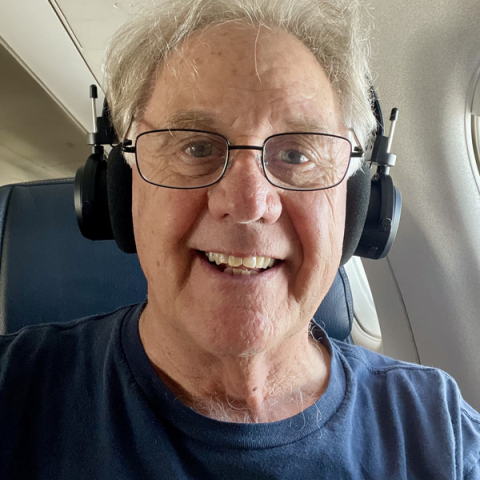
Forty years ago, when I was a much younger man, I was a strong dude. I recall one day in 1986, soon after I started working at Sound by Singer, when Krell cofounder Dan D'Agostino drove down from his factory in Connecticut to deliver a load of amplifiers and preamps for us to sell. As the new guy, I was expected to do the grunt work. At the time, Krell only made about a half-dozen products, and the KSA-100 was the biggest and heaviest, at around 120lb in the box. After watching me pick up a few KSA-100 amplifiers, heft them onto my shoulder, and carry them downstairs to the stockroom, Dan asked (jokingly, I think) if he could hire me.
I doubt I could lift half of that weight today without pulling a muscle, which is why some 15 years ago I decided to specialize in turntables. No more slithering through basement crawl spaces to install pairs of 220lb Krell KRS-200 mono amplifiers. No more unboxing 14 wood crates to set up a pair of original Wilson WAMMs before Dave Wilson flew in to dial them in. From then on I would stick to turntables, which were manageable and easy to lift. I didn't anticipate guys like Franc Kuzma coming along, making turntables that weigh more than those Krell KSA-100s I lifted 40 years earlier, let alone much more massive 'tables from TechDas, SAT, and so on.
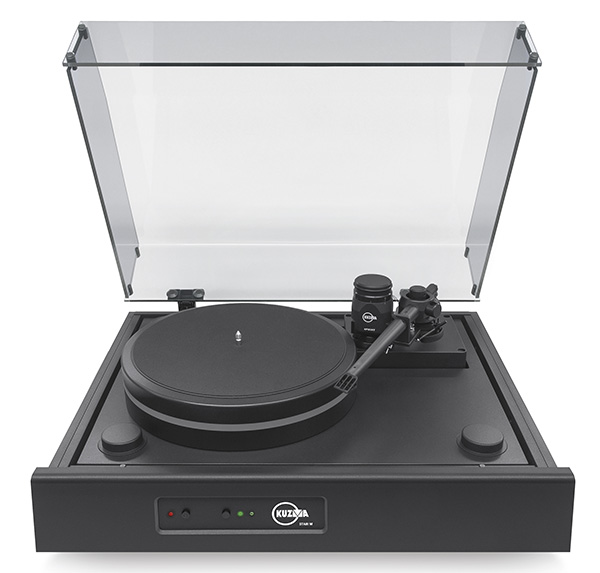
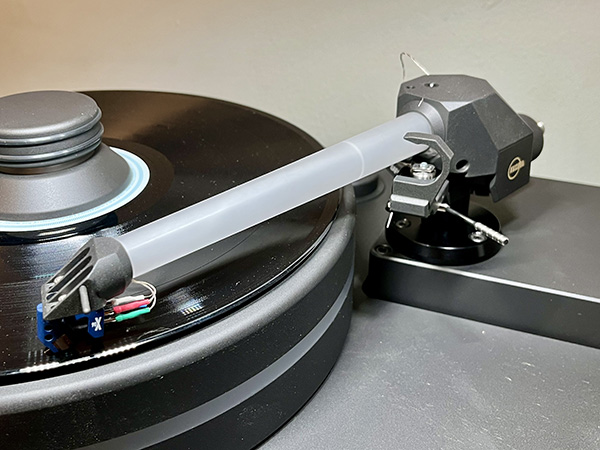 M is for Massive: the Kuzma Stabi M with Kuzma Safir 9
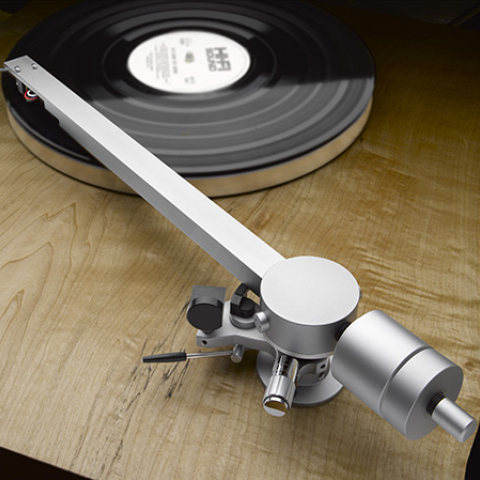
In Spin Doctor #21, I considered and listened to the Kuzma Safir 9 tonearm (above; from $22,160; $23,140 as tested), an extraordinary achievement in rigidity and performance that uses a single piece of lab-grown sapphire for its visually striking armtube. I went through a lot of effort to procure and drill a blank armboard so I could mount the Safir 9 on my trusty Brinkmann La Grange, but Kuzma importer Scot Markwell insisted that to truly experience everything the arm could do, I needed to hear it on a Kuzma 'table (footnote 1).
Kuzma has built and sold turntables for more than 40 years, but the launch of a new model by the Slovenian company is a rare event. The last new turntable from Kuzma was the Stabi R, which Ken Micallef reviewed in 2019, but I told Scot I was eager to try the Safir on an older model, the Stabi M, which was introduced in 2012. Here in the US, the Stabi M doesn't seem to get as much attention as the more versatile Stabi R and the lower cost Stabi S.
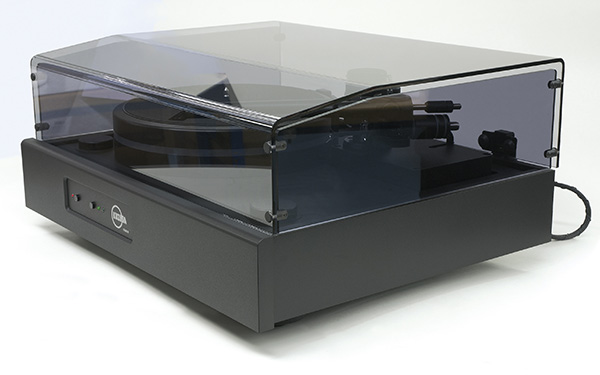
In many ways, the Stabi M (from $28,755; $30,441 as tested) is the purest embodiment of Franc Kuzma's design approach, in which all decisions are rooted in performance, with few concessions to appearance or style. That's a nice way of saying that the Stabi M is unlikely to win awards for beauty: It looks a bit like a Deuce-and-a-Half Army truck parked next to a 1960 Ferrari 250 GT California Spyder. With its rectangular plinth and tinted, hinged dust cover, it gives off a retro vibe, like an older Linn or Thorens that's been going to the gym. The Stabi M is deceptively large; in photographs, only the platter size suggests the scale. I was barely able to fit it on the shelf that tops my rack, and even then it was only because the M's three feet are set in, away from the perimeter.
Like most Kuzma products, going back to the original Stogi tonearm, which I owned at about the time I was hauling those Krells at Sound by Singer, the Stabi M is finished in heavily textured matte-black paint.
This type of finish is tricky to clean: If you try to "wipe with a damp cloth," the paint will shred your cloth before it gives up its finger marks. The review sample came with the optional walnut panels on the front and sides, a $1686 option; the panels lend the Stabi M a frisson of attractive domesticity. For an additional $2909, you can get it in your choice of colors from the RAL color chart. If you really want to add some bling, get the polished solid-brass panels for $6792 extra. I'd choose the standard all-black version, which sells for $28,755, and put some of the savings into sturdy cloths to wipe it with.
 Many turntables from European manufacturers have a completely solid construction, with no compliance or isolation between the feet and the record. Dr. Feickert, Acoustic Signature, and Clearaudio come to mind: no compliant layer anywhere to isolate the record from external vibration, not even rubber feet. A few years back, I set up a Clearaudio Innovation turntable in a Brooklyn apartment that was within shouting distance of an elevated subway line. Every time a train went past, the record skipped. All it took to fix the problem was a thin sheet of Sorbothane between each footer and the supporting shelf.
The Stabi M is one of only two Kuzma models that offer isolation—the other is the Ref 2—which makes it particularly well-suited to American houses with bouncy floors. The Stabi M adds the hinged dust cover made from extra-thick, nonresonant acrylic. At 9lb, the dust cover alone weighs almost as much as the Rega Naia I reviewed recently—more, actually, if you don't count the Naia's dust cover. Kuzma says the Stabi M should be used with the dust cover closed, where it can help keep vibrations away from the delicate stylus. I have long campaigned for a return to dust covers, mostly to combat housekeeper syndrome, the phenomenon by which a light layer of dust near a tonearm can lead to the destruction of a $10k phono cartridge. I would go further and offer a lockable dust cover option, to isolate delicate cantilevers not only from housekeepers but also from careless kids.
Minimizing vibration and isolating the record seems to have been a major part of the design brief for the Stabi M. It could be considered a suspended design, but it isn't springy-bouncy like a Linn LP12 or an Oracle Delphi. The outer frame is constructed from big, bolted-together slabs of aluminum, with three adjustable feet for leveling. Four cylindrical pods within the frame, some kind of elastic damping material embedded in them, support a heavy aluminum top plate that cradles the tonearm board and platter bearing. The motor is suspended from the top plate, embedded in a heavy brass housing to damp vibrations. Four knobs on the top side can be adjusted to level the top plate and platter within the frame. The main bearing is an inverted design, supporting the aluminum subplatter on a tiny ruby ball. The main platter is a hefty 27lb sandwich, with two aluminum layers bolted around an acrylic layer, combining high rotational inertia and exceptional damping. The top surface of the platter has an embedded record mat made from a fabric-like material with a tiny amount of give, providing good support and compliance for less-than-mirror-flat records (and a decent mechanical impedance match with vinyl). A washer and clamp combo flex the record down onto the mat, flattening out smaller warps and irregularities.
Most belt-drive turntables with heavy platters take forever to get up to speed. My Brinkmann's platter is even heavier than the M's, and you have almost enough time to read the liner notes before the platter reaches operating speed. Not so the Stabi M, partly because instead of a stretchy rubber belt, it uses a stiff, short plastic belt with very little give. Coupled to the M's powerful three-phase DC motor, it can get the platter up to speed in one rotation. That's as fast as many direct and idler drive turntables—pretty amazing for a platter that heavy.
The Stabi M's motor gets power from a shoebox-shaped external supply, which connects to the turntable with a pair of umbilical cables. Unusually, there are three ways to control the motor: directly from the front panel of the power supply, where you can also fine-tune each speed; from a smaller panel on the front of the turntable; or using the small, handheld remote. Thanks to its quick, smooth startup, you can cue up a stationary record with the stylus sitting in the groove then hit the start button on the remote control when you're comfortably seated. In addition to the standard 33 1/3 and 45 speeds, there's a way to make the Stabi M spin at 78rpm. Details are in the owner's manual
Many turntables from European manufacturers have a completely solid construction, with no compliance or isolation between the feet and the record. Dr. Feickert, Acoustic Signature, and Clearaudio come to mind: no compliant layer anywhere to isolate the record from external vibration, not even rubber feet. A few years back, I set up a Clearaudio Innovation turntable in a Brooklyn apartment that was within shouting distance of an elevated subway line. Every time a train went past, the record skipped. All it took to fix the problem was a thin sheet of Sorbothane between each footer and the supporting shelf.
The Stabi M is one of only two Kuzma models that offer isolation—the other is the Ref 2—which makes it particularly well-suited to American houses with bouncy floors. The Stabi M adds the hinged dust cover made from extra-thick, nonresonant acrylic. At 9lb, the dust cover alone weighs almost as much as the Rega Naia I reviewed recently—more, actually, if you don't count the Naia's dust cover. Kuzma says the Stabi M should be used with the dust cover closed, where it can help keep vibrations away from the delicate stylus. I have long campaigned for a return to dust covers, mostly to combat housekeeper syndrome, the phenomenon by which a light layer of dust near a tonearm can lead to the destruction of a $10k phono cartridge. I would go further and offer a lockable dust cover option, to isolate delicate cantilevers not only from housekeepers but also from careless kids.
Minimizing vibration and isolating the record seems to have been a major part of the design brief for the Stabi M. It could be considered a suspended design, but it isn't springy-bouncy like a Linn LP12 or an Oracle Delphi. The outer frame is constructed from big, bolted-together slabs of aluminum, with three adjustable feet for leveling. Four cylindrical pods within the frame, some kind of elastic damping material embedded in them, support a heavy aluminum top plate that cradles the tonearm board and platter bearing. The motor is suspended from the top plate, embedded in a heavy brass housing to damp vibrations. Four knobs on the top side can be adjusted to level the top plate and platter within the frame. The main bearing is an inverted design, supporting the aluminum subplatter on a tiny ruby ball. The main platter is a hefty 27lb sandwich, with two aluminum layers bolted around an acrylic layer, combining high rotational inertia and exceptional damping. The top surface of the platter has an embedded record mat made from a fabric-like material with a tiny amount of give, providing good support and compliance for less-than-mirror-flat records (and a decent mechanical impedance match with vinyl). A washer and clamp combo flex the record down onto the mat, flattening out smaller warps and irregularities.
Most belt-drive turntables with heavy platters take forever to get up to speed. My Brinkmann's platter is even heavier than the M's, and you have almost enough time to read the liner notes before the platter reaches operating speed. Not so the Stabi M, partly because instead of a stretchy rubber belt, it uses a stiff, short plastic belt with very little give. Coupled to the M's powerful three-phase DC motor, it can get the platter up to speed in one rotation. That's as fast as many direct and idler drive turntables—pretty amazing for a platter that heavy.
The Stabi M's motor gets power from a shoebox-shaped external supply, which connects to the turntable with a pair of umbilical cables. Unusually, there are three ways to control the motor: directly from the front panel of the power supply, where you can also fine-tune each speed; from a smaller panel on the front of the turntable; or using the small, handheld remote. Thanks to its quick, smooth startup, you can cue up a stationary record with the stylus sitting in the groove then hit the start button on the remote control when you're comfortably seated. In addition to the standard 33 1/3 and 45 speeds, there's a way to make the Stabi M spin at 78rpm. Details are in the owner's manual
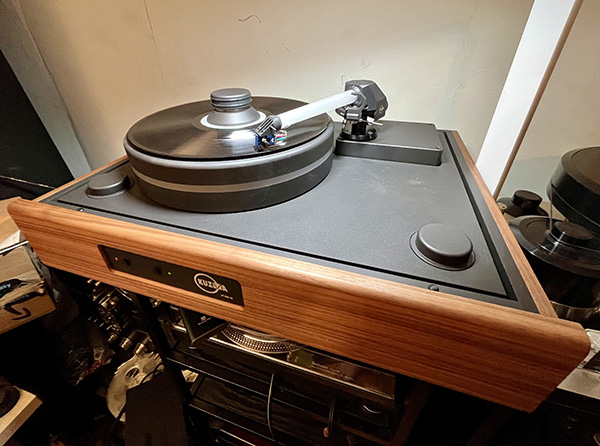 While the Stabi M can accommodate just one tonearm at a time, its chunky aluminum armboards can be swapped out easily by removing four mounting screws. These screws position the armboard accurately and repeatably, so you could have multiple 'arms and cartridges already set up on different armboards, swapping them out as needed in two or three minutes. Most tonearms, including Kuzma's own massive 14" 4Point, can be accommodated, although a few extra-tall or deep 'arms might not clear the closed dust cover.
With so much damping and rigid solidity in its construction, you might expect the Stabi M to sound powerful, thick, and ponderous. On the contrary: The Stabi M is indeed powerful, but it has an uncanny ability to strip away the mush that sits between sounds on a record, presenting each part openly, clear and distinct. This is an extension of the virtues I heard when I used the Safir 9 'arm on my Brinkmann; here, that ability is further enhanced by the inert platform that is the Stabi M.
For most of my listening, I used my Lyra Atlas λ Lambda cartridge, a particularly complementary match, though I also employed the outstanding Ortofon MC 90X and the DS Audio W3 optical cartridge.
While the Stabi M can accommodate just one tonearm at a time, its chunky aluminum armboards can be swapped out easily by removing four mounting screws. These screws position the armboard accurately and repeatably, so you could have multiple 'arms and cartridges already set up on different armboards, swapping them out as needed in two or three minutes. Most tonearms, including Kuzma's own massive 14" 4Point, can be accommodated, although a few extra-tall or deep 'arms might not clear the closed dust cover.
With so much damping and rigid solidity in its construction, you might expect the Stabi M to sound powerful, thick, and ponderous. On the contrary: The Stabi M is indeed powerful, but it has an uncanny ability to strip away the mush that sits between sounds on a record, presenting each part openly, clear and distinct. This is an extension of the virtues I heard when I used the Safir 9 'arm on my Brinkmann; here, that ability is further enhanced by the inert platform that is the Stabi M.
For most of my listening, I used my Lyra Atlas λ Lambda cartridge, a particularly complementary match, though I also employed the outstanding Ortofon MC 90X and the DS Audio W3 optical cartridge.
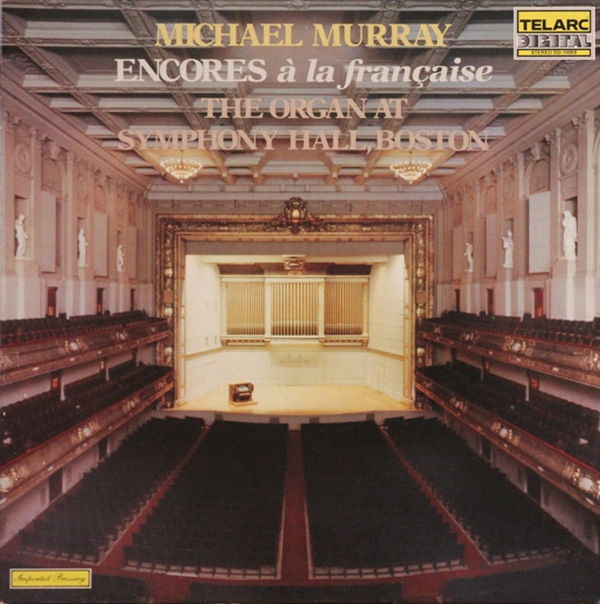 When I see a big, heavy turntable, my mind goes to big, powerful bass. Played on the massive Aeolian-Skinner pipe organ at Boston's Symphony Hall, Michael Murray's recording of the Toccata from Jean-Marie Widor's Symphony #5, on Encores à la Française (Telarc DG-10069), is guaranteed to blow the dust off your woofers. As expected, the bass was as deep, clear, and powerful as I've heard through my system, but what really struck me was the rest of the sound. My attention was drawn to the volume of air, the way notes hung in the acoustical space of Symphony Hall, and how each stop's tone was so clearly contrasted. Toward the end, when the big pedal stops kick in, I started to fear for the woofers in my twin Hsu Research TN1220HO subs, so I rolled the volume back a little.
For a little more get up and go, I played a 12" 45rpm single of "Infected" by The The (Some Bizarre TRUTH T3). This dance track has a sound typical of mid-1980s mixes, with lots of dense effects using early digital reverbs and lots of heavy compression and noise gating. Recordings like this can be fatiguing, but the Stabi M–Safir 9 combo did a great job of unwinding the mix, making it easy to hear each element of the recording. There was nothing sluggish about the groove, either: I'm not exactly known for my dance moves, but this one definitely had me tapping my toes.
Scot was right when he said I needed to hear the Safir 'arm mounted on a Kuzma turntable. The combination's synergy clarifies Franc Kuzma's design goals: a "just the facts" presentation with no artifice or embellishment. This turntable lays your recordings bare, allowing you to hear the inherent beauty in the music making rather than creating a "warm analog" sound. Such sonic honesty will deliver lasting musical enjoyment. Definitely recommended.
When I see a big, heavy turntable, my mind goes to big, powerful bass. Played on the massive Aeolian-Skinner pipe organ at Boston's Symphony Hall, Michael Murray's recording of the Toccata from Jean-Marie Widor's Symphony #5, on Encores à la Française (Telarc DG-10069), is guaranteed to blow the dust off your woofers. As expected, the bass was as deep, clear, and powerful as I've heard through my system, but what really struck me was the rest of the sound. My attention was drawn to the volume of air, the way notes hung in the acoustical space of Symphony Hall, and how each stop's tone was so clearly contrasted. Toward the end, when the big pedal stops kick in, I started to fear for the woofers in my twin Hsu Research TN1220HO subs, so I rolled the volume back a little.
For a little more get up and go, I played a 12" 45rpm single of "Infected" by The The (Some Bizarre TRUTH T3). This dance track has a sound typical of mid-1980s mixes, with lots of dense effects using early digital reverbs and lots of heavy compression and noise gating. Recordings like this can be fatiguing, but the Stabi M–Safir 9 combo did a great job of unwinding the mix, making it easy to hear each element of the recording. There was nothing sluggish about the groove, either: I'm not exactly known for my dance moves, but this one definitely had me tapping my toes.
Scot was right when he said I needed to hear the Safir 'arm mounted on a Kuzma turntable. The combination's synergy clarifies Franc Kuzma's design goals: a "just the facts" presentation with no artifice or embellishment. This turntable lays your recordings bare, allowing you to hear the inherent beauty in the music making rather than creating a "warm analog" sound. Such sonic honesty will deliver lasting musical enjoyment. Definitely recommended.
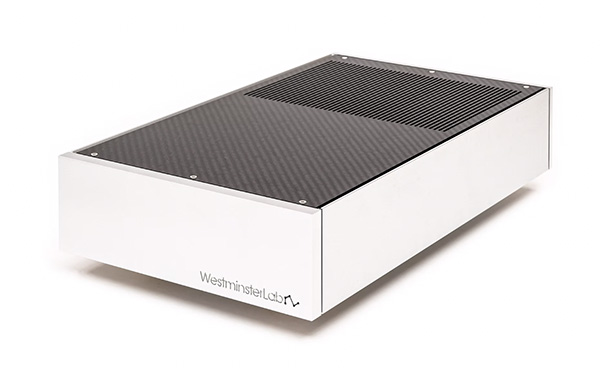 Westminster Lab Monologue Phono Preamp with Optical Module
I confess I was not familiar with Westminster Lab until a couple of years ago, when I began exploring DS Audio's remarkable optical phono cartridges and spotted Westminster's products on a list of compatible third-party equalizers. Gary Leeds, whom I knew as a customer way back in my Sound by Singer days, is now the importer (footnote 2). He asked if I would like to give their Monologue phono preamplifier ($13,900 with one card; additional cards cost $5200) a spin with its optical-cartridge EQ module. I said yes of course, so I then asked DS Audio importer Musical Surroundings if they could lend me an optical cartridge to use with it. They generously loaned me a W3—probably the same W3 I reviewed in Spin Doctor #11. Soon I was up and running. Westminster Lab was founded in 2014 by Hong Kong native Angus Leung while he was a student in the UK. Earlier, as a young boarding school student, he could see Westminster Abbey from his dorm room window; that was the inspiration for the company's name. He cut his teeth in hi-fi working in a repair shop, fixing and modifying gear from classic companies like Krell and Mark Levinson. At first, Westminster Lab was a cable manufacturer, but it soon moved to making electronics designed by Leung. Business grew, and after Leung finished his studies, he moved manufacturing back to his native Hong Kong, where it remains today.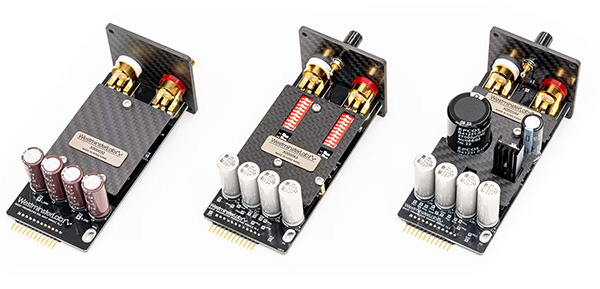 The Monologue is Westminster's first stand-alone phono preamp. It uses a phono board developed as a phono plug-in for Westminster Lab's Quest preamplifier. The Monologue is available with three board options, a moving coil and moving magnet board for conventional magnetic stereo cartridges, a mono version, and an equalizer for DS Audio optical cartridges. You can buy the boards separately, allowing you to change the functionality of the Monologue, but you can install only one board at a time, so it's not practical for someone with two tonearms. The optical-cartridge board has one pair of single-ended RCA inputs for the tonearm connection and a pair of balanced XLR connectors for output.
Housed in an attractive, half-width case, the Monologue has no controls other than a power switch and a pair of internal DIP switches on the optical board to tailor the low-frequency rolloff. Because of how an optical cartridge reads the groove, overextended bass can be an issue, so most optical equalizers provide a way to tailor the bass to match your system. I auditioned the Monologue with this filter disengaged.
The Monologue is Westminster's first stand-alone phono preamp. It uses a phono board developed as a phono plug-in for Westminster Lab's Quest preamplifier. The Monologue is available with three board options, a moving coil and moving magnet board for conventional magnetic stereo cartridges, a mono version, and an equalizer for DS Audio optical cartridges. You can buy the boards separately, allowing you to change the functionality of the Monologue, but you can install only one board at a time, so it's not practical for someone with two tonearms. The optical-cartridge board has one pair of single-ended RCA inputs for the tonearm connection and a pair of balanced XLR connectors for output.
Housed in an attractive, half-width case, the Monologue has no controls other than a power switch and a pair of internal DIP switches on the optical board to tailor the low-frequency rolloff. Because of how an optical cartridge reads the groove, overextended bass can be an issue, so most optical equalizers provide a way to tailor the bass to match your system. I auditioned the Monologue with this filter disengaged.
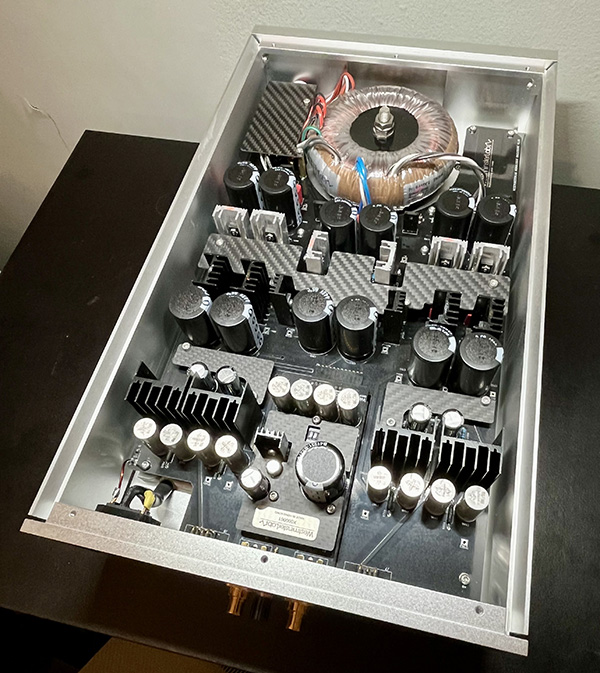 Lifting the hood, the attention to detail Westminster Lab exercised while building the Monologue is immediately clear. Most of the real estate inside the box is taken up by power supply components, all dedicated to providing the ideal electrical environment for the credit card–sized circuit board at its center. Custom capacitors tailored for the tiny signal levels of a cartridge are used, although these are less relevant when the optical board is in use, since the optical cartridge has a healthy output voltage. Special care is taken to minimize noise from the LED light source used in optical cartridges.
The obvious competitors for the Monologue with the optical cartridge board are DS Audio's own See DS-W3 equalizer ($10,000) and the EMM Labs DS-EQ1 ($12,500), now updated to V2 form since my review last year. I no longer have either on hand, so I couldn't do a direct comparison. I did the next best thing and auditioned the Monologue using the same system and recordings. That meant installing the W3 in my familiar Brinkmann La Grange turntable with its 10.5 tonearm. I also listened to the Monologue in the Kuzma setup described above.
Lifting the hood, the attention to detail Westminster Lab exercised while building the Monologue is immediately clear. Most of the real estate inside the box is taken up by power supply components, all dedicated to providing the ideal electrical environment for the credit card–sized circuit board at its center. Custom capacitors tailored for the tiny signal levels of a cartridge are used, although these are less relevant when the optical board is in use, since the optical cartridge has a healthy output voltage. Special care is taken to minimize noise from the LED light source used in optical cartridges.
The obvious competitors for the Monologue with the optical cartridge board are DS Audio's own See DS-W3 equalizer ($10,000) and the EMM Labs DS-EQ1 ($12,500), now updated to V2 form since my review last year. I no longer have either on hand, so I couldn't do a direct comparison. I did the next best thing and auditioned the Monologue using the same system and recordings. That meant installing the W3 in my familiar Brinkmann La Grange turntable with its 10.5 tonearm. I also listened to the Monologue in the Kuzma setup described above.
 First up: Vivaldi: Lute Concertos and Trios (Hungaroton SLPX 11978). I have been using this record to evaluate phono playback gear for more than 35 years. I looked back at my listening notes from the EMM Labs review. I felt they reflected essentially what I was hearing with the Monologue. The overall tonal signature is neutral; it was the Monologue's ability to flesh out the body and delicate richness of the lute that most captured my attention. This harmonic resolution is what allows you to hear subtle details: the difference between one maker's instrument and another's, or the difference in touch and the resulting tone between two musicians.
I used Bill Henderson's Live at the Times (Discovery DS-779) to evaluate the DS-W3 equalizer—specifically "Send in the Clowns." The Monologue puts a little more focus on exploiting the resolving capabilities of the W3 cartridge—slightly more resolution and detail—while the DS Audio EQ luxuriated a bit more in the richness and glow of Henderson's rich baritone voice. The Monologue feels a little more left-brain and definitive, while the W3 EQ punches up flavor and tonal color. Both approaches are valid, and individual taste will determine your preference. One important difference is that the Monologue can be converted to conventional magnetic cartridge use, while both the W3 and EMM Labs DS-01 are strictly for optical cartridges.
I hope to have another round with the Monologue soon with the stereo MM/MC phono card installed. Meanwhile, its optical card is doing a superb job of drawing out the strengths of DS Audio's very special cartridges.
First up: Vivaldi: Lute Concertos and Trios (Hungaroton SLPX 11978). I have been using this record to evaluate phono playback gear for more than 35 years. I looked back at my listening notes from the EMM Labs review. I felt they reflected essentially what I was hearing with the Monologue. The overall tonal signature is neutral; it was the Monologue's ability to flesh out the body and delicate richness of the lute that most captured my attention. This harmonic resolution is what allows you to hear subtle details: the difference between one maker's instrument and another's, or the difference in touch and the resulting tone between two musicians.
I used Bill Henderson's Live at the Times (Discovery DS-779) to evaluate the DS-W3 equalizer—specifically "Send in the Clowns." The Monologue puts a little more focus on exploiting the resolving capabilities of the W3 cartridge—slightly more resolution and detail—while the DS Audio EQ luxuriated a bit more in the richness and glow of Henderson's rich baritone voice. The Monologue feels a little more left-brain and definitive, while the W3 EQ punches up flavor and tonal color. Both approaches are valid, and individual taste will determine your preference. One important difference is that the Monologue can be converted to conventional magnetic cartridge use, while both the W3 and EMM Labs DS-01 are strictly for optical cartridges.
I hope to have another round with the Monologue soon with the stereo MM/MC phono card installed. Meanwhile, its optical card is doing a superb job of drawing out the strengths of DS Audio's very special cartridges.
Footnote 1: Kuzma, Jelenceva 1, SI-4000 KRANJ, Slovenia. Tel: +386 4 25 35 450. Email: kuzmaltd@siol.net. Web: kuzma.si. US distributor: Elite Audio/Video Distribution, 4718 San Fernando Rd. Unit H, Glendale, CA 91204. Tel: (818) 245-6037. Email: scotlt@eliteavdist.com. Web: eliteavdist.com. Footnote 2: Westminster Lab, Westminster Lab Ltd., Hong Kong Web: westminsterlab.com. US distributor: Hear This, 2200 Clay St., Newport Beach, CA 92663. Tel: (949) 467-9808. Email: gary@hearthis.us. Web: hearthis.us.
M is for Massive: the Kuzma Stabi M with Kuzma Safir 9In Spin Doctor #21, I considered and listened to the Kuzma Safir 9 tonearm (above; from $22,160; $23,140 as tested), an extraordinary achievement in rigidity and performance that uses a single piece of lab-grown sapphire for its visually striking armtube. I went through a lot of effort to procure and drill a blank armboard so I could mount the Safir 9 on my trusty Brinkmann La Grange, but Kuzma importer Scot Markwell insisted that to truly experience everything the arm could do, I needed to hear it on a Kuzma 'table (footnote 1).
Many turntables from European manufacturers have a completely solid construction, with no compliance or isolation between the feet and the record. Dr. Feickert, Acoustic Signature, and Clearaudio come to mind: no compliant layer anywhere to isolate the record from external vibration, not even rubber feet. A few years back, I set up a Clearaudio Innovation turntable in a Brooklyn apartment that was within shouting distance of an elevated subway line. Every time a train went past, the record skipped. All it took to fix the problem was a thin sheet of Sorbothane between each footer and the supporting shelf.
The Stabi M is one of only two Kuzma models that offer isolation—the other is the Ref 2—which makes it particularly well-suited to American houses with bouncy floors. The Stabi M adds the hinged dust cover made from extra-thick, nonresonant acrylic. At 9lb, the dust cover alone weighs almost as much as the Rega Naia I reviewed recently—more, actually, if you don't count the Naia's dust cover. Kuzma says the Stabi M should be used with the dust cover closed, where it can help keep vibrations away from the delicate stylus. I have long campaigned for a return to dust covers, mostly to combat housekeeper syndrome, the phenomenon by which a light layer of dust near a tonearm can lead to the destruction of a $10k phono cartridge. I would go further and offer a lockable dust cover option, to isolate delicate cantilevers not only from housekeepers but also from careless kids.
While the Stabi M can accommodate just one tonearm at a time, its chunky aluminum armboards can be swapped out easily by removing four mounting screws. These screws position the armboard accurately and repeatably, so you could have multiple 'arms and cartridges already set up on different armboards, swapping them out as needed in two or three minutes. Most tonearms, including Kuzma's own massive 14" 4Point, can be accommodated, although a few extra-tall or deep 'arms might not clear the closed dust cover.
With so much damping and rigid solidity in its construction, you might expect the Stabi M to sound powerful, thick, and ponderous. On the contrary: The Stabi M is indeed powerful, but it has an uncanny ability to strip away the mush that sits between sounds on a record, presenting each part openly, clear and distinct. This is an extension of the virtues I heard when I used the Safir 9 'arm on my Brinkmann; here, that ability is further enhanced by the inert platform that is the Stabi M.
For most of my listening, I used my Lyra Atlas λ Lambda cartridge, a particularly complementary match, though I also employed the outstanding Ortofon MC 90X and the DS Audio W3 optical cartridge.
When I see a big, heavy turntable, my mind goes to big, powerful bass. Played on the massive Aeolian-Skinner pipe organ at Boston's Symphony Hall, Michael Murray's recording of the Toccata from Jean-Marie Widor's Symphony #5, on Encores à la Française (Telarc DG-10069), is guaranteed to blow the dust off your woofers. As expected, the bass was as deep, clear, and powerful as I've heard through my system, but what really struck me was the rest of the sound. My attention was drawn to the volume of air, the way notes hung in the acoustical space of Symphony Hall, and how each stop's tone was so clearly contrasted. Toward the end, when the big pedal stops kick in, I started to fear for the woofers in my twin Hsu Research TN1220HO subs, so I rolled the volume back a little.
For a little more get up and go, I played a 12" 45rpm single of "Infected" by The The (Some Bizarre TRUTH T3). This dance track has a sound typical of mid-1980s mixes, with lots of dense effects using early digital reverbs and lots of heavy compression and noise gating. Recordings like this can be fatiguing, but the Stabi M–Safir 9 combo did a great job of unwinding the mix, making it easy to hear each element of the recording. There was nothing sluggish about the groove, either: I'm not exactly known for my dance moves, but this one definitely had me tapping my toes.
Scot was right when he said I needed to hear the Safir 'arm mounted on a Kuzma turntable. The combination's synergy clarifies Franc Kuzma's design goals: a "just the facts" presentation with no artifice or embellishment. This turntable lays your recordings bare, allowing you to hear the inherent beauty in the music making rather than creating a "warm analog" sound. Such sonic honesty will deliver lasting musical enjoyment. Definitely recommended.
Westminster Lab Monologue Phono Preamp with Optical ModuleI confess I was not familiar with Westminster Lab until a couple of years ago, when I began exploring DS Audio's remarkable optical phono cartridges and spotted Westminster's products on a list of compatible third-party equalizers. Gary Leeds, whom I knew as a customer way back in my Sound by Singer days, is now the importer (footnote 2). He asked if I would like to give their Monologue phono preamplifier ($13,900 with one card; additional cards cost $5200) a spin with its optical-cartridge EQ module. I said yes of course, so I then asked DS Audio importer Musical Surroundings if they could lend me an optical cartridge to use with it. They generously loaned me a W3—probably the same W3 I reviewed in Spin Doctor #11. Soon I was up and running. Westminster Lab was founded in 2014 by Hong Kong native Angus Leung while he was a student in the UK. Earlier, as a young boarding school student, he could see Westminster Abbey from his dorm room window; that was the inspiration for the company's name. He cut his teeth in hi-fi working in a repair shop, fixing and modifying gear from classic companies like Krell and Mark Levinson. At first, Westminster Lab was a cable manufacturer, but it soon moved to making electronics designed by Leung. Business grew, and after Leung finished his studies, he moved manufacturing back to his native Hong Kong, where it remains today.
The Monologue is Westminster's first stand-alone phono preamp. It uses a phono board developed as a phono plug-in for Westminster Lab's Quest preamplifier. The Monologue is available with three board options, a moving coil and moving magnet board for conventional magnetic stereo cartridges, a mono version, and an equalizer for DS Audio optical cartridges. You can buy the boards separately, allowing you to change the functionality of the Monologue, but you can install only one board at a time, so it's not practical for someone with two tonearms. The optical-cartridge board has one pair of single-ended RCA inputs for the tonearm connection and a pair of balanced XLR connectors for output.
Lifting the hood, the attention to detail Westminster Lab exercised while building the Monologue is immediately clear. Most of the real estate inside the box is taken up by power supply components, all dedicated to providing the ideal electrical environment for the credit card–sized circuit board at its center. Custom capacitors tailored for the tiny signal levels of a cartridge are used, although these are less relevant when the optical board is in use, since the optical cartridge has a healthy output voltage. Special care is taken to minimize noise from the LED light source used in optical cartridges.
The obvious competitors for the Monologue with the optical cartridge board are DS Audio's own See DS-W3 equalizer ($10,000) and the EMM Labs DS-EQ1 ($12,500), now updated to V2 form since my review last year. I no longer have either on hand, so I couldn't do a direct comparison. I did the next best thing and auditioned the Monologue using the same system and recordings. That meant installing the W3 in my familiar Brinkmann La Grange turntable with its 10.5 tonearm. I also listened to the Monologue in the Kuzma setup described above.
First up: Vivaldi: Lute Concertos and Trios (Hungaroton SLPX 11978). I have been using this record to evaluate phono playback gear for more than 35 years. I looked back at my listening notes from the EMM Labs review. I felt they reflected essentially what I was hearing with the Monologue. The overall tonal signature is neutral; it was the Monologue's ability to flesh out the body and delicate richness of the lute that most captured my attention. This harmonic resolution is what allows you to hear subtle details: the difference between one maker's instrument and another's, or the difference in touch and the resulting tone between two musicians.
I used Bill Henderson's Live at the Times (Discovery DS-779) to evaluate the DS-W3 equalizer—specifically "Send in the Clowns." The Monologue puts a little more focus on exploiting the resolving capabilities of the W3 cartridge—slightly more resolution and detail—while the DS Audio EQ luxuriated a bit more in the richness and glow of Henderson's rich baritone voice. The Monologue feels a little more left-brain and definitive, while the W3 EQ punches up flavor and tonal color. Both approaches are valid, and individual taste will determine your preference. One important difference is that the Monologue can be converted to conventional magnetic cartridge use, while both the W3 and EMM Labs DS-01 are strictly for optical cartridges.
I hope to have another round with the Monologue soon with the stereo MM/MC phono card installed. Meanwhile, its optical card is doing a superb job of drawing out the strengths of DS Audio's very special cartridges.
Footnote 1: Kuzma, Jelenceva 1, SI-4000 KRANJ, Slovenia. Tel: +386 4 25 35 450. Email: kuzmaltd@siol.net. Web: kuzma.si. US distributor: Elite Audio/Video Distribution, 4718 San Fernando Rd. Unit H, Glendale, CA 91204. Tel: (818) 245-6037. Email: scotlt@eliteavdist.com. Web: eliteavdist.com. Footnote 2: Westminster Lab, Westminster Lab Ltd., Hong Kong Web: westminsterlab.com. US distributor: Hear This, 2200 Clay St., Newport Beach, CA 92663. Tel: (949) 467-9808. Email: gary@hearthis.us. Web: hearthis.us.