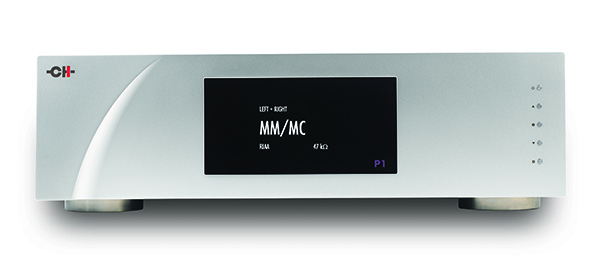
 Connecting the P1 was straightforward. Kevin showed me how to switch between the P1 with the X1 power supply and the P1 solo (with its built-in power supply) while leaving the X1 connected. This made it easy to compare the two configurations.
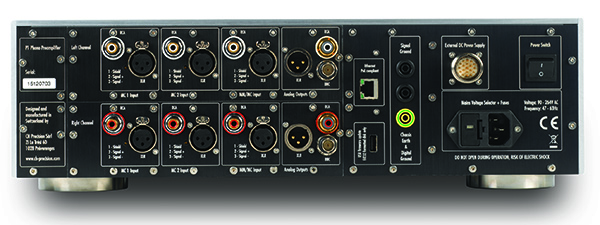
One of the fiddliest jobs when connecting a tonearm cable is hooking up that pesky ground wire, but CH Precision has come up with a simple but brilliant solution. A pair of banana plug sockets on the P1's back panel comes equipped with banana plugs topped with wing nuts, under which you can connect the ground wire. Because the plug can be removed from its socket, you can make the ground-wire connection in an accessible place instead of groping behind your equipment rack. Then simply push the banana plug, with the ground wire connected, into the socket on the rear panel. Easy peasy.
I tried the P1 with four cartridges: a standard Lyra Etna (4.2 ohms internal impedance), a Dynavector DRT XV-1s (approx. 6 ohms), a Miyajima Kotetu mono cartridge (approx. 4 ohms), and a Grado Epoch moving iron. The Grado can be a tricky cartridge to match with a phono stage because it has a relatively low output for a moving iron design, at 1mV, while its 95 ohm internal resistance demands a relatively high-impedance load. I used Input 3 for the Grado, and, after running the setup wizard with the Grado, selected 65k ohms of loading resistance, which the wizard said would deliver the most accurate frequency balance (footnote 3), with 65dB of gain. For the other three cartridges, I used the P1's current-mode amplifier; for the Lyra Etna, I also used the voltage-mode amplifier and did a comparison, about which, more below.
Connecting the P1 was straightforward. Kevin showed me how to switch between the P1 with the X1 power supply and the P1 solo (with its built-in power supply) while leaving the X1 connected. This made it easy to compare the two configurations.
One of the fiddliest jobs when connecting a tonearm cable is hooking up that pesky ground wire, but CH Precision has come up with a simple but brilliant solution. A pair of banana plug sockets on the P1's back panel comes equipped with banana plugs topped with wing nuts, under which you can connect the ground wire. Because the plug can be removed from its socket, you can make the ground-wire connection in an accessible place instead of groping behind your equipment rack. Then simply push the banana plug, with the ground wire connected, into the socket on the rear panel. Easy peasy.
I tried the P1 with four cartridges: a standard Lyra Etna (4.2 ohms internal impedance), a Dynavector DRT XV-1s (approx. 6 ohms), a Miyajima Kotetu mono cartridge (approx. 4 ohms), and a Grado Epoch moving iron. The Grado can be a tricky cartridge to match with a phono stage because it has a relatively low output for a moving iron design, at 1mV, while its 95 ohm internal resistance demands a relatively high-impedance load. I used Input 3 for the Grado, and, after running the setup wizard with the Grado, selected 65k ohms of loading resistance, which the wizard said would deliver the most accurate frequency balance (footnote 3), with 65dB of gain. For the other three cartridges, I used the P1's current-mode amplifier; for the Lyra Etna, I also used the voltage-mode amplifier and did a comparison, about which, more below.
 The hills are alive
Herb Reichert and I have occasionally discussed how audio equipment tends to sound like the country where it was designed and built. The CH Precision P1 provides further evidence in support of that hypothesis. I don't mean that CH gear sounds like yodeling and Alphorns—although I'm sure it would do a very fine job reproducing either—but that the Swiss national character is reflected in the sound of the equipment made there. When I was in my late teens and early 20s, I lived in Switzerland, less than an hour drive from the CH Precision factory. That was a long time ago, but I still have at least a little insight into how the Swiss think and listen, and the P1 reflects those values perfectly. For starters, the P1 is supremely quiet, whether you're using the current-mode or voltage-mode inputs. It is the first phono preamp I've heard in my system whose lack of noise beats the legendary Vendetta, long considered the benchmark for utter silence in vinyl playback—and this was without the X1 power supply. Adding the X1 enhanced this effect further; with nothing playing and the volume turned up way past any normal listening level, the low-level hiss I could hear with my ear pressed up next to the speaker was mostly from my line stage and power amplifier and not the P1. Apart from its silence, the P1's characteristic quality was its uncanny ability to unravel densely packed music and present it with utter clarity; this was laid bare when I played the track "Missed" from my 1993 German pressing of PJ Harvey's album Rid of Me (Island ILPS 8002). Steve Albini's stripped-down recording style is well served by the P1's "just the facts" presentation. This is loud and aggressive music, but with the P1's ability to deliver deep layers of fine-grained detail, it never became objectionable or sonically challenging.
Aspirational audio products like those made by CH Precision inevitably spark lively discussions about value and cost, but to me it's a question of personal priorities. A new P1 costs about the same as a midlevel Toyota Camry (footnote 5), and when you think about it that way, it no longer seems an outrageous extravagance. Nobody would bat an eye if you came home with a nice new car, but if you buy a nice hi-fi while driving a cheap car, they're ready to call in the men in the white coats. That makes little sense to me. Despite having been around for a few years, the P1 remains one of the finest phono stages I have ever experienced and very likely one of the finest ever offered, with resolution and transparency that belies its apparent complexity. It doesn't offer a rose-tinted view of your record collection. What it offers instead is a directness and clarity that makes for a listening experience that's ultimately more enjoyable. I plan to use this amazing tool to dig through as many of my records as I can until the sad day arrives when I get a call requesting its return.
 Revolution: The History Of Turntable Design
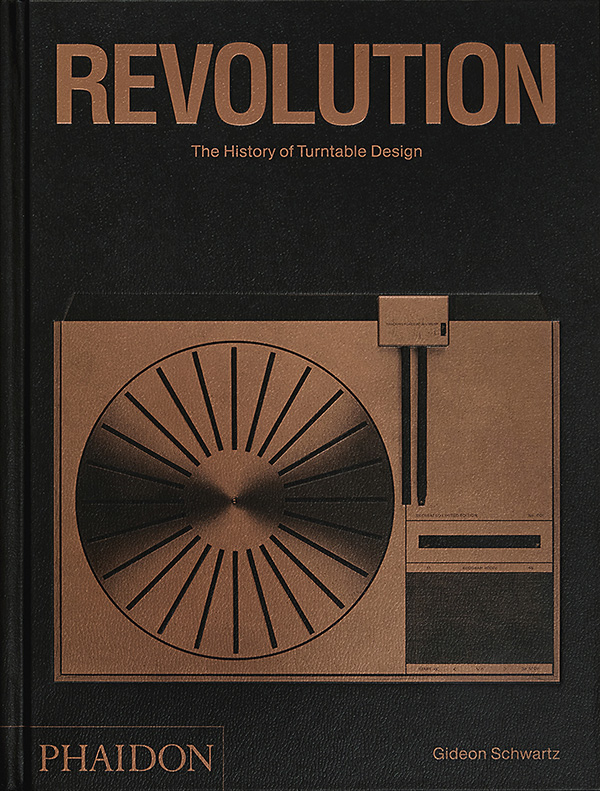
No audio format has a longer, richer history than the record player. Even radio didn't come along until about 30 years after the first record players, and dozens of other music carriers have come and gone in the century plus that records and record players have been around.
Footnote 3: Grado recommends 10k–47k ohms. Footnote 4: "Gain," here, is not rigorously defined—see footnote 2. 15dB is not the total gain but the extra gain beyond that intrinsic to the cartridge's internal resistance. For a 1 ohm cartridge, for example, the intrinsic "gain" is "70," but the P1 can add more in multiples of 5dB. For the Etna's 4.2 ohm load, the wizard recommends adding an extra 15dB to the intrinsic "gain."—Jim Austin