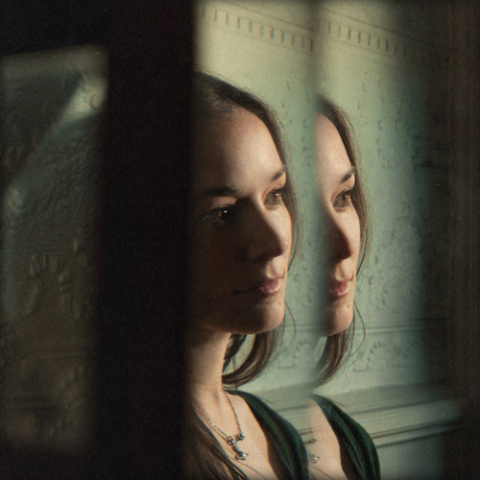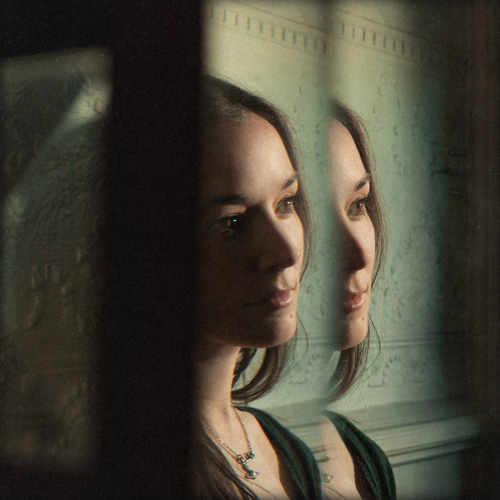
Margaret Glaspy: I Am Both
ATO Records (auditioned as 24/192 FLAC). 2026. Joe Henry, prod.; Patrick Dillett, Thom Beemer, engs.; Chris Gehringer, mastering.
Performance ****½
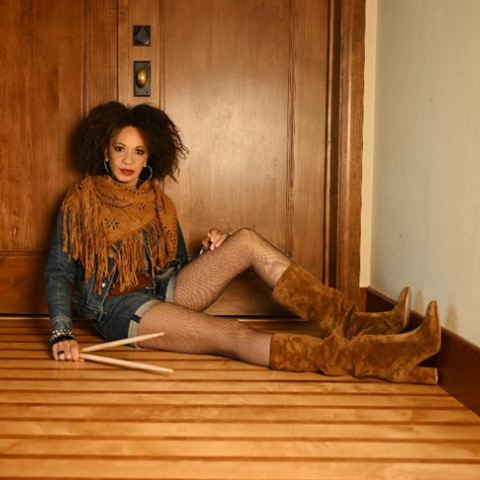
Sonics ****½ Margaret Glaspy is a Brooklyn-based singer/songwriter with a spare style and skill on acoustic guitar. I'd never heard of her before discovering this remarkable album on Qobuz. I say "discovering," but it didn't require a deep dive; this was one of a small handful of albums Qobuz chose to feature with its August 7 releases. If the other streaming services feature it as prominently, it will get attention.
Glaspy moved from northern California to Boston to attend the Berklee school, which may explain those guitar chops. Her bio on Qobuz, by Timothy Monger, says that when her scholarship money ran out, she kept sneaking into master classes while "honing her songs and working odd jobs." She moved to Brooklyn and released her debut EP, Homeschool, in 2012. Her first full-length release was 2016's Emotions and Math. I listened to a little bit of Emotions and Math. It's good, too.
On the title track, Glaspy talks as much as she sings, which made me think of recent British indie bands like Yard Act, Dry Cleaning, Fontaines D.C., and Sleaford Mods. But Glaspy's talk is sincere, not sardonic or arch; the similarity is more to country singers from the '60s and '70s than to Black Country, New Road. That tradition goes back through the talking blues to the Carter Family, probably further—a fact I suspect is not lost on the astute Ms. Glaspy. There's even a suggestion of Hank Williams in the opening words of the title track: He said I live too close to the train tracks / Well if you ask me, I'm just a little too far back. She went down to the river just to watch the fish swim by.
Those opening lines are sung, but just barely; it's the edge of spoken word. Further along, singing gives way to speaking. The voice is different, but it could be Dolly Parton—and where the song goes is remarkable: He said, 'You talk like such a fool. Well, are you courageous, or are you cruel?' / I am both. I am both.
At the end, the song is pure spoken word. It's as if the seriousness of the subject couldn't bear the pretense and decoration that singing is. I'm not sure I've ever thought of spoken word as raw, but here, it's the very definition.
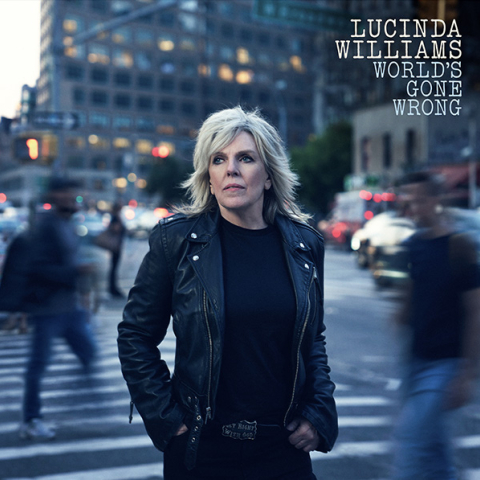
Despite the historical evocations, Glaspy is modern—thoroughly. Among newer artists, Sharon Van Etten is a point of comparison. Who else? She has mentioned Joni Mitchell's Blue explicitly, and it's obvious. She also mentioned Weezer's Pinkerton, which is odder, but I get it and respect it. She reminds me of Lucinda Williams, a true modernist hiding in plain sight who draws on traditional material. (Doesn't every true modernist draw on traditional material? "That Rose" is a Lucinda song through and through.) There's a southern/southwestern/country tinge on this album; Gillian Welch comes to mind. The producer, Joe Henry, has worked with Joan Baez, Mary Gauthier, Ani DiFranco, Susan Tedeschi, Bonnie Raitt, and Rosanne Cash. Given those credits, it's tempting to assume that this is a Joe Henry album with some random singer. Maybe he brought the tone, but this is Glaspy's show. She wrote all the songs, she sings, and she's the album's sole guitarist.
"I Thought She Was a Song" also has a lot of spoken word. It starts (after some nicely played guitar) with "We were in high school. She was sittin' in the sink." Sittin' in the sink?
Glaspy's subject is doing her eyeliner, "too close to really see what she was doing." "I was lookin' on, wishing I was that strong. / Some thought she was a hellion, but no, she was a song. / I thought she was a song, sung by a choir of a million strong." Such lyrical echo is effectively used throughout the album. Powerful stuff, and it benefits greatly from the minimalist presentation.
"Petty" is the album's rawest, angriest song, with its hardest edge. "I didn't know I had to speak up / That's why I'm foldin' your laundry / I'm makin' a meal of it / I'm slammin' doors you leave open / and I'm hopin' you're feelin' it." I know I am.
Glaspy's voice is strong and unaffected. The lyrics are smart. She's a skilled guitarist. The spareness makes me think of both old blues and new punk. The most complex arrangements (eg, "Michigan") have vocals, acoustic guitar, percussion, and light keyboards/ synths. That's all. If you can hear, you'll understand every word. The engineers exercised restraint. Joe Henry did his job well. "Sharp Knife" is the most powerful tune on I Am Both. I'll leave it to you to experience it fresh. I'll just share this remarkable lyric: You can't know you're sunk until you're sinking / On the ocean floor is where you keep your sharp knife / That's where you keep your sharp knife.
The ocean floor? Echoes of Robert Wyatt, even Geeshie Wiley.
The most seminal artists emerge fully formed. That's not this album. Glaspy is experimenting. You can hear it. Appreciate the opportunity to witness the experiment. Give her time.
This draft was written and I was working on final edits when I realized how indebted Glaspy is to John Prine. She lacks his humor, but otherwise, it's a match.
Before she started on this album, Glaspy "broke ties with social media to try and help re-center" her focus "on songwriting." She connected with Joe Henry and a trio of studio pros: Patrick Warren on keys; Ross Gallagher on bass; Jay Bellerose on drums and (mostly) percussion. The rest, if I may make a bold prediction, is history.—Jim Austin
ATO Records (auditioned as 24/192 FLAC). 2026. Joe Henry, prod.; Patrick Dillett, Thom Beemer, engs.; Chris Gehringer, mastering.
Performance ****½
Sonics ****½ Margaret Glaspy is a Brooklyn-based singer/songwriter with a spare style and skill on acoustic guitar. I'd never heard of her before discovering this remarkable album on Qobuz. I say "discovering," but it didn't require a deep dive; this was one of a small handful of albums Qobuz chose to feature with its August 7 releases. If the other streaming services feature it as prominently, it will get attention.