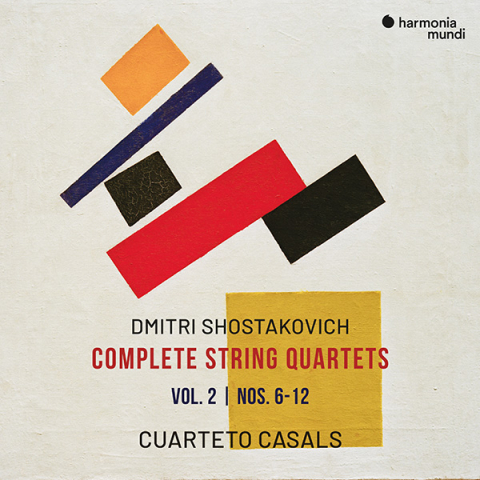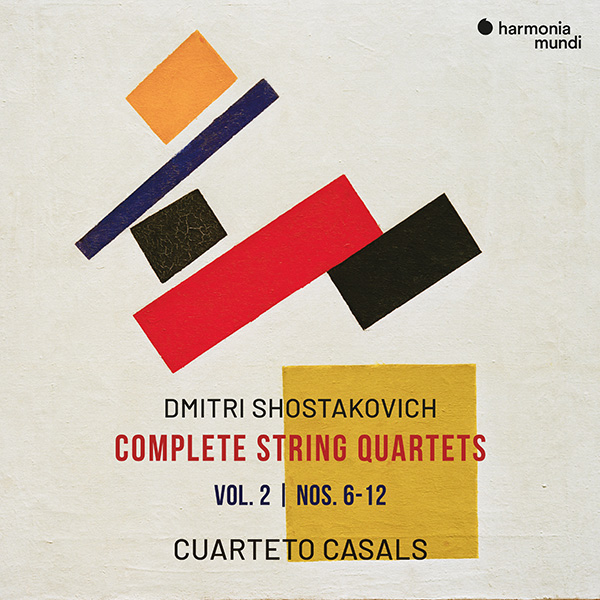
Shostakovich: Complete String Quartets Vol. 2 | Nos. 6–12
Cuarteto Casals
Harmonia Mundi HMU 902733.34. 2 CD (reviewed as 24/96). 2025. Alban Moraud, Alexandra Evrard, prod. and eng.
Performance *****
Sonics ****½ Often nakedly personal and direct in their responses to life events, Shostakovich's 15 String Quartets can overwhelm with the enigmatic elements that make his music so compelling and unique. Shaped as much by intimate relationships as the repressive political realities that wore him down, they stand as one of the later 20th century's major musical achievements. The seven quartets Nos. 6–12 that comprise the second volume of Cuarteto Casals' traversal of Shostakovich's complete string quartets were completed between August 1956 and the summer of 1968. The first arrived the month before Shostakovich turned 40; the last was composed seven years before his death at age 59. This fertile period commenced shortly after the death of Stalin, when Shostakovich's music was again able to circulate openly and be performed in the Soviet Union. As freeing as the "thaw" in repression may have been, it could not lessen the despair and emptiness Shostakovich experienced after the death of his wife in 1954.
The quartets abound with staggering musical invention, personal reflection and confession, and angst. The uncharacteristically joyful elements of Quartet No.6 reflect Shostakovich's buoyant response to his recent second marriage. The union, which was improbable, would last only three years, but its beginning inspired some of the jauntiest and most lyrical outpourings Shostakovich composed following Stalin's denunciation of his music, in 1936, for its "muddle" and bourgeois tendencies.
This is not to suggest that the Sixth is free of the dark, macabre, bitingly ironic elements that surface in many of Shostakovich's compositions. The achingly lovely sadness of its third movement suggests that no amount of immediate joy could efface the sorrow and despair that surrounded him for much of his adult life. In turn, his overarching sadness and bitterness could not efface the happiness that manifests in the lush lyricism of the final movement.
Quartet No.7, completed after that second marriage ended in divorce, commemorates the 50th birthday of his first wife, the late Nina Varzar. The first movement is mysterious and enigmatic, yet the haze of suspended sadness in the second movement and the violent beginnings of the last leave little question as to his emotional state as he reflects on his loss.
The eighth quartet was rapidly composed four years later, provoked by the composer's reluctant decision to join the Communist Party. A musical epitaph—a friend said Shostakovich was planning to commit suicide—Quartet No.8 is one of several works that employ the DSCH motif (D, E flat, C, and B), which spells out his name by musical means. (His daughter said he dedicated this quartet to himself, while party authorities claimed it was against fascism.) The haunting sorrow of the opening movement is as striking as the furious, insistent scurrying and panic of the second movement. The exquisite sadness of the final movement lingers long in the memory and, if you allow it, in the heart.
In the five-movement Quartet No.9, Shostakovich revels in the creative freedom unleashed by his third marriage, to Irina Supinskaya, in 1962. The wealth of musical invention here is staggering. The only musical reference that I immediately recognized was a bit of Rossini's Overture to his opera, William Tell, in the final movement, but others cite Marie's lullaby from Berg's opera Wozzeck, Shostakovich's score for Kozintsev's film Hamlet, and the opening theme to the finale of Dvořá.k's Symphony No.9, From the New World.
The harmonies of the ninth quartet's first movement are extraordinary, as is Cuarteto Casals' musicianship. During the fourth movement, I realized that the quartet's members had so deeply melded with Shostakovich's music that their instruments were transformed into riveting, emotional voices. Listen to how beautifully Vera Martínez Mehner's violin sings at the top of its range and the unbridled passion that she and her colleagues unleash at the start of the final movement's wild Allegro. Cellist Arnau Tomàs Realp contributes a torrent of thunderous pizzicato plucks, while the other instruments create a marvelous, drone-like buzz beneath. As one idea follows another faster than you can catch your breath, the music grows more driven until the conclusion's final repeat. If you love being blown away by music, to the point that you shake your head in disbelief at its brilliance, listen to Cuarteto Casals' rendition of this almost 28-minute quartet.
By the time you reach No.12, with a first movement that sounds funereal as it flirts with atonality, I expect that you will be in awe of Shostakovich's genius. Cuarteto Casals plays superbly, each player's numerous inflections reflecting deep involvement with this vital music. Special kudos to cellist Realp, whose nuanced sound is consistently smooth, rich, and without edge. Congratulations as well to Alban Moraud and Alexandra Evrard of Alban Moraud Audio, who have created beautifully transparent recordings. Some quartet recordings set the players farther back and offer a greater sense of space, but the directness and color of this team's achievement ensure that Shostakovich's extraordinary music reaches into the core of your being and propels you to realms that cannot be fully encapsulated in prose.—Jason Victor Serinus
Cuarteto Casals
Harmonia Mundi HMU 902733.34. 2 CD (reviewed as 24/96). 2025. Alban Moraud, Alexandra Evrard, prod. and eng.
Performance *****
Sonics ****½ Often nakedly personal and direct in their responses to life events, Shostakovich's 15 String Quartets can overwhelm with the enigmatic elements that make his music so compelling and unique. Shaped as much by intimate relationships as the repressive political realities that wore him down, they stand as one of the later 20th century's major musical achievements. The seven quartets Nos. 6–12 that comprise the second volume of Cuarteto Casals' traversal of Shostakovich's complete string quartets were completed between August 1956 and the summer of 1968. The first arrived the month before Shostakovich turned 40; the last was composed seven years before his death at age 59. This fertile period commenced shortly after the death of Stalin, when Shostakovich's music was again able to circulate openly and be performed in the Soviet Union. As freeing as the "thaw" in repression may have been, it could not lessen the despair and emptiness Shostakovich experienced after the death of his wife in 1954.