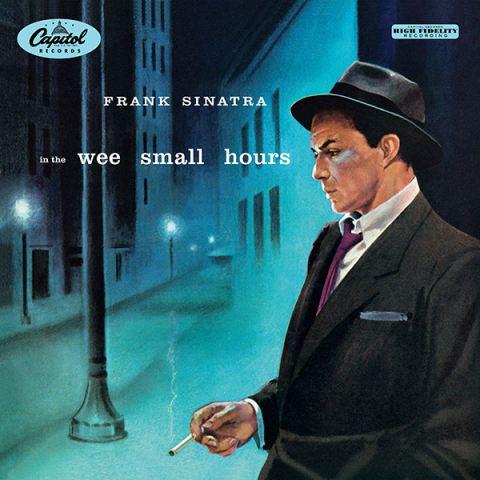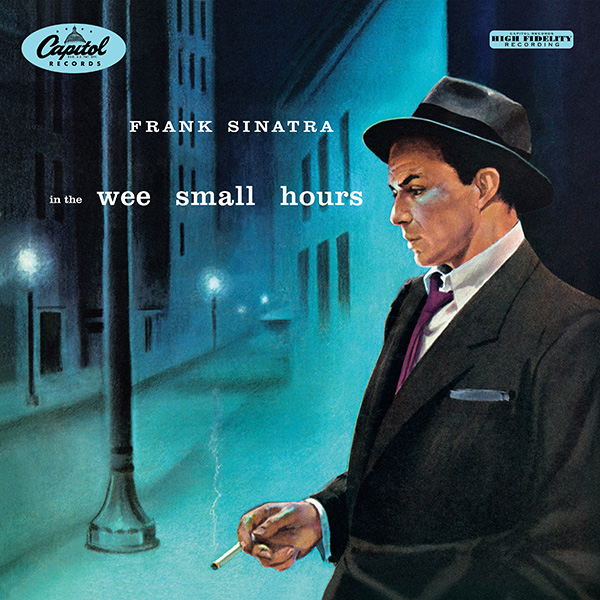
Frank Sinatra: In the Wee Small Hours
Capitol Records/Blue Note W581 (LP). 2025. Voyle Gilmore, Joe Harley, prods.; John Palladino, Kevin Gray, engs.
Performance *****
Sonics ***** Francis Albert Sinatra's milestone album In the Wee Small Hours was recorded and released in 1955 by Capitol Records. Now, in 2025, this never-out-of-print record has been remastered by Blue Note Records as part of their Tone Poet audiophile vinyl series. November 14 marks the 70th anniversary of the album's release on 12" LP. The new Tone Poet vinyl edition is produced by Joe Harley and was cut all-analog by Kevin Gray. The important news is that for the first time, alternate original "master" tapes were located and used. Joe Harley explained. "Larry Walsh, retired longtime Capitol engineer, said to me 'You might want to take a look at the phono reels.' Capitol ran two tape decks for this recording. One set was assembled and used many hundreds of times for the 12" LP. The other set was put away with each track filed separately, for use as singles. Those tapes had never been used before." Mastering engineer Gray provided more information. "The tapes were absolutely pristine ¼" full-track mono, running at 15ips. We added a smidgen of EQ on the bottom and took off 1dB in the upper midrange." That is all. I asked Harley if there was a bump up in the sound. His answer: "No question. Absolutely. Like lifting a veil!" Indeed.
In the early '50s, Sinatra's recording career had ebbed. Now that he was in his mid-'30s, his releases on Columbia Records weren't connecting with his audience the way they once had. In 1952, Columbia Records terminated his contract. Capitol Records, a newer label cofounded a decade earlier by singer-songwriter Johnny Mercer, stepped in and signed Frank in 1953, though many people in the company were against the idea. Capitol paired Sinatra with the brilliant young arranger Nelson Riddle, who at that time was the music director for Nat King Cole, another Capitol Records artist. The magic began. Riddle's first sessions with Frank were in 1953. In the Wee Small Hours was their third collaboration. The album was successful, reaching #2 on the Billboard 200 album chart and staying there for 18 weeks; an album by Jackie Gleason and the soundtrack from the film Love Me or Leave Me with Doris Day kept it from the #1 spot.
In the Wee Small Hours was innovative on several fronts. When it was released in 1955, it was one of the very first successful records in the 12" "long-play" (LP) format. (I own many Sinatra recordings on 78rpm records. Format wars are nothing new.) Earlier in the year, in April, the album was released as a two-disc 10" LP set and on a four-disc 45rpm "EP" set.
On the music side, the hefty, 16-track program all hung together in terms of music and emotion; some have called In the Wee Small Hours the first "concept" album. Frank himself called this "The Ava Album," a reference to his dissolving marriage to film star Ava Gardner. Riddle attributed Frank's new, more emotional approach to his breakup, and Sinatra himself acknowledged the emotional trauma. Three of the songs are by Rodgers and Hart, including "Glad to Be Unhappy" and the beautiful "It Never Entered My Mind." Two songs are by Harold Arlen, including a devastating take on "Ill Wind." Even Duke's "Mood Indigo" is on the record.
In later years, Sinatra was known to be highly efficient in the studio: He wasn't happy if a song required more than one take. But that wasn't how it went with In the Wee Small Hours. Five lengthy sessions—at night of course—were spread out over time, with groups of various sizes conducted by Riddle. Recording took place at Capitol's KHJ Studios on Melrose Avenue in Hollywood, next door to Paramount's film studio. A photo presented in the handsome gatefold album package shows Frank standing in the studio in front of a Neumann U 47 microphone, which he used a lot during his Capitol years.
Capitol had not yet built its famous office and studio complex at Hollywood and Vine. When they did, in 1956, the first sessions in the new Capitol Studios (which are still in use) were for Frank Sinatra; he was there to record material that would be released the following year as Close to You.
I've never heard Frank sounding like this. In gorgeous mono, it's as if a spotlight is beaming down on him in a small club. You can feel Frank exploring the lower range of his voice as it began to change with the years. He sits on the low notes in a way he hadn't done before, which takes the emotional stakes to a whole new level of intensity.
This album marked the start of that mature, reflective, world-weary Sinatra, one aspect of his great artistry. Record of the Month, Record of the Year, Record of the Decade, Record of the Century. A chestnut, a perennial Top 100, Top 10. A masterpiece. All these terms are appropriate descriptions of Frank Sinatra's In the Wee Small Hours, and now it sounds far better than it ever has before.—Sasha Matson
Capitol Records/Blue Note W581 (LP). 2025. Voyle Gilmore, Joe Harley, prods.; John Palladino, Kevin Gray, engs.
Performance *****
Sonics ***** Francis Albert Sinatra's milestone album In the Wee Small Hours was recorded and released in 1955 by Capitol Records. Now, in 2025, this never-out-of-print record has been remastered by Blue Note Records as part of their Tone Poet audiophile vinyl series. November 14 marks the 70th anniversary of the album's release on 12" LP. The new Tone Poet vinyl edition is produced by Joe Harley and was cut all-analog by Kevin Gray. The important news is that for the first time, alternate original "master" tapes were located and used. Joe Harley explained. "Larry Walsh, retired longtime Capitol engineer, said to me 'You might want to take a look at the phono reels.' Capitol ran two tape decks for this recording. One set was assembled and used many hundreds of times for the 12" LP. The other set was put away with each track filed separately, for use as singles. Those tapes had never been used before." Mastering engineer Gray provided more information. "The tapes were absolutely pristine ¼" full-track mono, running at 15ips. We added a smidgen of EQ on the bottom and took off 1dB in the upper midrange." That is all. I asked Harley if there was a bump up in the sound. His answer: "No question. Absolutely. Like lifting a veil!" Indeed.