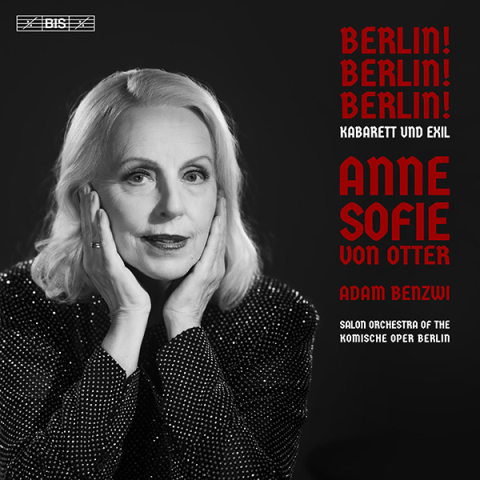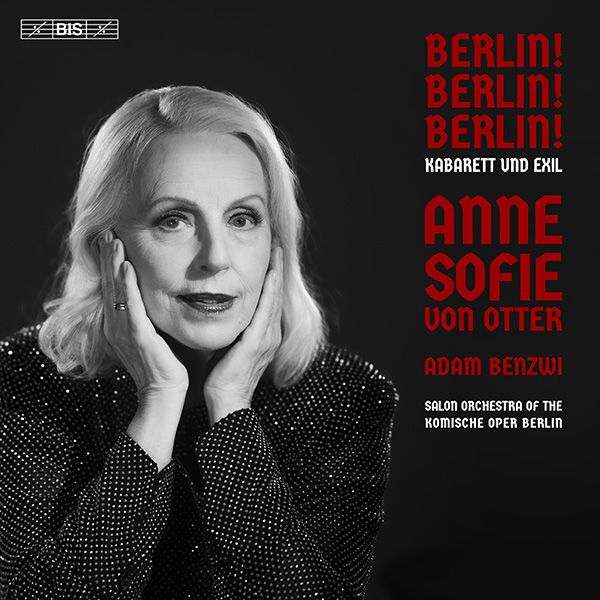
Berlin! Berlin! Berlin! Kabarett und Exil
Anne Sofie von Otter, mezzo-soprano; Salon Orchestra of the Komische Oper Berlin, Adam Benzwi
BIS-2827 (SACD; reviewed in its native 24/96). 2026. Markus Mittermeyer, prod., eng.
Performance *****
Sonics ****½ Anne Sofie von Otter is still recording? When I learned that the great Swedish mezzo, whose celebrated discography dates back 40 years, was 69 when she entered the Traumton Studio in Berlin to record Berlin! Berlin! Berlin!, I was less than optimistic about what I might hear. Imagine my surprise when I discovered, instead of shrieks, yowls, and a mile-wide vibrato, bountiful if inevitably altered vocal resources commanded by an artist with such skill as to make listening a nonstop delight. With her probing intellect and abundant personality, von Otter offers us one of the most engaging, enchanting, and enlightening vocal tours de force in recent memory. Complemented by pianist and musical director Adam Benzwi, an American expat whose supremely colorful, perfectly recorded Salon Orchestra of the Komische Oper Berlin includes soloists on singing saw, mandolin, banjo, and guitar as well as on the more customary cello, double bass, clarinet, sax, flute, trumpet, trombone, and drums, von Otter sings, speaks, croons, coaxes, teases, and cajoles her way through the vocal tracks on Berlin! Berlin! Berlin! (which I will henceforth refer to as Berlin! × 3). In every way, including the engineering, this recording is a triumph.
Berlin! × 3 comes from a program, originally entitled Ich wollt' ich wär' ein Huhn (I Wish I Were a Chicken), that premiered at the Komische Oper Berlin on March 6, 2020, directed by Barrie Kosky. The 19-track recording includes nine songs from movie soundtracks, two songs from plays, and two instrumentals. Almost entirely composed during the rise and maniacal reign of Hitler and the Nazi regime, the music is sometimes cheerful to the point of careless abandon. Von Otter describes it as an "explosive mix ... of songs with lots of lyrics, crazy nonsense, serious songs by Hanns Eisler, beautiful melodies and operatic numbers, and then again things that don't sound like operetta at all." The influence of African-American jazz is apparent; von Otter invokes the phrase "Prussian Schwing" to describe a whiter, squarer style that to her ear incorporates elements of Prussian militarism.
Von Otter and Benzwi's carefully calculated mixture of wit, melancholy, sadness, irony, and regret has elements of the quasimaniacal excess popularized by the Broadway show and movie Cabaret. Many of the pieces served as either avenues of escape or as scathing commentary on German society in the 1920s, '30s, and '40s. According to album note author Martin Siebert, the repertoire was chosen to illustrate the "combination of pain and splendor [and] underlying sadness beneath the glamour of beauty, and the bittersweetness of those years when life was celebrated and embraced despite the wounds and threats endured."
The dichotomy is well-illustrated by the transition from the oblivious bliss of the 1939 song "Heut' Abend lad' ich mir die Liebe ein" ("Tonight, I invite love in")—"There's nothing else I want to know tonight,/because I just want to kiss, all night long"—to Brecht's sobering "Über den Selbstmord" (On Suicide), from his 1943 Hollywooder Liederbuch (Hollywood Songbook) with Hanns Eisler.
The irresistibly upbeat, oft-riotous first four tracks originally enlivened movie soundtracks. First up is Walter Jurmann and Bronislaw Kaper's 1933 instrumental "Mein Gorilla hat 'ne Villa im Zoo" ("My Gorilla has a Villa in the Zoo"); this segment of the album extends through Friedrich Hollaender's "Illusions," from the 1948 movie A Foreign Affair.
Some of the characters von Otter conveys (with impeccable diction) are as delightful as they are transgressive and outrageous. As I listened to Michael Jary and Paul Kirsten's 1938 song "Der Onkel Jonathan" ("Uncle Jonathan"), I marveled at von Otter's masterful deployment of her voice. At times resorting to sprechstimme, a carefully pitched 20th century German style of expression that melds speaking and singing, her performances abound in wit, charm, tease, and style. Nothing is routine or sung on autopilot. In "Der Onkel Jonathan" as in many others, she seems to be having such a ball that it's impossible not to laugh with her. Just listen as she sings "Who is that strange gentleman / with that strange jacket" who is "even more in love than a totally smitten cock-of-the-walk / Di dudl dadl didl dudl dadl didl dadl daa" and try not to smile.
Von Otter's approach is very much her own; she's anything but a clone of Lotte Lenya or Ute Lemper. Her sound, which radiates beauty and intelligence rather than decadence and decay, never sounds arch, over the top, or world-weary. She comes across as more knowing than the full-hearted, celebratory, golden-voiced, incurably romantic Richard Tauber, whose approach retained its optimism even after he was forced to leave Germany in 1933 after being attacked in the streets by Nazi Brownshirts.
By program's end, you too may be convinced, as I was, that von Otter is as ideally suited to sing this repertoire as she was to sing the music of Handel, Mozart, Schubert, Grieg, and Richard Strauss earlier in her career.—Jason Victor Serinus
Anne Sofie von Otter, mezzo-soprano; Salon Orchestra of the Komische Oper Berlin, Adam Benzwi
BIS-2827 (SACD; reviewed in its native 24/96). 2026. Markus Mittermeyer, prod., eng.
Performance *****
Sonics ****½ Anne Sofie von Otter is still recording? When I learned that the great Swedish mezzo, whose celebrated discography dates back 40 years, was 69 when she entered the Traumton Studio in Berlin to record Berlin! Berlin! Berlin!, I was less than optimistic about what I might hear. Imagine my surprise when I discovered, instead of shrieks, yowls, and a mile-wide vibrato, bountiful if inevitably altered vocal resources commanded by an artist with such skill as to make listening a nonstop delight. With her probing intellect and abundant personality, von Otter offers us one of the most engaging, enchanting, and enlightening vocal tours de force in recent memory. Complemented by pianist and musical director Adam Benzwi, an American expat whose supremely colorful, perfectly recorded Salon Orchestra of the Komische Oper Berlin includes soloists on singing saw, mandolin, banjo, and guitar as well as on the more customary cello, double bass, clarinet, sax, flute, trumpet, trombone, and drums, von Otter sings, speaks, croons, coaxes, teases, and cajoles her way through the vocal tracks on Berlin! Berlin! Berlin! (which I will henceforth refer to as Berlin! × 3). In every way, including the engineering, this recording is a triumph.