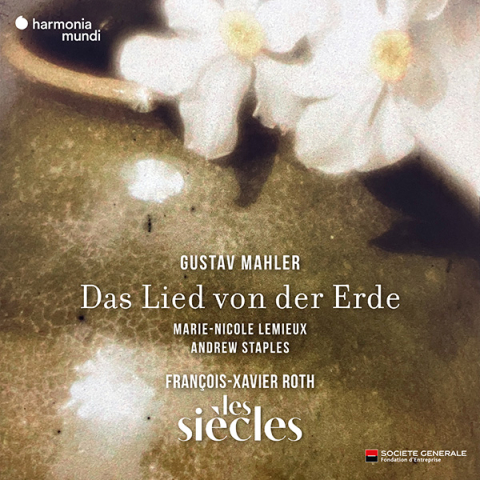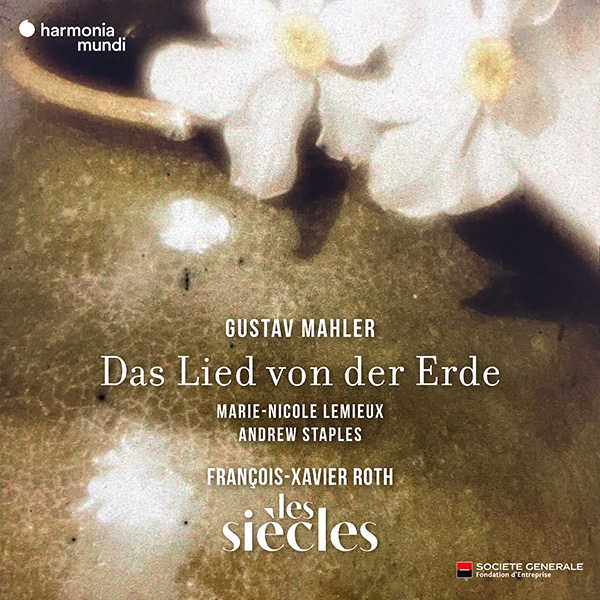
Mahler: Das Lied von der Erde
Marie-Nicole Lemieux, contralto; Andrew Staples, tenor. Les Siècles, François-Xavier Roth, cond.
Harmonia Mundi HMM 902740 (CD; reviewed as 24/96). 2026. Jiri Heger, prod., eng.
Performance *****
Sonics **** Why award Recording of the Month to a project whose vocal soloists, though thoroughly committed, are in some respects less than ideal? Because the orchestra and conducting in this Das Lied von der Erde (The Song of the Earth), one of the greatest works of music in the late German romantic idiom, shed such light on Mahler's achievement as to make the recording either a first choice or an essential supplement to the other great recordings of his career-defining creation. Mahler, who did not live to witness Bruno Walter conduct the premiere of this massive vocal symphony, composed Das Lied von der Erde in 1908 and 1909, a period when his life was in turmoil. His young daughter, Maria, had died unexpectedly, and Alma, his progressively estranged wife, blamed Maria's death on the composition of Mahler's song cycle, Kindertotenlieder, which reflects his obsession with the death of children. Add Mahler's diagnosis of heart disease and resignation as head of the Vienna Opera, and one might expect him to have composed a relentlessly tragic work. While those works would come—Symphony No.9 and the incomplete Symphony No.10—Das Lied von der Erde is much more than a statement of life's pain.
Certainly the names of the symphony's six movements—translated as "Drinking Song of the World's Misery"; "The Lonely Man in Autumn"; "Of Youth"; "Of Beauty"; "The Drunk Man in Spring"; and "The Farewell"—suggest isolation and loss. But these settings of somewhat spurious translations of Chinese poems by 8th century Tang Dynasty author Li Bai, augmented by texts of other Chinese poets and (in the final song) Mahler himself, lend themselves to multiple interpretations. The ultimate choice, as well as the choice of soloists as either tenor and baritone or tenor and alto, lies with the conductor.
In this case, conductor François-Xavier Roth has made an additional choice. Rather than embrace the rounder tones of the later 20th century instruments which dominate every classic recording—these include Walter's 1952 account with the Vienna Philharmonic, tenor Julius Patzak, and contralto Kathleen Ferrier, and Otto Klemperer's 1964–1966 account with what became the New Philharmonia Orchestra, tenor Fritz Wunderlich, and mezzo-soprano Christa Ludwig—Roth and Les Siècles opt for, his words, "the texture of gut strings, the different bores of the brass at this period, the round tone of the rotary valve trumpets, the heaviness of the trombones, [and] the knightly sound of the horns." Many of the orchestra's instruments were crafted in Germany and produce the very sounds Mahler heard in his head as he composed.
Roth, who eschews the no-nonsense dearth of romantic indulgence that marred his otherwise exceptional recording of Mahler's Symphony No.4, underscores how virtually every instrumental gesture in this great work mirrors and amplifies the text. Listen to the laughing in the first song as Staples sings, in translation, "The song of sorrow shall sound with a burst of laughter in your souls." Feel the intense yearning four minutes in, amplified by the unique sound of Les Siècles' period woodwinds. In the second song, listen to the light in the orchestra as it comments on Lemieux's words, "One would think an artist had sprinkled jade dust over the delicate blossoms."
Every song, sometimes every line, brings new revelations. The third song's pavilion of green and white porcelain, with music redolent of youthful light and atmosphere, comes to life guided by Roth's baton and sensibilities. The fourth song's fragrance of lotus flowers, horses neighing merrily, golden sunbeams, and supreme sense of youthful love and enchantment contrast mightily with the profound air of emptiness and finality with which Roth's intentionally gritty double basses announce the start of the sixth song's final "Farewell" ("Der Abschied"). You can hear somewhat similar acts of orchestral word painting in the final movement of Mahler's surprisingly sunny Fourth Symphony—but here it is further refined and fleshed out. The colors and textures are marvelous.
There's no getting around Staples's pinched high range nor a certain overripe (though never shrill) maturity in Lemieux's voice. (She turned 49 during the recording sessions, which stretched from March 18 to November 19, 2024.) But if Staples comes across less as carefree than a bit worn out from incessant drink, Lemieux's vocal beauty and understanding override occasionally excessive vibrato and strained high notes.
A week after the first of several listens to this recording, I cannot get Lemieux's performance in the fourth song—the way she conveys the essence of youth and beauty—out of my head. Nor can I forget how rather than darken her voice near the end of the final Farewell, she lightens it, as if to indicate transcendence of earthly concerns. Her voice is neither as smooth as Ferrier's nor as even as Ludwig's. Nor does it convey the extra-musical sense of farewell and sadness that one feels as Ferrier, stricken with terminal breast cancer, struggled to make one of her final recordings. Lemieux, though, acquits herself as an insightful artist who uses every means at her disposal to bring Mahler's world to life. Roth does, too. Highest possible recommendation.—Jason Victor Serinus
Marie-Nicole Lemieux, contralto; Andrew Staples, tenor. Les Siècles, François-Xavier Roth, cond.
Harmonia Mundi HMM 902740 (CD; reviewed as 24/96). 2026. Jiri Heger, prod., eng.
Performance *****
Sonics **** Why award Recording of the Month to a project whose vocal soloists, though thoroughly committed, are in some respects less than ideal? Because the orchestra and conducting in this Das Lied von der Erde (The Song of the Earth), one of the greatest works of music in the late German romantic idiom, shed such light on Mahler's achievement as to make the recording either a first choice or an essential supplement to the other great recordings of his career-defining creation. Mahler, who did not live to witness Bruno Walter conduct the premiere of this massive vocal symphony, composed Das Lied von der Erde in 1908 and 1909, a period when his life was in turmoil. His young daughter, Maria, had died unexpectedly, and Alma, his progressively estranged wife, blamed Maria's death on the composition of Mahler's song cycle, Kindertotenlieder, which reflects his obsession with the death of children. Add Mahler's diagnosis of heart disease and resignation as head of the Vienna Opera, and one might expect him to have composed a relentlessly tragic work. While those works would come—Symphony No.9 and the incomplete Symphony No.10—Das Lied von der Erde is much more than a statement of life's pain.