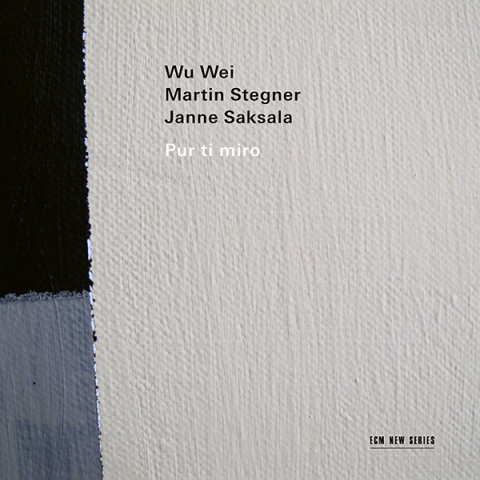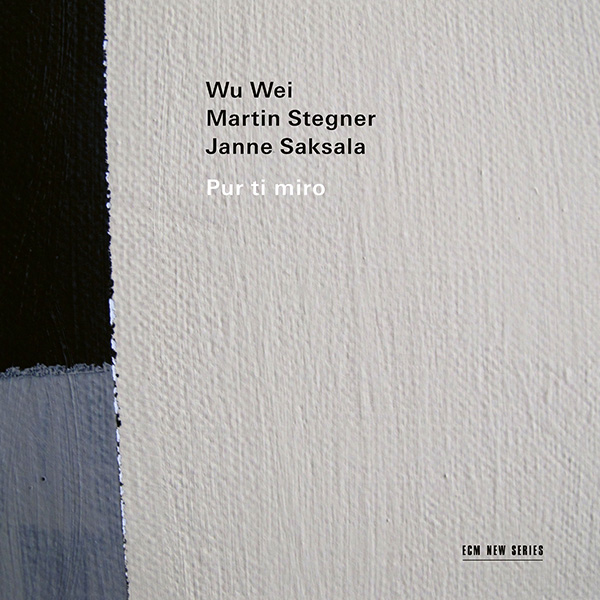
Pur ti miro
Wu Wei, sheng; Martin Stegner, viola; Janne Saksala, double bass
ECM New Series 2843 (CD; reviewed as 24/96). 2025. Manfred Eicher, exec. prod.; Martin Sauer, eng.
Performance *****
Sonics ****½ Pur ti miro presents a certifiably off-the-beaten-track crosscultural instrumental exploration that may strike some audiophiles as a bit weird, at least at first. Yet once you transcend tried-and-true expectations and allow what you hear to (in words immortalized by Grace Slick) "feed your head," you will likely find the timbral contrasts, colors, and expressive power of Pur ti miro's trio of sheng, viola, and double bass hard to resist. The overwhelming beauty of the sounds these three instruments make playing baroque music and beyond transforms something that at first seems like an oddity into near-visionary inspiration. For the project, Manfred Eicher, ECM's founder and visionary executive producer, enlisted three superb musicians: Wu Wei on sheng; Martin Stegner on viola; and Janne Saksala on double bass. I can't get enough of the sound of Wu Wei's sheng. A custom, modern instrument based on a 3000-year-old Chinese wind instrument consisting of a number of bamboo pipes outfitted with small metal reeds, all bundled together in a metal wind chamber, Wu Wei's sheng includes a modern key mechanism that makes it suitable for Western tonalities. Sonically, the instrument confounds the imagination by sounding more like a steel-stringed instrument than a woodwind.
It's astounding how much emotion the sheng can convey—at least a sheng that's energized by the lungs and heart of a recognized master who, since arriving in Germany on a scholarship in 1995, has inspired any number of forward-looking classical composers to write new music for him. On this recording, Wu Wei and his colleagues mostly limit themselves to baroque adaptations of vocal and instrumental music by Monteverdi, J.S. Bach, and Vivaldi—more on what else they do follows—but Wu Wei has recorded and performed in entirely different contexts with any number of contemporary, classical, and jazz ensembles.
Musicologically, there is nothing "authentic" about the baroque transcriptions on this recording save for a surprise bit of improvisation, which was de rigueur in baroque times. Stegner and Saksala both play modern instruments. Both hold prominent positions in the Berlin Philharmonic; Saksala is Principal Solo Double Bassist. Stegner, it should be noted, cofounded the Berlin Philharmonic Jazz Group, which Saksala performs in.
What is authentic about this recording is the playing. The music makes apparent that these men believe in and champion this odd instrumental combination. The opening track, Monteverdi's madrigal "Sì dolce è'l tormento," SV 332, for voice and continuo, is so arresting in its beauty that I must have played it a dozen times in the past week alone. Besides the perfect blend of music and timbre, what I find especially rewarding is how adept Wu Wei and Martin Stegner are in communicating the madrigal's plaintive, broken-hearted character. As the soprano sings—or rather, doesn't sing, since there's no soprano here—the opening lines "Sì dolce è'l tormento / Ch'in seno mi sta" ("So sweet is the torment / That lies in my heart"), the sheng and viola sigh and suffer in turn.
"Sì dolce è'l tormento" finds its ideal complement in the title track, "Pur ti miro"—the final love duet between Nero and Poppea in Monteverdi's great opera L'incoronazione di Poppea, SV 308. "I gaze upon you, I desire you," the lovers sing to each other. If instruments alone cannot fully transmit the vulnerability and adoration that they share, Wu Wei, Stegner, and Saksala nonetheless capture the warmth and love of the unpretentiously exquisite music Monteverdi composed for the words "I embrace you, I enchain you ... o my life, o my beloved, I am yours ... yes, my love, yes, my heart, my life, yes."
There's no pretending that a sheng has the same power as a baroque organ. Still, it's surprising, how well it captures the organ's effects in Bach's Organ Trio Sonata No.1 in E-flat major, BWV 525 and the andante from his subsequent Organ Trio Sonata No.4 in E minor, BWV 528. But the big surprise arrives when the trio begins to riff in the second half of Vivaldi's score for his Trio Sonata in D minor, Op.1 No.12, "La Follia," RV 63. Taking their cue from the familiar baroque theme's meaning as "madness" or "folly," they indulge in jazz, bluegrass, klezmer, and more during the longest track on an admittedly short recording. It's a helluva lotta fun.
After your listening concludes with a traditional Norwegian tune, I encourage you to search out some of Wu Wei's many other collaborations and commissions. If baroque fare, even baroque fare that swings, isn't at the top of your must-listen stack, classical commissions such as Unsuk Chin's striking, sometimes violent concerto, u for Sheng and Orchestra, may prove more to your liking. It's certainly more of-our-time. A decade after Wu Wei recorded this with the Seoul Philharmonic Orchestra under Myung-Whun Chung, Wu Wei headed to Norway to record Rolf Wallin's ear-opening Five Seasons with the Stavanger Symphony Orchestra under Andris Poga.
If you consider such explorations more fitting for Slick's white rabbit, please pass me a carrot ... but only after you listen to Pur ti miro.—Jason Victor Serinus
Wu Wei, sheng; Martin Stegner, viola; Janne Saksala, double bass
ECM New Series 2843 (CD; reviewed as 24/96). 2025. Manfred Eicher, exec. prod.; Martin Sauer, eng.
Performance *****
Sonics ****½ Pur ti miro presents a certifiably off-the-beaten-track crosscultural instrumental exploration that may strike some audiophiles as a bit weird, at least at first. Yet once you transcend tried-and-true expectations and allow what you hear to (in words immortalized by Grace Slick) "feed your head," you will likely find the timbral contrasts, colors, and expressive power of Pur ti miro's trio of sheng, viola, and double bass hard to resist. The overwhelming beauty of the sounds these three instruments make playing baroque music and beyond transforms something that at first seems like an oddity into near-visionary inspiration. For the project, Manfred Eicher, ECM's founder and visionary executive producer, enlisted three superb musicians: Wu Wei on sheng; Martin Stegner on viola; and Janne Saksala on double bass. I can't get enough of the sound of Wu Wei's sheng. A custom, modern instrument based on a 3000-year-old Chinese wind instrument consisting of a number of bamboo pipes outfitted with small metal reeds, all bundled together in a metal wind chamber, Wu Wei's sheng includes a modern key mechanism that makes it suitable for Western tonalities. Sonically, the instrument confounds the imagination by sounding more like a steel-stringed instrument than a woodwind.