

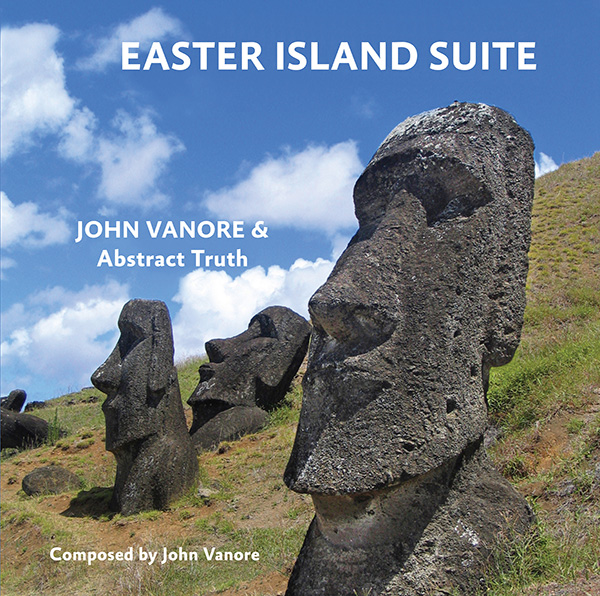
John Vanore & Abstract Truth: Easter Island Suite
Vanore, trumpet, flugelhorn, compositions, arrangements; 27 others
Acoustical Concepts AC-160 (CD). 1989, 2012, 2024/2026. Vanore, prod.; Terry Hoffman, Richard King, John Senior, engs.
Performance *****
Sonics **** Large-ensemble jazz was once the dominant format in the art form. Today it is a niche. Big jazz bands now survive mostly as labors of love. Current examples of beloved big bands include the Maria Schneider Orchestra, Darcy James Argue's Secret Society, and Ryan Truesdell's Gil Evans Project. There is another bandleader who belongs in this distinguished company whose name you may not know. John Vanore is a relatively well-kept secret except among hardcore big band junkies and Philadelphians. Until 2015, Vanore was director of music at Widener University in Philadelphia. But his labor of love for 40 years has been a large ensemble he calls Abstract Truth. Easter Island Suite is their seventh record. Its inspiration is one of the world's most isolated inhabited islands. Easter Island is in the Pacific Ocean, 2180 miles west of Chile. It is famous for its stone statues called moai—towering human figures, hundreds of years old. Vanore has never been there. But he has long been fascinated by a place he imagines as "the loneliest on earth." He is also drawn to the deep mystery of how the statues, some of which weight 80 tons, got there.
Easter Island Suite consists of four movements. The first, "Discovery," was recorded in 1989 and appears on the 2009 Abstract Truth album Blue Route. The second and third movements, "Gods & Devils" and "The Secret Caves," were recorded in 2012 and appear on the 2013 album Culture. (The 1989 version of "Discovery" also appears on Culture.) The fourth movement, "Rano Raraku," was recorded in 2024 and appears for the first time on the new album.
The concept behind a concept album is truly important only to the artist who conceived it. If you came to this music cold, absent any information, you could still respond to its richness and sweep. But when you realize that the suite tells the story of an imaginary visit to a world both magical and real, it gives the music even greater clarity and dimension. "Discovery" opens like a slow awakening, with the long calls of George Barnett's French horn and the deep drone of Craig Thomas's arco bass. The full ensemble enters like a force looming out of the sea, then clears the way for the powerful tenor saxophone of Mike Falcone. His solo portrays the wonderment of entering a landscape populated by mute, inscrutable monoliths.
Vanore has always intended Abstract Truth to be a "soloist based" orchestra. This characterization is claimed by other bands, but Vanore means it. He does employ traditional big band devices like full-ensemble shout choruses and section backgrounds, but his voicings are distinctive and his harmonic resolutions sound spontaneous, as if discovered in the moment by interacting improvisers.
Other features of the band, which support the "soloist based" plan, are its comparatively compact size and its instrumentation. Most editions of Abstract Truth have contained a rhythm section, five trumpets, two trombones, a French horn, and only two saxophones, doubling on flute and bass clarinet.
And those soloists—"Philly guys," as Vanore refers to them—kill, their lack of worldwide fame notwithstanding. On "Gods & Devils," Vanore himself on trumpet and Bob Howell on tenor saxophone make vivid statements. "The Secret Caves" is about the island's underground caverns. The ethereal reveries of Brian Landrus on bass clarinet, Michael Mee on flute, and Craig Thomas on waterphone all depict a state of awareness that haunts Vanore's suite: awe in the presence of the unexplainable.
"Rano Raraku" is the name of the island's volcanic crater lake. The extinct volcano was a quarry for about 500 years. It supplied the stone from which the moai were carved. The area around the lake contains hundreds of the statues, in various states of completion. It is one of the most extraordinary archaeological sites on earth. This last movement of the suite is based on a slow, dramatic, majestic three-note motif from the massed ensemble that, for 15 minutes, keeps emerging, then falling silent, then reemerging. Lyndsie Wilson on French horn is hypnotic in this piece. Guitarist Greg Kettinger and pianist Ron Thomas are stunning. "Rano Raraku" concludes with Thomas's hesitant, searching iteration of rare, pure piano impressionism. When his isolated, glittering notes insist for the last time on the three-note motif, a truth becomes manifest: Within the mystery that is at the heart of Vanore's suite, beauty is the greatest mystery of all.
Through extensive remastering, these four movements, recorded over a 35-year period, sound like a unified whole. Easter Island Suite is a major achievement, now finally available all together in one place.—Thomas Conrad
Vanore, trumpet, flugelhorn, compositions, arrangements; 27 others
Acoustical Concepts AC-160 (CD). 1989, 2012, 2024/2026. Vanore, prod.; Terry Hoffman, Richard King, John Senior, engs.
Performance *****
Sonics **** Large-ensemble jazz was once the dominant format in the art form. Today it is a niche. Big jazz bands now survive mostly as labors of love. Current examples of beloved big bands include the Maria Schneider Orchestra, Darcy James Argue's Secret Society, and Ryan Truesdell's Gil Evans Project. There is another bandleader who belongs in this distinguished company whose name you may not know. John Vanore is a relatively well-kept secret except among hardcore big band junkies and Philadelphians. Until 2015, Vanore was director of music at Widener University in Philadelphia. But his labor of love for 40 years has been a large ensemble he calls Abstract Truth. Easter Island Suite is their seventh record. Its inspiration is one of the world's most isolated inhabited islands. Easter Island is in the Pacific Ocean, 2180 miles west of Chile. It is famous for its stone statues called moai—towering human figures, hundreds of years old. Vanore has never been there. But he has long been fascinated by a place he imagines as "the loneliest on earth." He is also drawn to the deep mystery of how the statues, some of which weight 80 tons, got there.















