

Sidebar 3: Measurements
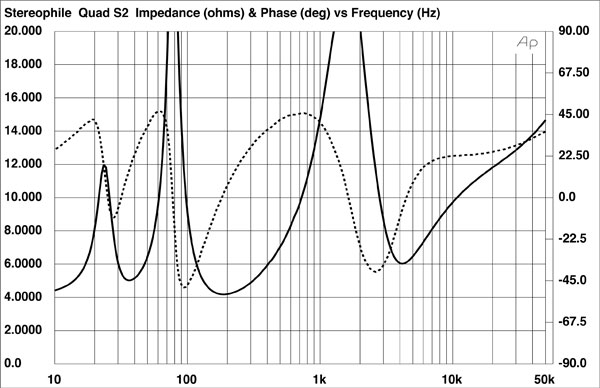
I used DRA Labs' MLSSA system and a calibrated DPA 4006 microphone to measure the Quad S-2's frequency response in the farfield, and an Earthworks QTC-40 for the nearfield responses. My estimate of the Quad's sensitivity was 86.9dB(B)/2.83V/m, confirming the specified figure of 87dB. Fig.1 shows how the impedance and electrical phase vary with frequency. Though the impedance has a minimum value of 4.17 ohms at 190Hz and there's a combination of 5.8 ohms and –37° phase angle at 117Hz, the S-2 is a relatively easy load for amplifiers to drive.
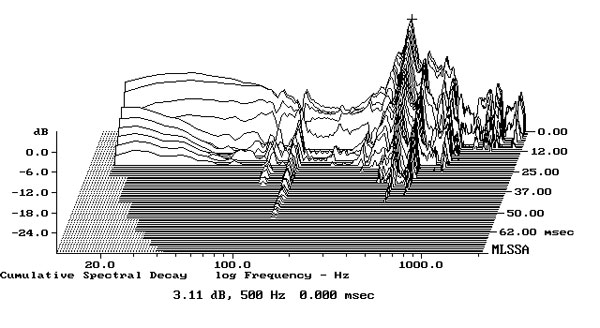
The traces in fig.1 are free from the small discontinuities that would suggest the presence of panel resonances. However, when I investigated the enclosure's vibrational behavior with a plastic-tape accelerometer, I did find a strong mode at 500Hz on the sidewalls (fig.2), with several lower-level modes present on the top panel. I note that Ken Micallef didn't comment on there being any midrange congestion, so it's possible this behavior measures worse than it sounds.
 The crossover between the woofer and the ribbon tweeter appears to be set at 3.3kHz, with fairly steep high- and low-pass filter slopes (fig.3). The woofer alignment is slightly underdamped, with the port on the rear panel (blue trace) tuned to 38Hz, the frequency of the expected notch in the woofer's output (red). The port rolls off cleanly above its passband, with no significant resonant peaks in its midrange output. Fig.4 shows how the outputs of the individual drive-units sum in the farfield, with the response averaged across a 30° horizontal window centered on the tweeter axis. The rise in output in the upper bass will be due in part to the nearfield measurement technique, but the S-2's woofer alignment is somewhat underdamped. As KM writes, "bass was juicy, rich, practically tumescent." Ahem!

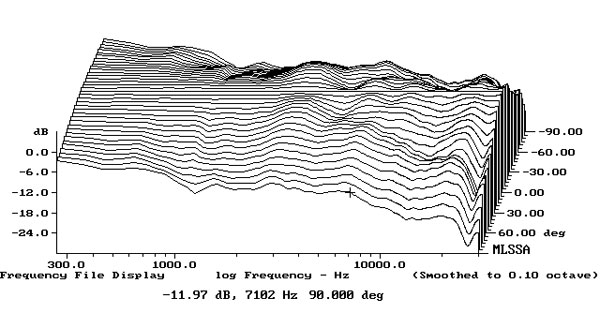
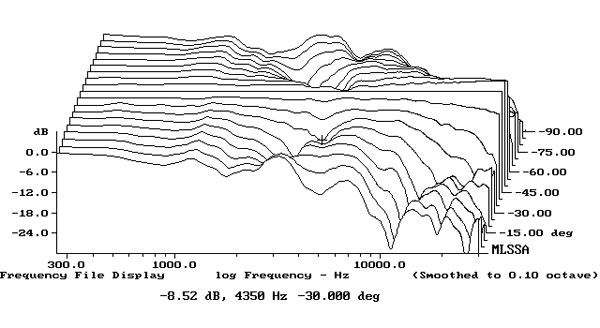
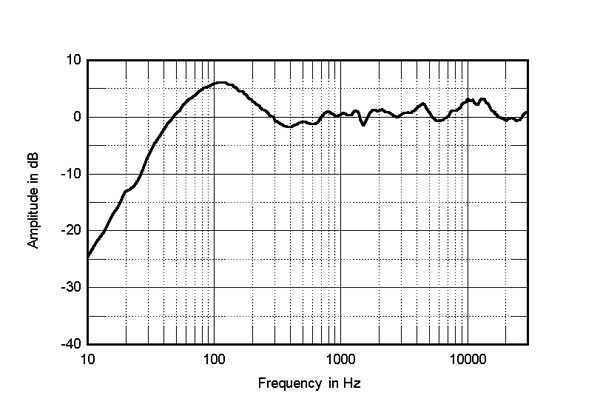 Higher in frequency, the Quad's farfield response is impressively flat, with a very slight rising trend evident between 1 and 12kHz. The horizontal off-axis behavior is also well controlled (fig.5), the ribbon tweeter maintaining its top-octave output up to a reasonable 15° to the speaker's sides. The ribbon tweeter is quite directional in the vertical plane (fig.6), and a suckout in the crossover region develops more than 5° above and 10° below the tweeter axis. For the optimal balance, the Quad S-2 needs to be used on stands that place the listener's ears level with the tweeter.
 In the time domain, the speaker's step response on the tweeter axis (fig.7) indicates that both drive-units are connected in positive acoustic polarity. Although the tweeter's output leads that of the woofer, their outputs meld relatively well, even if this graph does suggest that the optimal blend occurs just below the tweeter axis. The cumulative spectral-decay plot on the tweeter axis (fig.8) is superbly clean, which correlates with KM's having found that the S-2's treble offered "purity, clarity, and extension."
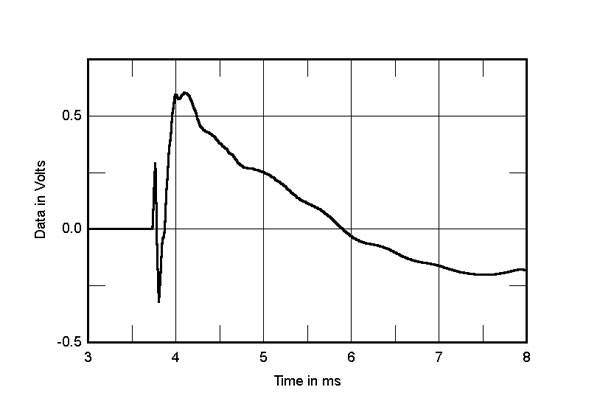
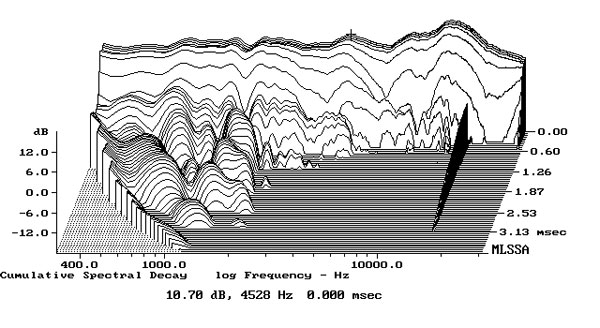
Fig.1 Quad S-2, electrical impedance (solid) and phase (dashed) (2 ohms/vertical div.).
Fig.2 Quad S-2, cumulative spectral-decay plot calculated from output of accelerometer fastened to center of sidewall (MLS driving voltage to speaker, 7.55V; measurement bandwidth, 2kHz).
Fig.3 Quad S-2, acoustic crossover on tweeter axis at 50", corrected for microphone response, with nearfield responses of woofer (red) and port (blue), respectively plotted in the ratios of the square roots of their radiating areas below 350Hz and 600Hz.
Fig.4 Quad S-2, anechoic response on tweeter axis at 50", averaged across 30° horizontal window and corrected for microphone response, with complex sum of nearfield woofer and port responses plotted below 300Hz.
Fig.5 Quad S-2, lateral response family at 50", normalized to response on tweeter axis, from back to front: differences in response 90–5° off axis, reference response, differences in response 5–90° off axis.
Fig.6 Quad S-2, vertical response family at 50", normalized to response on tweeter axis, from back to front: differences in response 45–5° above axis, reference response, differences in response 5–45° below axis.
Fig.7 Quad S-2, step response on tweeter axis at 50" (5ms time window, 30kHz bandwidth).
Fig.8 Quad S-2, cumulative spectral-decay plot on tweeter axis at 50" (0.15ms risetime).
I have known Peter Comeau, director of acoustic design for IAG, since his days at Heybrook in the 1970s. The Quad S-2 is a worthy addition to his loudspeaker portfolio.— John Atkinson















