

One of the better things about bookshelf loudspeakers is that they're innately portable. Though not generally considered the sort of music-reproduction machines you'd bring to a party, a 12-step group, or a Burning Man rave (though you certainly could), high-quality bookshelf speakers are overlooked tools in the eternal work-in-progress of introducing lovers, friends, and family to our beloved lifestyle. So during the first week or three of breaking in the Quad S-2 bookshelf speakers, I thought, Why keep these to myself? It's strict Stereophile policy that all gear be evaluated in the context of the reviewer's reference hi-fi rig(s), but there's no law against sharing the joy.
In their single shipping box, the S-2s together weigh about 28 lbs—it was easy for me to tote them all over New York City and environs and temporarily install them in the meager system of a Chelsea record store, in my girlfriend's entry-level rig in Forest Hills, Queens, and in my sister's none-too-shabby hi-fi (Cambridge Audio Topaz AM10 integrated amp, Pro-Ject Debut III record player) in Spring Lake, New Jersey. Everyone welcomed the sophisticated-looking, small-footprint S-2s—particularly my British brother-in-law, who fondly recalled his dad's classic Quad gear from the 1960s.
At the end of this peripatetic break-in period, I safely re-ensconced the Quad S-2s in my Greenwich Village apartment, where I listened to them in my smaller rig of Music Hall MMF 7.3 turntable and Heed amplification, and my majordomo system comprising a Kuzma Stabi and Stogi turntable and tonearm, and a Shindo Laboratory Allegro preamp and Haut-Brion power amp.
I'd reviewed high-end audio gear for various websites for 20 years before John Atkinson graciously took on this former Southern boy in 2015. That's when my real work began. But we all have history, right? And perhaps no audio history is as glorious as that of the British audio manufacturer Quad, now owned by the IAG Group, which manufactures Quad products in Shenzhen, China.
Innovator and audio designer Peter J. Walker founded S.P. Fidelity Sound Systems in 1936, and later that year changed its name to Acoustical Manufacturing Co. Ltd. After a decade of making public-address systems, their first commercial home-audio product came in 1948: the QA/12P integrated amplifier. (Quad was originally an acronym for Quality Unit Amplifier Domestic.) In 1949, the QA/12P was joined by another Walker design, the Corner Ribbon (CR) loudspeaker: the very first speaker to use the hybrid technology of a ribbon loaded by a horn.
The Quad QCII preamplifier and II power amplifier were introduced in 1953, followed four years later by the commercially successful Quad Electrostatic Loudspeaker or ESL, referred to unofficially as the ESL-57 and nicknamed "Walker's Wonder." The ESL remained in production for 28 years, and was eventually succeeded by the equally lauded ESL-63, which wowed the faithful until 1999. The ESL design is venerated for its low distortion, palpable midrange, brilliant transparency, transient speed, and lack of coloration. The trade-off is a tiny sweet spot and a lack of absolute low-end frequencies.
My Upper East Side pal and Methodist vicar Steven Yagerman enjoys his original ESLs as the holy relics they are—they bring to life the voices of Ella, Frank, Nat, John, and Paul as I'd never heard them before. I also recall how, in 2015, Robin Wyatt of Robyatt Audiobrought a pair of beautifully restored ESLs into a small showroom as attendees jostled for a taste of their itsy-bitsy yet terrific sweet spot. Peter Walker had legendary history and, thus, experience with electrostatic technology; no doubt that wisdom has trickled down, to endure in Quad's upscale Z-series speakers and less expensive S models, the latter including the smaller S-1 stand-mount, the S-4 and S-5 floorstanders, and the S-C center channel.
 Design
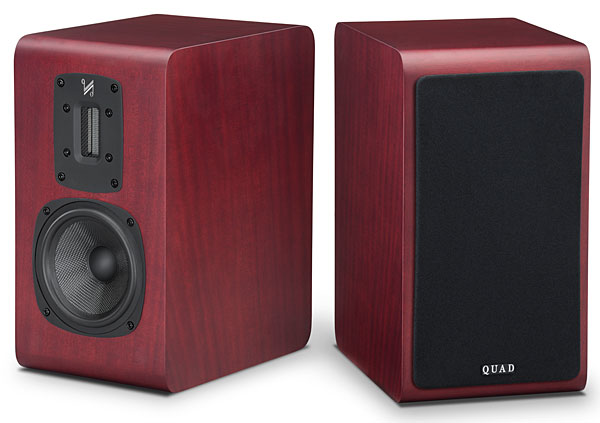
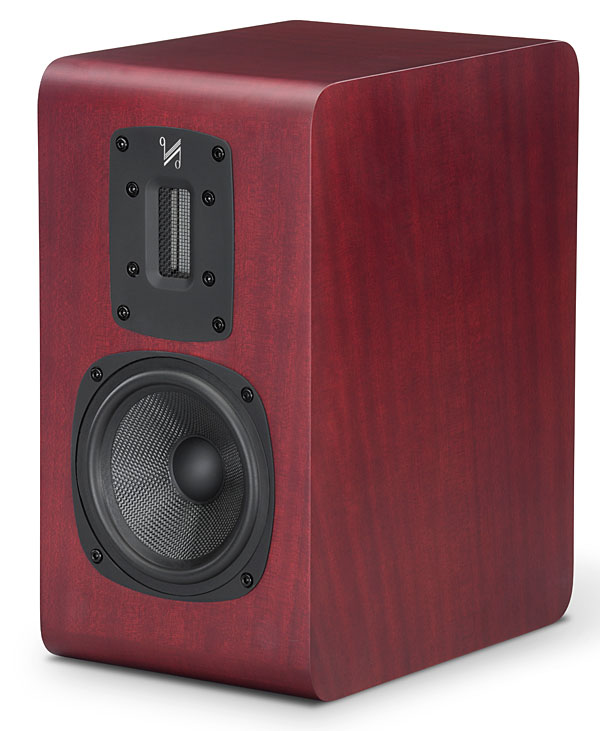
The Quad S-2 is a two-way, ported design with a 5" mid/bass drive-unit featuring a Kevlar cone and manufactured in-house, and Quad's newly designed, 0.5" by 1.75" (12 by 45mm) True Ribbon tweeter. Its specifications include a frequency response of 48Hz–22kHz, ±3dB; a sensitivity of 87dB; impedance of 8 ohms; bass extension down to 37Hz, –6dB; and a crossover frequency of 3kHz. Each Quad S-2 measures 13" high by 7.1" wide by 10.25" deep and weighs 13.5 lbs. "The ribbon tweeter in the S-2 is the same as in the S-1," said Jon Derda, of Quad's US distributor, MoFi Distribution, in an e-mail. "The Z-series tweeter is the same overall design, but has a larger surface area for an even smoother integration between the midbass and HF drivers."
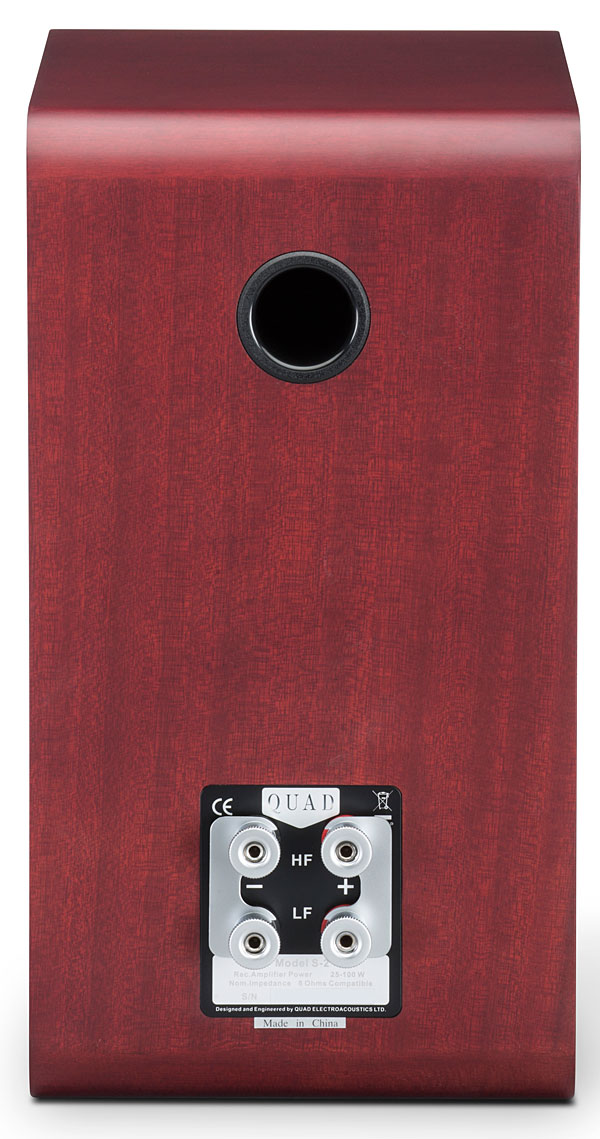
The S-2's cabinet comprises varying layers of MDF, with internal "circumference" bracing. The cabinet is a beauty. Its rounded corners and rolled edges put me in mind of Eero Saarinen or Le Corbusier, architects whose structures combined subtle modernity with powerful lines drawn from nature. The Sapele Mahogany finish of my review samples was silken to the touch. (The S-2 is also available in Black Oak, Piano White, or Piano Black.) The S-2s come with a thin sheet of rubberized paper, from which can be peeled eight plastic nubs to be used as footers. Near the bottom of the rear panel are two pairs of handsome, matte-finish aluminum binding posts; near the top, a 11/4"-diameter port. Even the placements of these mechanical bits and bobs seem well thought out, for purposes functional and cosmetic.
In an effort to learn more about the S-2's design and construction, I contacted Peter Comeau, director of acoustic design for the Hi-Fi division of IAG Group; he replied by e-mail:
"The biggest problem with dome tweeters is that the diaphragm is rarely fully under the control of the motor system as the voice-coil is only attached at the circumference of the dome. What we often see is the center of the diaphragm moving in anti-phase to the voice-coil and, obviously, this results in a critical loss of transient information and therefore musical detail. With a ribbon tweeter the diaphragm IS the voice-coil, so to speak, and so is always under the control of the music signal from the amplifier. In that respect it is closer to the performance of an ESL and, thankfully for Quad, shares some of the same characteristics.
"The True Ribbon treble uses a thin, metal ribbon suspended in a strong magnetic field. The music signal is passed directly to the ribbon and causes a deflection due to the induced magnetism. As the ribbon is directly driven by the amplifier, its resolution of musical detail is very high. The S series ribbon is made from a lightweight metallic alloy which is stronger than pure aluminum. In addition the ribbon is given extra mechanical strength by a very light, and thin, deposition of polycarbonate—giving it a sandwich construction that allows higher power handling."
 Setup
Setup
The S-2s quickly found favor in my smaller rig, which occupies Listening Room A: 14' long by 8' wide by 14' high. I set up the Quads along one long wall on 24"-high steel stands, which put their tweeters at the height of my ears when I sit down to listen. Each speaker was 9" from the front wall (measured from the toed-in speaker's rear inside corner). A support wall in my apartment creates a barrier on the left that was 5" from one S-2's rear outside corner; the space to the right of the right speaker is relatively open. The speakers were 5' from my listening seat—I listened to them in the nearfield. This setup provided the most coherent, cohesive sound from LPs and CDs. "Regarding setup," wrote Derda, "the ribbon tweeter has limited vertical dispersion, which reduces the effects of floor and ceiling reflections. It usually performs best aligning the tweeter at ear level of the listening position, or within a few degrees of ear level." I found this observation to be 100% spot on.
But in Listening Room B (12' L by 10' W by 12' H), placing the Quads 9" from the long front wall basically sapped their articulation. Repositioning them 27" out from the wall and 58" apart snapped their coherence into place.
Listening
In my smaller system in Room A, I listened to oud master Anouar Brahem's exotic Blue Maqams (CD, ECM 2580). The S-2's open, airy sound and smooth delineation of upper-frequency transients weren't the first things that impressed me. Instead, it was the speaker's fantastic reproduction of the lower midrange and bass—the lute-like oud, which looks like a pear sliced lengthwise in half, or a plump guitar with a split-back headstock, can go very low in pitch. Spinning the Christian McBride Big Band's Bringin' It (LP, Mack Avenue MAC1115) brought to the fore equally extraordinary lower-frequency tonnage allied with clarity. Both recordings presented nonfussy senses of immediacy and intimacy, as if the wall between me and the musicians—or, at least, between me and the mixing console—had been removed.
DesignThe Quad S-2 is a two-way, ported design with a 5" mid/bass drive-unit featuring a Kevlar cone and manufactured in-house, and Quad's newly designed, 0.5" by 1.75" (12 by 45mm) True Ribbon tweeter. Its specifications include a frequency response of 48Hz–22kHz, ±3dB; a sensitivity of 87dB; impedance of 8 ohms; bass extension down to 37Hz, –6dB; and a crossover frequency of 3kHz. Each Quad S-2 measures 13" high by 7.1" wide by 10.25" deep and weighs 13.5 lbs. "The ribbon tweeter in the S-2 is the same as in the S-1," said Jon Derda, of Quad's US distributor, MoFi Distribution, in an e-mail. "The Z-series tweeter is the same overall design, but has a larger surface area for an even smoother integration between the midbass and HF drivers."
SetupThe S-2s quickly found favor in my smaller rig, which occupies Listening Room A: 14' long by 8' wide by 14' high. I set up the Quads along one long wall on 24"-high steel stands, which put their tweeters at the height of my ears when I sit down to listen. Each speaker was 9" from the front wall (measured from the toed-in speaker's rear inside corner). A support wall in my apartment creates a barrier on the left that was 5" from one S-2's rear outside corner; the space to the right of the right speaker is relatively open. The speakers were 5' from my listening seat—I listened to them in the nearfield. This setup provided the most coherent, cohesive sound from LPs and CDs. "Regarding setup," wrote Derda, "the ribbon tweeter has limited vertical dispersion, which reduces the effects of floor and ceiling reflections. It usually performs best aligning the tweeter at ear level of the listening position, or within a few degrees of ear level." I found this observation to be 100% spot on.
In my smaller system in Room A, I listened to oud master Anouar Brahem's exotic Blue Maqams (CD, ECM 2580). The S-2's open, airy sound and smooth delineation of upper-frequency transients weren't the first things that impressed me. Instead, it was the speaker's fantastic reproduction of the lower midrange and bass—the lute-like oud, which looks like a pear sliced lengthwise in half, or a plump guitar with a split-back headstock, can go very low in pitch. Spinning the Christian McBride Big Band's Bringin' It (LP, Mack Avenue MAC1115) brought to the fore equally extraordinary lower-frequency tonnage allied with clarity. Both recordings presented nonfussy senses of immediacy and intimacy, as if the wall between me and the musicians—or, at least, between me and the mixing console—had been removed.















