These days, listeners the wide world over enjoy hearing their music recreated for them by equipment whose origins are international; trade isolationists might consider the example of PrimaLuna. This Holland-based company's operations span three continents, with designers from Floyd Design and Durob Audio in the Netherlands, manufacturing in China, and input from California-based Harmonia Distribution.
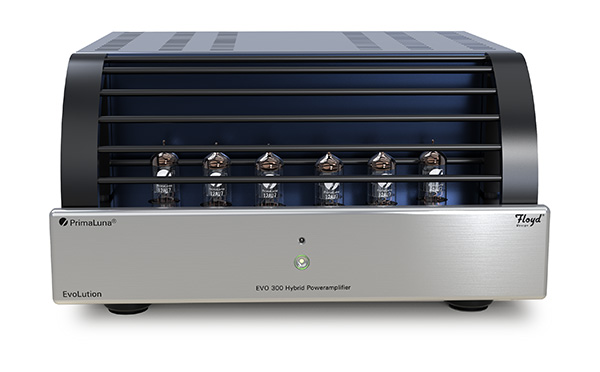
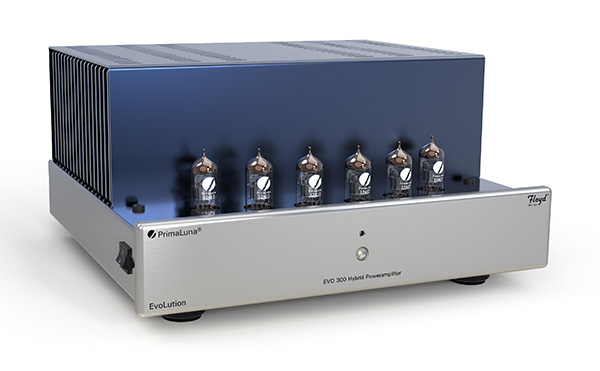
The PrimaLuna EVO 300 Hybrid is a hefty 63.8lb. It's designed to be used as either a stereo amplifier or, in pairs, as a monoblock ($7195 each, $14,390 for a pair). The handsome grayish-blue metal exterior is offered with either a black, pink, or silver-brushed front plate. The front panel is minimalist: just brand labeling and a power-status indicator light. Output specs for the EVO 300 Hybrid are 100Wpc into 8 ohms running stereo, and 220Wpc into 8 ohms running mono. These outputs increase into 4 ohm loads. The EVO 300 Hybrid is push-pull, operating in class-AB with a tubed input stage and solid state output.
PrimaLuna's history dates to 1998, when designer Marcel Croese convinced high-end retailer Kevin Deal that his tube-gear designs were the real deal. Deal's long-running retail company Upscale Audio, which is located in La Verne, California, has for many years been a go-to source for vacuum tubes, new and new old stock (NOS). PrimaLuna was a natural fit, as every product they produce includes tubes—even the EVO 100 DAC. Distribution for the US and Canada is handled by Harmonia Distribution.
Tubes vs solid state has long been one of those demarcation lines for hi-fi. Designers seem to line up one way or the other as well; few design both tubed and solid state devices. As for me, I like both: Sometimes you feel like a nut, sometimes you don't. I have owned beautiful-sounding low-powered tube designs and have likewise enjoyed handsome and super-sounding high-powered solid state amplification. Apples vs oranges.
On the other hand, designs that combine the two technologies are nothing new. Such devices are often termed "hybrid." McIntosh Labs has even trademarked the term "Hybrid Drive" and applied it to several of the newer designs in their current product lineup. I own two McIntosh pieces they label this way.
I asked Durob principal Herman van den Dungen about "hybrid" amplifiers. "A properly designed hybrid amplifier sounds like a tube amplifier but behaves like a transistor amplifier, in our case a MOSFET (metal oxide semiconductor field effect transistor) amplifier," he answered. "The choice of a hybrid was dictated by the wish to increase the range of speakers that can be connected to a PrimaLuna [amplifier]. Some PrimaLuna customers, though satisfied sonically, mentioned they needed more power. It was trickier than I originally thought, but in the end, I think it worked out: a good-sounding, reliable, affordable power amplifier with higher power than most tube amplifiers but with that typical tube-sound character."
 Going fishing
Following the signal stream of the EVO 300 as it flows from input to output, the first up are the six 12AU7 dual-triode tubes. In stereo operation, one tube provides voltage gain, one operates as a phase inverter, and a third lowers the output impedance of the input stage. The dual-triode elements of the 12AU7s are wired in parallel, increasing plate dissipation. The PrimaLuna-branded tubes are sourced from PSVane in China. Kevin Deal noted, "12AU7s are good tubes, and more of them are being made today than any other tube." Should the user roll tubes? "People don't have to do it, but should they choose to, that can give the sound a nudge." If you want a different sound, "you don't have to go out and buy new speakers." PrimaLuna states in its literature that a design priority is the quality of power supplies. The EVO 300 input section features separate high-voltage supplies for each tube and channel. Each has its own protection circuit. The amplifier is dual-mono throughout. Physically, the EVO 300 Hybrid Power amplifier is like a two-layer cake. The bottom layer is the tube layer, with components similar to those in the all-tube PrimaLuna EVO 400 preamplifier that Herb Reichert reviewed in June of 2019. The upper half of the layer cake contains the solid state output elements except that the 12AU7 tubes are mounted on top. The wiring, which is point-to-point, uses Swiss-made silver-plated oxygen-free copper wire with a Teflon dielectric.
In some respects, the EVO 300 Hybrid power amp is similar to the EVO 300 Hybrid integrated that Ken Micallef wrote about for our August 2024 issue. The key difference of course is in the preamplifier section—specifically in the fact that the EVO 300 Hybrid power amplifier doesn't have one. The other big difference is that this EVO 300 Hybrid can be bridged for mono operation—just transfer the loudspeaker cables to the mono posts and flip a switch. (Then go out and buy another one for the other channel.) Bridging doubles the output power available for each channel.
I asked Kevin Deal to compare mono to stereo operation. His candid answer: "They will absolutely sound better as monoblocks. All the output devices will be dedicated to one channel. Output impedance goes down. Slam goes up. Bass control increases. But the beauty of it is that the EVO 300 will drive anything."
 Designer Jan de Groot of Floyd Design has made black backgrounds a priority. "Everything about the EVO 300 is about dropping the noisefloor, including mechanical vibrations that can emanate into your listening space," Deal explained. PrimaLuna winds its own toroidal transformers, pots them, and shields them with mu-metal for low hum and electromagnetic noise. Another part of that effort is the "AC Offset Killer"—oddly named, since DC offset causes transformer noise. PrimaLuna says that this feature can "lower transformer noise to a place no other manufacturer dreams of going, regardless of how bad your electricity is."
In an email, Kevin Deal acknowledged the odd naming. "I'm not sure why Herman named it that, except that it does indeed happen over AC," he wrote. Then he added a little seasoning. "PrimaLuna has always been about dropping the noisefloor," he wrote. "Our power transformers are already mechanically quiet, and they are potted. The Offset Killer is a nice touch, and I think it's an example of spending the money to get as close to perfection as possible."
Parts? The output stages feature complementary JFETs (junction field effect transistor) from Linear Systems and a dual matched pair of MOSFETS from Hexicon in the output stage. High-quality Takman resistors are utilized, and Nichicon capacitors store a total of 120,000µF of charge. "The most crucial capacitors," PrimaLuna says, "the ones in the signal path, are extremely expensive tin-foil caps that are made in Europe. Elsewhere, even the caps outside the signal path are the top-quality models that modders use to upgrade their regular amps!"
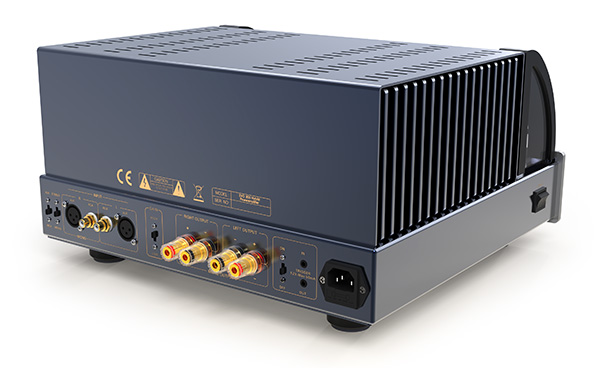
The rear panel of the EVO 300 power amplifier is unremarkable: AC in; Trigger in/out; an on/off switch; two pairs of output taps for stereo use, another for mono; a gain switch (Low/High, corresponding to 24dB and 30dB); XLR and RCA inputs, one pair each; a stereo/mono switch; and a switch to choose between the XLR and RCA inputs. The thin, hefty remote has just one function—or, I suppose, two: putting the amplifier into Standby mode and turning it on again.
When you power up the EVO 300 Hybrid, protection circuits kick the unit into standby/mute for about 60 seconds; this is indicated by the power light, which glows orange before the amp switches to full power on. The front panel light then turns green. The rolled form of the open cage on the front side of the unit protects the six 12AU7 input stage tubes and easily pops on and off. This, in a nutshell, is the PrimaLuna look. All PrimaLuna components share this same basic exterior design, which is simple and elegant.
I hooked up two PrimaLuna Hybrid 300s as a monoblock pair, driving my new Wilson Audio The WATT/Puppies (footnote 1).
Designer Jan de Groot of Floyd Design has made black backgrounds a priority. "Everything about the EVO 300 is about dropping the noisefloor, including mechanical vibrations that can emanate into your listening space," Deal explained. PrimaLuna winds its own toroidal transformers, pots them, and shields them with mu-metal for low hum and electromagnetic noise. Another part of that effort is the "AC Offset Killer"—oddly named, since DC offset causes transformer noise. PrimaLuna says that this feature can "lower transformer noise to a place no other manufacturer dreams of going, regardless of how bad your electricity is."
In an email, Kevin Deal acknowledged the odd naming. "I'm not sure why Herman named it that, except that it does indeed happen over AC," he wrote. Then he added a little seasoning. "PrimaLuna has always been about dropping the noisefloor," he wrote. "Our power transformers are already mechanically quiet, and they are potted. The Offset Killer is a nice touch, and I think it's an example of spending the money to get as close to perfection as possible."
Parts? The output stages feature complementary JFETs (junction field effect transistor) from Linear Systems and a dual matched pair of MOSFETS from Hexicon in the output stage. High-quality Takman resistors are utilized, and Nichicon capacitors store a total of 120,000µF of charge. "The most crucial capacitors," PrimaLuna says, "the ones in the signal path, are extremely expensive tin-foil caps that are made in Europe. Elsewhere, even the caps outside the signal path are the top-quality models that modders use to upgrade their regular amps!"
The rear panel of the EVO 300 power amplifier is unremarkable: AC in; Trigger in/out; an on/off switch; two pairs of output taps for stereo use, another for mono; a gain switch (Low/High, corresponding to 24dB and 30dB); XLR and RCA inputs, one pair each; a stereo/mono switch; and a switch to choose between the XLR and RCA inputs. The thin, hefty remote has just one function—or, I suppose, two: putting the amplifier into Standby mode and turning it on again.
When you power up the EVO 300 Hybrid, protection circuits kick the unit into standby/mute for about 60 seconds; this is indicated by the power light, which glows orange before the amp switches to full power on. The front panel light then turns green. The rolled form of the open cage on the front side of the unit protects the six 12AU7 input stage tubes and easily pops on and off. This, in a nutshell, is the PrimaLuna look. All PrimaLuna components share this same basic exterior design, which is simple and elegant.
I hooked up two PrimaLuna Hybrid 300s as a monoblock pair, driving my new Wilson Audio The WATT/Puppies (footnote 1).
 Gone listening
After starting this review, I received the sad news of the passing of longtime high-end audio retailer Robert Lietz. I had been a customer of Robert's since the turn of the millennium, when my wife and I located to upstate New York. Just a couple of weeks before he passed, Robert had sent me a note about a recording he wanted me to hear: Taneyev & Schumann Piano Quintets (24/96 FLAC, Signum Classics/Qobuz). The Sacconi Quartet plus Peter Donohoe on piano sounded exceptionally fine! Taneyev's quintet manifested unusually lifelike dynamics. This is an outstanding recording of chamber music, and the EVO 300s brought it all to Technicolor life.
This forceful, committed performance sounded as it does in a medium-sized performance space; hearing it reminded me of many similar performances I attended as a student in the San Francisco Conservatory of Music's Hellman Hall. Tactile string timbres brought out the emotions that intense chamber music excels at conveying.
These Wilson speakers require suitable amplification to sound their best. No problem! Tons of juice here for these speakers with a rated sensitivity of 89dB and a tough impedance curve. The volume control was set lower than usual, and this was with the Gain switch on the back panel of the EVO 300s set to Low, so in voltage terms, there were plenty of decibels in reserve. If you own a pair of Magnepans or similar speakers, these amps will be the bees knees!
 Few recordings are more important and influential than Alan Lomax's Southern Folk Heritage Series, field recordings made in 1959 and released in 1960 by Atlantic Records on seven LPs. I first heard them on CD; they were rereleased as a CD box set in 1993. I had not heard any of this material from the original LPs until recently. On eBay, I found and bought two of the titles in the series: the introductory sampler Sounds of the South (Atlantic SD-1346) and the stand-alone LP Roots of the Blues (Atlantic SD-1348). "I returned to my native South with hi-fi stereo equipment to offer the singers of the mountain, bayou, prison and cotton patch the best of modern sound technology," Lomax wrote in his liner notes.
I cannot recall previously describing a listening example as "hair-raising," but that's what happened: My hair rose. I was listening to "Levee Camp Holler" and "Eighteen Hammers" from Atlantic SD-1348 spinning on my VPI HW-40 turntable, sung by Johnny Lee Moore and 12 Mississippi Penitentiary convicts. In stereo. Those call-and-response vocals and pickaxes hit metal hard. The time machine created by the PrimaLuna EVO 300 Hybrids beamed me right down there onto that red clay. Holographic aural images summoned up a reality that most Americans didn't know existed. As Brian Eno said, "Without Lomax, it's possible that there would have been no blues explosion, no R&B movement, no Beatles and no Stones and no Velvet Underground."
Few recordings are more important and influential than Alan Lomax's Southern Folk Heritage Series, field recordings made in 1959 and released in 1960 by Atlantic Records on seven LPs. I first heard them on CD; they were rereleased as a CD box set in 1993. I had not heard any of this material from the original LPs until recently. On eBay, I found and bought two of the titles in the series: the introductory sampler Sounds of the South (Atlantic SD-1346) and the stand-alone LP Roots of the Blues (Atlantic SD-1348). "I returned to my native South with hi-fi stereo equipment to offer the singers of the mountain, bayou, prison and cotton patch the best of modern sound technology," Lomax wrote in his liner notes.
I cannot recall previously describing a listening example as "hair-raising," but that's what happened: My hair rose. I was listening to "Levee Camp Holler" and "Eighteen Hammers" from Atlantic SD-1348 spinning on my VPI HW-40 turntable, sung by Johnny Lee Moore and 12 Mississippi Penitentiary convicts. In stereo. Those call-and-response vocals and pickaxes hit metal hard. The time machine created by the PrimaLuna EVO 300 Hybrids beamed me right down there onto that red clay. Holographic aural images summoned up a reality that most Americans didn't know existed. As Brian Eno said, "Without Lomax, it's possible that there would have been no blues explosion, no R&B movement, no Beatles and no Stones and no Velvet Underground."
 Lately, Deutsche Grammophon's current "Original Source" series of remastered classical albums on vinyl has been getting a lot of audiophile press. It's state of the art in some ways, a mixed bag in others. The pressings, by Optimal in Europe, seem to vary: Some reviews rave about the quality of the vinyl, but I've heard more surface noise than I expect for the price. Plus, these Emil Berliner Studios remasterings sometimes feel a bit too hot and forward for my taste.
Of the ones I have purchased so far, the standout is the Ozawa/Boston Symphony box Maurice Ravel: The Orchestral Works (LP, Deutsche Grammophon 4866722). This Ravel set gets it right on all levels. The sound is spectacularly detailed, but not so much as to seem artificial or bright. If you want to give a stereo system a doctor's checkup, this is the music to do it with. This and Mahler. Hearing the PrimaLuna EVO 300 Hybrid as monoblocks was exciting. In Ma mère l'Oye, recorded in 1975, I heard beautiful, fully distinct and sorted solo winds, lovely, delicate strings, full-bore and lifelike dynamic contrasts, and a yuuuuuge soundstage, all fully revealing of the genius orchestrator that Ravel was. The concert harp was like a delicate breeze in a forest, and when Ravel starts up his gamelan-like pentatonic riffs, accompanied by tam-tam and celeste, we're off to a temple in Bali.
I was running the solid state output from my McIntosh preamp—a different kind of hybrid; you can use it either solid state or tubed—feeding into the tubed input stage of the EVO 300s then (obviously) on to its solid state output. When I tried the tubed output from my Mac preamp, it was too much of a good tube thing: I was losing some of those detailed, sparkling mids. If you have the luxury, audition these amps with different preamps to find the fit that's right for you.
Lately, Deutsche Grammophon's current "Original Source" series of remastered classical albums on vinyl has been getting a lot of audiophile press. It's state of the art in some ways, a mixed bag in others. The pressings, by Optimal in Europe, seem to vary: Some reviews rave about the quality of the vinyl, but I've heard more surface noise than I expect for the price. Plus, these Emil Berliner Studios remasterings sometimes feel a bit too hot and forward for my taste.
Of the ones I have purchased so far, the standout is the Ozawa/Boston Symphony box Maurice Ravel: The Orchestral Works (LP, Deutsche Grammophon 4866722). This Ravel set gets it right on all levels. The sound is spectacularly detailed, but not so much as to seem artificial or bright. If you want to give a stereo system a doctor's checkup, this is the music to do it with. This and Mahler. Hearing the PrimaLuna EVO 300 Hybrid as monoblocks was exciting. In Ma mère l'Oye, recorded in 1975, I heard beautiful, fully distinct and sorted solo winds, lovely, delicate strings, full-bore and lifelike dynamic contrasts, and a yuuuuuge soundstage, all fully revealing of the genius orchestrator that Ravel was. The concert harp was like a delicate breeze in a forest, and when Ravel starts up his gamelan-like pentatonic riffs, accompanied by tam-tam and celeste, we're off to a temple in Bali.
I was running the solid state output from my McIntosh preamp—a different kind of hybrid; you can use it either solid state or tubed—feeding into the tubed input stage of the EVO 300s then (obviously) on to its solid state output. When I tried the tubed output from my Mac preamp, it was too much of a good tube thing: I was losing some of those detailed, sparkling mids. If you have the luxury, audition these amps with different preamps to find the fit that's right for you.
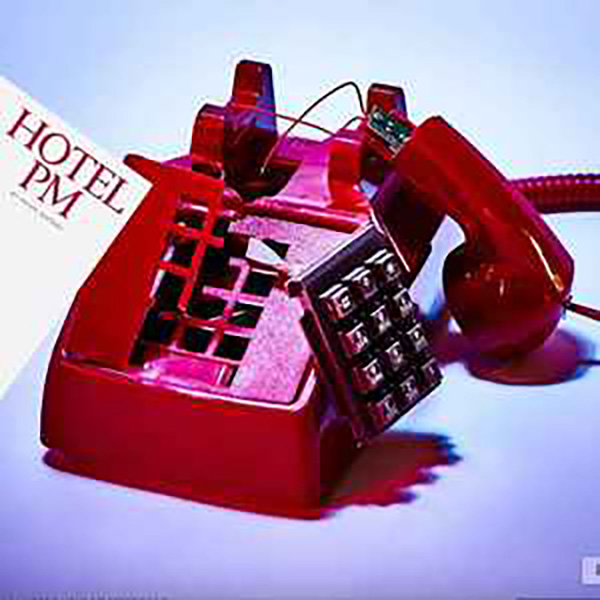 My son Peter has a new solo album out. Hotel PM (LP, Bastard Jazz Recordings BLP50) was produced and recorded in Mexico, Britain, and New York. It includes vocals, strings, brass, and assorted dance music electronics. This is a contemporary dance-groove production, so there isn't much "does this sound like a historical lute?" but rather, "are these colors and rhythms interesting?" and "does the bottom end slam and make you want to move?" The two PrimaLuna EVO 300s were commanding my WATT/Puppies to produce sound levels you'd hear in a high-end New York disco. Some of the album's tracks are instrumental; others feature intriguing guest singers. On "Shaky Escalator," with vocals by Peter's co-bandleader Domenica Fossati, the up-tempo synth-and-guitar rhythm section sounded unstoppable.
On the line
My son Peter has a new solo album out. Hotel PM (LP, Bastard Jazz Recordings BLP50) was produced and recorded in Mexico, Britain, and New York. It includes vocals, strings, brass, and assorted dance music electronics. This is a contemporary dance-groove production, so there isn't much "does this sound like a historical lute?" but rather, "are these colors and rhythms interesting?" and "does the bottom end slam and make you want to move?" The two PrimaLuna EVO 300s were commanding my WATT/Puppies to produce sound levels you'd hear in a high-end New York disco. Some of the album's tracks are instrumental; others feature intriguing guest singers. On "Shaky Escalator," with vocals by Peter's co-bandleader Domenica Fossati, the up-tempo synth-and-guitar rhythm section sounded unstoppable.
On the line
It was time to compare the EVO 300s to themselves, to contrast mono and stereo. I hooked one of the units up as a stereo amp and listened to some of the same tunes I had made notes about when there were two (bridged) amps in the system. I left the output levels on my preamp the same as I had them earlier.
I listened again to the Taneyev/Schumann recording. This was a very close call, hard to quantify, but here goes. With the input Gain still in the Low position, the volume seemed almost the same as it had been in mono. There seemed to be slightly less texture. Bow attacks were slightly deemphasized. This well-recorded piano exhibited a bit less pitch definition from its low-range notes.
When I listened once more to some of Ravel's Mother Goose Suite, much was essentially the same, but I did hear a few differences. Extreme frequencies, high and low, seemed attenuated: those low-booming whacks on the bass drum, the tinkliest percussion. On the Alan Lomax field recordings, I heard no difference at all: This is fife and drums and moanin' in church. Plenty of the emotional wallop coming through loud and clear. All of which is to say, not expensive violins with fancy timbre.
I would peg the single-box stereo EVO 300 at maybe 95% of what two amps gave me in bridged-mono mode, in a direct shootout. Diminishing returns? I would not put it that way. If you can, buy a pair.
Finally, I swapped into the reference system my newest pair of speakers, the small bookshelf–sized Harbeth P3ESRs. These normally reside in our living room, on actual bookshelves. Now I placed them on stands. I was pleasantly surprised at the scale and the top-to-bottom balance the Harbeths delivered, driven by one EVO 300 Hybrid power amp running stereo.
Caught one (or two)
The PrimaLuna EVO 300 Hybrid power amplifier will, I am sure, raise hair and goosebumps on the scalp and skin of those lucky enough to own them. Rock-solid build, rock-solid sound. It seems you can have serious power, low output impedance, and many (perhaps all) of the virtues of tubes. Whether you adopt one or a pair, you'll get capable, creative hi-fi that can bark like a pit bull and purr like a kitten.
Footnote 1: Martin Colloms reviewed the new WATT/Puppies in our February 2025 issue. In the Measurements section of that review, fig.1 shows Paul Miller's measurement of the impedance value and phase and the EPDR: the challenge the combined value and phase present to a partnering amplifier. Paul's measured sensitivity was 91.5dB, which is well above Wilson's specified value. Paul concluded, "The price paid for the WATT/Puppy's high sensitivity and fine bass extension is its substantial demands on the partnering amp." Apparently these relatively affordable PrimaLunas are up to the challenge.—Jim Austin
Going fishingFollowing the signal stream of the EVO 300 as it flows from input to output, the first up are the six 12AU7 dual-triode tubes. In stereo operation, one tube provides voltage gain, one operates as a phase inverter, and a third lowers the output impedance of the input stage. The dual-triode elements of the 12AU7s are wired in parallel, increasing plate dissipation. The PrimaLuna-branded tubes are sourced from PSVane in China. Kevin Deal noted, "12AU7s are good tubes, and more of them are being made today than any other tube." Should the user roll tubes? "People don't have to do it, but should they choose to, that can give the sound a nudge." If you want a different sound, "you don't have to go out and buy new speakers." PrimaLuna states in its literature that a design priority is the quality of power supplies. The EVO 300 input section features separate high-voltage supplies for each tube and channel. Each has its own protection circuit. The amplifier is dual-mono throughout. Physically, the EVO 300 Hybrid Power amplifier is like a two-layer cake. The bottom layer is the tube layer, with components similar to those in the all-tube PrimaLuna EVO 400 preamplifier that Herb Reichert reviewed in June of 2019. The upper half of the layer cake contains the solid state output elements except that the 12AU7 tubes are mounted on top. The wiring, which is point-to-point, uses Swiss-made silver-plated oxygen-free copper wire with a Teflon dielectric.
Designer Jan de Groot of Floyd Design has made black backgrounds a priority. "Everything about the EVO 300 is about dropping the noisefloor, including mechanical vibrations that can emanate into your listening space," Deal explained. PrimaLuna winds its own toroidal transformers, pots them, and shields them with mu-metal for low hum and electromagnetic noise. Another part of that effort is the "AC Offset Killer"—oddly named, since DC offset causes transformer noise. PrimaLuna says that this feature can "lower transformer noise to a place no other manufacturer dreams of going, regardless of how bad your electricity is."
Gone listeningAfter starting this review, I received the sad news of the passing of longtime high-end audio retailer Robert Lietz. I had been a customer of Robert's since the turn of the millennium, when my wife and I located to upstate New York. Just a couple of weeks before he passed, Robert had sent me a note about a recording he wanted me to hear: Taneyev & Schumann Piano Quintets (24/96 FLAC, Signum Classics/Qobuz). The Sacconi Quartet plus Peter Donohoe on piano sounded exceptionally fine! Taneyev's quintet manifested unusually lifelike dynamics. This is an outstanding recording of chamber music, and the EVO 300s brought it all to Technicolor life.
Few recordings are more important and influential than Alan Lomax's Southern Folk Heritage Series, field recordings made in 1959 and released in 1960 by Atlantic Records on seven LPs. I first heard them on CD; they were rereleased as a CD box set in 1993. I had not heard any of this material from the original LPs until recently. On eBay, I found and bought two of the titles in the series: the introductory sampler Sounds of the South (Atlantic SD-1346) and the stand-alone LP Roots of the Blues (Atlantic SD-1348). "I returned to my native South with hi-fi stereo equipment to offer the singers of the mountain, bayou, prison and cotton patch the best of modern sound technology," Lomax wrote in his liner notes.
Lately, Deutsche Grammophon's current "Original Source" series of remastered classical albums on vinyl has been getting a lot of audiophile press. It's state of the art in some ways, a mixed bag in others. The pressings, by Optimal in Europe, seem to vary: Some reviews rave about the quality of the vinyl, but I've heard more surface noise than I expect for the price. Plus, these Emil Berliner Studios remasterings sometimes feel a bit too hot and forward for my taste.
Of the ones I have purchased so far, the standout is the Ozawa/Boston Symphony box Maurice Ravel: The Orchestral Works (LP, Deutsche Grammophon 4866722). This Ravel set gets it right on all levels. The sound is spectacularly detailed, but not so much as to seem artificial or bright. If you want to give a stereo system a doctor's checkup, this is the music to do it with. This and Mahler. Hearing the PrimaLuna EVO 300 Hybrid as monoblocks was exciting. In Ma mère l'Oye, recorded in 1975, I heard beautiful, fully distinct and sorted solo winds, lovely, delicate strings, full-bore and lifelike dynamic contrasts, and a yuuuuuge soundstage, all fully revealing of the genius orchestrator that Ravel was. The concert harp was like a delicate breeze in a forest, and when Ravel starts up his gamelan-like pentatonic riffs, accompanied by tam-tam and celeste, we're off to a temple in Bali.
My son Peter has a new solo album out. Hotel PM (LP, Bastard Jazz Recordings BLP50) was produced and recorded in Mexico, Britain, and New York. It includes vocals, strings, brass, and assorted dance music electronics. This is a contemporary dance-groove production, so there isn't much "does this sound like a historical lute?" but rather, "are these colors and rhythms interesting?" and "does the bottom end slam and make you want to move?" The two PrimaLuna EVO 300s were commanding my WATT/Puppies to produce sound levels you'd hear in a high-end New York disco. Some of the album's tracks are instrumental; others feature intriguing guest singers. On "Shaky Escalator," with vocals by Peter's co-bandleader Domenica Fossati, the up-tempo synth-and-guitar rhythm section sounded unstoppable.
On the lineIt was time to compare the EVO 300s to themselves, to contrast mono and stereo. I hooked one of the units up as a stereo amp and listened to some of the same tunes I had made notes about when there were two (bridged) amps in the system. I left the output levels on my preamp the same as I had them earlier.
The PrimaLuna EVO 300 Hybrid power amplifier will, I am sure, raise hair and goosebumps on the scalp and skin of those lucky enough to own them. Rock-solid build, rock-solid sound. It seems you can have serious power, low output impedance, and many (perhaps all) of the virtues of tubes. Whether you adopt one or a pair, you'll get capable, creative hi-fi that can bark like a pit bull and purr like a kitten.
Footnote 1: Martin Colloms reviewed the new WATT/Puppies in our February 2025 issue. In the Measurements section of that review, fig.1 shows Paul Miller's measurement of the impedance value and phase and the EPDR: the challenge the combined value and phase present to a partnering amplifier. Paul's measured sensitivity was 91.5dB, which is well above Wilson's specified value. Paul concluded, "The price paid for the WATT/Puppy's high sensitivity and fine bass extension is its substantial demands on the partnering amp." Apparently these relatively affordable PrimaLunas are up to the challenge.—Jim Austin