Sidebar 3: Measurements
I wasn't concerned by the absence of significant output beyond 19kHz from this tweeter design, and there is no ultrasonic peak. And with its low-diffraction build (including a woolen felt-absorbing layer on the WATT's front panel), the lateral off-axis behavior was very good.
As is considered ideal, the response on and below the tweeter axis is nicely uniform. If you are above that axis, ie, standing, there is a 15dB "phase notch" in the crossover region, here mildly displaced to 2.7kHz, together with some other moderate irregularities. This is typical behavior for a first-order topology.
Bass port tuning for the Puppy is at a low 32Hz, slightly overdamped to improve room matching at low frequencies. (The Sasha V's port is tuned to 24Hz, reflecting its greater enclosure volume and potentially deeper bass extension, footnote 1.) With the usual room gain, there was perceptible reach to 25Hz, and when driven at 30Hz, to a really loud room-shaking level (5W sinewave), distortion was commendably low, in fact considered inaudible at these low frequencies. At this level the second harmonic lay at –22dB (7.9%), the third harmonic at –30dB (3%), with little else of note.
The Puppy sustained a huge 26V input maximum at 30Hz without mechanical overload: this equivalent to 170W/4 ohms continuous! (I dared not input any more.) Understandably, there was moderately audible distortion with this exacting pure sinewave stimulus, but it would likely be masked with full frequency-range program. The power handing in the low bass was therefore considered to be exceptionally good.
A number of related readings for distortion at higher frequencies showed excellent results, as we have come to expect from these ScanSpeak drive units. With a midrange tone at 400Hz at a loud 92dB level with 1W input, the second harmonic was judged harmless at 0.45% (–47dB), while the third was negligible at 0.04% (–68dB). With a 1.2kHz input we got 0.1% (–60dB), second harmonic, and 0.02% (–74dB) third; at 3.3kHz the second lay at 0.12% (–58dB), the third at 0.05% (–66dB). For the record, the higher harmonics were also minuscule: the fourth at 0.03% (–70dB) and the fifth at 0.008% (–82dB). Some low-order harmonics were also present at high input frequencies—for example with a 7kHz signal, the second harmonic lay at 0.35% (–49dB), but the more annoying third was held to a very fine 0.008%. Beyond 10kHz, the second harmonic trended to an impressive 0.1%, way below audible thresholds. These results are in accordance with high-quality, well-matched samples.—Martin Colloms
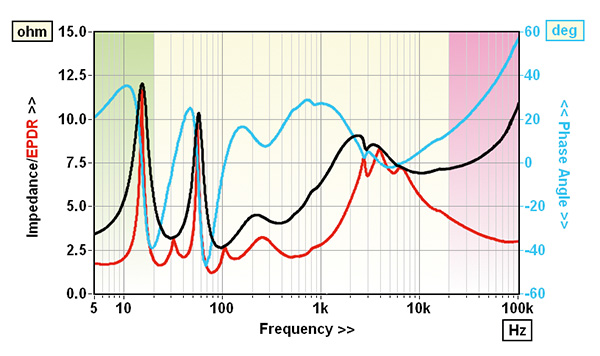
Fig.1 Impedance modulus (black), impedance phase (blue), and EPDR (equivalent peak dissipation resistance, red) over an extended 5Hz–100kHz bandwidth. The 20Hz–20kHz audio bandwidth (yellow shade) is bounded by sub-bass (green shade) and ultrasonic (pink shade). Wilson's specified minimum 2.87 ohms/86Hz impedance is broadly met at 2.6 ohms/97Hz while the modest +25°/–47° phase angles in the bass region contribute to a minimum 1.2 ohms EPDR at 77Hz. The EDPR is at or below 3 ohms from 60Hz–1kHz, so the price paid for the Watt/Puppy's high sensitivity and fine bass extension is its substantial demands on the partnering amp.—Paul Miller
The sensitivity without the grille was high, at 91.5dB/2.83V/1m, but as this is a 4 ohm design, the textbook sensitivity is 3dB lower, at 88.5dB/W/1m. This is still a high value, a significant 2dB above the industry average of 86.5dB. The DC input resistance measured 3.3 ohms, this reflecting both the sum of those two paralleled bass drivers and Wilson's traditional use of a shunt 20 ohm damping resistor for the low-pass crossover feed to the woofers. When the complex impedance is accounted for in respect of peak current draw, the minimum value is close to 2.7 ohms at 93Hz. Amplifiers capable of driving 4 ohm loads are indicated.
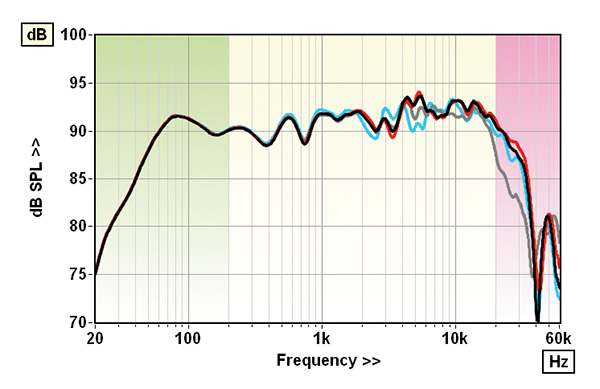
Measured with 1/3-octave resolution, the on-axis pair match was held to excellent ±0.5dB tolerance, 200Hz–15kHz. The lower grille had little effect on the woofers' response, while the upper grille introduced some mild ±1.5dB perturbation, as well as an average loss of 0.75dB in the treble. However, this was judged to be almost imperceptible. In context this is a good result; you may take your pick as to whether to leave the grilles on.
Fig.2 Response including nearfield, summed drivers/port (green shaded area), freefield corrected to 1m at 2.83V (yellow shade), ultrasonic (pink shade). Left, black; right, red; ±15°, grey; with grille, blue. The (new) WATT/Puppy's forward response has many of the features seen in the Alexia V and Sasha V, including the modes associated with the 178mm mid driver at 500Hz–1kHz and the step at 3.5kHz once the 25mm CSC tweeter gets into stride. Treble extension is good to 31kHz (–6dB ref. 10kHz) and diffraction-corrected bass to 38Hz (–6dB ref. 200Hz).—Paul Miller
Not only was the pair match excellent but the primary frequency response was also very good, notwithstanding the inevitable errors incurred while testing this good-sized floorstander in-room. The response on the ideal axis 5° to the speaker's side, with the microphone at listener ear height, not only met excellent ±2.5dB limits from 350Hz to 17kHz but also met an extraordinarily uniform ±1.5dB from 3.5kHz to 17kHz before rolling off harmlessly beyond 18kHz on this axis.
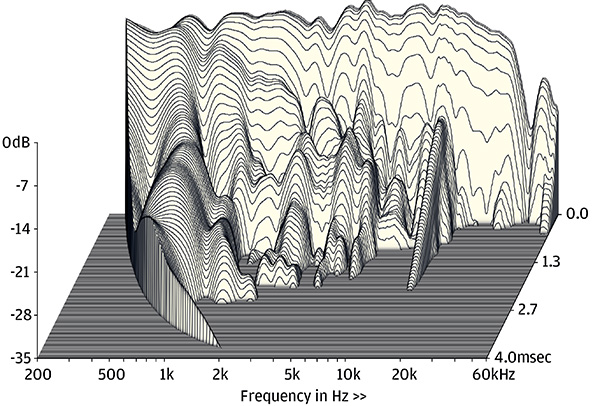
Fig.3 CSD waterfall expressed over 4ms and across a 60kHz bandwidth. Low-frequency resolution is limited to about 200Hz here, but the dense, mineral-loaded resin cabinets are free of any significant modes. A resonance or mistermination at the top of the mid unit's range at ~2.8kHz is joined by a short-lived treble mode at ~14kHz, features that are also reflected on the forward response(s); see fig.2.—Paul Miller
The good observed acoustic integration should help deliver beneficial spatially averaged in-room behavior, and it did. I ran 100 1/3-octave captures from 20Hz to 20kHz with a wide-angle ¼" microphone. The "acoustic power" uniformity was impressive, typically measuring ±3dB, 120Hz–10kHz, which also illuminates this three-way system's good phase integration and correlates with the neutral in-room timbre heard. With moderately wider ±4dB limits, the Wilson speakers' room response fell within a broad 45Hz–15kHz range, which is impressive for a floorstanding three-way. However, there were two mild energy prominences of about +1.5dB, one centered on 1kHz in the upper midrange, the other in the 35–45Hz region. These would very likely pass unnoticed if the speaker did not have such an intrinsically uniform output. The slotted port for the midrange driver is well-damped with only a minor acoustic contribution at 400Hz. It may serve to equalize local bass pressure variations, potentially increasing resolution.