Sidebar 3: Measurements
I used my Audio Precision SYS2722 system to measure one of the PrimaLuna EVO 300 Hybrid amplifiers that had been auditioned by SM. It had the serial number XA994S8721BN. After making sure the six preamplifier tubes were correctly seated and letting the amplifier operate at low power for 30 minutes, I performed a complete set of tests in both Stereo and Mono modes.
The PrimaLuna preserved absolute polarity with both the balanced and single-ended inputs in both Stereo and Mono modes. The balanced input XLR jacks are wired with pin 2 hot, the AES standard. A switch on the rear panel allows the gain to be set to Low or High. In Stereo mode with the Low setting, the voltage gain at 1kHz into 8 ohms was 24.2dB, balanced input, and 25.3dB, single-ended input. With the High setting, the gain into 8 ohms was 29.9dB, balanced, and 31.1dB, single-ended. The balanced input gains into 8 ohms in Mono mode were 24.2dB, Low gain, and 30.0dB, High gain. The unbalanced input gains in Mono mode were approximately 6dB lower.
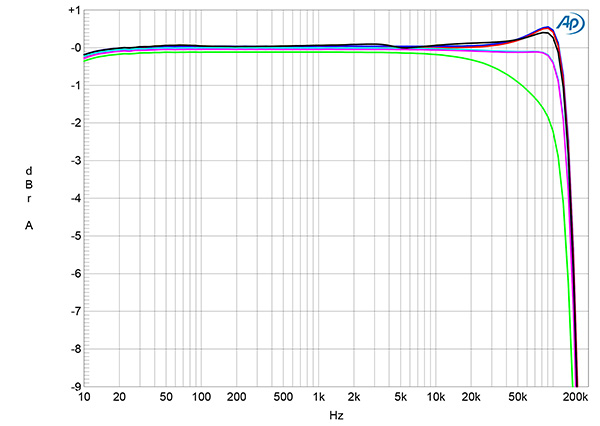
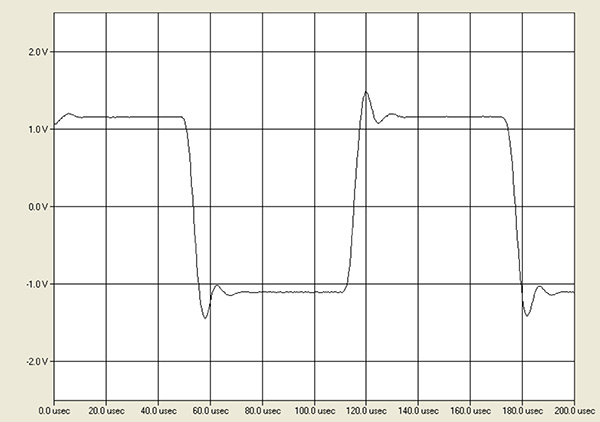
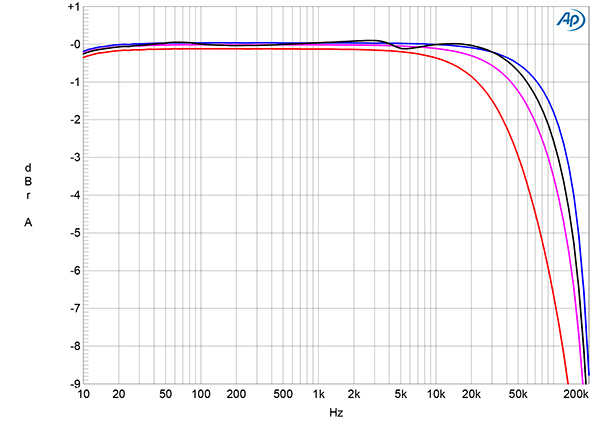
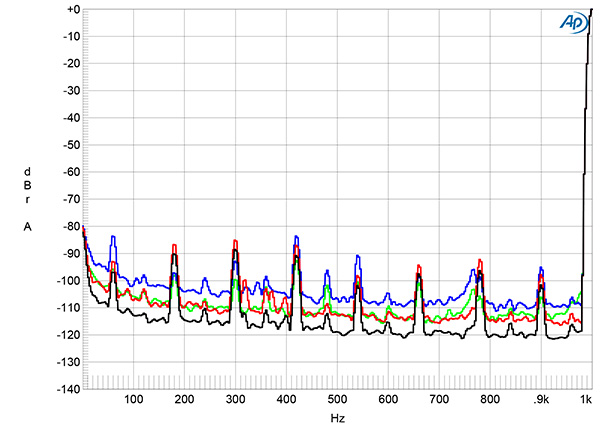
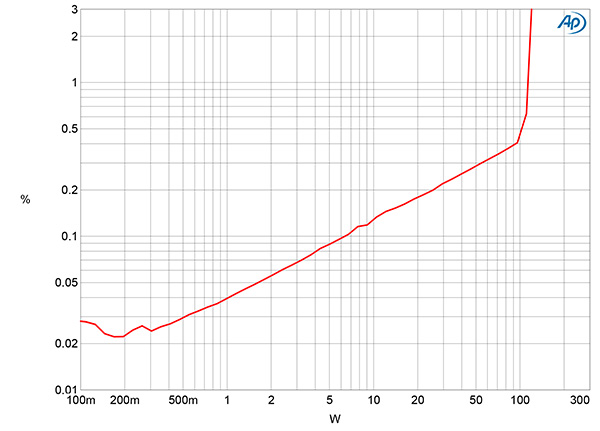
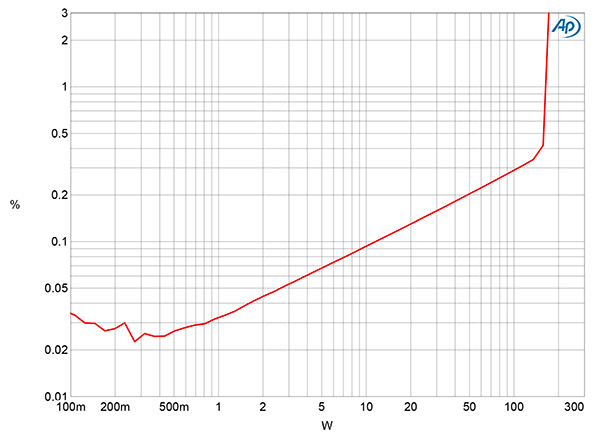
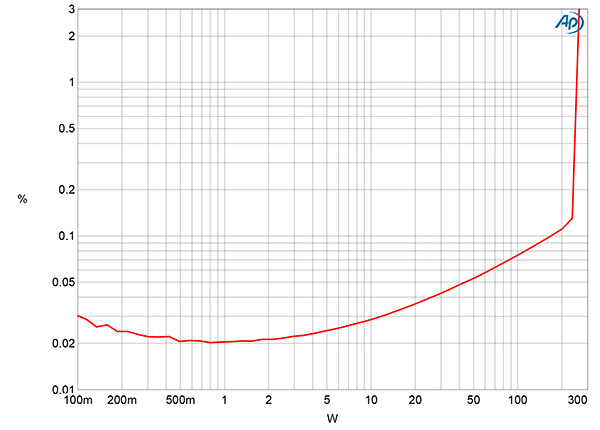
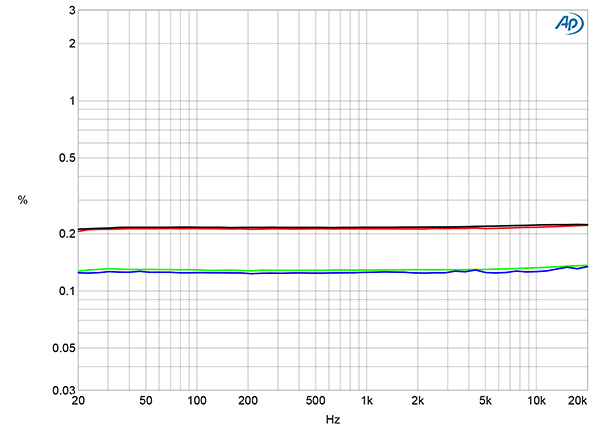
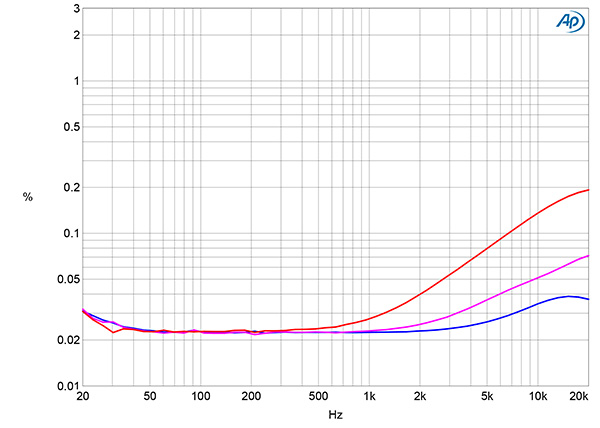
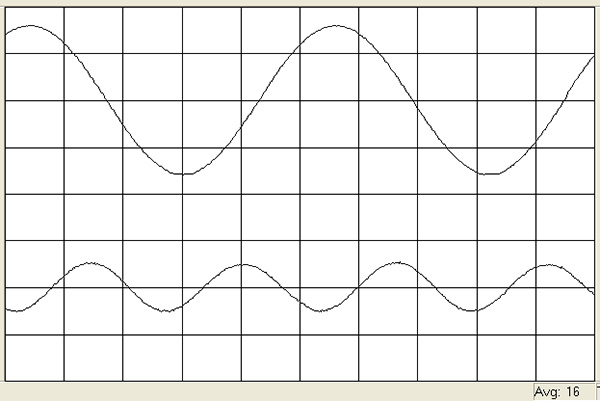
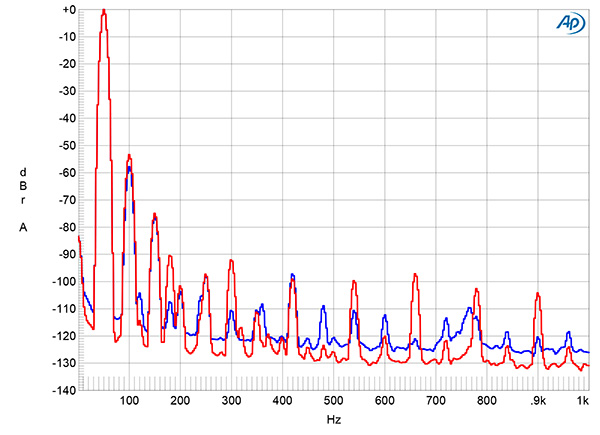
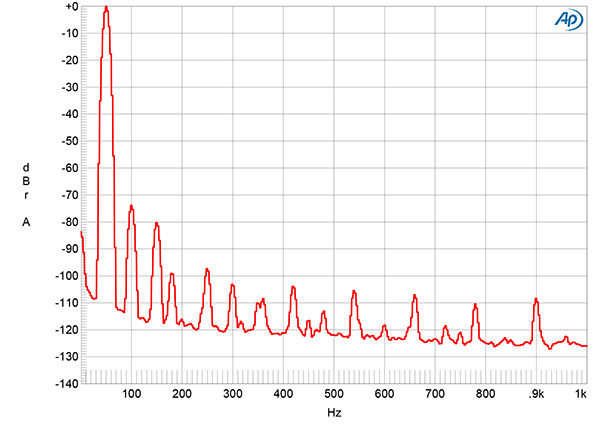
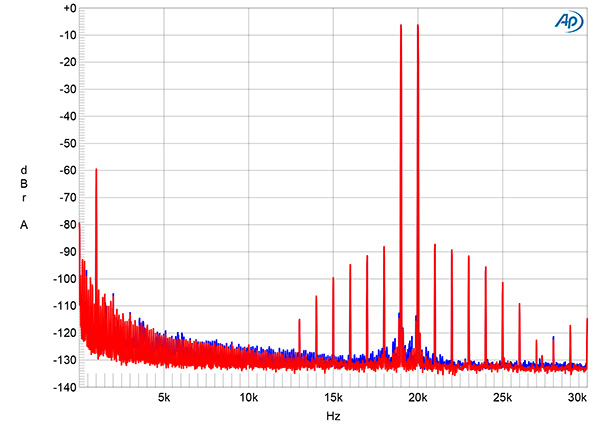
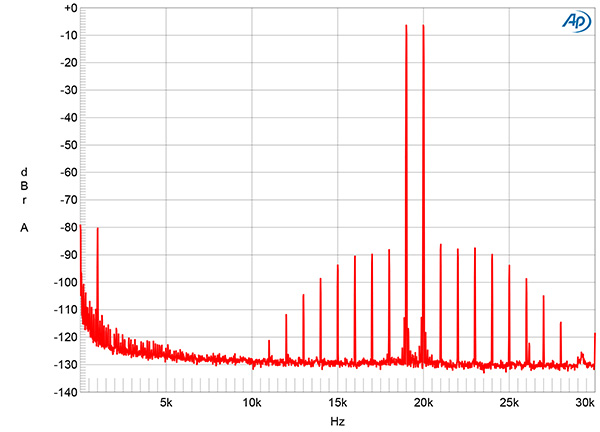
Fig.1 Prima Luna EVO 300 Hybrid, balanced input, Low gain, Stereo mode, frequency response at 2.83V into: simulated loudspeaker load (gray), 8 ohms (left channel blue, right red), 4 ohms (left cyan, right magenta), and 2 ohms (green) (1dB/vertical div.).
Fig.2 Prima Luna EVO 300 Hybrid, balanced input, Low gain, Stereo mode, small-signal 10kHz squarewave into 8 ohms.
The balanced input impedance was lower than the specified 49k ohms, at 5.3k ohms across the audioband. The unbalanced input impedance, which is specified as 32k ohms, was 30.7k ohms at 20Hz and 1kHz, 25k ohms at 20kHz. The output impedance in Stereo mode was low, at 0.045 ohms at 20Hz and 1kHz, 0.095 ohms at 20kHz. As a result, the variation in the amplifier's frequency response with our standard simulated loudspeaker (fig.1, gray trace) was negligible. The response into resistive loads (blue, red, cyan, magenta, and green traces) was flat up to 40kHz. Fig.1 was taken with the balanced inputs and the gain set to Low. The response peaks by 1dB between 70kHz and 100kHz, followed by a sharp rolloff. This peak was absent with the gain set to High and with the unbalanced inputs. However, it is associated with a small overshoot followed by critically damped ringing on the waveform's leading edges (fig.2).
Fig.3 Prima Luna EVO 300 Hybrid, balanced input, Low gain, Mono mode, frequency response at 2.83V into: simulated loudspeaker load (gray), 8 ohms (blue), 4 ohms (magenta), and 2 ohms (red) (1dB/vertical div.).
As there are now two output stages in series, the output impedance in Mono mode was higher than it was in Stereo mode, at 0.056 ohm in the bass and midrange, rising to 0.17 ohm at the top of the audioband. The ultrasonic peak was absent from the frequency response in Mono mode, though the output rolled off earlier into resistive loads (fig.3). Into 4 ohms (magenta trace) it was down by 3dB at 90kHz; into 2 ohms (red trace) it was down by 3dB at 50kHz.
The PrimaLuna's channel separation in Stereo mode was very good, at >90dB in both directions below 1kHz, reducing to 60dB at 20kHz. The unweighted, wideband signal/noise ratio, taken with the unbalanced input shorted to ground and the gain set to Low, was a very good 78.2dB ref. 1W into 8 ohms (average of both channels) in Stereo mode. This ratio improved to 82.8dB when the measurement bandwidth was restricted to the audioband, and to 86dB when A-weighted. The S/N ratios were 4–6dB lower with the gain set to High and respectively 3dB lower than in Stereo mode with the two gain settings in Mono mode.
Fig.4 Prima Luna EVO 300 Hybrid, balanced input, Stereo mode, spectrum of 1kHz sinewave, DC–1kHz, at 1Wpc into 8 ohms with gain set to High (left channel blue, right red) and to Low (left green, right gray) (linear frequency scale).
Spectral analysis of the low-frequency noisefloor while the PrimaLuna set to Low drove a 1kHz tone at 1Wpc into 8 ohms revealed that the random noisefloor was very low in level (fig.4, green and gray traces), though power supply–related spuriae are present at 60Hz and its odd-order harmonics. These are most likely due to magnetic interference from the power transformer being picked up by the steel pins of the preamp tubes. Repeating the analysis with High gain and the level of the input signal lowered so that the output voltage remained the same raised the level of both the random noisefloor and the supply-related spuriae by approximately 6dB (blue and red traces).
Fig.5 Prima Luna EVO 300 Hybrid, Stereo mode, distortion (%) vs 1kHz continuous output power into 8 ohms.
Fig.6 Prima Luna EVO 300 Hybrid, Stereo mode, distortion (%) vs 1kHz continuous output power into 4 ohms.
Fig.7 Prima Luna EVO 300 Hybrid, Mono mode, distortion (%) vs 1kHz continuous output power into 8 ohms.
PrimaLuna specifies the EVO 300 Hybrid's maximum power in Stereo mode as 100Wpc into 8 ohms (20dBW) and 150Wpc into 4 ohms (18.75dBW). Stereophile defines clipping as when the THD+noise reaches 1%. With both channels driven and in both gain modes, the PrimaLuna amplifier slightly exceeded the specified powers with a 1kHz signal, clipping at 115W into 8 ohms (20.6dBW, fig.5) and 160W into 4 ohms (19dBW, fig.6). The specified powers in Mono mode are 220W into 8 ohms (23.4dBW) and 300W into 4 ohms (21.75dBW); the amplifier clipped at 250Wpc into 8 ohms (24dBW, fig.7) and 305W into 4 ohms (21.8dBW, not shown).
The FTC's updated "Amplifier Rule" states that maximum power should also be assessed at frequencies other than 1kHz. I therefore repeated the clipping tests with a 20kHz signal. Commendably, the EVO 300 Hybrid's maximum powers at 20kHz into 8 ohms in both Stereo and Mono modes were the same as they had been at 1kHz.
Fig.8 Prima Luna EVO 300 Hybrid, Stereo mode, THD+N (%) vs frequency at 8.95V into 8 ohms (left channel blue, right red), 4 ohms (left cyan, right magenta), and 2 ohms (left green, right gray).
Fig.9 Prima Luna EVO 300 Hybrid, Mono mode, THD+N (%) vs frequency at 8.95V into 8 ohms (blue), 4 ohms (magenta), and 2 ohms (red).
The shape of the traces in figs.5 and 6 indicate that the THD+N percentage rises with increasing power in Stereo mode. I therefore examined how the EVO 300 Hybrid's THD+N percentage in this mode varied with frequency at 8.95V, which is equivalent to 10W into 8 ohms, 20W into 4 ohms, and 40W into 2 ohms (fig.8). The THD+N was very consistent across the audioband, just above 0.1% in the left channel into all three impedances (blue, cyan, and green traces), but closer to 0.2% in the right channel (red, magenta, and gray traces). In Mono mode, the THD+N at low and moderate powers in fig.7 was significantly lower than it had been in Stereo mode. This can be seen in fig.9, which plots the THD+N against frequency at the same 8.95V into 8 ohms (blue trace), 4 ohms (magenta), and 2 ohms (red). However, the percentage does rise in the top two octaves, particularly into the lower impedances, which will be due to the circuit having limited open-loop bandwidth, which lowers the amount of corrective negative feedback available at high frequencies.
Fig.10 Prima Luna EVO 300 Hybrid, Stereo mode, 1kHz waveform at 20W into 4 ohms, 0.125% THD+N (top); distortion and noise waveform with fundamental notched out (bottom, not to scale).
Fig.11 Prima Luna EVO 300 Hybrid, Stereo mode, spectrum of 50Hz sinewave, DC–1kHz, at 20Wpc into 4 ohms (left channel blue, right red, linear frequency scale).
Fig.12 Prima Luna EVO 300 Hybrid, Mono mode, spectrum of 50Hz sinewave, DC–1kHz, at 20W into 4 ohms (linear frequency scale).
In Stereo mode, the distortion waveform with a 1kHz tone at 20W into 4 ohms was dominated by the subjectively innocuous second harmonic (fig.10), with the third harmonic the next highest in level and higher-order harmonics all lying below 90dB (0.003%, fig.11). Repeating this spectral analysis at the same output power in Mono mode (fig.12) showed that the second harmonic was still the highest in level, but it now lay at –74dB (0.02%) compared with –60dB (0.1%), left channel, and –54dB (0.15%), right channel in Stereo mode.
Fig.13 Prima Luna EVO 300 Hybrid, Stereo mode, HF intermodulation spectrum, DC–30kHz, 19+20kHz at 20Wpc peak into 4 ohms (left channel blue, right red, linear frequency scale).
Fig.14 Prima Luna EVO 300 Hybrid, Mono mode, HF intermodulation spectrum, DC–30kHz, 19+20kHz at 20Wpc peak into 4 ohms (linear frequency scale).
The levels of the higher-order intermodulation products with an equal mix of 19kHz and 20kHz tones at 20W peak into 4 ohms were similar in Stereo (fig.13) and Mono (fig.14) modes, other than the difference product at 1kHz lying at –60dB (0.1%), Stereo, and –80dB (0.01%), Mono.
I was impressed by the PrimaLuna EVO 300 Hybrid's measured performance. In both Stereo and Mono modes, it can deliver relatively high power even at 20kHz into low impedances. As a conventional stereo amplifier, the spectrum of its harmonic distortion is dominated by the subjectively benign second harmonic, which should add a touch of "tube" character to its sound quality. It is not unusual for distortion to be lower when a stereo amplifier is used as a bridged monoblock—if the transfer functions of the two channels' output stages are identical, the even-order harmonics in each channel will be in opposite polarity and will therefore cancel. However, while the overall distortion was much lower with the EVO 300 Hybrid operated in Mono mode than it was in Stereo, the second harmonic was still the highest in level. This is unusual, but I suspect that it is generated in the tubed preamp stage.—John Atkinson