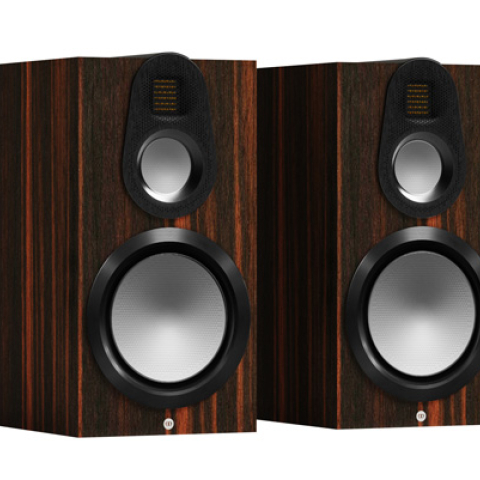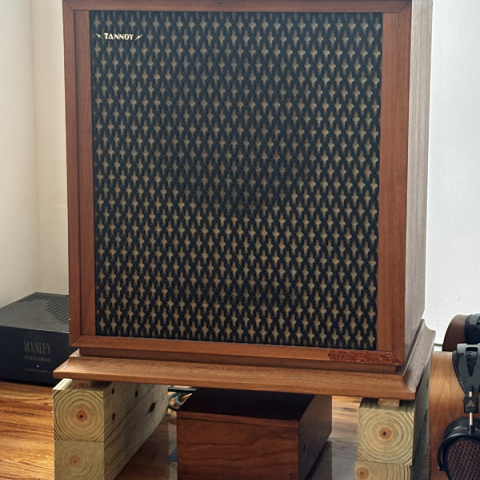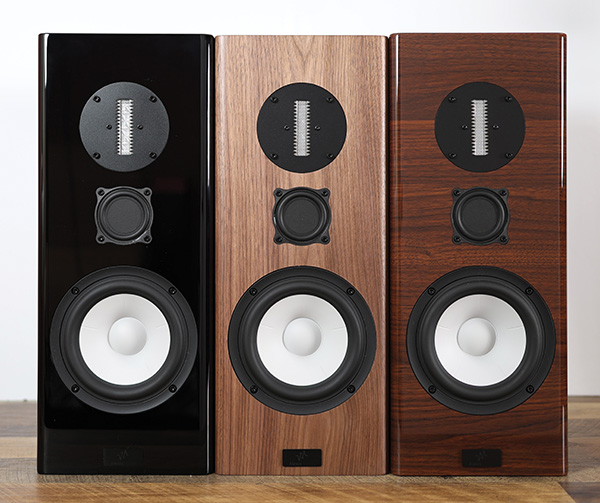
I realize I've spent an inordinate amount of space talking about what essentially was my failure to set up the speakers properly in the first place, but trust me when I say there's method to my madness. My experience in positioning them was the beginning of my awakening to the traits that define these speakers' character. Two of those traits combined make this speaker magical.
But first I want to talk about this speaker's resolution, which is impressive by any standard, and the first of this speaker's defining traits that was revealed to me by that positioning exercise. The BMRs taught me my first lesson, that while a wide-dispersion design may sound better to a wider swath of listeners at any one time than a narrower dispersion one, you still need to position them carefully to reap the benefits. Do this, and what a fabulous sweet-spot response the BMRs will grant you!
The BMRs proved again how keenly resolving they are when I changed a couple of cables in my system midreview. I don't normally do this, but there was something in what I heard when I got the BMRs' placement right that inspired me to substitute my Kimber Kable speaker cable for the Audience one I had been using, and change the LessLoss power cable feeding my tube Sonic Frontiers phono stage to a DR Acoustics one. I want to be careful not to overstate the benefits of these changes, but the BMRs made them obvious. I did not make these changes because something sounded bad. These speakers' inherent musicality is nearly as unquashable as Goldie Hawn's sunny disposition on
Rowan & Martin's Laugh-In. I made these changes because I had heard the BMRs' potential.
What were the two complementary traits that made the BMRs sound magical? The first had to do with how well they're able to recreate a soundstage. Recording permitting, the BMRs produce fertile grounds for images to materialize and for sound to appear to travel; listening room boundaries are less of an obstacle. The BMRs do space exceedingly well; perhaps their wide-dispersion design is why. The second trait is tone, by which I don't mean the rich kind of tone we might associate with color verging on bloat. I'm talking about tone with texture, physicality, reflected light, acrylic-paint pigmentation, and some molten metal-like substance that moves through the air like sculpture in motion. That's the kind of tone the BMRs deliver.
Taken together, those two qualities constituted the infrastructure of a picture that could sound so solid, realized, and self-contained, I occasionally wondered if this might not be all the audiophile sound I need. Sure, I could probably get more of this or that with a pricier speaker, but what a shame it would be to lose what the BMR Monitors can do so
intoxicatingly.
This BMR driver is darn special. It isn't like any speaker driver I've heard squawking out unpronounceable names at the airport. If it was, could the strings on the recording
Bach: Brandenburgische Konzerte Nos.1, 2, 3 (CD, Archiv Produktion 447 287-2) have sounded this uncannily real? Those strings didn't just blow though the air; their sound was molded inside a concave infrastructure. They were tone-driven and deep-colored, with texture that became more explicit as the sound became more dynamic. When a group of violins lashed out on a punctuated note, I could sense their collective sound colliding with the air, almost as if I were hearing the impact of a shovel against a thick layer of snow.
The strings, the horn, the oboe, the cello, the bassoon, the harpsichord—each instrument type spawned an envelope of sound that remained separate from the others. Tone was conspicuous, starkly realistic, and startling in its authenticity, endowing notes with a strong structural core and a silhouetted precision that gave perspective to images' locations in relation to each other. Imaging solidity seemed in large part a function of tonal abstractions.
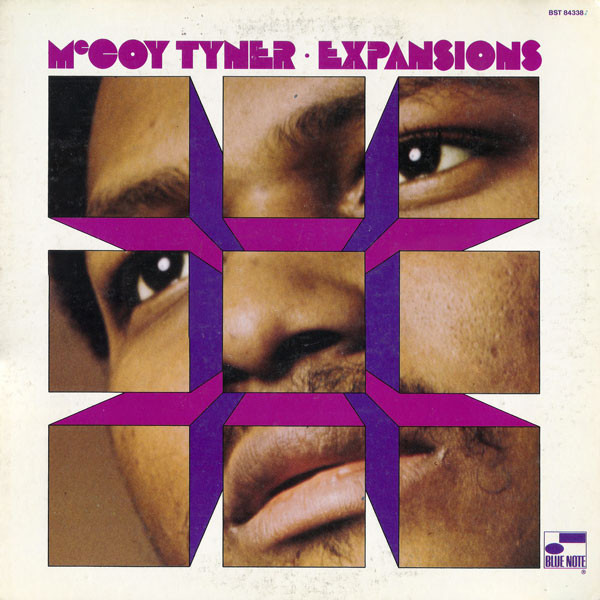
The BMRs revealed distinctly how my vinyl setup produced images with a bit more body, but with less tonal shadings, than my digital setup. The dab of extra warmth imparted by my Sonic Frontiers phono preamp helped McCoy Tyner's somewhat dry-sounding
Expansions (LP, Blue Note BST 84338) sound more robed in flesh and infused with oxygen. Compared to my digital front-end, my vinyl rig produced an earthier tint and brought objects farther into my room, impasto painting–like.
I knew this record was chockfull of great solos, but I couldn't recall them sounding this resolved, laid bare, or fun to listen to. Skill and creative expression were emphasized, every note an amuse-bouche for the senses and intelligence. The music possessed a spry demeanor that kept the presentation buoyant and moving at a good clip.
Listening to Tyner, Wayne Shorter, Gary Bartz, and Woody Shaw tear into their solos, I was struck by how the BMRs preserved the integrity of each note by defining the space between them, where one cuts off before the other takes flight.
Every solo was a dance routine but also a revelation in tone. These masters of their instrument spent their lives perfecting their tone and the way they play their notes. The BMRs easily conveyed both, shining a light on the uniqueness of each person's art so it sounded like a distinct dialect. The BMRs offered a front row center view into each musician's individual creative process.
Of course, the BMR driver didn't act alone; it was flanked by drivers that sounded made to measure for use with the BMR driver. I felt I could hear how Dennis had fine-tuned the transition between drivers to make them sound flawlessly unified. I heard one picture without frequency-related borders. The BMRs produced a transparent, balanced picture.
The BMR's midrange reminded me of that of the $9500/ pair
Dynaudio Contour 30i. The BMRs didn't have the more expensive Dynaudios' textural refinement or possess as many tonal shades, but they projected a not-dissimilar audioband clarity. The BMRs won't show a midbass bump unless it's on the recording; otherwise, lower frequencies remain on the bottom, higher ones on top, as it should be.
 Epilogue
My listening to the BMRs didn't stop after I'd completed this review, because the more I listened to them, the more attached I became. I listened to Gentle Giant's 1974 album
In a Glass House (CD, Alacard alu-gg-02), particularly the first track, "The Runaway," which is a rather complex prog rock composition with myriad instrumental parts. "The Runaway" is all about space and tone, two things the BMRs combine exceptionally well. The song sounded glorious through the BMR Monitors—big, colorful, 3D, bounding with creativity and musicianship. At one point, I took a moment and yelled into space, "Today's music sucks!"
If there's a caveat to my experience with the BMRs it's that, powered by my 37Wpc Shinai amplifier, they tended to snap into ultimate soundstage/tonal focus when I wasn't playing them too loud. At sufficient volume, they delivered sound that was the stuff of my audiophile dreams. More power is recommended.
At $2000/pair for the nicest finish, I consider the BMR Monitors a bargain. They don't just look great. Musically, they wielded a tractor-beam effect: I was compelled to move toward the music.
But remember, if you are considering buying a pair, that they are very revealing of whatever they're connected to. Experimentation with their environment, and with ancillary equipment, is recommended for maximum fun. Just make sure you get their positioning right. Roger Waters can help.
Maybe JA will be willing to test another pair of current-production BMR Monitors instead of these. I'm reluctant to let them go.