 When I swapped in the A-50 for the WiiM Amp, I immediately heard an improvement: deeper, firmer bass, a warmer but still precise and detailed top end. I invited my audio buddy Dave (aka Father Time, an old dude who's a drummer) to listen; Dave owns and enjoys daily the KEF LSX wireless speaker-gadgets. We agreed that the Onkyo A-50 is a great partner for KEF LS50 Metas. We spent most of an afternoon streaming favorite songs. One album Dave turned me on to that day was Bill Frisell's Guitar in the Space Age! (Okeh, Qobuz 16/44.1 stream). Frisell's reverb-heavy take on Brian Wilson's "Surfer Girl" proved to be a way to hear the effect of engaging the tone controls and other DSP. With the A-50 in Direct mode (no DSP), the reverb was slightly heavier and deeper, like an echo chamber surrounded the soundstage.
When the A-50 was switched out of Direct mode, with the tone controls flat and with no room-correction engaged, there was slightly less reverb. The "tails" evaporated a little sooner, similar to what happens when I digitize a tape: The nth degree of reverb depth and tape hiss doesn't make it to the bits. This usually doesn't make the music less enjoyable or present in the room, but it is audible. There were albums that sounded better with a nip of the bass, tuck of the treble, or a heavier hand on the tone controls. I liked having the option of DSP tone controls, and I commend Ueda and his team for providing the Direct switch. While the A-50 was in the Junior System,
I had my first dance with Dirac Live (footnote 5). The folks at Onkyo provided a full-function license. I read the brief section on Dirac in the A-50 manual, which basically said "download and run the software, follow the directions from there." Without going too deeply into the calibration process: I used an old camera tripod to set the microphone where my head usually is in the listening chair and in a square of four positions even with the back of the chair, about a foot above and below the height of my head. The software, which I downloaded to my Windows laptop, found the A-50 on my network and ran the calibration process, telling me when to change microphone positions and running frequency sweeps and impulse-response tones, then crunching the data and creating a room-correction profile. The A-50 has storage for up to four profiles.
When I swapped in the A-50 for the WiiM Amp, I immediately heard an improvement: deeper, firmer bass, a warmer but still precise and detailed top end. I invited my audio buddy Dave (aka Father Time, an old dude who's a drummer) to listen; Dave owns and enjoys daily the KEF LSX wireless speaker-gadgets. We agreed that the Onkyo A-50 is a great partner for KEF LS50 Metas. We spent most of an afternoon streaming favorite songs. One album Dave turned me on to that day was Bill Frisell's Guitar in the Space Age! (Okeh, Qobuz 16/44.1 stream). Frisell's reverb-heavy take on Brian Wilson's "Surfer Girl" proved to be a way to hear the effect of engaging the tone controls and other DSP. With the A-50 in Direct mode (no DSP), the reverb was slightly heavier and deeper, like an echo chamber surrounded the soundstage.
When the A-50 was switched out of Direct mode, with the tone controls flat and with no room-correction engaged, there was slightly less reverb. The "tails" evaporated a little sooner, similar to what happens when I digitize a tape: The nth degree of reverb depth and tape hiss doesn't make it to the bits. This usually doesn't make the music less enjoyable or present in the room, but it is audible. There were albums that sounded better with a nip of the bass, tuck of the treble, or a heavier hand on the tone controls. I liked having the option of DSP tone controls, and I commend Ueda and his team for providing the Direct switch. While the A-50 was in the Junior System,
I had my first dance with Dirac Live (footnote 5). The folks at Onkyo provided a full-function license. I read the brief section on Dirac in the A-50 manual, which basically said "download and run the software, follow the directions from there." Without going too deeply into the calibration process: I used an old camera tripod to set the microphone where my head usually is in the listening chair and in a square of four positions even with the back of the chair, about a foot above and below the height of my head. The software, which I downloaded to my Windows laptop, found the A-50 on my network and ran the calibration process, telling me when to change microphone positions and running frequency sweeps and impulse-response tones, then crunching the data and creating a room-correction profile. The A-50 has storage for up to four profiles.
 With the full-range system
In the living room, at the time of this review, I had Ø Audio Verdande speakers in for review. These speakers have high sensitivity, but they benefit from some real power to drive their stiff 15" woofers. The A-50 made them sing and stomp.
 Especially enjoyable spins that afternoon: Blues A-Plenty by Johnny Hodges (Verve/Analogue Productions MG VS-68358); The Big Beat by Art Blakey & the Jazz Messengers (Blue Note Classic Vinyl ST-84029); Out of the Afternoon by Roy Haynes (Impulse!/Analogue Productions A-23); Buddy and the Juniors (Blue Thumb/Verve/Acoustic Sounds BTS 20).
The next day, I swapped in The Vessel moving magnet cartridge and switched the A-50 phono preamp to MM. With the cartridge parked in the armrest, I turned up the volume, all the way, to see if the woofers would start flapping again. They didn't, and just as admirably, there was no audible hum and very little hiss. Used with MM cartridges, the A-50's is a very low-noise phono preamp.
I commenced to playing through the Stones' five-LP Black and Blue box set, this time listening in full range and at nearly rock-concert level. Suffice to say, the house rocked.
Especially enjoyable spins that afternoon: Blues A-Plenty by Johnny Hodges (Verve/Analogue Productions MG VS-68358); The Big Beat by Art Blakey & the Jazz Messengers (Blue Note Classic Vinyl ST-84029); Out of the Afternoon by Roy Haynes (Impulse!/Analogue Productions A-23); Buddy and the Juniors (Blue Thumb/Verve/Acoustic Sounds BTS 20).
The next day, I swapped in The Vessel moving magnet cartridge and switched the A-50 phono preamp to MM. With the cartridge parked in the armrest, I turned up the volume, all the way, to see if the woofers would start flapping again. They didn't, and just as admirably, there was no audible hum and very little hiss. Used with MM cartridges, the A-50's is a very low-noise phono preamp.
I commenced to playing through the Stones' five-LP Black and Blue box set, this time listening in full range and at nearly rock-concert level. Suffice to say, the house rocked.
During my last days reviewing the Onkyo A-50, I pulled out the tripod-mounted microphone and set up Dirac Live in the living room using the same five-point method I used downstairs. I also calibrated the FidelityIQ automated loudness DSP. FidelityIQ turned out to work differently than I thought. Accessed through the phone app, it has options for Low, Mid, and High volume levels. It seems to apply a traditional loudness curve for each setting, with more bass and treble enhancement at the low settings, less as the volume increases. The "High" setting was a bit below my normal listening level, and the computer-set loudness curve preserved much of the tonality and dynamics of music as it was played at still-louder levels. The low end engaged the room correctly at the High and Mid levels. The Low level was inadequate for serious listening—the correction couldn't make up for the low impact at such low volume levels—but it would be good for background music at a party, the kind where people talk rather than dance. I concluded that FidelityIQ is a useful feature, especially for someone who can't turn the volume up as far as they'd like to due to thin apartment walls or a sleeping baby. Dirac in the living room created a sound profile similar to the one it created in the junior system. Music sounded similar—but bigger due to the full-range speakers. Just like downstairs, some recordings benefitted from Dirac; some didn't. My wife noticed the same things: to choose Dirac was a tradeoff between precision details and stereo imaging vs "humanity" as she put it. "Blood and guts" was my description; she thought it made music sound "colder but clearer." I was also troubled by the fact that Dirac's purpose is to "correct" the room, which inherently means undoing some woofer-floor-room interactions. As a man who loves the beat and bassline, this doesn't sit well—and I noticed it when I started shuffling through my Bass Test playlist (footnote 6). More than in the Junior System, I judged Dirac to be a mixed bag but worth further exploration if I get another compatible device in for review.
 High value embodied
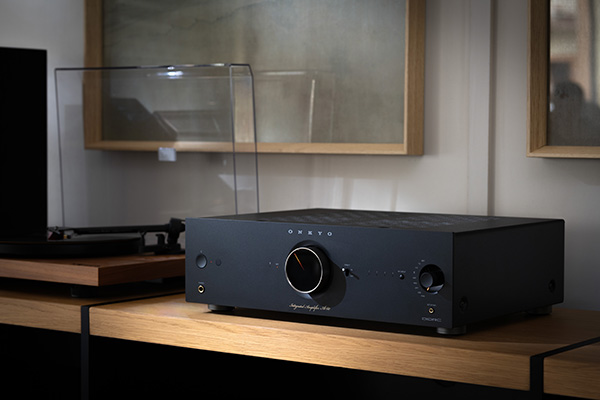
The last time Stereophile reviewed an integrated amplifier from Onkyo was 19 years ago, in 2007, when Robert Deutsch reviewed the A-9555. It's worth a look back to see how far the notion of a full-featured integrated amp has evolved. The A-9555 cost $699, which equates to about $1100 today. It had no onboard streaming, no DSP for tone-shaping, and no built-in DAC. The main features it shared with the A-50 were class-AB amplification, a linear power supply, and an onboard phono preamp. There's a whole different value proposition today. I had a lot of fun listening to the Onkyo A-50 for the three months I had it here. It is amply featured and does most of what it does very well. The design is smartly considered and well-executed. Its look and finish proudly declare "high quality." For your $1600, you get a lot of stuff in a handsome, reasonably sized package. If you're streaming-centric, this is all you need except for a good pair of speakers. (It deserves good speakers. It will make them sound good.) If you are into vinyl, that's covered too—just pick up a high-quality, no-pretense turntable, like the Technics SL-50C I reviewed last month. I wouldn't recommend the built-in preamp with a car-priced vinyl rig, but it's fine with a workingman's record player, and with a MM cartridge it fits the 90% Rule (90% of records will sound good 90% of the time). The control app is full-featured and works well, except in how it searches metadata in server-based file libraries.
Footnote 5: See Kalman Rubinson's review of the Dirac Live software as it stood in 2021. Footnote 6: See open.qobuz.com/playlist/21395182. New tracks recently added.