 Details
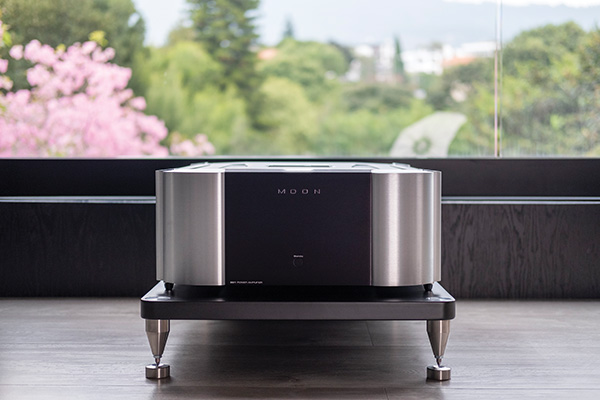
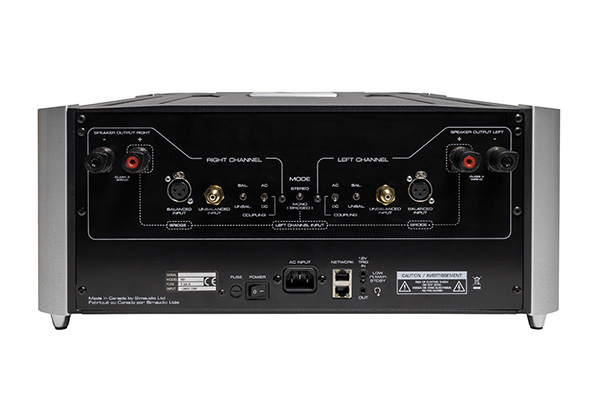
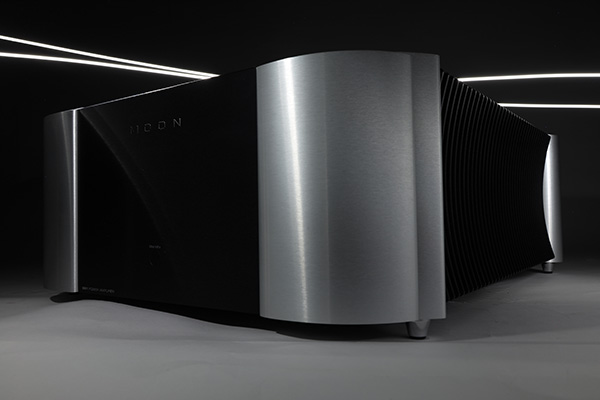
The Moon 861's attractive front panel is blessedly free of bells, whistles, and unnecessary clutter. It includes a discretely placed button that toggles the amp between "active" and "inactive" modes (ie, on and standby), and a status indicator light that differentiates between powering up, normal operation, and firmware update status. The light's unusual placement and shape add to the amp's distinct aesthetics. There's more action on the rear. Beyond two pairs of speaker output posts and single pairs of balanced and single-ended inputs, the rear panel holds toggle switches that allow the user to choose between balanced and unbalanced operation and AC/DC (capacitor/ direct) coupling, one for each channel. There's also a stereo/mono (bridged) toggle switch, 12V trigger in and out, network ports for firmware updates/MOONLink functionality with compatible Moon products/extending the network to an additional device/connecting the device to a network router, low power standby toggle switch, main power rocker switch, and 15A AC input. Moon recommends setting the low power standby toggle switch to "Reg" to reduce the amount of time necessary to reach optimal playing conditions (footnote 3). "Low" reduces energy consumption when not in use, at the cost of shutting off more of the amplifier and requiring longer warm-up. The AC/DC coupling switch enables the input to block DC signals. Sayeth the manual: "AC coupling is useful with preamps suspected of outputting DC (due to age or design) or if the amplifier frequently enters DC protection mode." Koulisakis recommended I keep it in "DC." I did, and everything worked fine.
 The three faces of 861
Koulisakis and I placed the amps on the floor, warmed them up, and began playing familiar music. The sound was enthralling, initially. As much as we audiophiles frequently cite a "black" background to describe presentations devoid of electronically induced noise, this was the first time I've heard an obsidian black shine between and around each note. As alluring as it was, the shine soon felt artificial, like switching one's computer screen view from a white background to black. Against that polished black, colors felt overly hyped—if you're old enough, think Fujifilm vs Kodak—yet strangely monotoned. As fascinating as the sound was—it seemed perfect for the soundtrack to an AI-generated cinematographic journey into outer space—it sounded little like what I hear in the best acoustic and amplified venues.
With character and personality stabilized—I'm talking about the Moon 861s, not me—I could finally sit back and enjoy. The job of reviewing isn't nearly as luxurious as it sounds, especially when it requires, in addition to meticulous setup, switching heavy amplifiers and a frightening number of cables multiple times. But when everything sounds as good as it can, pleasure takes precedence over pain.
 I used the bridged pair of 861s to audition several recordings whose reviews have since appeared in Stereophile or San Francisco Classical Voice. First up was The Kurt Weill Album (24/96 WAV download, Deutsche Grammophon), performed by the Konzerthausorchester Berlin under Joana Mallwitz. Bass was marvelous, totally right in every respect. Images had impressive weight and focus, and soundstage size was everything I could wish for. Equally important (or perhaps more important depending on your point of view), Weill's and Mallwitz's musical intent came through clearly.
The discord, alarm, and disconsolate interludes of Weill's Symphony No.1 were intense and potent. I heard a huge contrast in musical development and language between the relatively early First Symphony and the other two Weill works on the recording, The Seven Deadly Sins and the equally gripping Symphony No.2.
I was especially taken by the emotional import of Katharine Mehrling's grittily alluring instrument and three-dimensional personality. Listening to this album through the 861s transported me from the mostly even flow of life in Port Townsend to the Kingdom of Major Wow.
I used the bridged pair of 861s to audition several recordings whose reviews have since appeared in Stereophile or San Francisco Classical Voice. First up was The Kurt Weill Album (24/96 WAV download, Deutsche Grammophon), performed by the Konzerthausorchester Berlin under Joana Mallwitz. Bass was marvelous, totally right in every respect. Images had impressive weight and focus, and soundstage size was everything I could wish for. Equally important (or perhaps more important depending on your point of view), Weill's and Mallwitz's musical intent came through clearly.
The discord, alarm, and disconsolate interludes of Weill's Symphony No.1 were intense and potent. I heard a huge contrast in musical development and language between the relatively early First Symphony and the other two Weill works on the recording, The Seven Deadly Sins and the equally gripping Symphony No.2.
I was especially taken by the emotional import of Katharine Mehrling's grittily alluring instrument and three-dimensional personality. Listening to this album through the 861s transported me from the mostly even flow of life in Port Townsend to the Kingdom of Major Wow.
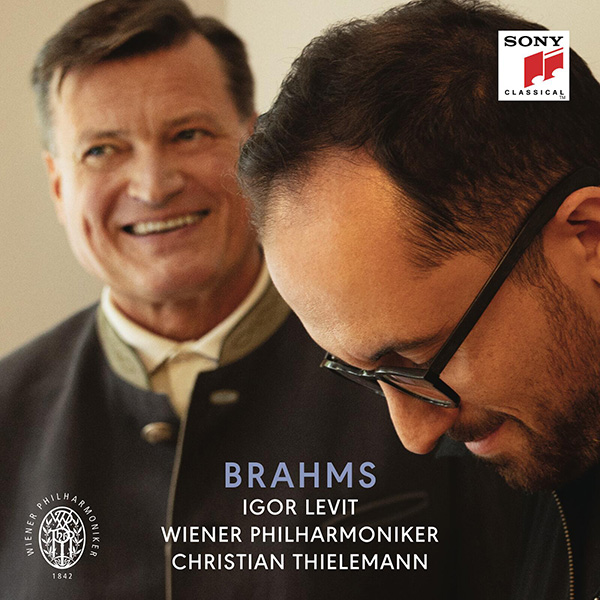 Turning to another recording I reviewed, Igor Levit's Brahms: Concertos for Piano and Orchestra Nos.1 & 2, Works for Solo Piano Opp 116–119, with the Vienna Philharmonic under Christian Thielemann (24/96 FLAC download, Sony), I hung on every note as Levit sensitively performed the most delicate of the solo works. The fragility of Intermezzo No.1 in E-flat Major, Op.117, drove me to write "GORGEOUS!" in my notes. Again and again, I found myself swept away by Levit's playing as the pair of bridged 861s laid bare Brahms's emotional core and his messenger's sympathetic response.
For excitement, expanse, and multiple wild rides, you can't do much better than Dalia's Mixtape (mixed resolution FLAC download, Platoon), the new recording from conductor Dalia Stasevska and the BBC Symphony Orchestra. This recording, filled with music by some of today's most trendy classical/new music composers, is available to stream in immersive format through Apple Music, but I much prefer the illusion and depth of two-channel stereo to artificially hyped reality. Besides, in my admittedly lively room, the Moon 861s enabled good old two-channel hi-rez to assume 3D proportions.
Turning to another recording I reviewed, Igor Levit's Brahms: Concertos for Piano and Orchestra Nos.1 & 2, Works for Solo Piano Opp 116–119, with the Vienna Philharmonic under Christian Thielemann (24/96 FLAC download, Sony), I hung on every note as Levit sensitively performed the most delicate of the solo works. The fragility of Intermezzo No.1 in E-flat Major, Op.117, drove me to write "GORGEOUS!" in my notes. Again and again, I found myself swept away by Levit's playing as the pair of bridged 861s laid bare Brahms's emotional core and his messenger's sympathetic response.
For excitement, expanse, and multiple wild rides, you can't do much better than Dalia's Mixtape (mixed resolution FLAC download, Platoon), the new recording from conductor Dalia Stasevska and the BBC Symphony Orchestra. This recording, filled with music by some of today's most trendy classical/new music composers, is available to stream in immersive format through Apple Music, but I much prefer the illusion and depth of two-channel stereo to artificially hyped reality. Besides, in my admittedly lively room, the Moon 861s enabled good old two-channel hi-rez to assume 3D proportions.
 Dalia's Mixtape contains a number of slow, touching compositions; Noriko Koide's Swaddling Silk and Gossamer Rain, which traces the short life of a silkworm in 11 minutes, and the late Johann Johannsson's elegiac "
 Sentencing
During the only listening session I was able to schedule with Scott while the 861s were in place, I asked, "What other amps have I reviewed near the price of this bridged pair of Moon 861 stereo amps that were anywhere near as good?" Neither of us could come up with an answer. The wonderful sounding, beautifully colored Octave MRE 220 SE tube monoblocks ($37,100/pair with all their options) are gems, but they lack the weight and oomph of a pair of bridged 861s. A pair of Accuphase A-300s ($51,900 for two) don't cost that much more, but their sound is markedly different. The Krell KMA-i800 monoblocks are superb in many ways, but their far warmer presentation, bass heft, and dynamic impact will set you back at least $29,000 more. The D'Agostino Momentum M400s are in a class of their own and considerably more expensive. After scrolling back through several years of my reviews, I could not find a similarly priced amplifier whose overall sound is as neutral and balanced as the 861's and whose bass, soundstaging, and dynamics will cause eyes, ears, and wallet to open wide.
Footnote 3: Warm-up can take as little as a half hour if listening room temperature and conditions are optimal.