

Sidebar 3: Measurements
Simaudio's Moon 861 can be operated as a conventional two-channel amplifier or, by bridging the two output stages, as a monoblock. I performed a complete set of measurements in both modes on a different sample from those auditioned by Jason Victor Serinus. Mine had the serial number 311A22426220. I mainly used my Audio Precision SYS2722 system for the testing, repeating some of the measurements with the magazine's higher-performance APx555 system. I preconditioned the Moon 861 by following the FTC's recommendation of running it in stereo mode at one-eighth the specified power into 8 ohms for an hour. At the end of that time, the temperature of the top panel was 92.5°F (33.6°C) but that of the side-mounted heatsinks was almost too hot to touch, at 132.1°F (55.6°C).
In both stereo and mono modes, the Moon preserved absolute polarity with both the unbalanced and balanced inputs. The balanced input impedance was the specified 47k ohms in the bass and midrange, dropping inconsequentially to 38k ohms at the top of the audioband. For the single-ended inputs, I measured 25k ohms at 20Hz and 1kHz, 15k ohms at 20kHz. These measurements were taken with the inputs direct-coupled, but there was no difference in AC-coupled mode. The voltage gain at 1kHz into 8 ohms in stereo mode was close to the specified 31dB, at 31.4dB. As expected, the gain in mono mode was 6dB higher.
The Moon 861 exceeds its high specified powers in both stereo and mono modes and offers extremely low distortion and noise, even into low impedances. This is superb measured performance for a power amplifier, one of the best I have encountered.—John Atkinson
Footnote 1: See fig.3 here. Also note that the 861 is said to employ no global feedback. Footnote 2: When two output stages are bridged, this tends to cancel even-order distortion.
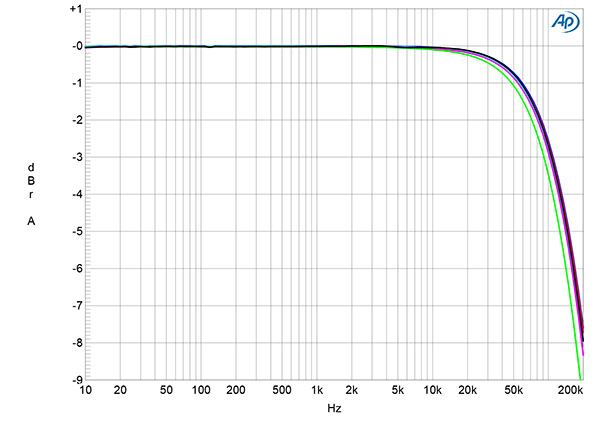
Fig.1 Moon 861, stereo mode, frequency response at 2.83V into: simulated loudspeaker load (gray), 8 ohms (left channel blue, right red), 4 ohms (left cyan, right magenta), and 2 ohms (red) (1dB/vertical div.).
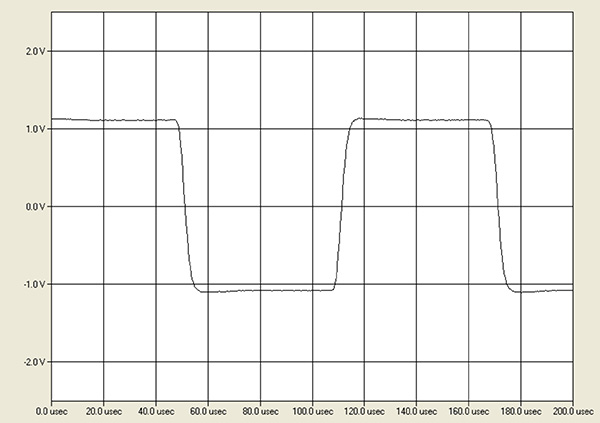
Fig.2 Moon 861, mono and stereo modes, small-signal 10kHz squarewave into 8 ohms.
The output impedance in stereo mode was extremely low, at 0.008 ohms at 20Hz and 1kHz, rising slightly to 0.03 ohms at 20kHz. As the two output stages are in series in mono mode, the output impedances were twice the stereo values. In both stereo and mono modes, the variation in the frequency response with our standard simulated loudspeaker (fig.1, gray trace) was negligible. The response into resistive loads in both modes was flat in the audioband and didn't reach –3dB until 110kHz. Fig.1 was taken with the balanced inputs and with the inputs direct-coupled; the response with the unbalanced inputs was identical, and when I repeated the measurement with the inputs AC-coupled, the only difference was that the output at 10Hz dropped by 1dB. With its wide small-signal bandwidth, the Moon's reproduction of a 10kHz squarewave into 8 ohms featured very short risetimes in both modes (fig.2), with no overshoot or ringing.
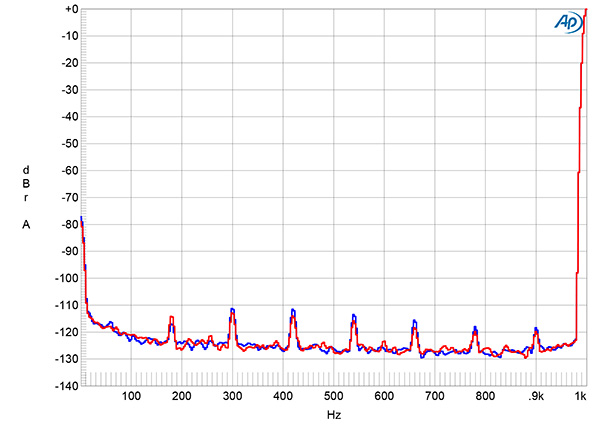
Fig.3 Moon 861, stereo mode, spectrum of 1kHz sinewave, DC–1kHz, at 1Wpc into 8 ohms (left channel blue, right red; linear frequency scale).
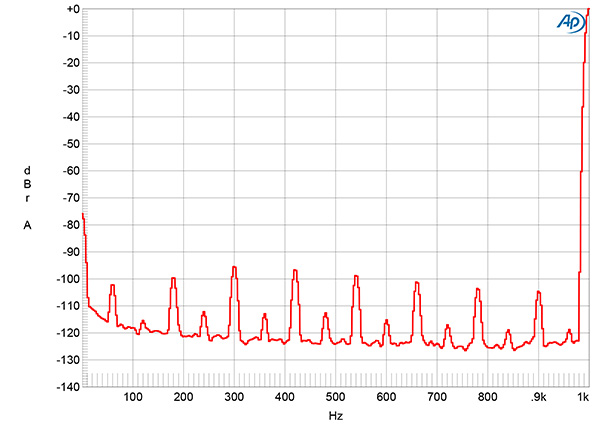
Fig.4 Moon 861, mono mode, spectrum of 1kHz sinewave, DC–1kHz, at 1Wpc into 8 ohms (linear frequency scale).
Channel separation in stereo mode (not shown) was superb, at >120dB in both directions below 2kHz and still 104dB at the top of the audioband. In stereo mode, the unweighted, wideband signal/noise ratio taken with the input shorted to ground was an excellent 86.3dB ref. 1W into 8 ohms in both channels. This ratio improved to 93.9dB when the measurement bandwidth was restricted to the audioband, and to 96.6dB when A-weighted. The ratios were slightly lower in mono mode but still respectably high. Spectral analysis of the low-frequency noisefloor while the Moon drove a 1kHz tone at 1Wpc into 8 ohms in stereo mode revealed that while power supply–related spuriae at the odd-order harmonics of 60Hz were measurable, all were inconsequential, laying at or below –109dB (fig.3). As expected, given the 6dB greater gain in mono mode, the level of the random noisefloor was 6dB higher, and those of the supply-related spuriae increased by 12dB (fig.4).
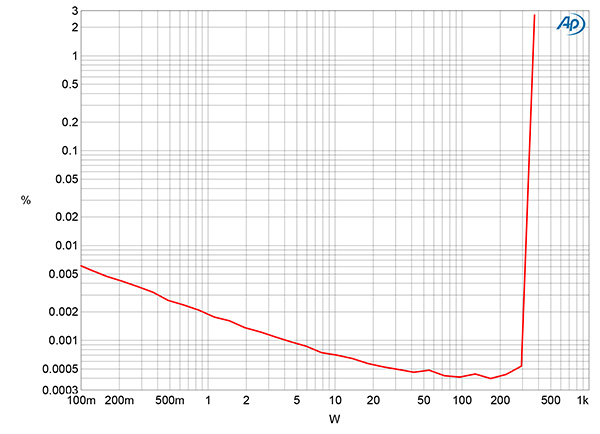
Fig.5 Moon 861, stereo mode, distortion (%) vs 1kHz continuous output power into 8 ohms.
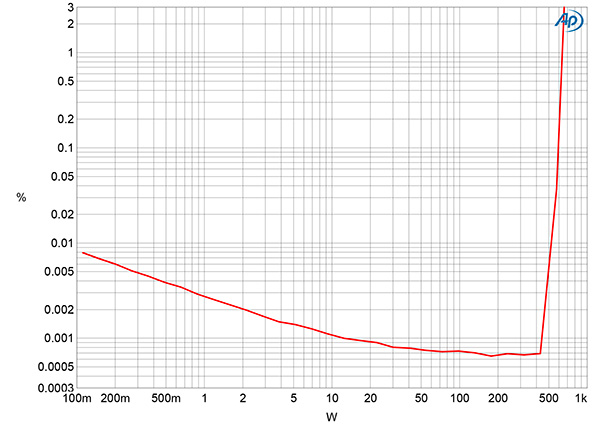
Fig.6 Moon 861, stereo mode, distortion (%) vs 1kHz continuous output power into 4 ohms.
Simaudio specifies the Moon 861's maximum power in stereo mode as 300Wpc into 8 ohms and 600Wpc into 4 ohms, both powers equivalent to 24.77dBW. With our usual definition of clipping, which is when the THD+noise reaches 1%, the 861 exceeded the specified power with both 20Hz and 1kHz signals. With both channels driven, it clipped at these frequencies at 360Wpc into 8 ohms (25.56dBW, fig.5) and 650Wpc into 4 ohms (25dBW, fig.6). The clipping power into 8 ohms with a 20kHz signal was only slightly lower than that at lower frequencies, at 350Wpc (25.44dBW). With one channel driven, the 861 clipped at 1020W into 2 ohms (24.1dBW; not shown).
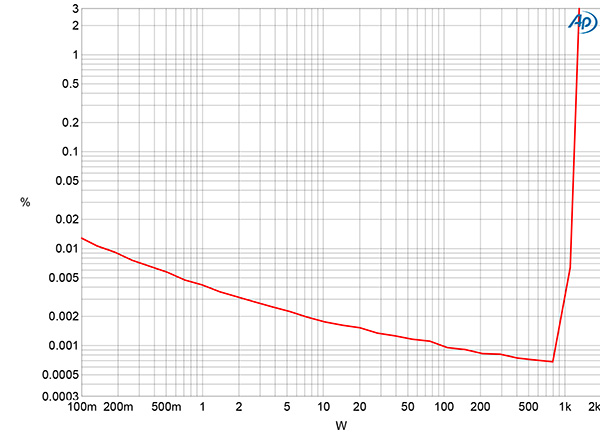
Fig.7 Moon 861, mono mode, distortion (%) vs 1kHz continuous output power into 8 ohms.
In mono mode, the Moon 861 clipped at 1150W into 8 ohms (30.6dBW, fig.7), which is 1.6dBW higher than the specified 800W into this load, this despite the AC wall voltage, 119V with the amplifier idling, sagging to 114.9V with the amplifier at full power. Simaudio specifies the maximum power in mono mode into 4 ohms as 1400W (28.45dBW). When I examined the 4 ohm power, the amplifier went into protection at 1000W (27dBW), the white light at the top of the front panel flashing for a short while before the amplifier turned off.
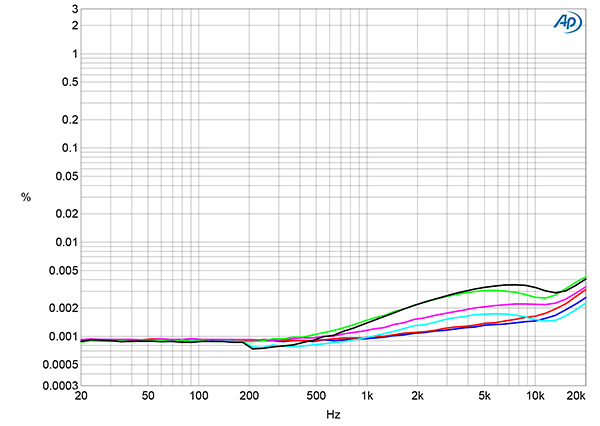
Fig.8 Moon 861, stereo mode, THD+N (%) vs frequency at 20V into: 8 ohms (left channel blue, right red), 4 ohms (left cyan, right magenta), and 2 ohms (left green, right gray).
Fig.9 Moon 861, mono mode, THD+N (%) vs frequency at 28.3V into: 8 ohms (blue) and 4 ohms (red).
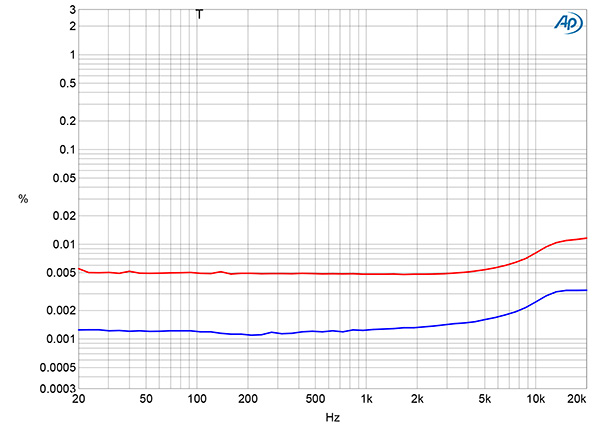
I waited a few minutes, then turned the amplifier on again and examined how the percentage of THD+N in stereo mode varied with frequency at 20V, which is equivalent to 50W into 8 ohms, 100W into 4 ohms, and 200W into 2 ohms (fig.8). The THD+N was very low in the bass and midrange into all three loads and rose only slightly in the top audio octaves. This implies that the circuit has a wide open-circuit bandwidth (footnote 1). In mono mode at 28.3V—equivalent to 100W into 8 ohms and 200W into 4 ohms—the THD+N percentage was slightly higher into 8 ohms than it had been in stereo mode, with a small rise at the top of the audioband (fig.9, blue trace). It was almost 5× higher at the same voltage into 4 ohms (red trace) but was still very low in absolute terms.
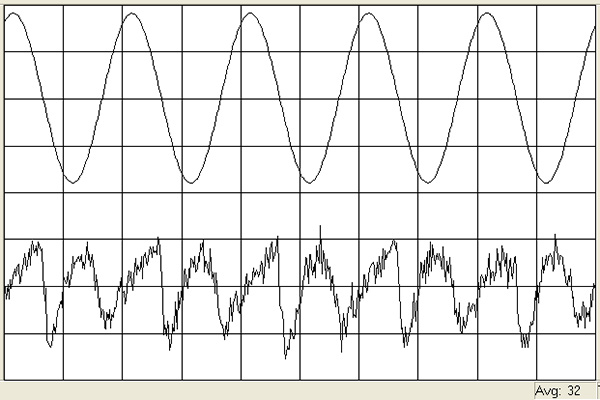
Fig.10 Moon 861, stereo mode, 1kHz waveform at 50W into 8 ohms, 0.0008% THD+N (top); distortion and noise waveform with fundamental notched out (bottom, not to scale).
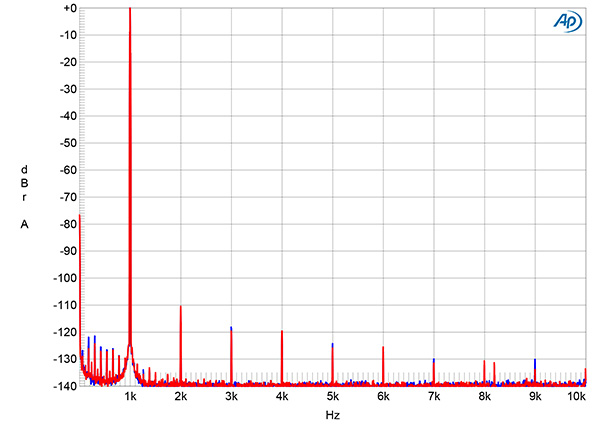
Fig.11 Moon 861, stereo mode, spectrum of 1kHz sinewave, DC–10kHz, at 50Wpc into 8 ohms (left channel blue, right red; linear frequency scale).
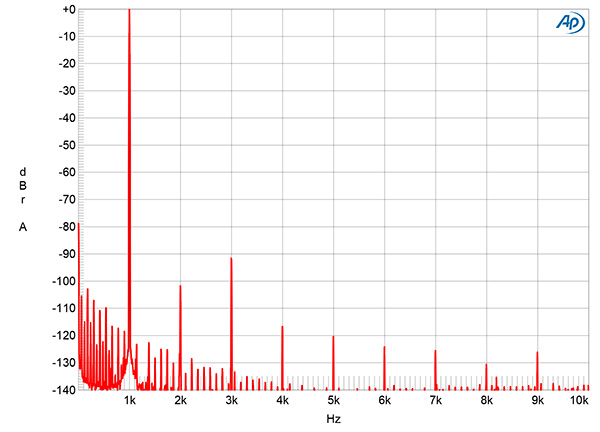
Fig.12 Moon 861, mono mode, spectrum of 1kHz sinewave, DC–10kHz, at 200W into 4 ohms (linear frequency scale).
The distortion waveform in stereo mode was predominantly the second harmonic (fig.10), at a negligible –110dB (0.0003%) ref. 50W into 8 ohms (fig.11). While higher-order harmonics are present, these all lie at or below –120dB (0.0001%). The third harmonic was the highest in level in mono mode (footnote 2), but even into 4 ohms lay at just –90dB ref. 200W (0.003%, fig.12).
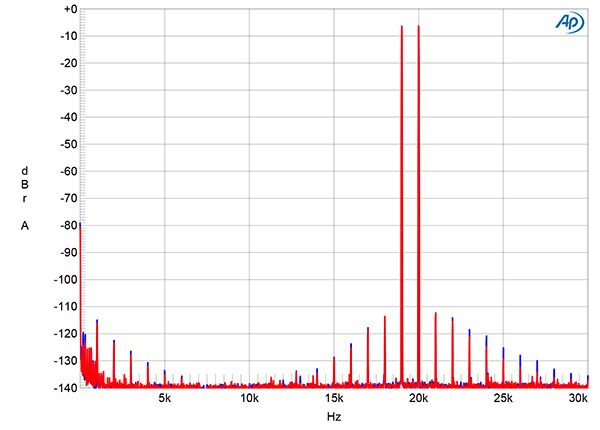
Fig.13 Moon 861, stereo mode, HF intermodulation spectrum, DC–30kHz, 19+20kHz at 100W peak into 4 ohms (left channel blue, right red; linear frequency scale).
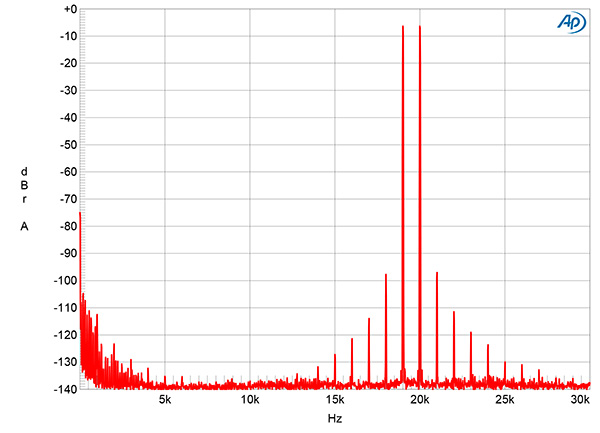
Fig.14 Moon 861, mono mode, HF intermodulation spectrum, DC–30kHz, 19+20kHz at 200W peak into 4 ohms (linear frequency scale).
Intermodulation distortion was also very low, the 1kHz difference product resulting from an equal mix of 19 and 20kHz tones at 50Wpc peak into 8 ohms lying at just –120dB in stereo mode (not shown), rising just 6dB at the same voltage into 4 ohms (fig.13). Even with the same signal at 28.3V into 4 ohms in mono mode, the intermodulation products were not significantly higher in level (fig.14).
Footnote 1: See fig.3 here. Also note that the 861 is said to employ no global feedback. Footnote 2: When two output stages are bridged, this tends to cancel even-order distortion.















