Sidebar 3: Measurements
MonAcoustic's combination of the PlatiMon VC One MK2 and VC Two is the most complicated loudspeaker system that I have encountered in 37 years of measuring loudspeakers. As well as the VC One MK2, which can be used as a standalone two-way standmount, when it is used with the VC Two subwoofer/supertweeter module, the combinations can be used as a "3.5-way" system or a "four-way" system. The latter has four settings for what MonAcoustic calls the "Harmonic Tweeter" control.
I first performed a complete set of tests on one of the VC Ones, which was labeled "LEFT," to get a picture of the system's baseline behavior, then repeated some tests on the other VC One, labeled "RIGHT." I then mounted that sample on top of the "RIGHT" VC Two, using the three ball bearings in the recesses in the Two's top panel to separate the two cabinets. (All the measurements were performed without the grilles.) Sasha Matson had told me that he had primarily auditioned the PlatiMon system as a four-way system with the Harmonic Tweeter control set to "ST," so I performed a complete set of measurements in that mode, repeating some of the tests in 3.5-way mode. (I carefully followed the connection diagrams in the manual for the measurements in these modes.)
I used DRA Labs' MLSSA system and a calibrated DPA 4006 microphone with an Earthworks microphone preamplifier to measure the PlatiMon VC One/VC Two's farfield frequency behavior and dispersion. I took a full set of farfield measurements with the microphone at my usual 50" distance on the tweeter axis, which is 38" from the floor with the VC Two standing on its feet. (To move the reflections of the drive units' outputs from the floor back in time, I lifted the system onto a dolly for the measurements, which placed the tweeter several inches higher.) I used an Earthworks QTC-40 microphone, which has a small, ¼"-diameter capsule, for the nearfield responses and Dayton Audio's DATS V2 system to examine the system's impedance.
MonAcoustic specifies the sensitivity of both the VC One and the 3.5-way VC One/ VC Two combination as 91dB/2.83V/1m. My B-weighted estimates were slightly lower, at 89.1dB(B)/2.83V/1m for the VC One and 89.3dB(B)/2.83V/1m for the 3.5-way system. The PlatiMon's sensitivity in four-way mode is specified as 90dB/2.83V/1m, though the manual also says that that mode's sensitivity is lowered by 2dB, not 1dB, "to achieve a more linear response." My estimate was 87.2dB/2.83V/1m, ie, 2dB lower.
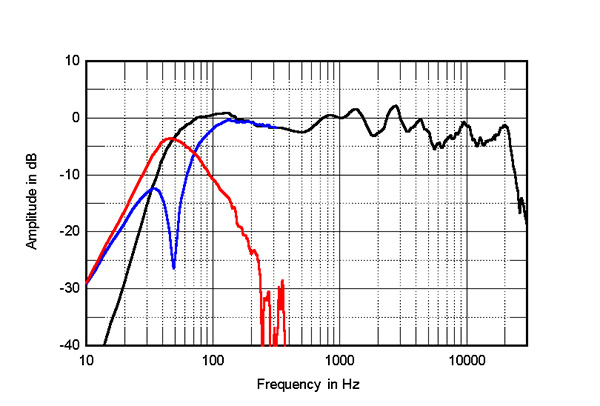
The black trace above 310Hz in fig.5 shows the VC One LEFT's quasi-anechoic farfield response, averaged across a 30° horizontal window centered on the tweeter axis. There is a very slight lack of energy in the midrange and in the top two octaves, with some small peaks in the treble balanced by small dips. To check that there hadn't been a systematic error measuring the farfield behavior, I remeasured the tweeter-axis responses of the LEFT and RIGHT samples with a different measurement system (FuzzMeasure) and with the Earthworks microphone feeding my Metric Halo MIO2882 microphone preamplifier and A/D converter. The responses of both speakers were basically identical to that shown in fig.5 and matched to within ±0.25dB over the upper midrange and treble and within 1dB above 10kHz.
Considered on its own, the PlatiMon VC One offered respectable measured performance. Adding the VC Two gave somewhat idiosyncratic results due to the overlap between the widely spaced high-frequency drive units. The interference in the treble I noted in four-way mode would probably be ameliorated at greater listening distances.—John Atkinson
Footnote 1: EPDR is the resistive load that gives rise to the same peak dissipation in an amplifier's output devices as the loudspeaker. See "Audio Power Amplifiers for Loudspeaker Loads," JAES, Vol.42 No.9, September 1994, and stereophile.com/reference/707heavy/index.html. Footnote 2: This means that the loudspeaker is firing into hemispherical space rather than a full sphere. A speaker that has a truly flat response in the usual "4pi" space will therefore appear to have a boosted upper-bass output with a nearfield measurement, the center frequency of that boost depending on the physical dimensions of the speaker and the woofer alignment. See this explanation or aes2.org/publications/elibrary-page/?id=7171.
Footnote 3: The "Harmonic Tweeter" control reduces the level in the mid-treble by up to 5dB, depending on the setting.
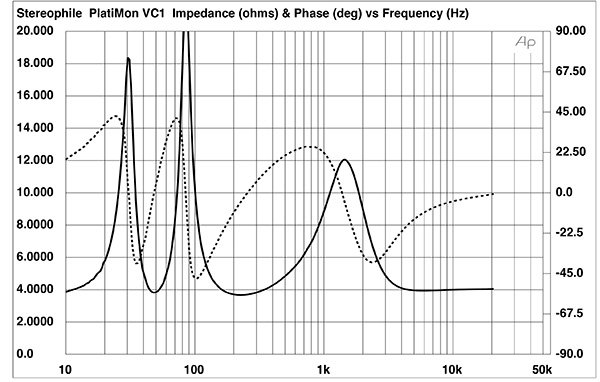
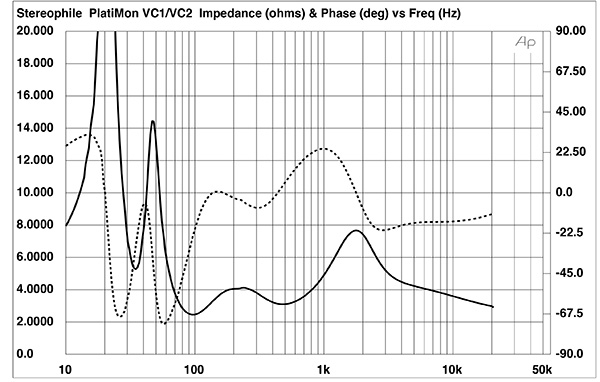
Fig.1 PlatiMon VC One, electrical impedance (solid) and phase (dashed) (2 ohms/vertical div.).
The solid trace in fig.1 shows the VC One's impedance. Specified as 4 ohms, the magnitude is higher than 4 ohms for almost all of the audioband, with a minimum value of 3.68 ohms at 230Hz. The electrical phase angle (dashed trace) is often high; as a result the effective resistance, or EPDR (footnote 1), drops below 3 ohms in several regions. The minimum EPDR values are 2.1 ohms at 40Hz and 57Hz, 1.83 ohms at 135Hz, and 1.9 ohms at 3.16kHz. The VC One is a demanding amplifier load. The saddle centered at 48Hz in the solid trace indicates that this is the reflex tuning frequency of the two ports on the VC One's rear panel.
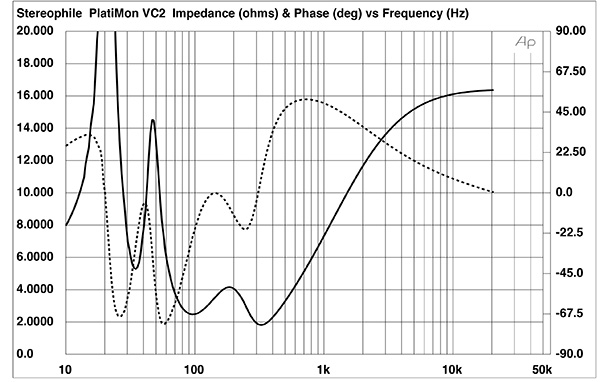
Fig.2 PlatiMon VC Two, electrical impedance (solid) and phase (dashed) (2 ohms/vertical div.).
Fig.2 shows the impedance magnitude and electrical phase angle for the VC Two alone, with both ports open and the supertweeter turned off with the knob on the enclosure's rear panel. The minimum impedance is 1.82 ohms at 322Hz. The saddle centered at 35Hz in the magnitude trace suggests that this is the tuning frequency of the two ports. I haven't calculated how the VC Two's EPDR changes with frequency, as this module won't be used alone.
Fig.3 PlatiMon VC One/VC Two, four-way mode, "ST" setting, electrical impedance (solid) and phase (dashed) (2 ohms/vertical div.).
The impedance magnitude and phase angle for the VC One/VC Two combination in four-way mode and SM's preferred "ST" setting are shown in fig.3. The magnitude lies below 6 ohms for most of the midrange and treble, with minimum values of 2.46 ohms at 99Hz, 3.1 ohms at 470Hz, and 2.9 ohms at 20kHz. These low impedances are exacerbated by an EPDR that lies below 3 ohms for much of the audioband and less than 1 ohm between 67Hz and 90Hz, a region where music can have high levels. The minimum EPDR values are 0.9 ohms at 78Hz, 1.9 ohms at 710Hz, and 1.9 ohms between 2.6kHz and 20kHz. The PlatiMon system is one of the most current-hungry loads I have measured.
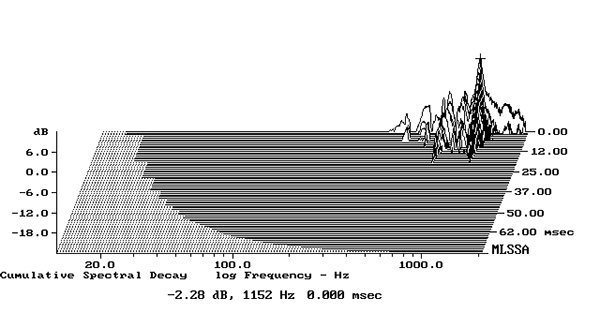
Fig.4 PlatiMon VC One, cumulative spectral decay plot calculated from the output of an accelerometer fastened to the rear panel below the ports. (MLS driving voltage to speaker, 7.55V; measurement bandwidth, 2kHz.).
Both enclosures seemed inert. When I rapped the surfaces with my knuckles, I heard faint "plinks," suggesting that any resonances were high in frequency. The loudest "plinks" were on the VC One's rear panel. Using a plastic-tape accelerometer, I found some resonant modes on this surface, the highest in level lying at 1152Hz (fig.4). Both the high frequency and the high Q (Quality Factor) will work against this mode having sonic consequences.
Fig.5 PlatiMon VC One, anechoic response on tweeter axis at 50", averaged across a 30° horizontal window and corrected for microphone response, with the nearfield responses of the woofers (blue), ports (red), and their complex sum (black), respectively plotted below 310Hz, 380Hz, and 310Hz.
The VC One's two woofers behaved identically, and their output had the expected minimum-motion notch at the port tuning frequency of 48Hz (fig.5, blue trace). The ports' output (red trace) peaks at the same frequency, with a clean upper-frequency rolloff disturbed by a couple of low-level peaks between 250Hz and 380Hz. The black trace below 310Hz in fig.5 shows the complex sum of the VC One's woofer and port responses, taking into account acoustic phase and the fact that the ports are on the rear panel. There is only a slight rise in the midbass region, which will be due to the nearfield measurement technique, which assumes that the drive units are mounted in a true infinite baffle (footnote 2). The woofers' tuning is somewhat overdamped.
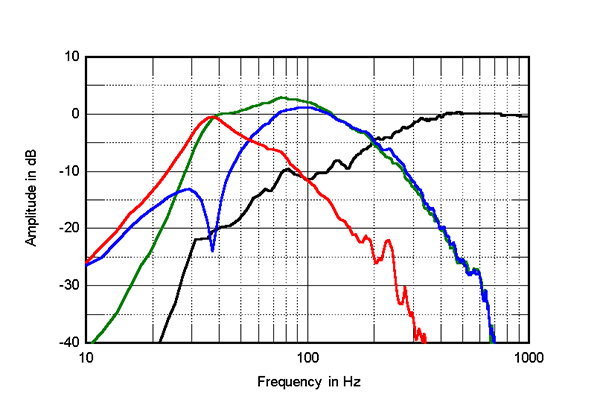
Fig.6 PlatiMon VC One/VC Two, nearfield responses of the VC Two woofer (blue), VC Two ports (red), their complex sum (green), and that of the VC One woofers and ports when fed from the VC Two (black), respectively plotted below 700Hz, 325Hz, 700Hz, and 1kHz.
Though the port on the VC Two's rear panel and the downward-firing port on the speaker's base are different sizes, their nearfield responses were identical. The sum of these responses is shown by the red trace in fig.6; it peaks at the tuning frequency of 35Hz, with a smooth upper-frequency rolloff. The blue trace in fig.6 shows the nearfield response of the VC Two's woofer. As expected, it has its minimum-motion notch, which is when the back pressure from the port resonance holds the woofer cone stationary, at 35Hz.
When I calculated the complex sum of the VC One's nearfield woofer and port responses when connected to the VC Two (fig.6, black trace), this started to roll off below 400Hz with a second-order, 12dB/octave, high-pass slope. The complex sum of the VC Two's nearfield woofer and port responses (green trace) started to roll off above 125Hz with a second-order low-pass slope. The crossover between the VC One and VC Two appears to be close to the specified 250Hz.
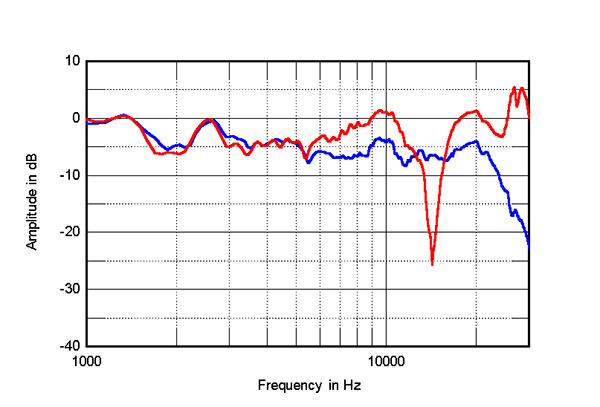
Fig.7 PlatiMon VC One/VC Two in four-way mode, anechoic response above 1kHz on tweeter axis at 50", averaged across a 30° horizontal window and corrected for microphone response, with the supertweeter turned off (blue) and with the supertweeter set to "ST" (red).
Connecting the VC Two to the VC One in four-way mode but turning the Two's supertweeter off gave the farfield response shown as the blue trace in fig.7. (The response in 3.5-way mode was similar other than a broad peak centered on 13kHz and an output that extended above 30kHz.) Other than the rolloff above 10kHz, the four-way combination's response is similar to that of the VC One alone (fig.5, black trace above 1kHz). However, when I set the supertweeter to "ST," a 5dB peak between 7kHz and 12kHz appeared, followed by a deep suckout centered on 16.5kHz and a 10dB peak above 25kHz (fig.7, red trace; footnote 3).
The specifications and the manual state that the VC Two's 1" supertweeter extends the system's response above 25kHz. While this ultrasonic extension is correct, the supertweeter's response in four-way mode rises above 5kHz. Its output therefore overlaps that of the VC One's AMT tweeter. The VC Two's supertweeter and the VC One's tweeter are separated on the front baffles by 14", with the VC One sitting on top of the VC Two. The result is a combination of constructive and destructive interference in the treble. I haven't shown the four-way MonAcoustic speaker's radiation pattern in the vertical plane, therefore, as it is very difficult to interpret. Basically, however, the interference between the tweeter and the supertweeter results in peaks and suckouts in the treble, the frequencies and sizes of which will depend on the axis on which I measured the response. The smoothest high-frequency response was that 5° below the tweeter axis, which is on the low side for a seated listener.
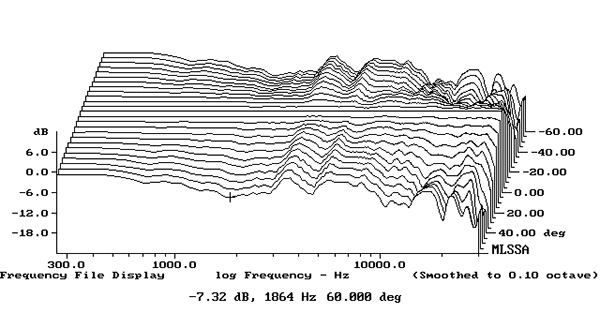
Fig.8 PlatiMon VC One/VC Two, supertweeter turned off, lateral response family at 50", normalized to response on tweeter axis, from back to front: differences in response 60–5° off axis, reference response, differences in response 5–60° off axis.
Because of the interference between the high-frequency drive units, I examined the VC One/VC Two's horizontal dispersion in four-way mode with the supertweeter turned off. The traces in fig.8 are normalized to the response on the tweeter axis, which thus appears as a straight line. While the dispersion narrows in the top two octaves, the radiation pattern is generally even, which correlates with stable stereo imaging, though there is a lack of energy to the speaker's sides at the top of the woofers' passband.
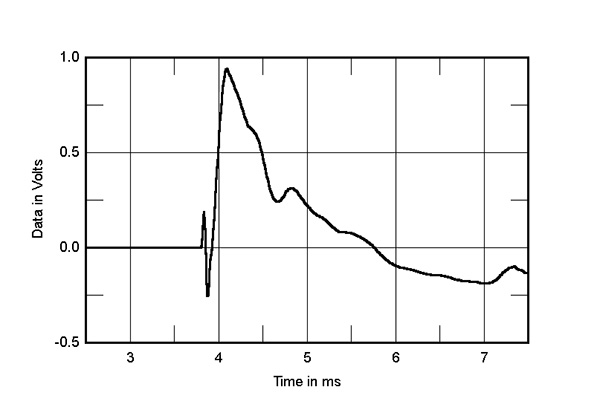
Fig.9 PlatiMon VC One, step response on tweeter axis at 50" (5ms time window, 30kHz bandwidth).
In the time domain, the PlatiMon VC One's step response on the tweeter axis (fig.9) indicates that the tweeter and woofers are connected in positive acoustic polarity. The tweeter's output arrives first at the microphone, followed by that of the woofers. The decay of each drive unit's step smoothly blends with the start of the step of the next one lower in frequency, which implies an optimal crossover implementation. However, there is a small reflection 1ms after the initial arrival of the speaker's output at the microphone.
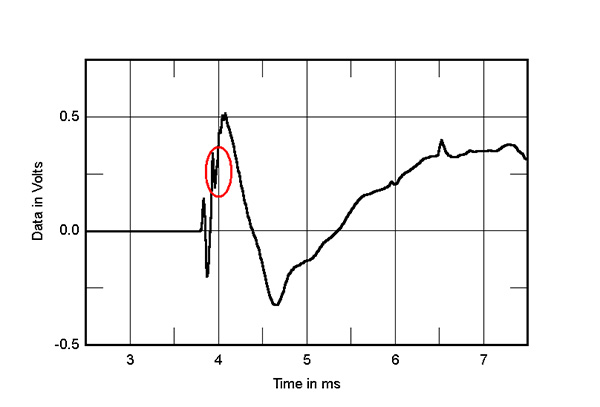
Fig.10 PlatiMon VC One/VC Two in four-way mode, "ST" setting, step response on tweeter axis at 50" (5ms time window, 30kHz bandwidth).
This reflection was absent when I examined the VC One/VC Two's step response in four-way mode with the "ST" setting (fig.10). However, you can now see the supertweeter's positive-polarity step (circled in red) interfering with the start of the VC One woofer's step. In addition, there is now a reflection 2.75ms after the initial arrival. I suspect that this is due to the supertweeter's output reflecting off the floor between the loudspeaker system and the microphone. (I windowed out this reflection to create the traces shown in fig.7.)
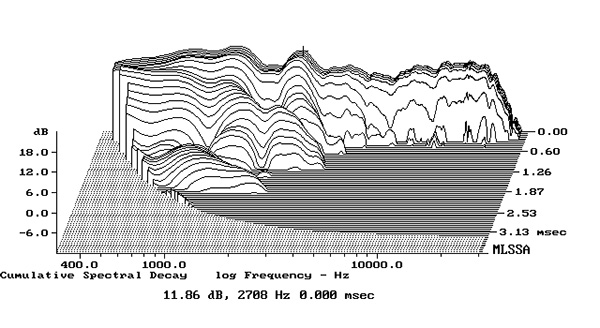
Fig.11 PlatiMon VC One/VC Two in four-way mode with supertweeter off, cumulative spectral-decay plot on tweeter axis at 50" (0.15ms risetime).
Because the VC One/VC Two's cumulative spectral-decay, or waterfall, plot in four-way mode was corrupted by the supertweeter's output, I calculated it with the supertweeter turned off (fig.11). Other than a ridge of delayed energy at 2.8kHz, it is clean overall.
Footnote 1: EPDR is the resistive load that gives rise to the same peak dissipation in an amplifier's output devices as the loudspeaker. See "Audio Power Amplifiers for Loudspeaker Loads," JAES, Vol.42 No.9, September 1994, and stereophile.com/reference/707heavy/index.html. Footnote 2: This means that the loudspeaker is firing into hemispherical space rather than a full sphere. A speaker that has a truly flat response in the usual "4pi" space will therefore appear to have a boosted upper-bass output with a nearfield measurement, the center frequency of that boost depending on the physical dimensions of the speaker and the woofer alignment. See this explanation or aes2.org/publications/elibrary-page/?id=7171.