Sidebar 3: Measurements
I measured the Mojo Mystique X SE with my Audio Precision SYS2722 system after leaving the processor decoding AES3 data for several hours to make sure it was fully warmed up. A slide switch on the processor's back panel lifts the DC ground from the AC, chassis, and Earth grounds. The manual recommends lifting the DC ground; it also says that most people prefer the single-ended analog output. So I performed a complete set of tests using AES3 data with these outputs with the DC ground lifted. I repeated some tests with the balanced outputs, with USB and coaxial S/PDIF inputs, and with the ground connected.
The AES3 and coaxial S/PDIF inputs locked to datastreams sampled at all rates up to 192kHz. Another slide switch above the USB port, labeled "USB Lift," is claimed to remove "all internal clocking noise" from inside of the DAC's chassis with USB data. This switch was set to Off when I unboxed the Mystique X. However, when I slid this switch to the recommended Lift position, neither my MacBook Pro nor my Mac mini recognized the Mojo DAC. I therefore left the switch in the Off position. Apple's USB Prober app then identified the Mystique X as "JLsounds Hi-Rez Audio 2.0" from "JLsounds" and revealed that the USB port operated in the optimal isochronous asynchronous mode. Apple's AudioMIDI utility showed that the Mystique accepted 16- and 32-bit integer data sampled at all rates from 44.1kHz to 768kHz via USB.
The maximum level from the Mystique X's outputs was 4.54V from the balanced output and 2.1V from the single-ended output. (The specified levels are a little higher, at 5V and 2.5V, respectively.) The output impedances were very low, at 51 ohms, balanced, and 75 ohms, unbalanced. Both types of output preserved absolute polarity.
The Mystique X's measured performance was disappointing, though it is probable that the problems I found will be least audible with 16/44.1 data. (Mojo does say in the product's manual that "16-bit 44.1kHz music files played from a high-performance CD transport will have better time, tune, tone, timbre, and harmonic coherency than any MQA, SACD, DSD, or whatever resolution or format music file streamed or played from computer audio.") Even so, I feel the limited resolution, coupled with the high positive linearity error at low levels, is a matter for concern.—John Atkinson
Footnote 1: For textbook behavior with 16- and 24-bit versions of this undithered signal, see figs.9 & 10 here.
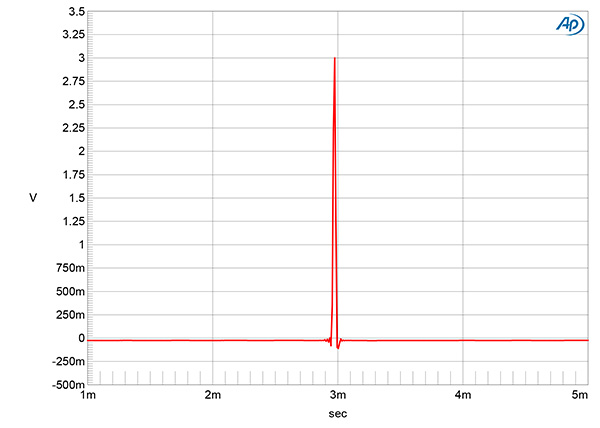
Fig.1 Mojo Mystique X, impulse response (one sample at 0dBFS, 44.1kHz sampling, 4ms time window).
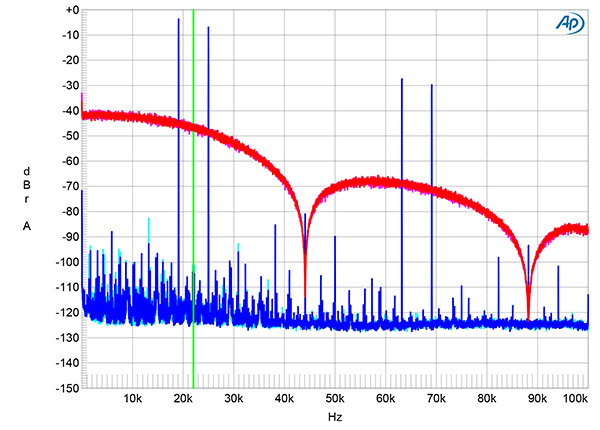
Fig.2 Mojo Mystique X, wideband spectrum of white noise at –4dBFS (left channel red, right magenta) and 19.1kHz tone at 0dBFS (left blue, right cyan) into 100k ohms with data sampled at 44.1kHz (20dB/vertical div.).
Fig.1 shows the Mystique X's impulse response with 44.1kHz data. There is no Nyquist-frequency ringing either before or after the single full-scale sample, which indicates that the DAC doesn't use a reconstruction filter. With 44.1kHz white-noise data, the Mojo's output rolls off very slowly above the audioband, with nulls at each integer multiple of the sample rate (fig.2, magenta and red traces). Accordingly, with a 19.1kHz tone at 0dBFS (cyan, blue), the aliased image at 25kHz is only suppressed by about 6dB, and other aliased images can be seen at 63.2kHz (44.1+19.1) and 69.1kHz (88.2–19.1). The harmonics associated with the 19.1kHz tone are all low in level, however, with the second harmonic the highest, at –84dB (0.006%).
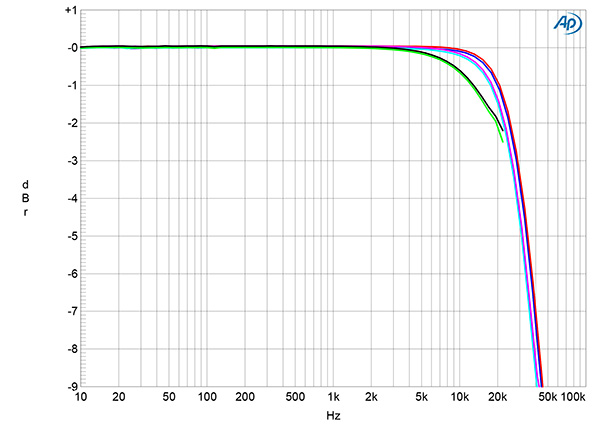
Fig.3 Mojo Mystique X, frequency response at –12dBFS into 100k ohms with data sampled at: 44.1kHz (left channel green, right gray), 96kHz (left cyan, right magenta), and 192kHz (left blue, right red) (1dB/vertical div.).
The Mojo's frequency response with data sampled at 44.1, 96, and 192kHz is shown in fig.3. The 44.1k response (green and gray traces) starts to roll off below 20kHz, reaching –0.6dB at 10kHz and –2dB at 20kHz. With higher sample-rate data, the response is flat to 10kHz with then a gentle rolloff, reaching –1dB at 20kHz and –3dB at 30kHz. Note that the response with 192kHz data (blue, red trace) extends only slightly higher than with 96kHz data (cyan, magenta).
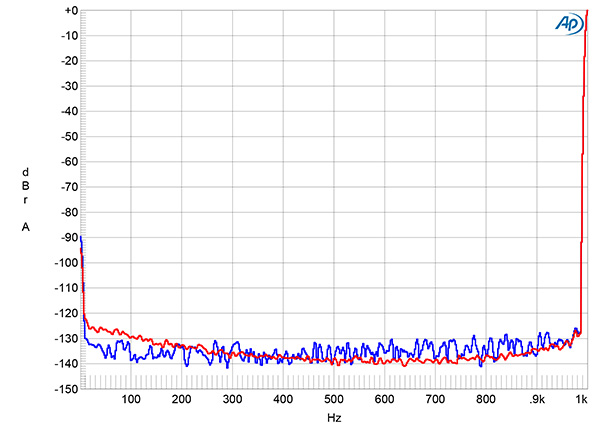
Fig.4 Mojo Mystique X, spectrum with noise and spuriae of dithered 1kHz tone at 0dBFS with 24-bit data (left blue, right red) (20dB/vertical div.).
Channel separation (not shown) was excellent, at >100dB in both directions below 1kHz, falling to a still good 86dB at the top of the audioband. The low-frequency noisefloor with the DC ground lifted (fig.4) was free from any power supply–related spuriae, and random noise was very low in level. However, ultrasonic noise with a center frequency of 940kHz was present, with levels of 32.5mV in the left channel and 26mV in the right. Neither the level of this noise nor that of the audioband noise was affected by setting the rear-panel switch to Ground or lifting the USB port's ground.
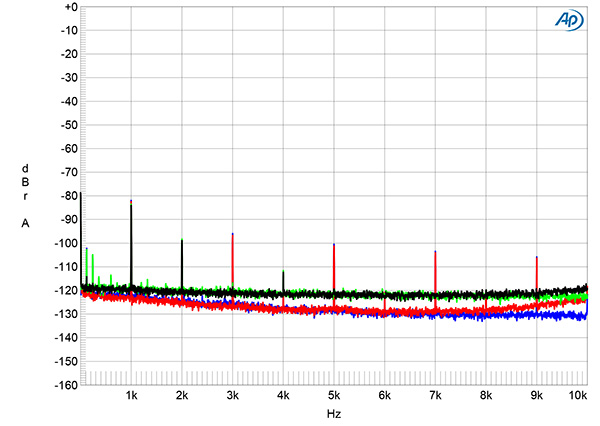
Fig.5 Mojo Mystique X, spectrum with noise and spuriae of dithered 1kHz tone at –90dBFS with: 16-bit data (left channel green, right gray), 24-bit data (left blue, right red) (20dB/vertical div.).
I estimate a D/A processor's resolution by examining how much the noisefloor drops in level when I increase the word length from 16 bits to 24 bits with dithered data representing a 1kHz tone at –90dBFS. With 16-bit data, the noisefloor is actually that of the LSB-level dither; with 24-bit data, the noisefloor is that of the DAC chip. With both 16-bit data (fig.5, green and gray traces) and 24-bit data (blue, red), the tone was reconstructed almost 9dB too high in level. The increase in bit depth from 16 to 24 dropped the Mystique X's noisefloor by just 6dB, and then only in the mid-treble region. This indicates that the Mojo's real-world resolution is about 16 bits below 1kHz and 17 bits above about 4kHz.
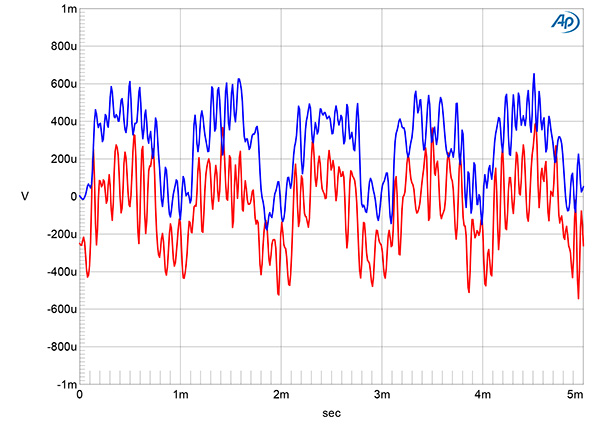
Fig.6 Mojo Mystique X, waveform of undithered 1kHz sinewave at –90.31dBFS, 24-bit data (left channel blue, right red).
You can see in fig.5 that while second and fourth harmonics are present with the 16-bit tone, the spectrum of the 24-bit tone has peaks at 3kHz, 5kHz, 7kHz, and 9kHz. The presence of these odd-order harmonics is due to truncation of the least-significant bits with 24-bit data, something I first observed more than 30 years ago. This was confirmed by the fact that the waveform of an undithered 24-bit tone, at exactly –90.31dBFS (fig.6), was identical to that of the undithered 16-bit tone, with just three voltage levels visible rather than the expected sinewave and with some asymmetry (footnote 1).
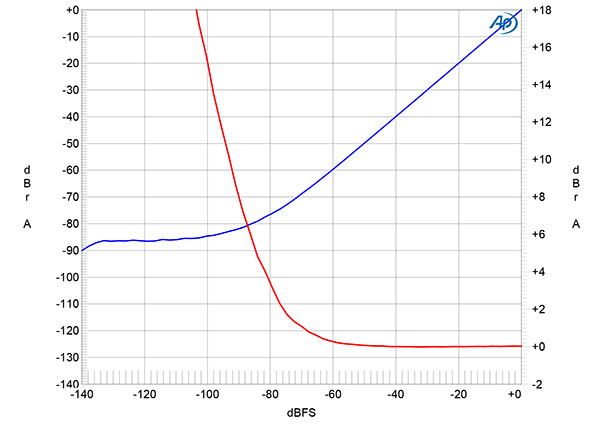
Fig.7 Mojo Mystique X, left channel, 1kHz output level vs 24-bit data level in dBFS (blue, 20dB/vertical div.); linearity error (red, 2dB/small vertical div.).
The red trace in fig.7 shows the error in the output level of the Mystique's DAC as the level of a 24-bit, 1kHz signal steps down from 0dBFS to –140dBFS. The output starts to become too high in level around –60dBFS, with a tone at –70dBFS reproduced at –69dBFS, a tone at –80dBFS reproduced at –76dBFS, and a tone at –90dBFS reproduced at –82dBFS. This graph was taken with the left channel; the right channel behaved identically.
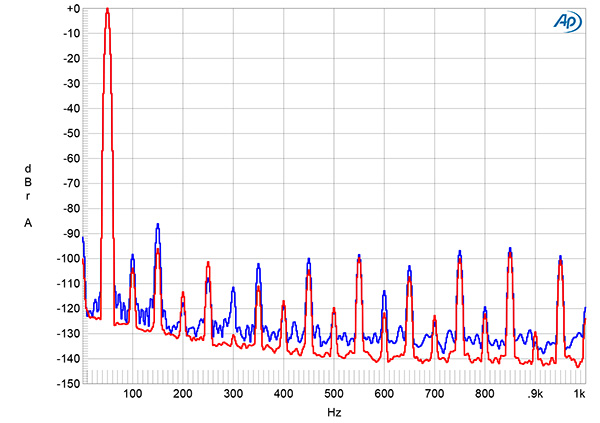
Fig.8 Mojo Mystique X, 24-bit data, spectrum of 50Hz sinewave, DC–1kHz, at 0dBFS into 100k ohms (left channel blue, right red; linear frequency scale).
The Mystique X's output featured a low level of harmonic distortion. With a full-scale 50Hz tone (fig.8), the third harmonic was the highest in level, at –87dB (0.009%) in the left channel and –96dB (0.0015%) in the right. However, a large number of higher-order harmonics can be seen in both channels. While these all lie close to –100dB, their presence suggests that something somewhere in the circuit is suboptimal. The levels of the distortion harmonics were not affected when I replaced the high 100k ohm load with the more difficult 600 ohms.
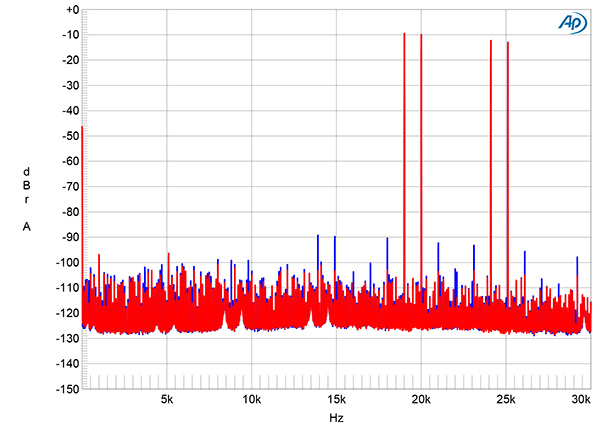
Fig.9 Mojo Mystique X, 24-bit data sampled at 44.1kHz, HF intermodulation spectrum, DC–30kHz, 19+20kHz at 0dBFS into 100k ohms (left channel blue, right red; linear frequency scale).
The intermodulation distortion products with an equal mix of 19 and 20kHz tones sampled at 44.1kHz, the signal peaking at 0dBFS, were all low in level (fig.9). As expected from fig.2, however, the aliased images of the primary tones were very high in level, and the audioband noisefloor was muddied by low-level images. Repeating this analysis with the same signal sampled at 96kHz (not shown), the high-level images at 24.1kHz and 25.1kHz disappeared as expected, though a large number of low-level aliased products were still present in the audioband, these spaced at 1kHz intervals. This behavior was not affected, at either sample rate, by reducing the signal level by 3dB.
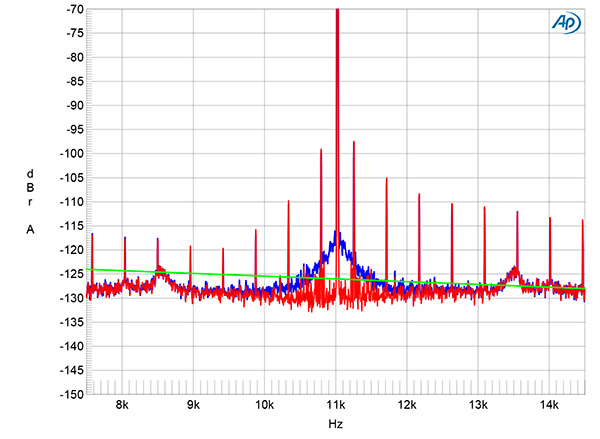
Fig.10 Mojo Mystique X, high-resolution jitter spectrum of analog output signal, 11.025kHz at –6dBFS, sampled at 44.1kHz with LSB toggled at 229Hz: 16-bit AES3 data (left channel blue, right red). Center frequency of trace, 11.025kHz; frequency range, ±3.5kHz.
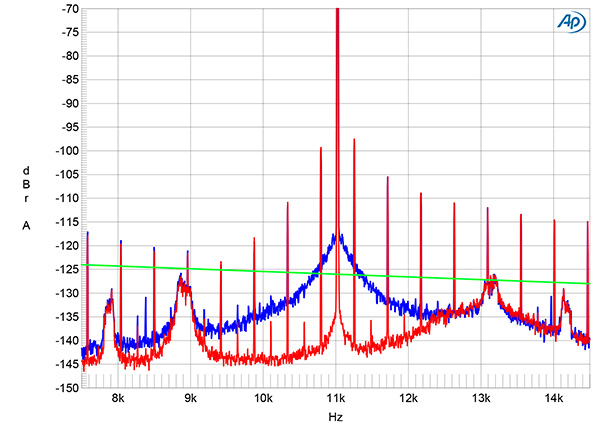
Fig.11 Mojo Mystique X, high-resolution jitter spectrum of analog output signal, 11.025kHz at –6dBFS, sampled at 44.1kHz with LSB toggled at 229Hz: 16-bit USB data (left channel blue, right red). Center frequency of trace, 11.025kHz; frequency range, ±3.5kHz.
Fig.10 shows the spectrum of the Mystique X's output when its AES3 input was fed high-level, undithered, 16-bit J-Test data. The odd-order harmonics of the undithered low-frequency LSB-level squarewave all lie higher than the correct levels, these indicaed by the sloping green line. This is especially the case with the sideband pairs closest to the frequency of the high-level tone at one-quarter the sample rate. Examining the USB port's jitter rejection with J-Test data is not diagnostic, as the word clock is not embedded in the datastream. Nevertheless, repeating the spectral analysis with 16-bit USB data (fig.11) gave a result similar to what I found with AES3 and coaxial S/PDIF data, although the level of random noise was lower, particularly in the right channel (red trace).
Footnote 1: For textbook behavior with 16- and 24-bit versions of this undithered signal, see figs.9 & 10 here.