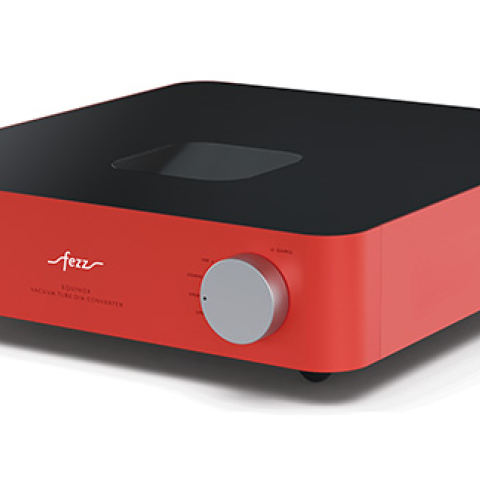
John Atkinson wrote about the Mojo Mystique X SE in May 2023 (Vol.46 No.5):
Herb Reichert reviewed the Mojo Mystique X SE very favorably in Stereophile's April 2023 issue (footnote 1). While he found that the dCS Bartók DAC made piano recordings sound crisper and more dramatic, "sounding bigger, tighter, and more forceful through the piano's left-hand octaves" than they did through the Mystique X SE, "Mojo's Mystique X SE ... disappeared from my listening awareness more than any DAC I'd previously encountered." He concluded that this nonoversampling (NOS) D/A processor "produced a unique, sophisticated listening experience that presented digital recordings as beautiful, probing, and engaging."
In my measurements, I found that while the Mojo processor offered low levels of harmonic and intermodulation distortion and good channel separation, those characteristics were paired with relatively high levels of jitter-related artifacts through all three digital inputs—AES3, coaxial S/PDIF, and USB—and its resolution was limited to about 16 bits below 1kHz and 17 bits above about 4kHz. In addition, the vintage, 20-bit Analog Devices AD1862 DAC chips the Mojo uses (footnote 2) demonstrated high linearity error at low levels, as a result of which a dithered tone at –90dBFS was reproduced almost 10dB too high in level. I wondered whether this behavior correlated with something Herb wrote in his review: that the Mojo "made piano tones glow and whisper, how all the little quiet notes—ones I don't usually hear—got through, letting me enjoy their unique expressiveness and admire them individually."
I concluded my measurements report by writing, "The Mystique X's measured performance was disappointing, though it is probable that the problems I found will be least audible with 16/44.1 data. ... Even so, I feel the limited resolution, coupled with the high positive linearity error at low levels, is a matter for concern."
Given the conflict between the auditioning comments and the measured behavior, once Herb's review had been prepared for publication, Editor-in-Chief Jim Austin proposed that I write a follow-up review. "This DAC does raise the issue of measured vs subjective performance quite acutely," he wrote, "so I'd be very interested in your subjective observations in the light of your measurements." Initially I demurred, concerned that my experience with the measurements would influence my listening. But Jim argued that I should honestly test my expectations against what I heard. I therefore agreed to do a follow-up.
As Herb Reichert had exclusively used the USB output of his Roon Nucleus+ server as the source for his review, I connected the USB output from my Nucleus+ to the Mojo via an AudioQuest JitterBug FMJ and an AudioQuest Coffee USB cable. (Roon recognized the Mystique as an ALSA device.) I used the Mojo's balanced outputs, connecting them to a pair of Parasound Halo JC 1+ monoblock amplifiers via an NHT passive balanced volume control. Loudspeakers were my usual KEF LS50s.
For reference, I used the Benchmark DAC3 B ($1799) I reviewed in the March 2023 issue, this also connected to the Roon server's USB output, and the MBL N31 ($18,680 with Roon Ready module), which was fed audio data over my network. The output levels of all three D/A processors were matched to within 0.5dB with the 1kHz, –20dBFS warble tone from Stereophile's Editor's Choice CD, using the NHT control for the Benchmark and Mojo DACs and Roon's volume control for the MBL.
I used the Mojo for a few days of casual listening before starting my critical auditioning in order to get comfortable with its presentation. I didn't notice anything immediately questionable about the Mystique's sound quality; the tonal balance was warm, and there was nothing fatiguing about the treble. But when I compared it with the more expensive MBL processor, I found that female voices were projected forward in the soundstage via the Mojo and were perhaps a touch coarse-sounding. This was noticeable with two sparsely scored tracks that Roon Radio had selected, Cassandra Wilson's "No More Blues" (from Another Country, 16/44.1 FLAC, eOne Music/Tidal) and Christy Baron's "Will It Go 'Round In Circles?" (from Steppin', 16/44.1 FLAC, Chesky/Tidal).
Similarly, the cello on Schubert's Arpeggione Sonata (16/44.1 ALAC file, ripped from The Wigmore Hall Recital, CD, DG 479 0965) sounded slightly more rosiny, a little more like a viola, than it had with the MBL N31. However, the hall ambience surrounding the image of the piano was more audible with the Mojo processing the bits than I am used to with this recording.
The Mystique's upper bass sounded warmer than the MBL's upper bass: Rob Wasserman's double bass on Jennifer Warnes's "Ballad of a Runaway Horse" (16/44.1 FLAC, from Duets, Verve/Tidal) lacked a little articulation as a result. But, as with the Schubert recording, the reverberant decay on the double bass at the end of each verse was nicely audible. Paradoxically, though, the apparent enhancement of recorded ambience didn't lead to a great sense of soundstage depth. With the late Lars Vogt performing the first Brahms Piano Concerto with the Royal Northern Sinfonia (24/48 FLAC, Ondine/Qobuz), the image of the orchestra seemed to be almost in the same plane as that of the piano. And at climaxes, when piano and orchestra were playing together, the presentation started to sound a touch congested.
This was also the case with the 24/96 master files for Sasha Matson's new album Molto Molto (Stereophile STPH023-2). Congestion set in on climaxes, like that at the end of the third movement of Symphony 3. Again, soundstage depth was restricted even though the reverb on the piano was a little more noticeable than I usually hear.
Comparing the Mojo Mystique with the less-expensive Benchmark DAC3 B, both fed USB data, the Benchmark had a better sense of drive and low-frequency impact as well as excellent clarity and transparency. The close-balanced piano on David Chesky's The Great European Songbook (DSD64, played natively with the Benchmark, transcoded by Roon to 24/176.4 PCM with the Mojo, The Audiophile Society) sounded more uneven with the Mystique, with some notes jumping forward a little more than they did with the Benchmark and Billy Drummond's cymbals positioned closer behind the piano. But the double bass had better upper-bass weight with the Mojo, providing a solid foundation for David Chesky's improvisations.
The DAC3 B's low-frequency balance was lighter than that of the Mystique, making me wish I was still using the Dirac low-frequency EQ I had used with the LS50s for my review of the NAD C 3050 SE in the April issue. I didn't feel I needed to boost the KEFs' lows with the Mojo DAC. However, the occasional sense of congestion that I heard on orchestral climaxes with the Mystique was absent with the DAC3 B.
Overall, with USB data, the Mojo processor did better with simple mixes—female voice and backing, for example—or solo piano than it did with complex orchestral recordings. It stepped out of the way most successfully with solo piano, such as Lars Vogt's performance of the Op.10 Ballades on the Brahms concerto album.
The Mystique's manual says that "16-bit 44.1kHz music files played from a high-performance CD transport will have better time, tune, tone, timbre, and harmonic coherency than any MQA, SACD, DSD, or whatever resolution or format music file streamed or played from computer audio." Also, Mojo's Benjamin Zwickel wrote in an email to Jim Austin, "My 'less is more' design allows you to fully appreciate the benefits of more advanced clocking in your external digital source. This is why my current reference is the Jay's Audio CDT3-MK3 CD transport set to 176.4kHz upsampling (it only reads 16/44.1 discs), with its advanced OCXO clock reputed to have residual jitter of 1ps (undetectable by most test equipment)."
As coincidence would have it, I had the Jay's Audio CD transport ($4998) in house to examine its measured performance; see Michael Trei's review on p.89 of this issue. I connected the Jay's AES3 output, set to upsample CD data to 176.4kHz, to the Mystique and played the Sasha Matson Molto Molto CD. Without adjusting the volume, there was an immediately audible improvement compared with the 24/96 data fed to the Mojo's USB input. The congestion at orchestral climaxes I noticed with the USB data was noticeably absent, and the cello on the Arpeggione Sonata recording didn't sound as rosiny when played back from CD. The imaging with the CD played back with 4× upsampling was holographic.
Listening to the Molto Molto CD with the transport set to output a 44.1kHz datastream, there was a little less sense of air around the solo instruments, and the cymbals seemed less precisely defined in space at the CD's native sample rate. I repeated the auditioning with the Jay's Audio transport into the Benchmark DAC3 B and noted the same difference between the two sample rates.
Jitter Measurements
Intrigued by the improved sound quality I noted with the Jay's Audio transport, I examined the effect of datastream jitter on the Mystique's analog outputs using my Audio Precision SYS2722 system. I wrote an article for Stereophile in 2009 on how I measure the effects of jitter. I feed the device being tested undithered J-Test data, which represents a high-level tone with a frequency equivalent to one-quarter the sample rate, over which is superimposed an LSB-level squarewave with a frequency of the sample rate divided by 192. This signal was developed by the late Julian Dunn of PrismSound and Paul Miller (footnote 3), and because both test signals are exact even-integer fractions of the sample rate, there is no quantizing noise or distortion. Any spuriae that appear in the decoded analog noisefloor are due to the behavior of the device under test.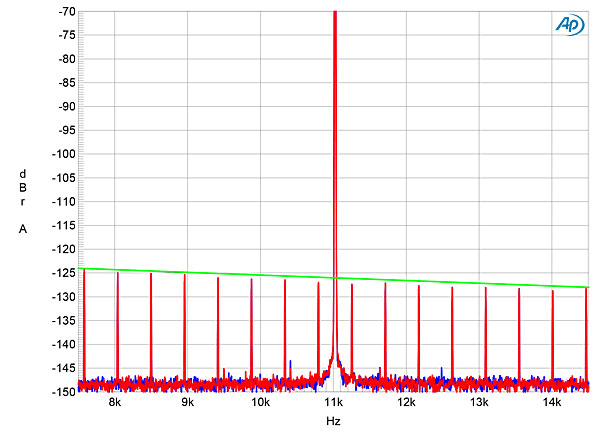

Summing up
Its pleasantly warm tonal balance notwithstanding, overall I was disappointed with the sound quality of the Mystique X SE when it was used with USB data played with Roon, which HR used for his very positive review. But my auditioning confirmed the recommendation from Mojo's Benjamin Zwickel: that CDs are best played with the Jay's Audio CDT3-MK3 CD transport set to 176.4kHz upsampling. This extracted the best sound from the Mystique and the most optimal measurements. But at $14,997 for the pair, this is a high price to pay for good CD sound, particularly as the Rotel DT-6000 CD player, which offers state-of-the-art measurements from CDs, and which HR enthusiastically recommended in his March 2023 Gramophone Dreams column, costs $2300.—John Atkinson
Footnote 1: The Mystique costs $9999 as reviewed. (The non-SE version costs $7999.) Mojo Audio, 12941 Marva Place SE, Albuquerque, NM 87123. Tel: (949) 438-6656. Web: mojo-audio.com. Footnote 2: The datasheet for the Analog Devices AD1862 chip can be downloaded here. Note that as well as the datasheet's pages being overprinted with the word "obsolete," it mentions that an external midscale adjustment can be performed to improve distortion performance with small and very small signal amplitudes (–60dB and lower). It is possible that this adjustment had not been made with the review sample's DAC chips.
Footnote 3: In addition to being editor of Hi-Fi News and Stereophile's editorial director, Miller is a designer of measurement equipment and the founder of Miller Audio Research.
Footnote 4: See the measurements report on the Jay's Audio transport on p.91 of this issue.
Intrigued by the improved sound quality I noted with the Jay's Audio transport, I examined the effect of datastream jitter on the Mystique's analog outputs using my Audio Precision SYS2722 system. I wrote an article for Stereophile in 2009 on how I measure the effects of jitter. I feed the device being tested undithered J-Test data, which represents a high-level tone with a frequency equivalent to one-quarter the sample rate, over which is superimposed an LSB-level squarewave with a frequency of the sample rate divided by 192. This signal was developed by the late Julian Dunn of PrismSound and Paul Miller (footnote 3), and because both test signals are exact even-integer fractions of the sample rate, there is no quantizing noise or distortion. Any spuriae that appear in the decoded analog noisefloor are due to the behavior of the device under test.
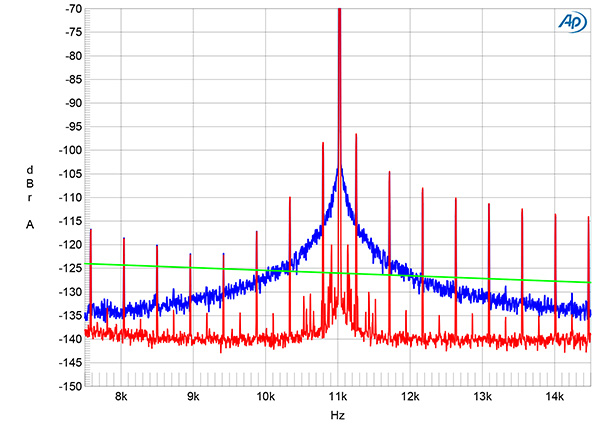
Fig.1 Benchmark DAC3 HGC, high-resolution jitter spectrum of analog output signal, 11.025kHz at –6dBFS, sampled at 44.1kHz with LSB toggled at 229.6875Hz: 16-bit USB data (left channel blue, right red). Center frequency of trace, 11.025kHz; frequency range, ±3.5kHz.
Although the J-Test is not diagnostic for USB data, where the clock is not embedded in the datastream, I still find it useful. Fig.1 shows the spectrum of a D/A processor that does well on this test when fed 16-bit, 44.1kHz J-Test data via USB. The spectral spike that represents the high-level tone is cleanly defined, the odd-order harmonics of the undithered low-frequency, LSB-level squarewave all lie at the correct levels, these indicated by the sloping green line, and the noisefloor between the harmonics is extremely low in level.
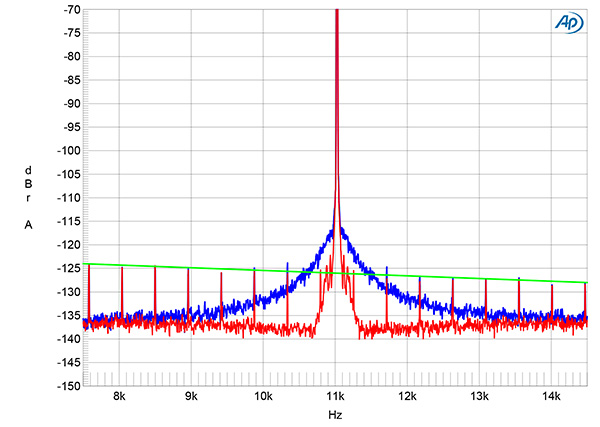
Fig.2 Mojo Mystique X, high-resolution jitter spectrum of analog output signal, 11.025kHz at –6dBFS, sampled at 44.1kHz with LSB toggled at 229.6875Hz: 16-bit USB data (left channel blue, right red). Center frequency of trace, 11.025kHz; frequency range, ±3.5kHz.
By contrast, fig.2 shows the spectrum of the Mystique X's output when its USB input was fed the same J-Test data. (This test was performed with the Mojo's balanced outputs, which performed slightly better with the J-Test signal than the single-ended outputs, which I had used for fig.11 in the original review's measurements.) The odd-order harmonics of the undithered low-frequency, LSB-level squarewave all lie higher than the correct levels, and the level of random noise is higher than in fig.1, particularly in the left channel (blue trace).
Fig.3 Mojo Mystique X, high-resolution jitter spectrum of analog output signal, 11.025kHz at –6dBFS, sampled at 44.1kHz with LSB toggled at 229.6875Hz: 16-bit AES3 data from Jay's Audio CDT3 Mk3 upsampled to 176.4kHz (left channel blue, right red). Center frequency of trace, 11.025kHz; frequency range, ±3.5kHz.
Fig.4 Mojo Mystique X, high-resolution jitter spectrum of analog output signal, 11.025kHz at –6dBFS, sampled at 44.1kHz with LSB toggled at 229.6875Hz: 16-bit AES3 data from Jay's Audio CDT3 Mk3 (left channel blue, right red). Center frequency of trace, 11.025kHz; frequency range, ±3.5kHz.
Feeding 16-bit J-Test data from the Jay's Audio CDT3-MK3, upsampled to 24/176.4, to the Mystique X's AES3 input gave the spectrum shown in fig.3. While the level of random noise in the left channel is mostly identical to that with USB data, the right channel's spectrum is significantly cleaner, and in both channels the harmonics of the low-frequency squarewave are very close to the correct levels. Repeating this analysis without upsampling gave an interesting result (fig.4), revealing that the Jay's Audio transport dithers its digital output at the LSB level with this setting (footnote 4). There are now equal levels of random noise in both channels, these levels equivalent to 15 bits of resolution, and the squarewave's harmonics are almost all masked by this noise.
It is impossible to directly correlate these spectra with sound quality, but they do confirm that other than the linearity error, the Mojo Mystique X performs significantly better with upsampled AES3 data than it does with USB data.
Its pleasantly warm tonal balance notwithstanding, overall I was disappointed with the sound quality of the Mystique X SE when it was used with USB data played with Roon, which HR used for his very positive review. But my auditioning confirmed the recommendation from Mojo's Benjamin Zwickel: that CDs are best played with the Jay's Audio CDT3-MK3 CD transport set to 176.4kHz upsampling. This extracted the best sound from the Mystique and the most optimal measurements. But at $14,997 for the pair, this is a high price to pay for good CD sound, particularly as the Rotel DT-6000 CD player, which offers state-of-the-art measurements from CDs, and which HR enthusiastically recommended in his March 2023 Gramophone Dreams column, costs $2300.—John Atkinson
Footnote 1: The Mystique costs $9999 as reviewed. (The non-SE version costs $7999.) Mojo Audio, 12941 Marva Place SE, Albuquerque, NM 87123. Tel: (949) 438-6656. Web: mojo-audio.com. Footnote 2: The datasheet for the Analog Devices AD1862 chip can be downloaded here. Note that as well as the datasheet's pages being overprinted with the word "obsolete," it mentions that an external midscale adjustment can be performed to improve distortion performance with small and very small signal amplitudes (–60dB and lower). It is possible that this adjustment had not been made with the review sample's DAC chips.