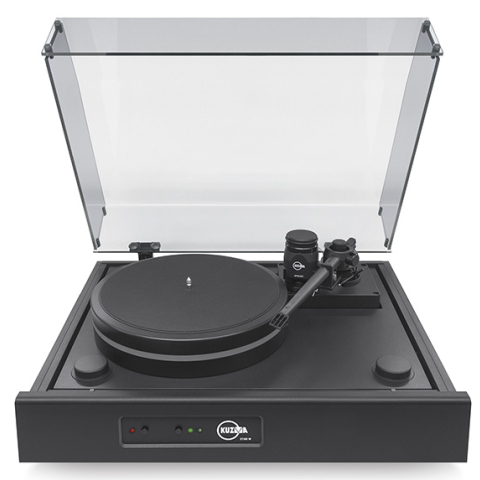
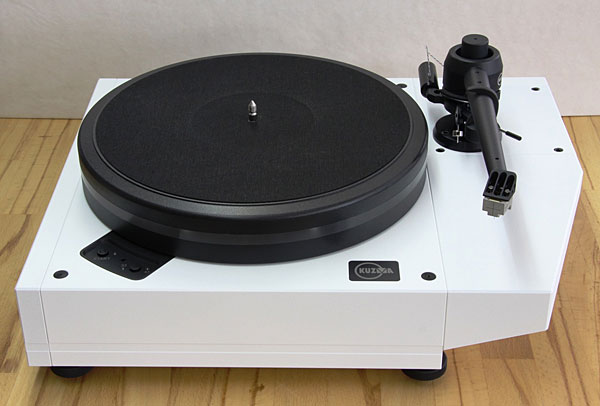
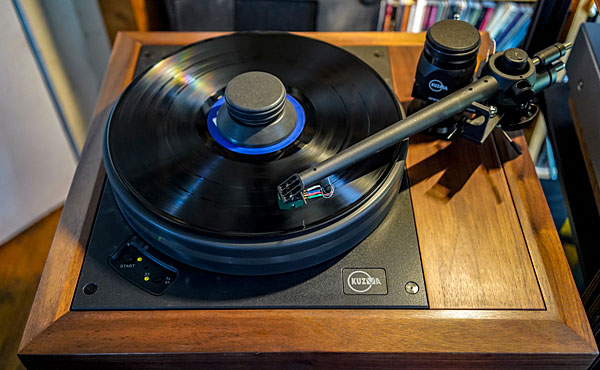
I set about navigating the somewhat confusing manual, apparently written for the base Stabi R model and its single detachable aluminum wing. I had to read between the lines to reconcile the instructions with my walnut-framed review sample and its somewhat different armboard arrangement. (Different versions of a new turntable design deserve different, dedicated manuals.)
Once that was sorted, the remaining instructions were clear: Add oil to the bearing well and bearing shaft, and lower the subplatter, with its dunce-hat-shaped hub, onto that shaft; position the belt around the motor pulley and the subplatter rim; lower the platter onto the subplatter; connect the internal power source via the supplied power cord; familiarize yourself with the turntable's rear panel on/off switch and top-panel Start and 33 and 45rpm buttons.
Setting up the Kuzma 4Point tonearm was relatively easy. Supplied with the arm is a flat plastic installation template, used for setting the correct spindle-to-pivot distance—but when Michael Trei came by to check the alignment of my Hana EL cartridge, he found that the arm's position was a bit off, and he used his Feickert Universal Protractor to aid in making the correction. (That's not to say the Kuzma installation template is incorrect—but in use it has a bit of give to it, requiring extra care for optimal results.) All of which points to the good news that the 4Point is eminently and easily adjustable.
I connected the arm's standard Crystal Cable output cables to the twin RCA jacks of the Luxman EQ-500 phono preamplifier, itself connected, via a pair of Triode Wire Labs Spirit II interconnects, to the Schiit Audio Ragnarok integrated amplifier. Triode Wire Labs American speaker cables connected DeVore Fidelity O/93 speakers to the Ragnarok.
Art Dudley suggested that I first try my reference Stabi/Stogi player on the new cinder-block podium, to gauge the difference the podium would bring to the overall sound of my system. Gadzooks! The massive stand brought greater dynamics, blacker backgrounds, longer decay times, larger images, and an overall weightier presentation—and served to further confirm the extraordinary value of Kuzma's pipe bomb. And now I wondered: Would the Stabi R improve upon its smaller sibling's stellar performance?
 Listening
In audio, subtle changes can have major repercussions: Individual elements of reproduced sound—imaging, soundstaging, touch, tone, drive, dynamics, presence—can have a major impact on how music affects us. As I played well-loved LPs on the combination of Stabi R turntable and 4Point tonearm, those and other elements grew in importance: the sound of a musician's lips on a horn's reed, metal brushes that stirred and drumsticks that thwacked, a snare drum's plastic head, a finger plucking a string, the proximity of vocalist to microphone . . . all became even more pronounced via the Kuzma combo. Even ambient sounds that I was previously unaware of became distinctly apparent, like illuminated brush strokes in a familiar painting.
I recently had dinner with Art Dudley and his wonderful family. Afterward, we played records. I'd heard Art's rig in his previous listening room, but in his new, dedicated space, his choice of volume setting seemed . . . well, quiet. Yet Art's Shindo-based system made mighty music and lost nothing of the recordings' vibrancy. This same ability to communicate force at lower volumes, a kind of tranquil power, found its way to my rig when joined by the Stabi R. Dynamic shifts became more profound—and as the dynamic range expanded, I no longer needed high volume levels to reveal the music's strength and presence. For a former musician who has always played music at high loudness levels, this was a stone-cold revelation/revolution.
An example: After my upstate New York minivacation, during which I drank much wine, smoked many cigars, and visited several record stores—including the Record Shoppe (Hudson), Spike's Record Rack (Catskill), Rocket Number Nine (Kingston), and John Doe (Troy)—my LP bag was heavy and my spirits were high. One vinyl find (Flying Fish HDS 701) was an album that seems to have no title beyond the names of its performers—a bluegrass supergroup that includes Norman Blake, Dave Holland, Jethro Burns, Vassar Clements, and Sam Bush. At first, I jacked the juice—but when I tried backing off the volume pot, this record sounded no less rich and powerful when played on the Stabi R: This music sounded graceful, forceful, and grooving, and the party jam continued.
The Stabi R and 4Point brought a greater sense of image focus and soundstage depth, and of musicians performing in the larger recorded space now cast before me. Record after record, leading edges of notes and the outlines of instrumental images were stronger, as was the sense of weight behind those instrumental sounds. On the minus side, also increased were surface noise, excesses of sibilance, and the other inescapable trappings of worn records and poor recordings.
Fresh revelations came at every turn. The Beatles' Please Please Me (LP, Parlophone PMC 1202) revealed all its Abbey Road secrets: the boom and echo of Ringo's drums, Lennon and McCartney's magical harmonies laid bare, Harrison's glistening guitar playing . . . all were heightened and concentrated. Those early mono Parlophone records are pure joy, and the Stabi R captured Please Please Me anew, making me smile.
A previously unknown-to-me Jimmy Smith record from 1964, The Cat (Verve MV 2065)—which, as it turns out, was recently reissued as part of Verve's Vital Vinyl series—features Lalo Schifrin's large-scale arrangements and such ringers as trumpeter Thad Jones, guitarist Kenny Burrell, and drummer Grady Tate, all recorded at Rudy Van Gelder's Englewood Cliffs studio. Not sure how they squeezed a 19-piece big band into RVG's New Jersey digs, but the music is superdynamic and BIG, defying its small-studio origins. In contrast to his intimate Blue Note organ-trio records, here Smith plays the lion tamer of the circus, the big band charts punching and soaring within a large soundstage. The Stabi R relayed every nuance, from the subtle interplay of the rhythm section to the full, brassy shouts of the horn section, all with natural dynamic ease.
 Moving in a very different musical direction, Kode9 & Burial's double LP, Fabriclive 100 (Fabric200LP), bundles such dance-music subgenres as South African gqom and Chicago footwork with '90s rave and synthpop; the Stabi R tracked this music with acute rhythmic clarity. Massive bass blobs washed over me like asphalt waves as other sounds buzzed overhead like mosquitoes. The Stabi R and 4Point reported the sonic facts without editorializing: the beat, the menace, nothing more.
After that slab of darkness and fright, I felt the need to get happy—so onto the platter went Ella Fitzgerald's Get Happy (LP, Verve VG-4036), with its swinging big-band charts by Nelson Riddle, Frank De Vol, and Russell Garcia. This is 1959 party music, Sinatra-style but infused with Fitzgerald's trademark verve and sparkling vocals. The Stabi R punched out these skyscraper-scaled big band arrangements with ease—and I've heard no other turntable play this music with such rhythmic and melodic steadiness. On this record in particular, it also seemed to me the Kuzma combo's extraordinary detail retrieval and the Hana cartridge's smoothness were a good fit: system synergy at its finest.
Conclusion
Moving in a very different musical direction, Kode9 & Burial's double LP, Fabriclive 100 (Fabric200LP), bundles such dance-music subgenres as South African gqom and Chicago footwork with '90s rave and synthpop; the Stabi R tracked this music with acute rhythmic clarity. Massive bass blobs washed over me like asphalt waves as other sounds buzzed overhead like mosquitoes. The Stabi R and 4Point reported the sonic facts without editorializing: the beat, the menace, nothing more.
After that slab of darkness and fright, I felt the need to get happy—so onto the platter went Ella Fitzgerald's Get Happy (LP, Verve VG-4036), with its swinging big-band charts by Nelson Riddle, Frank De Vol, and Russell Garcia. This is 1959 party music, Sinatra-style but infused with Fitzgerald's trademark verve and sparkling vocals. The Stabi R punched out these skyscraper-scaled big band arrangements with ease—and I've heard no other turntable play this music with such rhythmic and melodic steadiness. On this record in particular, it also seemed to me the Kuzma combo's extraordinary detail retrieval and the Hana cartridge's smoothness were a good fit: system synergy at its finest.
Conclusion
It's the rare audio component that can fully alter your playback point of view. I've experienced such moments only a handful of times: when acquiring the Shindo Allegro preamplifier and Haut-Brion power amplifier, when hearing horn-loaded loudspeakers in my apartment—and when spinning records on the Kuzma Stabi R turntable and 4Point tonearm. This Kuzma combo transformed my notions of what's possible from hi-fi—at least from my hi-fi. As reviewed, the Stabi R sells for between four and five times the price I paid for my Stabi S, adjusted for inflation. (And did I mention this thing weighs almost 80lb?) Is it that much better than my Stabi S? Yes. No other turntable has created its level of stability, presence, resolution and sheer physicality—not in my system.
An $8500–$9595 turntable is not for everyone. At this level, there are other analog-playback choices, including the AMG Giro G9 ($10,000 with arm) and the Dr. Feickert Analogue Firebird ($10,995 without arm), to name just two European-made competitors to the Stabi R. On my next trip upstate, maybe I should visit a casino or two? Rake in some big numbers, then lay low with some records . . .
Your financial status may enable this serious outlay of cash without gambling—and if so, the Kuzma Stabi R turntable is worth the coin: It's a game-changer. Extremely recommended.
ListeningIn audio, subtle changes can have major repercussions: Individual elements of reproduced sound—imaging, soundstaging, touch, tone, drive, dynamics, presence—can have a major impact on how music affects us. As I played well-loved LPs on the combination of Stabi R turntable and 4Point tonearm, those and other elements grew in importance: the sound of a musician's lips on a horn's reed, metal brushes that stirred and drumsticks that thwacked, a snare drum's plastic head, a finger plucking a string, the proximity of vocalist to microphone . . . all became even more pronounced via the Kuzma combo. Even ambient sounds that I was previously unaware of became distinctly apparent, like illuminated brush strokes in a familiar painting.
Moving in a very different musical direction, Kode9 & Burial's double LP, Fabriclive 100 (Fabric200LP), bundles such dance-music subgenres as South African gqom and Chicago footwork with '90s rave and synthpop; the Stabi R tracked this music with acute rhythmic clarity. Massive bass blobs washed over me like asphalt waves as other sounds buzzed overhead like mosquitoes. The Stabi R and 4Point reported the sonic facts without editorializing: the beat, the menace, nothing more.
It's the rare audio component that can fully alter your playback point of view. I've experienced such moments only a handful of times: when acquiring the Shindo Allegro preamplifier and Haut-Brion power amplifier, when hearing horn-loaded loudspeakers in my apartment—and when spinning records on the Kuzma Stabi R turntable and 4Point tonearm. This Kuzma combo transformed my notions of what's possible from hi-fi—at least from my hi-fi. As reviewed, the Stabi R sells for between four and five times the price I paid for my Stabi S, adjusted for inflation. (And did I mention this thing weighs almost 80lb?) Is it that much better than my Stabi S? Yes. No other turntable has created its level of stability, presence, resolution and sheer physicality—not in my system.