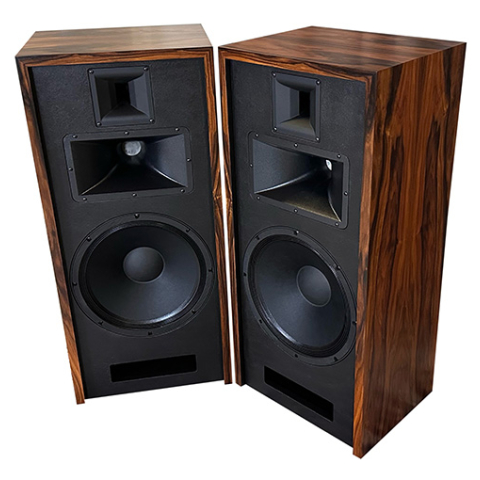
The appearance of these speakers testifies to their somewhat conflicted purpose. According to a PR representative for Harman, JBL's parent company, the 4367s are in fact marketed for home use. Their "professional" appearance seems to suggest otherwise and betrays little discernible concern with domestic decor. While they are impressively constructed, their "furniture-grade walnut veneer wood finish" does not bring to mind fine furniture. In fact, the 4367s looked less at home in my loft than any speaker I can recall and would look more appropriate in a mastering studio. Then again, anyone contemplating buying these speakers is not likely to be doing it for their elegant design or interior decor potential. And doubtless some people will like the look.
In my 56' × 19' loft, which has 15.5' ceilings, I positioned the JBLs along the long wall. After much listening and moving with the help of friends, I ended up with the speakers positioned 6' apart and 30" from the wall behind them, toed in so that the horns converged at a listening seat 10.5' away. This position provided the best compromise between center fill and soundstage width and the best balance of bass response and treble smoothness. After playing with the high-frequency controls, I found I preferred them set to their neutral positions.
Listening
My first three weeks of listening to the JBLs were pretty miserable. They sounded rhythmically disjointed, grayish, soft, bass shy, and so incapable of creating a soundstage that I at first thought I had connected them out of phase. This confused me, because the Harman rep had informed me that these were demo units, presumably with many hours of use. Yet, after about 200 hours of play, the 4367s had improved dramatically, and after 300 they began to sound great. I later learned that the pair I received had only a few hours on them. Mystery solved.
 As expected, the big JBLs proved remarkable in their ability to play (very) loudly. Almost every speaker and amplifier combination reaches a point where you know to back off the volume control: The music begins to sound disorganized and strident, or it starts to compress, with the quiet parts getting louder but the loud parts remaining the same. Driven by a sufficiently powerful amplifier, the 4367s reached that point at appreciably higher volumes than any speaker I've heard in my home. I took advantage of this dynamic headroom to enjoy music that sounds best loud. Played at a plate-rattling volume I hadn't attempted before, the opening percussion on "Five Man Army" from Massive Attack's Blue Lines (16/44.1 rip from Virgin TOCP-53870), a record that has lost none of its rousing, innovative charge, sounded intensely satisfying and yet completely composed.
 If the JBLs' brutalist exterior led me to expect an arena-rock bass juggernaut, in use they were nothing of the sort, reproducing as much bass as was present on the recording and no more. When the electric bass comes in on the delicately arranged "Who By Fire" from Leonard Cohen's New Skin for the Old Ceremony (LP, Columbia KC-33167), it was delivered with eerie realism and a wallop surprising for a "folk-rock" record. The 4367s never added bass of their own or "warmed" the lower mids, a testament to their superb engineering and well-judged frequency response. During a visit from Herb Reichert and Ken Micallef, Ken remarked on how the JBLs allowed us to focus on Ella Fitzgerald's quicksilver voice and barely notice that the record—an early pressing of Ella Fitzgerald Sings the Cole Porter Songbook (LP Verve MG V-4001-2)—contains hardly any deep bass at all.
 The JBLs' portrayal of detail and atmosphere was just as superb. During the letter scene in Eugene Onegin (LP, Decca SET 596-8), performed by the Orchestra of the Royal Opera House, Covent Garden, and the John Alldis Choir, Georg Solti's brisk, unsentimental reading of Tchaikovsky's score was presented in ultrahigh definition. I could follow the scene's unfolding orchestration in minute detail, the musicians almost visible between the speakers.
 Frank Ocean's "Pink Matter," from Channel Orange (16/44.1 Qobuz stream), superimposes a closely miked, starkly physical portrayal of Ocean's voice onto layers of instruments and sound effects. The 4367s offered more insight into this recording than I'd previously heard, making every element audible and musically significant and placing them across a soundstage that was not as vast as some I've heard but possessed outstanding depth and specificity, showing me where every sound was located in 3D space. The highly resolving presentation didn't distract me from Ocean's singing, with its thrilling falsetto runs and gospel emotiveness, or from the narrative thrust of his songwriting.
To get a better handle on the JBLs, I auditioned them with four amplifiers, three solid state and one tube.
With the Line Magnetic LM-845IA
Frank Ocean's "Pink Matter," from Channel Orange (16/44.1 Qobuz stream), superimposes a closely miked, starkly physical portrayal of Ocean's voice onto layers of instruments and sound effects. The 4367s offered more insight into this recording than I'd previously heard, making every element audible and musically significant and placing them across a soundstage that was not as vast as some I've heard but possessed outstanding depth and specificity, showing me where every sound was located in 3D space. The highly resolving presentation didn't distract me from Ocean's singing, with its thrilling falsetto runs and gospel emotiveness, or from the narrative thrust of his songwriting.
To get a better handle on the JBLs, I auditioned them with four amplifiers, three solid state and one tube.
With the Line Magnetic LM-845IA
The Line Magnetic brought out the loveliest and most realistic timbres from the 4367s and lent them much of its pellucid transparency. But regardless of whether I used the amplifier's 4- or 8-ohm taps, the combination made bass sound slightly rubbery and slow, alerting me that 22 are simply too few watts to take control of the JBLs' woofers. Lesson learned.
With the Pass Labs INT-60
Pass Labs claims that their integrated amplifier outputs 60W into 8 ohms and doesn't leave class-A until 30W. According to the illuminated meter on the front of the amp, it remained in class-A while driving the 4367s, even during loud crescendos. With the INT-60, the JBLs became sonic microscopes, unraveling every mix, no matter how busy. On the Frank Ocean track, the hiyaa-ing martial arts students, who can sometimes sound like white noise, were rendered with rare realism and presence. Even the subtle changes in air pressure at the beginning of certain tracks became easily audible. This sci-fi level of resolution proved fascinating, but I prefer champagne to water and soon began to long for more color and emotion. With the Mark Levinson No.5805
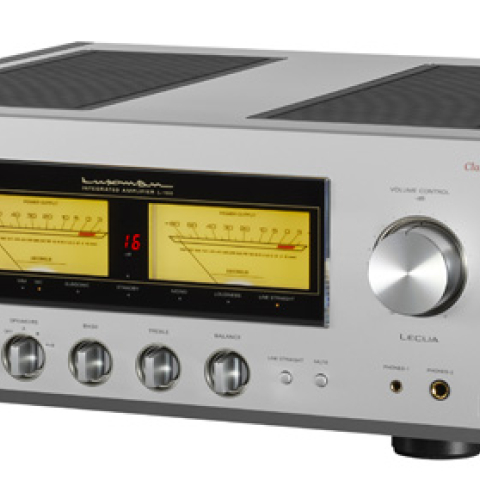
At the Harman store in New York City, the 4367s are hooked up to this integrated amplifier, and I could quickly hear why. The two made a synergistic sound—more full bodied if not quite as resolving as with the Pass—that was propulsive and easy to listen to. The combination drew attention to the music's rhythmic lines and offered the most satisfying bass reproduction. On "Pink Matter," Charlie Hunter's electric bass came in with whiplash-inducing force and tunefulness. The Levinson's Bluetooth input and built-in DAC made it easy to listen to movies streamed from the Roku stick in my projector, which proved to be a blast through the JBLs. With the Ayre AX-5 Twenty
When I connected the Ayre amplifier and Frank Ocean began to sing, I might have teared up. Compared to the Pass and Levinson, the Ayre subtly shifted my attention from the sound of Ocean's voice to the meaning of his words. In the bargain, it added more saturated tone colors and more distinct instrumental textures and timbres. Like the other solid state amps I listened to, it took full advantage of the 4367s' bass-making abilities and macrodynamic talents. This was the combination I found to be the most musically enlightening and the one I ended up listening to most.
Wrapping up
After living for several months with the JBLs, I found them to be sonically impeccable—both forceful or delicate when called for. They reproduced music in an utterly neutral, evenhanded way, sounded robust while resolving lots of detail, and never struggled to fill the unusually large room where I had placed them. The contemporary JBLs better my vintage Altecs sonically in the expected ways. They produce deeper and tighter bass, capture more detail, offer a more accurate tonal balance, and image with more precision. They also play even louder without strain. The 4367s excel at illuminating even the darkest corners of the mix; I imagine that they would be wonderful tools for a recording engineer. Maybe that's why, as I listened to them, I found my attention drifting from the performance to the recording. Despite their ability to remain unflappable at very high volumes, the 4367s didn't startle as reliably as the Altecs do, nor did they infuse recordings with as much excitement, purpose, and drama. I didn't get swept up in the music as I do with my Altecs. As much as I admired all that the JBLs offer for the head, I wished they offered more for the heart.
 Yet the 4367s deliver more of what I love about the Altecs than more conventional designs do. They don't deliver it all, but they deliver what they do with fewer sonic tradeoffs. And even more than the Altecs, they largely free the listener from the mental calculus of deciding which types of recordings will sound good on their hi-fi: Unlike most contemporary audiophile speakers, the JBLs are at home with anything from solo harpsichord to the loudest EDM single. When called upon to do so, they can play back music at sound levels that rival a live performance. Besides their imposing size and appearance there's not much you have to give up for these abilities. Sure, the 4367s will not sound quite as airy and holographic as some rivals, but, at least for me, the tradeoff is more than fair.
The JBL 4367 Studio Monitors provide a lot for your $16,500. They effortlessly fill the largest living spaces with loud music, don't require mammoth amps (though at least 50W is recommended for all but the smallest spaces), and most importantly will play your whole record collection well. For listeners who want to hear every detail on their favorite recordings at lifelike volumes, these may be just right.
Yet the 4367s deliver more of what I love about the Altecs than more conventional designs do. They don't deliver it all, but they deliver what they do with fewer sonic tradeoffs. And even more than the Altecs, they largely free the listener from the mental calculus of deciding which types of recordings will sound good on their hi-fi: Unlike most contemporary audiophile speakers, the JBLs are at home with anything from solo harpsichord to the loudest EDM single. When called upon to do so, they can play back music at sound levels that rival a live performance. Besides their imposing size and appearance there's not much you have to give up for these abilities. Sure, the 4367s will not sound quite as airy and holographic as some rivals, but, at least for me, the tradeoff is more than fair.
The JBL 4367 Studio Monitors provide a lot for your $16,500. They effortlessly fill the largest living spaces with loud music, don't require mammoth amps (though at least 50W is recommended for all but the smallest spaces), and most importantly will play your whole record collection well. For listeners who want to hear every detail on their favorite recordings at lifelike volumes, these may be just right.
My first three weeks of listening to the JBLs were pretty miserable. They sounded rhythmically disjointed, grayish, soft, bass shy, and so incapable of creating a soundstage that I at first thought I had connected them out of phase. This confused me, because the Harman rep had informed me that these were demo units, presumably with many hours of use. Yet, after about 200 hours of play, the 4367s had improved dramatically, and after 300 they began to sound great. I later learned that the pair I received had only a few hours on them. Mystery solved.
As expected, the big JBLs proved remarkable in their ability to play (very) loudly. Almost every speaker and amplifier combination reaches a point where you know to back off the volume control: The music begins to sound disorganized and strident, or it starts to compress, with the quiet parts getting louder but the loud parts remaining the same. Driven by a sufficiently powerful amplifier, the 4367s reached that point at appreciably higher volumes than any speaker I've heard in my home. I took advantage of this dynamic headroom to enjoy music that sounds best loud. Played at a plate-rattling volume I hadn't attempted before, the opening percussion on "Five Man Army" from Massive Attack's Blue Lines (16/44.1 rip from Virgin TOCP-53870), a record that has lost none of its rousing, innovative charge, sounded intensely satisfying and yet completely composed.
If the JBLs' brutalist exterior led me to expect an arena-rock bass juggernaut, in use they were nothing of the sort, reproducing as much bass as was present on the recording and no more. When the electric bass comes in on the delicately arranged "Who By Fire" from Leonard Cohen's New Skin for the Old Ceremony (LP, Columbia KC-33167), it was delivered with eerie realism and a wallop surprising for a "folk-rock" record. The 4367s never added bass of their own or "warmed" the lower mids, a testament to their superb engineering and well-judged frequency response. During a visit from Herb Reichert and Ken Micallef, Ken remarked on how the JBLs allowed us to focus on Ella Fitzgerald's quicksilver voice and barely notice that the record—an early pressing of Ella Fitzgerald Sings the Cole Porter Songbook (LP Verve MG V-4001-2)—contains hardly any deep bass at all.
The JBLs' portrayal of detail and atmosphere was just as superb. During the letter scene in Eugene Onegin (LP, Decca SET 596-8), performed by the Orchestra of the Royal Opera House, Covent Garden, and the John Alldis Choir, Georg Solti's brisk, unsentimental reading of Tchaikovsky's score was presented in ultrahigh definition. I could follow the scene's unfolding orchestration in minute detail, the musicians almost visible between the speakers.
Frank Ocean's "Pink Matter," from Channel Orange (16/44.1 Qobuz stream), superimposes a closely miked, starkly physical portrayal of Ocean's voice onto layers of instruments and sound effects. The 4367s offered more insight into this recording than I'd previously heard, making every element audible and musically significant and placing them across a soundstage that was not as vast as some I've heard but possessed outstanding depth and specificity, showing me where every sound was located in 3D space. The highly resolving presentation didn't distract me from Ocean's singing, with its thrilling falsetto runs and gospel emotiveness, or from the narrative thrust of his songwriting.
To get a better handle on the JBLs, I auditioned them with four amplifiers, three solid state and one tube.
With the Line Magnetic LM-845IAThe Line Magnetic brought out the loveliest and most realistic timbres from the 4367s and lent them much of its pellucid transparency. But regardless of whether I used the amplifier's 4- or 8-ohm taps, the combination made bass sound slightly rubbery and slow, alerting me that 22 are simply too few watts to take control of the JBLs' woofers. Lesson learned.
Pass Labs claims that their integrated amplifier outputs 60W into 8 ohms and doesn't leave class-A until 30W. According to the illuminated meter on the front of the amp, it remained in class-A while driving the 4367s, even during loud crescendos. With the INT-60, the JBLs became sonic microscopes, unraveling every mix, no matter how busy. On the Frank Ocean track, the hiyaa-ing martial arts students, who can sometimes sound like white noise, were rendered with rare realism and presence. Even the subtle changes in air pressure at the beginning of certain tracks became easily audible. This sci-fi level of resolution proved fascinating, but I prefer champagne to water and soon began to long for more color and emotion. With the Mark Levinson No.5805
At the Harman store in New York City, the 4367s are hooked up to this integrated amplifier, and I could quickly hear why. The two made a synergistic sound—more full bodied if not quite as resolving as with the Pass—that was propulsive and easy to listen to. The combination drew attention to the music's rhythmic lines and offered the most satisfying bass reproduction. On "Pink Matter," Charlie Hunter's electric bass came in with whiplash-inducing force and tunefulness. The Levinson's Bluetooth input and built-in DAC made it easy to listen to movies streamed from the Roku stick in my projector, which proved to be a blast through the JBLs. With the Ayre AX-5 Twenty
When I connected the Ayre amplifier and Frank Ocean began to sing, I might have teared up. Compared to the Pass and Levinson, the Ayre subtly shifted my attention from the sound of Ocean's voice to the meaning of his words. In the bargain, it added more saturated tone colors and more distinct instrumental textures and timbres. Like the other solid state amps I listened to, it took full advantage of the 4367s' bass-making abilities and macrodynamic talents. This was the combination I found to be the most musically enlightening and the one I ended up listening to most.
After living for several months with the JBLs, I found them to be sonically impeccable—both forceful or delicate when called for. They reproduced music in an utterly neutral, evenhanded way, sounded robust while resolving lots of detail, and never struggled to fill the unusually large room where I had placed them. The contemporary JBLs better my vintage Altecs sonically in the expected ways. They produce deeper and tighter bass, capture more detail, offer a more accurate tonal balance, and image with more precision. They also play even louder without strain. The 4367s excel at illuminating even the darkest corners of the mix; I imagine that they would be wonderful tools for a recording engineer. Maybe that's why, as I listened to them, I found my attention drifting from the performance to the recording. Despite their ability to remain unflappable at very high volumes, the 4367s didn't startle as reliably as the Altecs do, nor did they infuse recordings with as much excitement, purpose, and drama. I didn't get swept up in the music as I do with my Altecs. As much as I admired all that the JBLs offer for the head, I wished they offered more for the heart.
Yet the 4367s deliver more of what I love about the Altecs than more conventional designs do. They don't deliver it all, but they deliver what they do with fewer sonic tradeoffs. And even more than the Altecs, they largely free the listener from the mental calculus of deciding which types of recordings will sound good on their hi-fi: Unlike most contemporary audiophile speakers, the JBLs are at home with anything from solo harpsichord to the loudest EDM single. When called upon to do so, they can play back music at sound levels that rival a live performance. Besides their imposing size and appearance there's not much you have to give up for these abilities. Sure, the 4367s will not sound quite as airy and holographic as some rivals, but, at least for me, the tradeoff is more than fair.
The JBL 4367 Studio Monitors provide a lot for your $16,500. They effortlessly fill the largest living spaces with loud music, don't require mammoth amps (though at least 50W is recommended for all but the smallest spaces), and most importantly will play your whole record collection well. For listeners who want to hear every detail on their favorite recordings at lifelike volumes, these may be just right.