Sidebar 3: Measurements
I performed a complete set of tests on the first sample of the Ayre KX-8, serial number 31B0101, with my Audio Precision SYS2722 system, then, when that sample failed, I carried out a limited series of tests on the second sample, serial number 31B0106, to make sure it behaved identically. (It did, except where noted later in this sidebar.)
Looking first at the KX-8's performance as an analog line preamplifier, all the inputs and outputs preserved absolute polarity, ie, were noninverting. The KX-8's input impedance was very high, at close to 480k ohms unbalanced and 1M ohm balanced. The preamplifier's balanced output impedance was 494 ohms from 20Hz to 20kHz; the unbalanced impedance was half that value, as expected; and the single-ended headphone output impedance was a very low 3 ohms across the audioband.
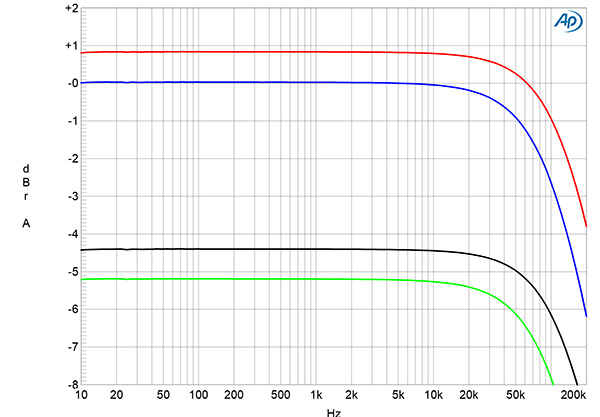
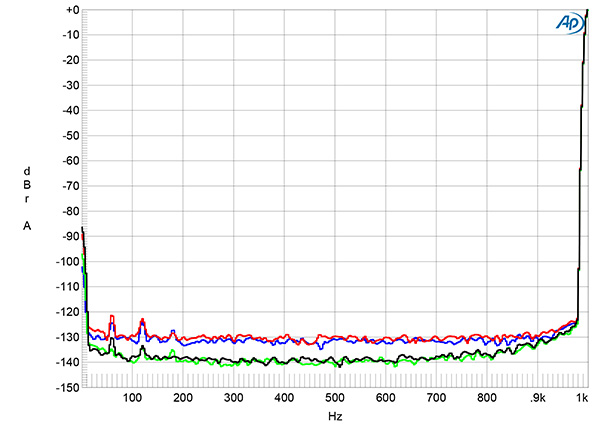
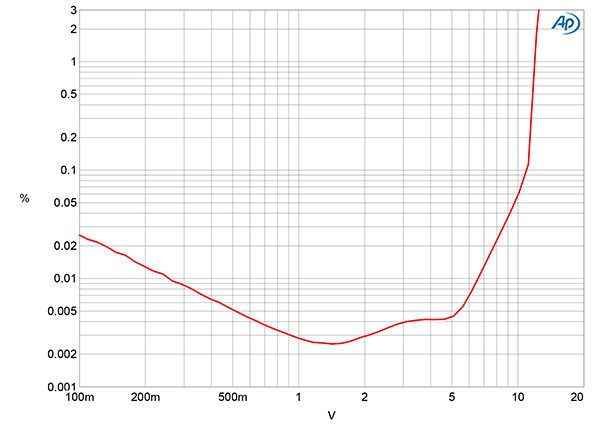
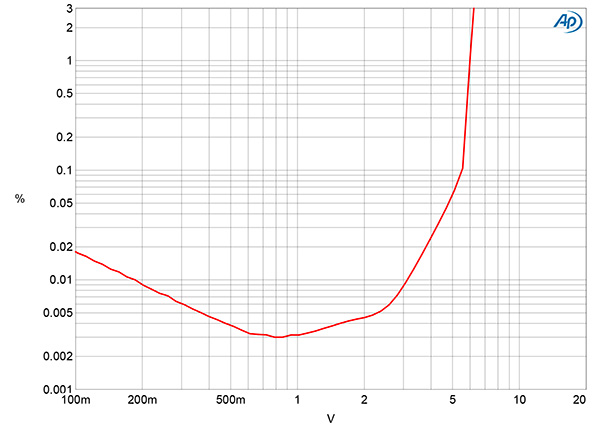
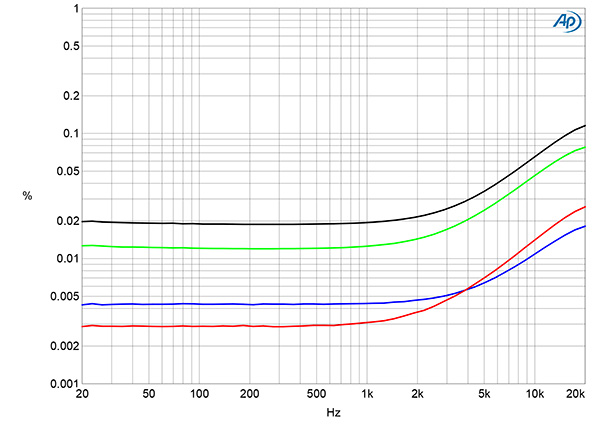
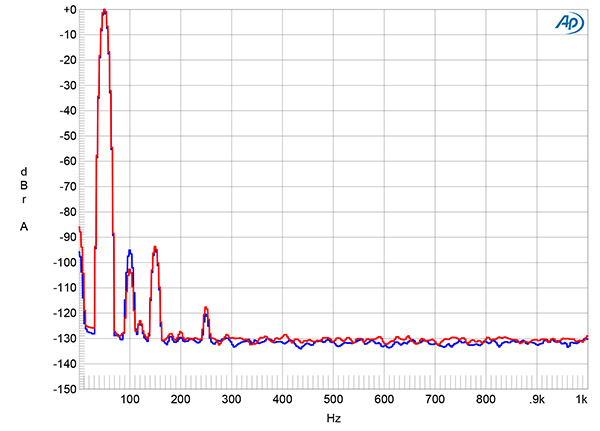
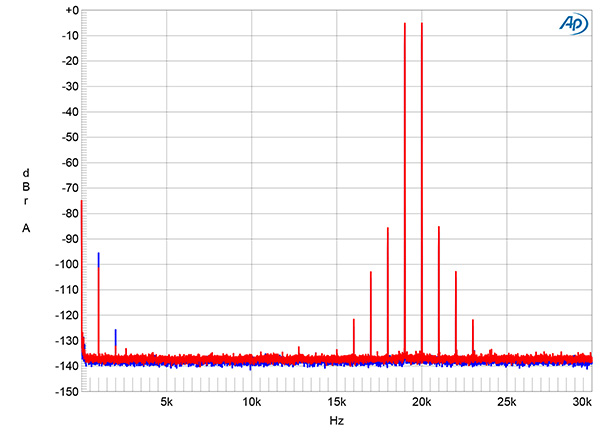
Fig.1 Ayre Acoustics KX-8, balanced frequency response with volume control set to the maximum at 1V, into: 100k ohms (left channel blue, right red), 600 ohms (left green, right gray) (1dB/vertical div.).
The first sample's maximum gain from the left channel's balanced and unbalanced inputs was 1.87dB at the balanced output, –4.03dB at the unbalanced output, and 1.97dB at the unbalanced headphone output. The maximum gain of the second sample's left channel was 0.6dB lower than that of the first sample, and the right channels of both samples were slightly higher in level than the left channels. For example, with the volume control set to the maximum, the first sample's right-channel gain was 0.8dB higher than the left's; the second sample's right channel was 0.5dB higher in level. This channel imbalance can be seen in fig.1, which plots the KX-8's frequency response into 100k ohms (blue and red traces) and 600 ohms (green and gray traces) with the volume control set to the maximum. The channels' gains were slightly better matched at lower volume-control settings with both samples. The channel imbalance was also present in Pass-Through mode. While the right channel's gain in this mode was the expected unity, the left channel's was 0.5dB lower.
Fig.2 Ayre Acoustics KX-8, balanced spectrum of 1kHz sinewave, DC–1kHz, at 2V into 100k ohms with volume control set to the maximum (left channel blue, right red) and to –12dB (left green, right gray); (linear frequency scale).
Channel separation was excellent, at >100dB below 1kHz in both directions and still 80dB at 20kHz. With the volume control set to the maximum, the wideband, unweighted S/N ratio (ref. 1V output) of both samples was an excellent 82dB (average of both channels), which increased to 90.6dB when the measurement bandwidth was reduced to the audioband, and to 93.2dB when A-weighted. Spectral analysis of the Ayre's low-frequency noisefloor with the preamplifier outputting a 1kHz tone at 2V with the volume control set to the maximum (fig.2, blue and red traces) revealed that the power supply–related spuriae in the noisefloor were very low in level. A feature of the KX-8's CVGT circuit topology is that when the signal level is reduced with the volume control, the noise level is also reduced. Repeating the analysis with the volume control set to –12dB and the level of the input signal increased so that the output was the same 2V (green and gray traces) dropped the level of the noisefloor by around 10dB.
Fig.3 Ayre Acoustics KX-8, balanced THD+N (%) vs 1kHz output voltage into 100k ohms.
Fig.4 Ayre Acoustics KX-8, single-ended THD+N (%) vs 1kHz output voltage into 100k ohms.
Fig.3 plots the THD+noise percentage in the Ayre preamp's balanced output against voltage into 100k ohms with the volume control set to the maximum. Actual distortion lies below the noisefloor up to 1V output and increases slightly up to 5V. With clipping defined as when the THD+N reaches 1%, the KX-8's balanced outputs clipped at a high 11.9V into this load. The balanced clipping voltage into 600 ohms was 6.6V, while the unbalanced outputs clipped at 6V into 100k ohms (fig.4) and 4.1V into 600 ohms.
Fig.5 Ayre Acoustics KX-8, balanced THD+N (%) vs frequency at 4V into: 100k ohms (left channel blue, right red), 600 ohms (left green, right gray).
Fig.6 Ayre Acoustics KX-8, balanced spectrum of 50Hz sinewave, DC–1kHz, at 2V into 100k ohms (left channel blue, right red; linear frequency scale).
Fig.7 Ayre Acoustics KX-8, balanced HF intermodulation spectrum, DC–30kHz, 19+20kHz at 2V into 600 ohms (left channel blue, right red; linear frequency scale).
The balanced outputs' THD+N percentage was very low in the bass and midrange into 100k ohms, rising in the top three audio octaves (fig.5, blue and red traces). The THD+N was higher into 600 ohms (green and gray traces) but still low in absolute terms. The distortion signature was primarily third harmonic at a very low –93dB (0.002%, fig.6), though the second harmonic was slightly higher in the left channel (blue trace) than in the right (red). This graph was taken at 2V output, which appears to be the "sweet spot" for the KX-8's measured behavior. Intermodulation distortion with an equal mix of 19 and 20kHz tones was very low. Even into 600 ohms, the difference component at 1kHz lay at almost –100dB (0.001%, fig.7).—John Atkinson